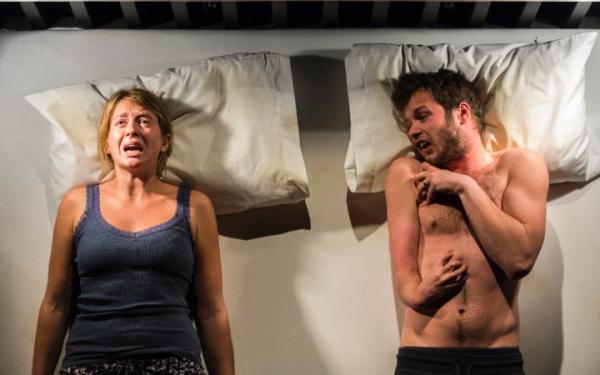
GENEVIEVE BARR AND ARTHUR HUGHES AS ALICE AND PHIL IN THE SOLID LIFE OF SUGAR WATER BY JACK THORNE CREDIT: PATRICK BALDWIN
 Amit Sharma has been the Associate Director of Graeae Theatre Company, London, since 2011. He recently directed The Solid Life of Sugar Water, a Graeae Theatre Company and Theatre Royal Plymouth production, gaining unanimous acclaim at the 2015 Edinburgh Festival Fringe, leading to a 2016 UK tour including a run at the National Theatre.
Amit is a graduate from Graeae’s Missing Piece actor training course. In 2012, he co-directed the outdoor spectacle Prometheus Awakes (with La Fura dels Baus/co-commissioned by GDIF and SIRF), marking the first large-scale outdoor production to be artistically led by Deaf and disabled people in the UK. Also for Graeae, he directed Ted Hughes’ The Iron Man, which toured both nationally and internationally and co-directed Graeae’s Rhinestone Rollers in Sequins and Snowballs with Jenny Sealey at the Southbank Centre. As Assistant Director, he has worked on Graeae’s productions of The Threepenny Opera, The Changeling and on The Four Fridas for Greenwich and Docklands International Festival 2015. Amit currently leads on Write to Play, Graeae’s flagship new-writing programme in partnership with venues across the UK.
GaeleSobott: Can we start by talking about the set design in The Solid Life of Sugar Water. The bed is central, upstage, vertical with the actors standing against it. From the audience perspective it is as if they are looking down on the characters lying on the bed.
Amit Sharma: The thing about Sugar Water and the aspect that I was really interested in was the relationship between the two characters, Alice and Phil, how much they were or weren’t communicating. The style, as it was written by Jack Thorne, consists of two monologues essentially inter-dispersed with both the characters’ dialogue. Well it is much more intricate and clever than how I’ve just described it to you, but the nature of them not talking to each other and addressing the audience set up something which is immediately striking, irrespective of the subject matter. There is some form of subtext that is going on between the two characters, which is very exciting. When we did our original set design it was very abstract, very sparse actually. Then we did a reading of it and the designer said to me, ‘I think we’ve got this wrong. I think the audience needs to be placed in the bedroom. The bed is missing.’
She was absolutely right. The bed was like the third element of the relationship within the text. So then we needed to decide how to be artistic about it. We didn’t want the bed to be literal. The piece isn’t naturalistic. We jump from the past to the present and then back again. So we developed the idea of looking down into the couple’s bedroom.
GS: What is that perspective? What does it give to the play?
AS: I really wanted the audience to feel that they couldn’t get away from being privy to and a part of the couple’s life. I don’t know about you, but when I visit a friend’s house the bedroom is always the last place I look. It would be a bit weird to go and look in their bedroom. That’s because it’s private and you’d feel as if you were prying into someone’s very personal space, even if they’re not in the room. I wanted the audience to feel like they were able to be in that space.
GS: How does this position the audience? Are they voyeurs or perhaps fly on the wall?
AS: I think more fly on the wall. I think voyeurism has an element of choice about it. Maybe fly on the wall does too. I just wanted the audience to really feel the pressure cooker of the couple’s relationship and be a part of that. Not able to separate themselves from it. That’s what the play does. You fall into it and by the end you’re feeling all kinds of emotions because of the performances but also because of Jack’s writing. The writing and the set. That’s why I wanted the audience to be together in the bedroom with the couple. I wanted them to be with them in their private moments without feeling they were intruding. At the end I wanted the audience to feel they have been through so much with this couple. It’s actually about healing both for the couple and also for the audience.
GS: The audience are looking down on the bed but they are also being spoken to directly by the characters. It is not possible for the audience to position themselves as just observers. They have to participate. What are your thoughts on this?
AS: That’s the good thing about theatre. You can set up a convention and then just totally break it. So whenever the characters were on the floor, that was like the wall of their bedroom but it became less about the bedroom, it was the post office, the bridge, even though the bed was always present. As a creative team we wanted it to be subtle, so yes the bed was always in the background because there was always that big question of them trying to have sex.
GS: There are many disabled artists and directors who feel there is a need to explore sex and disability, for various reasons including societal attitudes, the infantilisation of disabled people. What is the importance of sex in disabled art? What is the relation of this play to the exploration of sex and disability?
AS: The most interesting thing coming out of Sugar Water is that question has not been asked. It has not been unpacked. What the play does is almost normalise that very question of sex and disability. It is such a huge topic for so many different reasons. Perhaps it is because of the performers, one performer is Deaf and one performer has a physical impairment, but not to the extent where it impacts on their sex lives. What I mean by that is that if, say, one of the characters was a wheelchair user who had 24 hour personal care then that dynamic shifts. I was reading an article today about the Independent Living Fund and this guy saying how it can be difficult to live independently for example to go out and chat up girls because you’ve got someone else there all the time. So you have to negotiate that relationship. This play doesn’t go there. People have picked up on the element of communication between the couple, but the sex element not so. I also think it is because of how Jack as a writer was playing with the idea of sex. There’s a lot of comedy with some really graphic descriptions.
GS: Well yes there is comedy and there are very serious moments, a fine line.
AS: Yes, Jack Thorne gets that fine line absolutely right. In rehearsals we spoke about how graphic we should get or if we should get graphic at all. If we were brave enough to show our naked bodies and those kinds of discussions. It quickly became apparent that it wasn’t about that. It would have become alienating, as opposed to the audiences going: ‘Come on, we’re theatre audiences. We’re pretty smart. We can go whichever way you want us to go. We don’t have to see nudity to get what you’re talking about.’
It felt like we could just tell the story. The most interesting thing is the intricacy of communication between the audience and the performers. The couple think they are talking to each other and they’re not really, and they do the direct address where there is a conceit between each character and the audience. There are many different levels of communication.
GS: Can you talk a little about the quality of the reviews the play has received?
AS: Well I think the journey of journalism and the way this show, and other shows at the Edinburgh Fringe by Deaf and disabled artists, have been reviewed has really shifted. It’s really come a long way. The art is now being reviewed as opposed to the performers and their physical shapes and sizes and what have you. It is really refreshing to see the work being reviewed in this way.
Talking about Sugar Water the reviews spoke about the subject matter as happening to two human beings not to two disabled people. In relation to Genevieve, being a Deaf performer, the discourse was quite intelligent as opposed to talking about a Deaf person blah blah blah, it was more sophisticated in both the reviewing and the conversation around it. That hasn’t always been the case.
GS: What comments did reviewers make in relation to Genevieve being a Deaf performer and character?
AS: The discussions were linked to the idea of communication. Naturally if your partner doesn’t sign then you have to rely on lip reading and you may not catch all the communication. Phil can’t sign so he is not able to get what he feels across all the time. The scene when he’s on the bridge and he tries to sign and gets it completely wrong really resonated and got the biggest laugh every time. By that point the audience realises Alice and Phil are not communicating on a number of levels. It was about them as individuals and what they felt for each other, what they wanted and needed from each other. Phil had never had a huge number of relationships before hand. Alice had just come out of a very difficult relationship. So that makes two very vulnerable people in a position where they are wondering if the relationship can work, can they get along. Can they get married and try to have a baby. Is their relationship driven by their love and passion for each other or by their insecurities? Sometimes the best art doesn’t answer the questions it poses. It poses the questions for the audience to consider.
GS: Do you think Alice and Phil’s relationship is resolved in the end?
AS: I don’t want to say. Some people are unsure whether they continue or they don’t and I intended for that to happen. In my head they do, yeah. But I didn’t want to answer that. I spoke to Jack about it. He really wanted a happy ending and I really didn’t want a happy ending. I said, “Ok if we’re going to have a happy ending we have to hint and suggest the possibility.”
GS: I do think the play ends with them understanding and respecting each other.
AS: It’s only at the end that they actually say, ‘I love you’ to each other. Having been through the trauma of losing a baby. Jack’s a smart dude!
GS: There seems to be some relationship and similarities between The Solid Life of Sugar Water and Lungs, which also played at 2015 Edinburgh Fringe. Can you explain this?
AS: We had read the script about three or four years ago. When we got the script we were really interested. Duncan Macmillan is a great writer. We were thinking of doing a double bill but then Paines Plough went ahead with the commission so we didn’t.
GS: I found the story quite similar.
AS: Yes that’s why we had the idea that the two plays could work together.
GS: Where are you taking the play next?
AS: We’re putting a tour together. We’re going to be at the National Theatre for three weeks, which is superb. It’s the first time Graeae has been there and we’re incredibly proud. We hope the momentum builds from there.
It’s one of those plays. I remember reading it for the first time, here as a company, and the kind of silence at the end of the reading, everyone taking deep breaths. We knew it was a huge impact type of play. Audience reactions to the play have been emotional and deep. One woman stopped watching half way through. She sat there with her head down and just wouldn’t watch. There was obviously something that really connected with her. She started watching again a bit later. She was with a group of her friends and I saw her at the end. She was just in complete floods of tears. I don’t really feel bad about too many things but I did then.
GS: Why did you feel bad?
AS: I felt for her because I didn’t know her story and didn’t know what it was that she was relating to. I went over and asked her and her friends if they were alright and did as much as I could, offered her a gin and tonic. Theatre is such a powerful thing. I think people sometimes forget the impact theatre can have.
GS: Why do you think theatre powerful as opposed to other mediums of storytelling?
AS: It’s so immediate. You’re there. You can connect, relate to the work. You are immersed in the play for the length of the piece. People love stories.
GS: You can watch a series on TV and experience stories. What is it specifically about theatre?
AS: The craft of theatre is important, the putting together of the story although you can also do that with film and TV. There is something unique about theatre in showing that passage of time. I think the immediacy of you as a member of the audience and your relationship with the performers is so unique to you in an environment where there are other people as well. That is very special. You can watch television or a film in a cinema however the screen allows you to be one step removed from it. You can’t really do that with theatre. It is more interactive. It’s more immediate.
The question in theatre is – Why now? What’s important about telling the story now? With TV and film you can go back to it again and those performances won’t change but with theatre they will. You can go one night and the next night there will be subtle differences, something may have shifted – become more superficial, something may have become deeper. There’s an unknown quality. There’s that thing also where if something ‘goes wrong’ the performers just have to pick up the baton and carry on and audiences love those moments when it doesn’t all go to plan. Film and TV are created where it all goes to plan so with theatre there’s a different type of freedom and an improvisational quality.
It’s about creating the story. The performers grab the audience very quickly, in a vital and stark way, asking them to empathise with them.
GS: Did the actors contribute to Jack Thorne’s script during rehearsal. Were changes made for any reason?
AS: Well the actors didn’t really suggest changes but we did shift the script around them. We didn’t have any idea who we wanted to work with so in the beginning in Jack’s script the character, Alice, wasn’t Deaf. When we cast Genevieve as the actor for that part, Jenny Sealey, the Artistic Director of Graeae, and I had a conversation and we gave notes to Jack saying there are elements relating to Genevieve that should have some representation in the script. But in contrast, the Post Office scene about Phil not being very strong wasn’t adapted for him because of Arthur’s arm or anything. That was the original script.
GS: I didn’t take that scene as being about his arm.
AS: Well some people do you see. They think that was where his impairment was being referenced because he had this big box that he couldn’t quite carry. That was always there. But Phil signing on the bridge wasn’t there before we cast the actors. Jack did a couple of rewrites based on Jenny’s and my notes.
The stuff that happens behind the scenes may change according to the actor you cast. At the beginning we had created a soundscape and every now and then there’d be a heartbeat noise as a cue for the actors to shift position. There was also a sound cue for the actors to know the audience was seated and we’d got clearance from front of house. It was a dog bark. Genevieve has hearing aids so she could feel the vibrations of the heartbeats, the shift and the change, because there was a speaker close to her. What became slightly tricky was her trying to listen to the dog barking because of the frequency and because there were so many people in the room all making noise. So we discussed a better way of cueing and her feeling comfortable within the cueing system.
Also because there is so much direct address, I said, ‘You have permission to look at Arthur whenever you want. We’re not asking you to play hearing.’ But Genevieve got around that by learning Arthur’s script as well and picked up on his rhythms, picked up on how he delivered the text. That was her process. She wanted the same access and freedom as him and decided on her own cues. That didn’t mean Arthur had to do it exactly the same way each time. So there was that kind of negotiation going on during rehearsal.
GS: How do you cast at Graeae? How did you cast the actors for this play?
AS: For this play I got a casting director in. We work with some amazing performers and some amazing actors. I just felt this time round it would be really healthy for the Company to audition new people and add to our expanding pool of performers.
GS: Do you specifically cast disabled actors?
AS: For this play I decided the casting breakdown. Irrespective of impairment this is what I’m looking for. Just by the nature of the play we needed people who would be good at delivering text. I don’t mean in the classical sense, I mean it’s such a wordy play. There is a demand that Jack’s writing presents itself. That doesn’t mean being quick or slow or whatever. That’s what Graeae does – we say this is the play and this is what we are looking for. Let’s see who we can get through the door.
GS: I believe Graeae practises some form of affirmative action in casting performers and actors who identify as Deaf and disabled. How does this work?
AS: Yeah in our plays we’ve got at least fifty percent actors who identify as Deaf or disabled. For the two-hander I thought we had to have two performers who identify. We couldn’t have one. It just didn’t feel right. It was such a small company. But when we did the Threepenny Opera there were something like twenty performers so ten were disabled and ten were non-disabled. As it transpired, we got to the end of rehearsals and three of the people who previously didn’t identify said, Oh yeah, I’m deaf in this ear or I’ve got this impairment. So the Deaf and disabled were staring to outnumber the non-disabled. It was interesting. One of the reasons is that if people declare their impairment jobs shut down.
GS: But not here at Graeae?
AS: Yeah exactly, absolutely not at Graeae. For Sugar Water we were conscious we wanted new blood and we found it. The other thing is that we will use some of the people who auditioned but didn’t get involved in Sugar Water for other projects. So we did pull in a new pool of actors. We are good at that.
GS: What’s the next project?
AS: At the moment we’ve got the Write to Play initiative, nurturing new writing talent. We’re also developing a new adaptation of The Hunchback of Notre Dame for production in 2017. There is also a verbatim play around the Incapacity Benefit, the Employment and Support Allowance, that’s under commission.
GS: Whose voices are represented? Those who apply for or receive the benefit, or those in the bureaucracy who assess people, hand out the benefit.
AS: A bit of both but mostly people on the receiving end of decisions. We’ve got a doctor. We’ve got a legal aid person, a variety. We’re doing a taster session at the moment in aerial training building up to a project with war veterans in 2018 – an outdoor piece I think. It’s linked into the recent 1914-1918 reflections on the First World War. There’s a big artistic element to it all. We are very fortunate to be working in this profession on great projects with wonderful people. It’s a really odd time because for a lot of Deaf and disabled people at the moment they don’t know whether they’re coming or going.
GS: Are you referring to government austerity measures?
AS: Yeah but the profile of Graeae is really accelerating. The Company is being recognised for the work that we’re doing. We’ve got Ensemble starting next week. It’s an eight-month, work-based, professional-development programme for six young artists. They’re nineteen to twenty-five year olds and we’re training them as theatre makers. Jodi Alissa Bickerton is our Creative Learning Director. She’s running that programme. It’s in response to barriers faced by many Deaf and disabled artists, as well as a lack of diversity within the current theatre climate.
GS: How do you choose the participants?
AS: We get the information out there. There’s an application process. We audition, then we interview them and go from there.It’s difficult at the moment because the austerity drive is seriously impacting disabled people on a number of levels, work, living, health.
GS: Do you think disabled artists have a responsibility to reflect this in their art?
AS: I think disabled artists have a responsibility to their art. It’s a tricky one. I think it’s about choice. Some artists are deciding to reflect in their work what’s happening socially, economically in our society. Other artists feel that the art itself, no matter what it’s about, will create the shift, create the change. It’s a difficult choice but I don’t begrudge anyone for whatever the choice is that they make. I really resist the idea of hierarchical disability. Disability includes such a wide range of circumstances. It can mean so many different things to people. The wider the experience and the subject matter of our art, the better it is for changing perspectives. Graeae does a lot of advocacy work but it can be really relentless. The cuts are creating a lot of insecurity.
GS: How important do you feel disability-led writing and directing is to changing public perceptions around disability?
AS: I think everything needs to be driven by the story that the writer or the director is trying to convey. Sometimes that feeling of importance can be restricting and uncreative. Audiences are smart, open and intelligent. If you take them on a journey then they’ll go with it. If everything about a play or a show becomes agenda driven then it can fail in changing those perceptions. The story is the thing.
Further Information:
Interview with Genevieve Barr & Arthur Hughes
Information on Graeae and the tour of The Solid Life of Sugar Water or Follow @graeae
The interview was conducted by Gaele Sobott on 28th September 2015 at Graeae Theatre Company in London

People Love Stories – an Interview with Amit Sharma by Gaele Sobott is licensed under a Creative Commons Attribution-NoDerivatives 4.0 International License.

 Gaele Sobott