In Memory of Lauretta Ngcobo 1931-2015

Front cover of book. Close up photo of woman's eye, nose and mouth in orange tones. Title - And They Didn't Die Autor - Lauretta Ngcobo


Lauretta Gladys Nozizwe Duyu Ngcobo (née Gwina)  was born in the southern-most part of KwaZulu Natal in 1931. She was the first girl in a family of four. Her mother, Rosa Fisekile Cele, had a difficult time with the birth. Lauretta wrote,

On the night of the second day, my grandfather, who knew the white doctor personally, had managed to persuade him to venture into the black reserve, by night, to save the life of his elder daughter and her unborn child. And so he did.1

Lauretta was born into a family of storytellers, growing up in a rural setting where she valued her exposure to oral literary traditions. Commenting on how poetry informed all occasions she said,

It was performed to honour kings, to welcome newly born babies, and to rock them to their sleep. It is sung at weddings, at funerals and at war. It even heralds peace.2

She recalled her mother relenting in family arguments and reciting poetry at the doorway of the ‘great house’, ‘the maternal family line first, followed by the paternal line’ until the grandmother nodded her head and the argument was over.3

Lauretta’s mother would tell her African folk stories. Her great-grandmother narrated episodes of Zulu history. She composed poetry about her painful life as the least-loved wife of her husband’s four wives. She also created poetry for each child in the family including Lauretta who used to cry as a baby. ‘Apparently I had a very sharp voice . . . My poetry imitates the honey bird which is very insistent.’ 4

When Lauretta was seven years old her father, Simon Shukwana Gwina, died. Both he and Lauretta’s mother were teachers. Lauretta’s mother became the sole breadwinner in the family. Despite the difficulties, she was determined that all her children would be educated regardless of their gender.

The public openly condemned us, girls, who ‘demanded’ the same privileges as boys. In a family where mother had never made us aware of the preferences, the remarks were not only hurtful, but created a throbbing consciousness of one’s burdensome value.5

Lauretta went to primary school in Webbstown and Nokweja. In 1944 she was at a boarding school run by American missionaries in Dumisa and then in 1946 she went to Inanda Seminary. At home, she had gained a knowledge and interest in English literature and history from her mother.

My mother got me interested in her favourite writer, Montgomery, Anne of Green Gables. Her stories became my favourites too. From her I learned about Henry the Eighth. I was very fond of Thomas Hardy and his stories of rural England and I liked Charles Dickens.6

She enjoyed school but began to sense a ‘silent disapproval of the barefoot life-style and art that was part of my whole way of life’. The ‘borrowed culture of city girls’ was the dominant ethos and she found herself caught in a ‘tug of warring cultures’. She described how she felt a ‘disfigurement of outlook, a mutilation within’, a conflict that ‘persisted even against the most arduous efforts to strike a balance’.7

In 1950 Lauretta attended the University of Fort Hare and obtained a BA in Psychology, and Zulu Language and Literature. She also studied for a postgraduate University Education Diploma. Fort Hare had a ‘ratio of thirty-five women students to five hundred men in those days. In some classes the preference given to male students was disarming.’ 8

Her first job as a teacher was in Pietermaritzburg in 1954. One year later, she took up a position as a scientific research assistant for the CSIR. In 1957 she married Abednego Ngcobo and in 1960 went back to teaching in Durban. Lauretta always enjoyed writing. She wrote a number of articles and books which she discarded or burned mainly due to her assumption that nobody would be interested in reading anything she had to say, ‘not the men’ and not the ‘white people’.  She stated,

I don’t think I know why I write, I just know I must. I scribble a lot that I know will never be read by anyone, for since I was a little girl by conditioning, I never expected anyone to read anything that I wrote, outside my classroom assignments. I feel the need to communicate with myself. It is a duty to myself. Yet, by its very nature, writing is an outgoing channel of communication, no matter how private.9

She saw the Bantu Education Act of 1953 as the greatest limitation on Black writing in South Africa. 

Cut off from the mainstream of world literature which could otherwise act as a model and an inspiration. I have shared these limitations with all Black South Africans whether male or female.’10

Lauretta’s husband was imprisoned in 1960 for his political activities in the PAC and the Sharpeville uprising. In 1963 she was forced to leave South Africa.

I learned that there was a plan to have me arrested. It was the month of May. I had to escape and leave my two children with my mother. I decided to leave at once: the next day, at five in the morning, the police burst into my house to get me. I made it by the skin of my teeth.11

She spent the first six years of her exile in Swaziland and Zambia where she worked as a teacher. Her children were later able to join her in Swaziland. The family moved to England in 1969 and Lauretta began teaching in London at Tufnell Park Primary School. She then taught at Lark Hall Infant School where she became Deputy and then acting Head. She also began to write, spending ‘hours pinning my episodes together at the seams. I cannot think of a more time-consuming way to write . . . I had no time limit to my expression and no deadlines to meet.’ 12

In 1987, her novel, Cross of Gold, was published and time became very important her. She was invited to talk and write essays on a wide range of subjects,

I had to read a lot more widely. This factual diet does little for my creativity – especially considering how limited time is between my teaching job, my ‘factual’ reading and speechifying and creativity. What I need as a writer, more than anything, is time.13

Cross of Gold is told from the perspective of a young, male activist, Mandla. The women characters are silent and isolated. The only active, strong woman, Sindisiwe, dies in the first chapter of the book. She is shot by the South African border police while trying to flee apartheid South Africa into Botswana. Reflecting on the many questions that came from women readers, Lauretta realised that although she was actively occupied with gender issues in her life, ‘it hadn’t occurred to me that the book was not about me, was not about Sindisiwe, it was about a man!’14 She felt that this was a product of her socialisation and began to think of her construction as a rural, black South African woman growing up with the migrant labour system and the absence of men. ‘I was brought up by women. They were strong, independent and silent . . . it was inescapable that I should turn out very much like them: fertile and rich from within but silent or barren from without.’15

Lauretta edited a collection of essays, stories and poems, Let It Be Told: Black Women Writers in Britain, published in 1987.  The book aims to ’embody a largeness and a continuity’ extending beyond conventional race and gender stereotypes.16 She included a detailed introduction, an essay on her life and writing and an extract from Cross of Gold. In 1990, she published her second novel, And They Didn’t Die. Lauretta said,

I hadn’t written about women successfully, but at the same time I knew all about women. As I had shared so much of their pain, it could be that that was one of the reasons why I could write a different story in And They Didn’t Die.17

She presents active women characters and portrays the solidarity and strength that binds rural Black South African women. It is through the life of Jezile, a young rural woman, that we are made aware of women’s experiences under apartheid and the migrant labour system. Traditional Zulu power structures, especially that of the mother-in-law, and patriarchy are also problematised in what is a tragic yet tender tale of deep love, human strength and resilience. Her children’s story, Fiki Learns to Like Other People, published in 1993, is based in Southern Africa and aimed primarily at children learning English as a second language.

Lauretta taught Black Women’s Literature on a part-time basis in the Department of Extra-Mural Studies at the University of London. She lectured in Britain, the United States, Italy, Holland, Sweden, South Africa, Botswana and in Zimbabwe where she spoke on the problems of women in publishing at the International Book Fair. She published various essays under the name of Nomzamo. Her article, ‘Four Women Writers in Africa’, was published in South African Outlook in 1984. ‘Black African Women Writers’ was published in Cambridge Journal of Education in the same year. She wrote,

In our modern world, when women assert their right to self-determination and self-definition, it has become urgent for the African woman to write, to reverse the long-established opinions and beliefs that are prevalent today. It has become imperative for our schools to approach African women with enlightened curiosity. It is in the classrooms of our changing world that people must learn about the African women from the authentic voices of the African women themselves.18

In 1985 Kunapipi published ‘The African Woman Writer’, a speech given by Lauretta at the African Writers’ Conference in London in 1984, and an essay entitled ‘My Life and Writing’. ‘The Plight of Exiles’ appeared in African Concord and in 1990 ‘Black, Female, British and Free’ was published in For a Change. For many years Lauretta was president of ATCAL, the Association for the Teaching of Caribbean, African and Associated Asian Literatures.  She said, ‘We sought to persuade the Department of Education and Science through the inspectorate, to introduce into the various syllabi some text books from these rich literature sources.’19 She was also a founding member of the African women’s organisation, Akina Mama Wa Afrika which produced the journal, African Woman.

Lauretta felt strongly that ‘African writing should draw more from the African traditions of oral culture. I have not done much myself in this way but I feel it ought to be the way my writing goes’.20  She would like to write fictional works based on the lives of some of Southern Africa’s women leaders and spiritualists. After thirty years in exile, she returned to South Africa. She worked in education, and served on the KwaZulu-Natal provincial legislature until 2008.  It was in this year that she was awarded the Order of Ikhamanga by the South African government in recognition of her literary achievements. She edited an anthology of exiled South African women writers, Prodigal Daughters published in 2012. Lauretta Ngcobo died in Johannesburg on the 3rd November 2015. She is one of South Africa’s literary pioneers. A writer who fought tirelessly to give voice to her people, to Africans, to people of the African diaspora, to Black women. She specifically represented the experiences, resistance and power of Black, South African women. 

Hamba Kahle Mme Lauretta Ngcobo

Notes

1 ‘My Life and My Writing’. Kunapipi, Special Double Issue Colonial and Post-Colonial Women’s Writing, 7, 2 &3, 1985, p.83 Lauretta Ngcobo has published two articles entitled ‘My Life and My Writing’. One published in Kunapipi and republished in A Double Colonization: Colonial and Post-Colonial Women’s Writing, eds. K. Petersen and A. Rutherford. Oxford: Dangaroo Press. 1986 and another published in Let It Be Told, ed. Lauretta Ngcobo, London: Virago. 1988. The two articles are different.
2 ibid p.84
3 ibid
4 Interview with Lauretta Ngcobo’ by Anissa Talahite, Journal of Gender Studies, 1,3 1992, p.317
5 ‘My Life and My Writing’, Kunapipi, p.85
6 Letter from Lauretta Ngcobo to Gaele Sobott, June, 1993
7 ‘My Life and Writing’, Kunapipi, p.85
8 ibid
9 ‘My Life and Writing’. Let It Be Told. ed. Lauretta Ngcobo. London:Virago, 1988, p.134
10 ibidp.135
11 Interview with Lauretta Ngcobo by ltala Vivan, August, 1980, Between The Lines II. eds. Eva Hunter and Craig Mackenzie, Grahamstown: NELM, 1993, p.99
12 ‘My Life and Writing’, Let It Be Told, p.139
13 ibid
14 ‘Interview with Lauretta Ngcobo’ by Anissa Talahite, p.317
15 ibid. p.317
16 lntroduction to Let It Be Told, p.l
17 ‘Interview with Lauretta Ngcobo’ by Anissa Talahite, p.318
18 ‘Black African Women Writers’, Cambridge Journal of Education, 14, 3, 1984, p.17
19 Letter, June 1993
20 ibid

Bibliography

Books

Cross of Gold, London: Longman, 1981

Let it Be Told: Black Women Writers in Britain, ed. Lauretta Ngcobo, London: Pluto, 1987

And They Didn’t Die, London:Virago, 1990; Johannesburg: Skotaville, 1991; New York:

George Braziller Publishers, 1991

Fiki Learns to Like Other People, London: Macmillan, 1993

Prodigal Daughters, University of KwaZulu-Natal Press,  2012

Essays/Articles

‘Four Women Writers in Africa’, South African Outlook, May, 1984, p.16

‘Black African Women Writers’, Cambridge Journal of Education, 14,3 1984, p.17

‘The Plight of Exiles’, African Concord, May, 1987, p.32

‘The African Woman Writer’ and ‘My Life and Writing’, Kunapipi, Special Double Issue

Colonial and Post-Colonial Women’s Writing, 7, 2 & 3 1985 pp.83-86; A Double Colonization: Colonial and Post-Colonial Women’s Writing, eds. Petersen & Rutherford, Oxford: Dangaroo, 1986

‘Impressions and Thoughts on the Options of South African Women’, Kunapipi, Double Issue New Art and Literature From South Africa, 13, 1&2 1991, pp.165-169

Introduction to Like A House On Fire: Contemporary Women’s Writing, Art and Photography, Johannesburg: COSAW, 1994


This is an edited version of an entry written in 1994 for Wozanazo : A Bio-bibliographical Survey of Twentieth-Century Black South African Women Writers (University of Hull)

Creative Commons License
In Memory of Lauretta Ngcobo by Gaele Sobott is licensed under a Creative Commons Attribution-NoDerivatives 4.0 International License.
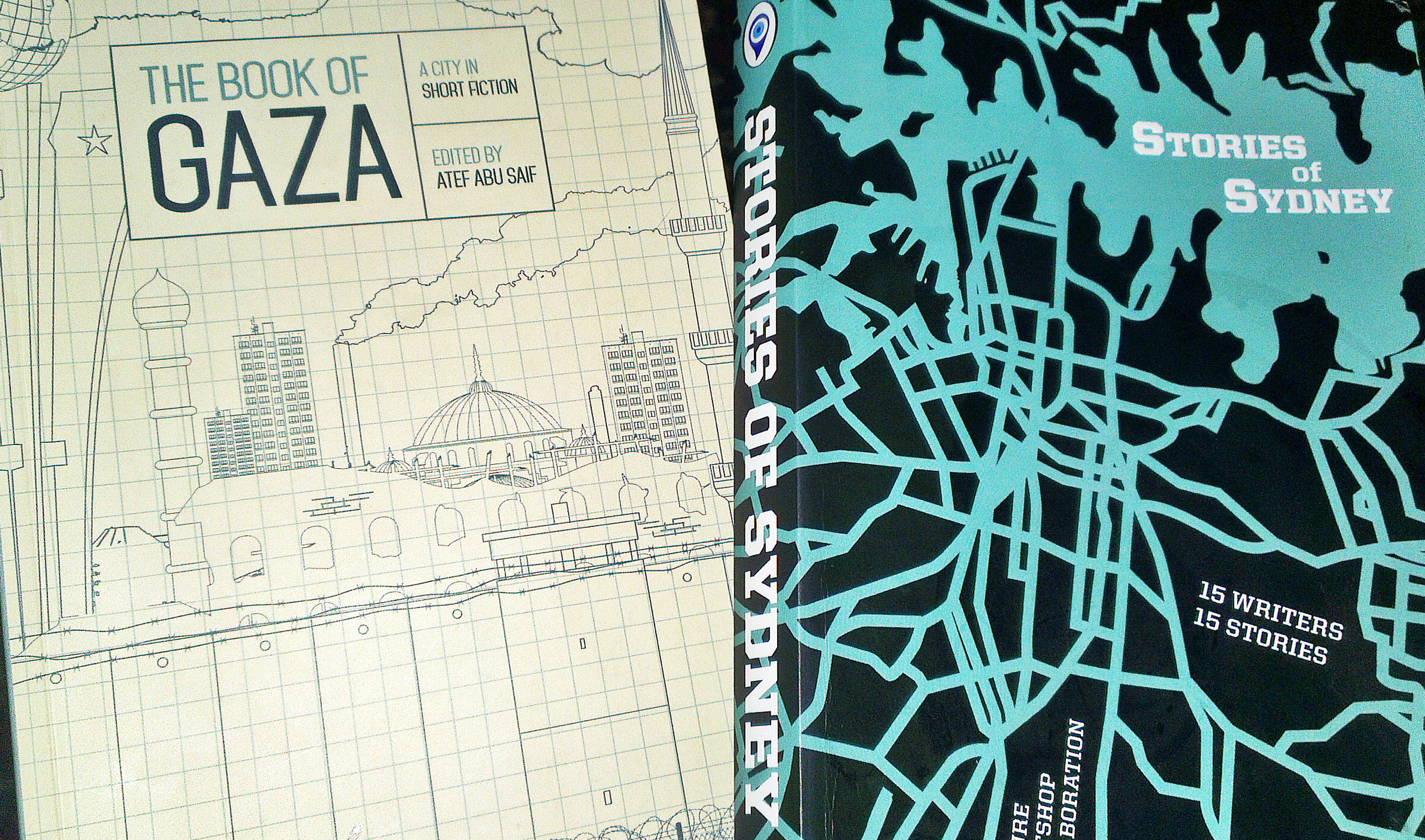


CROSSING CHASMS OF MISCONCEPTION: Contemporary short stories from Gaza and Sydney

Image Description: Two books.The Book Of Gaza - Front cover is a drawing of Israeli Separation Wall in the foreground and the city of Gaza beyond the wall. Stories of Sydney - Front cover is Sydney harbour and streets in turquoise on black background.
The Book of Gaza
Edited by Atef Abu Saif
Published by Comma Press 2014
128 pages
ISBN 978-1-905583-64-5
£8.75 plus postage from Comma Press

Stories of Sydney
Edited by Michael Mohammed Ahmad, Alice Grundy and David Henley
Published by Seizure and Sweatshop 2014
249 pages
ISBN 978-1-921134-26-5
$19.95 AU Seizure

“Gaza has always had a central place in the literary life of Palestine,” says editor and writer, Atef Abu Saif in his introduction to The Book of Gaza. Important Palestinian literary figures from Gaza extend back to the eighth-century poet, philologist and one of the founders of Islamic jurisprudence, Imam al-Shafii. They include poets like Mu’in Bseiso and Harun Hashim Rasheed both born in the late 1920s, and the novelist and poet, Abdul Karim Sabawi born in 1942. In 1948 the city of Gaza and the surrounding Gaza strip, which has a total area of 360 km², suddenly became home to a large number of Palestinian refugees forced from their houses, villages, towns and cities by an-Nakba. As well as being one of the oldest cities in the world Gaza became one of the most densely populated cities. With Israel’s occupation of the Gaza strip in 1967, most writers left and took refuge in countries like Lebanon, Egypt and Iraq. Abdul Karim Sabawi eventually migrated to Australia. Atef Abu Saif describes how:

Despite restrictions on freedom of expression, the art of the short story attained great popularity during the 1960s, 1970s and 1980s . . . Through the brevity and symbolism of the short story, Gazan writers found a way to overcome printing and publishing restrictions imposed by Israeli occupation forces.

In the 1980s and 90s Gaza gained a reputation as “the exporter of oranges and short stories.”

The Book of Gaza brings together 10 short stories by ten of Palestine’s modern writers. Abdallah Tayeh, Zaki al ‘Ela and Ghareeb Asqalani represent the pioneers of the short story. They describe the long queues of exhausted Palestinian workers waiting to cross into Israel. They write of curfews, prisoners’ suffering, and heroes like Zaki al ‘Ela’s Abu Jaber, who actively resists Israeli oppression. They also write about the determination and solidarity that exists between Palestinian people. Asqalani’s story in this Anthology, “A White Flower for David”, is complex and dense. It is hard work figuring out the characters and their relationships to each other. The narrators change, perspectives shift. A fraught friendship develops between a Palestinian family, which includes three generations, and Esther who is married to David, a Jewish man. Sahimah, The Palestinian mother and grandmother, finds Esther’s name strange. Esther sits cross-legged on the bed. We see her through Mahmoud’s eyes as he addresses David, ” exposing half of her flesh, nearly making my brother, Abdallah pass out. My mother threw her coat over Esther’s nakedness . . . It was Arab shame and fear, something she hadn’t expected, but you were typically Hebrew in kidding me about it.” Esther leaves the family at the end of the day wearing a madjalawi robe, a gift from Sahimah, and a knitted shawl wrapped around her head.

Cultural differences are part of the tension that underscores the relationship between the two families but far more ominous is the fact that despite the human desire to be kind, understanding, to be friends, they are positioned socially, economically, and in the everyday reality of Gaza, as enemies. The story begins with Mahmoud standing “face to face with death” forced to choose between “two deaths: to kill or see your son killed.” He decides to hurl the rock he is clasping in his hand.

Israeli soldiers are ever-present. As Mahmoud walks late at night he sees soldiers ahead of him chasing some young men. “Kicks, blows and batons rained down; aching bones and suppressed moans. The soldiers hammered them, marked every inch of their bodies, ripped out their very identities . . .”  One handsome young man cracks a joke and bursts out laughing until the pain in his jaw becomes too much for him. Mahmoud touches the man’s moist face and curses as the life drains from him. Later, Abdallah is beaten by soldiers as his nephew looks on. He lies on the ground, “a bleeding, crumpled heap . . . his vision clouding over as the sand of the street soaked up his gushing blood. It pooled in a great red patch as the UN truck loomed into view. The soldiers dragged the wounded man into the armoured car and set off . . .”  The men sell their souls seeking a day’s work, trying to scrape a living together, martyrs fall, nerves dangle on a thread. The force of anger churns in the breasts of the young men.

Mahmoud, his wife, Haifa, and son, Husam visit Esther and David’s house. Once inside, Mahmoud watches his son looking out the balcony window. His heart pounds as Husam observes a group of soldiers at a bus stop, saying “If only I had a catapult with me . . .”

The writing is tight and nuanced. The atmosphere is claustrophobic. Somehow a very delicate shard of humanity survives amongst the rubble.

The younger generation of writers in the anthology are more introspective. They write about feelings and desire. They engage with and critique their society. Their stories are less hopeful, sometimes despondent. The space surrounding the characters seems even more restricted. Atef Abu Saif’s story, “A Journey in the Opposite Direction” is about two young men and two young women who were friends in their younger days but haven’t seen each other for ten or more years. They meet by chance in the border city of Rafah. The description is rich. Thin shafts of evening sunlight play across the road. Bananas and dates hang “like lost opportunities” in front of the fruit shop at the corner of the square. Travellers are returning from work or from visiting friends and family in Gaza city. Honda and Mercedes taxis line up. People sit on plastic chairs sipping hot anise tea at a small wooden hut that serves as a café. There is just enough room for the owner to squeeze inside to make the hot drinks on a gas stove beside the fridge, or prepare the nargilah pipe. The journey to Rafah from Gaza city is about 40 kilometres. It is the longest stretch of coast and the lengthiest trip any resident of Gaza can make. Ramzi is in Rafah to meet his brother who has been living overseas for twenty years. But it takes a miracle to get in or out of Gaza.

The four young characters chase after the moon, driving from Rafah back towards Gaza in Ramzi’s small blue car. As they approach the bridge over Wadi Gaza the road gets busier until the traffic grinds to a halt. “The water from the valley had spilled over onto the road and the bridge was impassable.” The four of them stand by the car looking at the scene in disbelief like “scarecrows or ships’ masts” sunk in the harbour.

Gaza is not known for its women writers. Palestine does however have a history of women writers and poets. Although she has been largely left out of literary studies, Samira Azzam, born in Akka in 1926 is considered a pioneer in the development of the Arab and Palestinian short story. In 1948 she fled with her family to Lebanon. By the time of her death in 1967 she had published four collections of short stories including Tiny Matters (1954) and The Great Shadow (1956). Sahar Khalifeh is Palestinian writer, born 1942 in Nablus, who has published many novels depicting the life of Palestinian women.[1]

Five of the ten writers in The Book of Gaza, are women – Mona Abu Sharekh, Najlaa Ataallah, Asmaa al Ghul and Nayrouz Qarmout. Their stories are bold, sensuous, and defiant. All explore gender restrictions in their society. Nayrouz Qarmout’s “The Sea Cloak” is about a family’s trip to the beach. Gaza’s coastline is not clean. Everything is scattered about in disarray. The sand is littered with rubbish and tents dot the beach. “This is just the way Gaza is: a young girl yet to learn the art of elegance. A young girl who has not yet developed her own scent and is still, willingly or not, perfumed by all around her.” The protagonist remembers the point where her family no longer considered her a girl. Her father slapped her across the cheek. Her mother dragged her from the room, yelling, “That’s the last time you’re going out on the streets . . . You’re grown-up now, not a little girl. Go and look at yourself in the mirror. Take your sister’s scarf and wrap your hair in it.”

On the beach she is wearing a long black robe and a headscarf. She walks past a group of young men playing cards, children dying their lips with Slush Puppies, a donkey splashing about in the sea, and a stall selling lupin beans. The scent of cardamom-infused coffee wafts from hot coals, an old man recounts tales of Palestine’s history. She walks, surrounded by her memories, into the ocean. She swims further out, feeling “an excited tingle that was almost too much to bear. Arousal grew inside her . . .”

The Book of Gaza is successful in doing what it sets out to do. That is to present us with “glimpses of life in the Strip that go beyond the global media headlines.” There are stories of anxiety, oppression, violence and self-reflection, of resilience, despair and hope. By translating these stories into English and creating this anthology, Comma Press offers English-speaking readers the opportunity to read Palestinian literature and understand the everyday experiences of the people of Gaza as they struggle to live with dignity in what many have called the largest prison in the world.

Stories of Sydney is an anthology featuring five writers from Inner Sydney and ten writers from Western Sydney. In the Editor Notes at the back of the book, Michael Mohammed Ahmad explains the editors agreed that since Western Sydney’s population outweighs Inner Sydney’s population, the ratio should be reflected in the publication. Ahmad despairs that Western Sydney is misrepresented. “When you watch a movie or read a book on Western Sydney, it’s usually about ethnic crime – our guns, gangs, drugs and sexual assaults.” The anthology claims to celebrate the diversity that exists in Sydney. If diversity means an assortment or a miscellany of stories then there is definitely a mix of identifiable cultural experiences, storytelling traditions, and other language influences on the English language and writing styles within this anthology. Some stories are stronger than others. While the content of the stories vary, it is by and large situated within the context of the humdrum of everyday life.

The protagonist in Peter Polites’ story “More Handsome than a Monkey” furtively tracks his lover, “a wheat-fed kid” with “overdose green eyes and speckled guns.” He follows him on a train trip, catching the:

6.30 am, XPT Central – Orange…The shiny city turned into the inner west. The inner west became suburbia with a middle class name. Suburbia became the outer west. The outer west. The outer west became large streets, backyards with children’s toys and BBQ patios. It slowly became rural.

Polites’ writing style is almost Neo-noir with terse dialogue and a snappy first-person narrative. The observations are realist and generally gritty. A sexual relationship drives the plot. The milieu is low-level drug dealing involving “getters” and “freshies”. The main character works in a sports club where the carpet is “a multi-colour galaxy. Yellow stars, red crescents and green comets on a cyan background.” He is flawed but not deeply. He’s looking for love. His behaviour is borderline self-destructive. When things go wrong for him he finds a “fat Leb” in a matching tracksuit. Does a blowie in the toilets and is given some crystals. He moves back into the family home. It seems he always has a room there.

“The 25th Paragon of Filial Piety” by Amanda Yeo is a collection of finely wrought, slightly tongue-in-cheek snippets of the family, work and social life of a young woman. The Yuan Dynasty scholar, Guo Jujing wrote exemplars of filial piety towards parents, nearly all about the piety of sons. These were assembled into a book called The Twenty-four Paragons of Filial Devotion. Amanda Yeo tells her stories of a daughter’s exemplary conduct, helping her mother prepare kai lan, pouring hot water into an aunty’s mug while the women interrogate her sister about her ang moh boyfriend. In the story “The Curtain Between” Maryam Azam explores the tender beginnings of a relationship between two Muslim students. Tamar Chnorhokian writes about an Armenian-Australian woman who reminisces about her late aunt in “Let Me Look at Your Face”. In “Five Arrivals” Luke Carman’s character is torn away from a conversation with an artist at a party in Concord by a phone call from his cousin growling, “Where the seven fucks have you been dick-nigger?” He gets into his Camry, with its bald tyres and speeds down the highway towards Western Sydney. The road outside his cousin’s house is “streaked with tyre marks from doughies and burnouts leading to stretches of muddied lawn.” PM Newton’s story “Aqua” is superb in its rendering of emotion. The geographical setting encompasses Sydney from Chatswood to Marrickville but focuses on the North Sydney Olympic Swimming Pool with Sydney Harbour Bridge to one side and the leering grin of the Luna park entrance on the other side. It is a story told through the eyes of a daughter, now a mother, of her family’s painful experiences of the war in Vietnam, and the pool’s significance in her life.

In the Editor notes, Alice Grundy and David Henley write:

. . . there remains a divide between ‘inner’ and ‘outer’ Sydney, between the new-formed establishment and writers who live in Western Sydney, or who speak English as a second language, or whose families are migrants, or from an Indigenous background; or a combination of the above.

So what of the pressing question of diversity? It seems that here, diversity is about cultural minorities or “lives you don’t often get to see, from authors as varied as the city itself” becoming more visible, being heard, accessing the centre. In an article she wrote for The Guardian about racism in Australian theatre, Nakkiah Lui interrogates the use of the word ‘diversity’, claiming that “diversity doesn’t challenge whiteness, it bolsters it, because we are never questioning what is at the centre.” Rather than asking, why is there not enough diversity in the arts, she argues people in positions of power should be asking questions like “Why am I in the position I am in? Why do I think I deserve to be here?” She says:

We need to remember that diversity is the means to an end. Diversity isn’t complexity, and ultimately, what we want is not a diverse country but a complex one.  By accepting diversity as an end we are just fooling ourselves into thinking that the playing field is equal.[2]

Rather than critique Stories of Sydney for not including for example, more First Nation writers or writers from African communities or of African heritage, I would ask that publishers and editors look at the processes. When applying for funding for a writing/publishing project, they should think about working to  include leaders and decision makers from diverse communities. It is not a matter of ticking boxes, or token last minute inclusions to make a collection of stories diverse. It is an organic and lengthy process of searching for and inviting existing writing groups from different communities to participate, of acting in solidarity to assist the development of new groups, new writers. It is a process of opening up to varied story telling and literary traditions, different uses of language, of seemingly unusual or irregular and sometimes uncomfortable realities. It is also a process of invigorating Australian short fiction through the reinvention of writing aesthetics and reading values. The publishers of Stories of Sydney Seizure and Sweatshop Western Sydney Literacy Movement, are at least on the right path. The launch of the First Nations Australia Writers’ Network in February, and the Accessible Arts NSW Scribbler Literature Forum held in June this year are also positive moves to achieving this kind of complexity.

The Book of Gaza and Stories of Sydney present us with tales from two very different cities. While generally recognising established short story traditions, both books offer writing that contests dictates of form and style. The stories, especially those from Gaza and Western Sydney, give voice to perspectives that challenge mainstream victim, terrorist, criminal, and superhero stereotypes. Instead of flattening people into one-dimensional images these stories offer the reader a chance to feel and experience the day-to-day life of individuals, brothers, sisters, mothers, fathers, children, lovers, workers, living in Gaza and in Sydney. Much of the writing in these two anthologies is an act of resistance. The writers in Gaza have responded to the latest Israeli onslaught by continuing to write. [3] According to an email from Ra Page, director of Comma Press, “all of the Book of Gaza contributors are writing away like crazy, whilst they have power.” [4]

The writers in both anthologies provide bridges for readers to cross over chasms of misconception, and meet the inhabitants of different communities, neighbourhoods, suburbs, cities and surrounds. This is one way of looking at people we don’t know, to look and actually see, at least partially, the depth and complexity of their humanity.

In reading these stories we also begin to understand our own identities, our privileges and our oppression. We begin to understand our responsibilities as human beings. With Israel’s relentless aerial bombardments, shelling and ground attacks in Gaza over the past two weeks, I believe this understanding is urgent.

1. Sahar Khalifeh’s books include We Are Not Your Slave Girls (1974), Thorns(1975) translated into English by Al-Saqi Books in 1985, Sunflower(1980), Memoirs of an Unrealistic Woman (1986), The Door of the Courtyard (1990) and The Inheritance (1997).

2. Nakkiah Lui, “Is Australian Theatre Racist? The Guardian 12 June, 2014

3. Follow Najlaa Ataallah’s blog

4. Sarah Irving, “Gaza’s writers keep writing under the bombs”, Electronic Intifada, 20 July, 2014 (Eighty percent of households in Gaza currently have only up to four hours power per day)