Time to Know Palestine:An Interview with Dina Turkeya


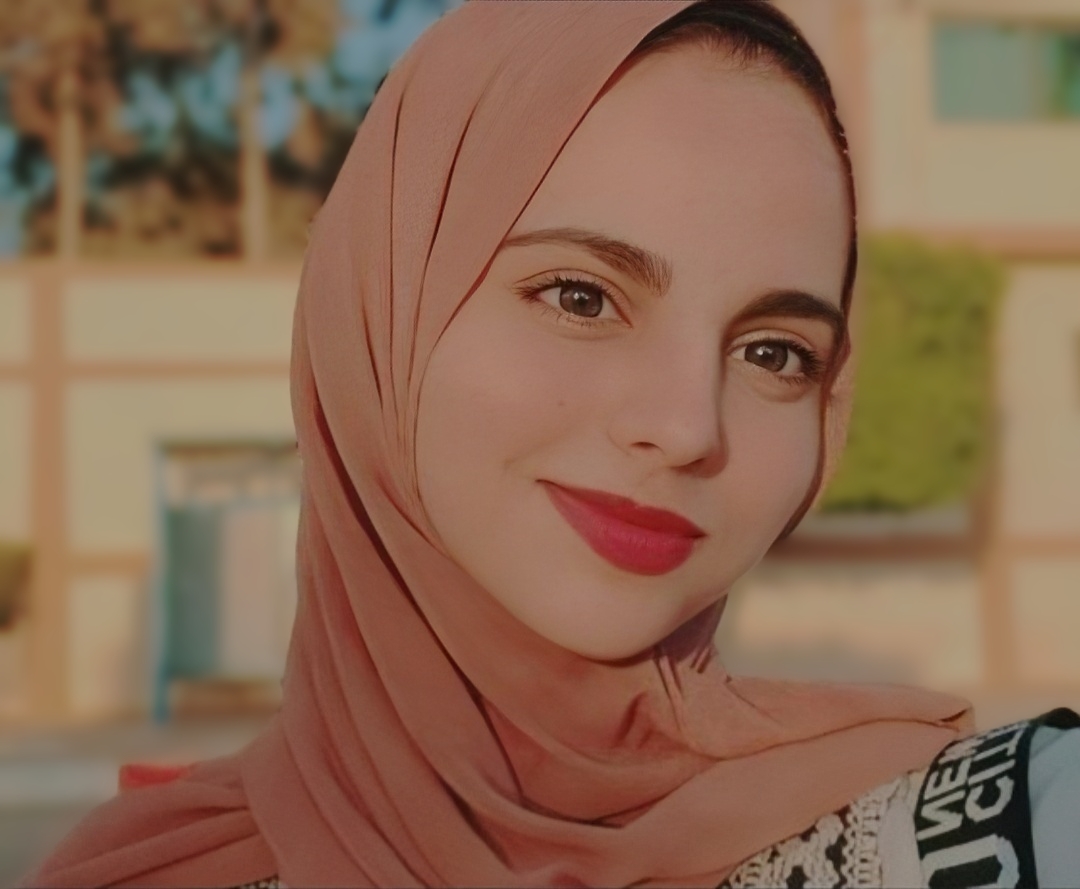
A head shot of Dina Turkeya. She is smiling and wearing a head scarf.

Dina Turkeya is a Palestinian dentist, author and translator. Her family is originally from Yaffa, but she was born and raised in Gaza. She has survived eight wars and aggressions, and still holds onto her dreams and ambitions. Dina’s love for her homeland inspired her to write her debut book, Time To Know Palestine (2024). She is interested in learning languages, writing, drawing and exploring different cultures.

Gaele Sobott: Please tell us a little about your family, including where they originate from and how their experiences have impacted your life.

Dina Turkeya: My great-grandfather was Turkish. He moved to Palestine in the early 1900s and married in Yaffa, where my grandfather was born. After the Nakba of 1948, my grandfather and his family were forcefully displaced to Gaza. He left everything they owned to start from scratch with the label ‘refugees’ on their identification cards. I still remember how my grandfather longed to return to Yaffa, their lovely house and the orange groves. He was waiting for the moment when his feet would touch his homeland after years of deprivation, but what happened was another Nakba. He was displaced from his house in Gaza to a tent in the south of Gaza in this ongoing war. His body couldn’t bear the inhuman conditions and the heartbreak of displacement again, and he died in the tent after years of suffering and yearning.

GS: Where/when were you born? Describe that place and tell us about your time growing up, including your experiences with siblings, cousins and school friends.

DT: I was born in December 2001 and lived my whole life in a very beautiful city called Al-Zahra. This coastal city is nestled in the heart of the Gaza Strip, boasting stunning natural beauty with lush trees, vibrant flowers, serene and spacious streets and kind locals. Growing up, I resided in our lovely house for about 22 years, which witnessed my earliest steps, first words, school journey and university studying nights. Every laugh, tear and whoop echoed through its walls. It was everything to me.
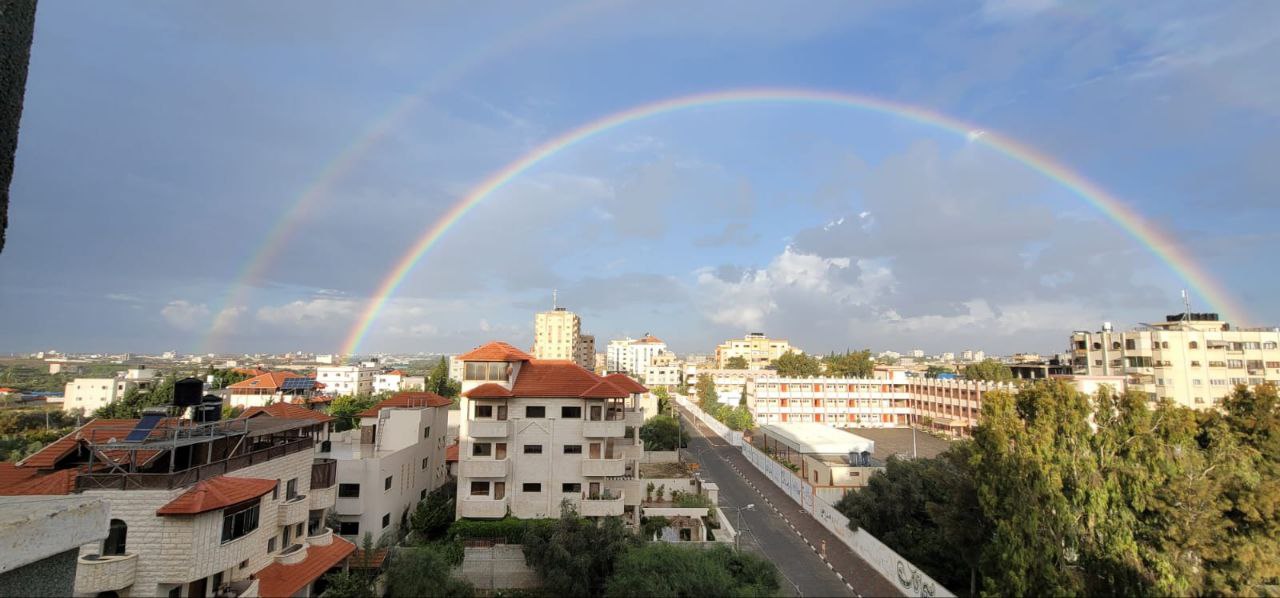
Al-Zahra showing white apartment buildings with red roofs, a blue sky and two rainbows stretching over the city
Al-Zahra

I had plenty of friends there and neighbours like a second family. I am the eldest of three siblings. We’d grown up in a family atmosphere full of love, involvement and support. My cousins were more than relatives. We gathered every Thursday, talked and shared our updates and stories, played cards and challenge games, ate delicious homemade food and desserts, watched movies and celebrated our special days. These weekly gatherings were cherished moments of respite from our bustling lives. I was fortunate to have wonderful friends I met through school, volunteer work, training programmes and even online international courses. True friends simplify life by offering guidance and support, celebrating victories and lightening the load on tough days.

GS: Apart from Arabic, what other languages do you speak? Where/how did you learn these languages?

DT: I speak English, Spanish and French. I’ve always been passionate about learning new languages. For me, language is not only a tool for communication but also a gateway to discover the world, learn new insights and open doors for new opportunities. My English proficiency was honed through school education and active participation in English clubs and programs. Similarly, I studied French for three years in primary school and continued for two years in secondary school, culminating in taking the DELF exam. Additionally, I dedicated three years to learning Spanish at Instituto Cervantes during my university years.

GS: Tell us what roles different languages play in your life and how different languages give or subtract from your view of the world.

DT: Arabic is my mother tongue; a rich, sophisticated and poetic language. The musicality and rhythm of Arabic, along with its diverse dialects adds to its charm and beauty. While I have studied many languages, none possess the deep meanings and elegant words found in Arabic.

Mastering languages has opened numerous opportunities for me, enhancing my skills in both personal and professional aspects. It helped me understand other cultures and perspectives, especially since living in Gaza has restricted my ability to travel and explore the world freely. Travelling is not a luxury when you reside in Gaza. It involves encountering various challenges along the way.

GS: Describe how the Zionist occupation of Palestine impacted your life from a young age.  If it is not too much for you, can you comment on your experiences of the current genocide in Gaza?

DT: Throughout my 22 years in Gaza, I endured eight wars and aggressions, which left me grappling with feelings of instability and the lasting effects of violence and trauma. The constraints of the siege limiting our freedom of movement, the scarcity of electricity, and the obstacles to accessing education, healthcare, and economic opportunities all contributed to a persistent sense of hardship.

I still remember every detail of that unforgettable day on the 19th of October 2023, around 6:30 in the morning. A man’s loud cry of “Get out of your homes” jolted me awake in a panic, prompting me to rouse my family. We hastily left with only essential documents and some money. Seeking refuge at our aunt’s house down the street, we were startled by a deafening explosion, followed by another. The smoke was suffocating, my heart was about to stop from the intensity of the explosion. The shock and horror of losing our home hit hard as we realised it was our building that had been destroyed. I lost the place where I felt safe, warm, grateful and happy. I lost my sweet memories. I’m the kind of person who likes to save everything. I saved my childhood photos, the old coins, gifts and letters from my friends and family, my summaries, drawings and pieces of writing. I lost everything in the blink of an eye.

During the night, when the city was enveloped in darkness, we were startled by the sound of people running and screaming in the streets. We were informed that Israel was planning to bomb more than 25 towers in Al-Zahra city. Confused and frightened, we rushed out into the streets, unsure of where to go. Moments later, as the bombings commenced, the deafening explosion knocked us to the ground, prompting us to flee as far as we could.
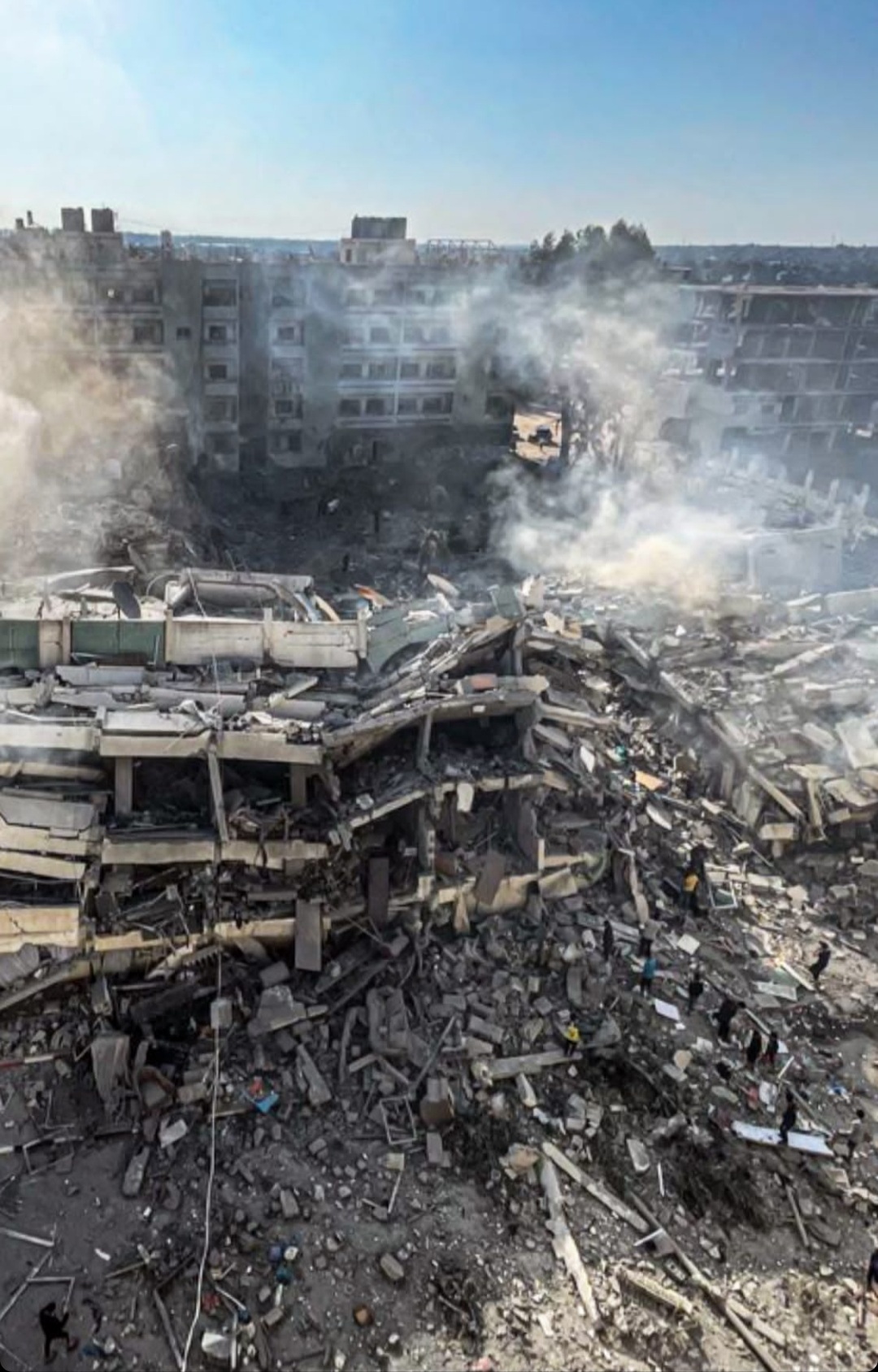
Dina's apartment building in ruins and smouldering the day after it was bombed.
Dina’s apartment block after it was bombed on 19 October 2023

More than 16,000 people found themselves on the streets. Surrounded by fire, the towers were under attack from the south, while nearby cities were being bombarded from the north. War boats approached from the west and tanks advanced from the east. Amidst this turmoil, babies were crying, the elderly were sitting in wheelchairs, women were screaming in terror and men attempted to calm down their families.  I remember that even the dogs were running in panic at the sound of explosions, seeking refuge among the people. What happened is beyond the endurance of any human being and any creature with a heart and mind.

We spent 15 hours in horror; we were afraid, exhausted, cold, hungry and heartbroken. Not only the residents of Al-Zahra city witnessed this difficult night, but also other displaced people who had sought shelter in Al-Zahra after fleeing their houses. It was the hardest night of my life. I didn’t think that we would be alive the next day. I remember waiting for the sun to rise to warm us with its rays. The devastated city was shrouded in grey smoke, evoking a sombre atmosphere. We eventually evacuated to the south of Gaza, and tears welled in our eyes. Witnessing my once-vibrant neighbourhood reduced to rubble was heart-wrenching; a place that had once bloomed with flowers and love.

Even worse,  Al Zahra city has lost all its landmarks and has been completely devastated by the continued bombing. Our city was built in 1998 to stop the expansion of Israel’s Netzarim settlement situated to the North. Netzarim was the last settlement to be evacuated and demolished by Israel when they withdrew from the Gaza Strip in 2005.  Now, history repeats itself in an even more dreadful form. After forcibly displacing all the people in the area during the first weeks of this war of genocide, Israel created the Netzeim Corridor to divide the Gaza Strip into northern and southern zones. They did this by destroying everything in their way, including our beautiful city.

The bombs killed my cousin in cold blood. She was staying with her husband’s family. I didn’t get the chance to say goodbye to her before I left. She was dead under the rubble. It is heartbreaking not to be able to visit her grave, lay flowers or properly mourn her death. The harsh reality of her non-existence brings to mind the concept of annihilation. The pain is profound when someone you shared precious moments with — chatting, laughing, watching sunsets — is gone forever, and we have even been deprived of the solace of burial and mourning rituals.

Many of my friends and colleagues were killed as well. Each of them had dreams and worked hard to create a brighter future. They were simply trying to live, yet what they received was death. It is extremely hard for me to look at their pictures and realise that I will never see them again or hear their voices. I find myself recalling every conversation and every moment spent together. However, what brings me solace is the thought that they are in a better place, away from this evil and brutality. Their souls deserve peace and purification from this harsh world.

GS: Please talk about your tertiary education. What did you choose to study and why? Where did/do you study?
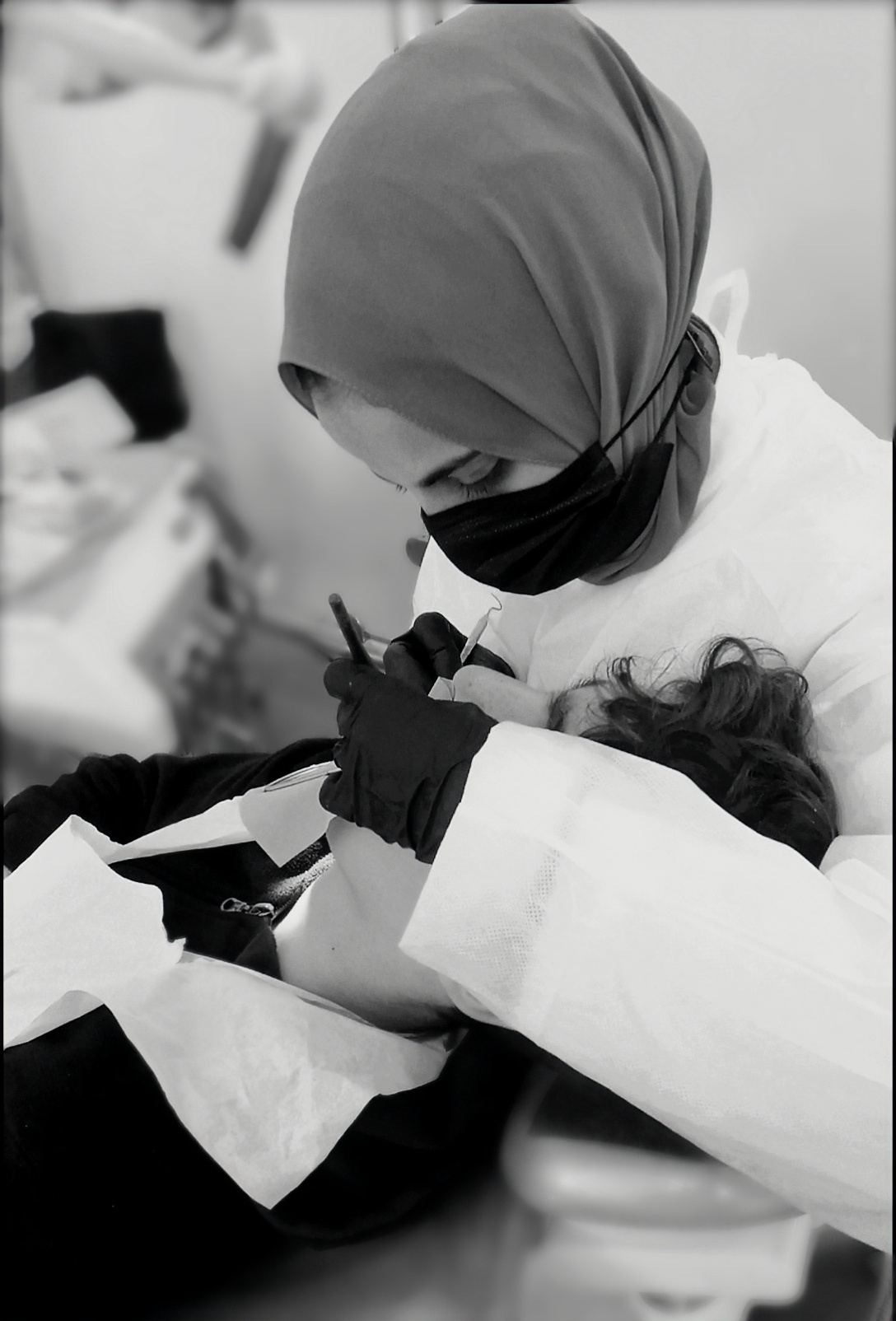
Dina doing dentistry on a young patient
Dina practising dentistry

DT: I was studying dentistry at the University of Palestine. I have chosen this speciality because I feel that relieving a patient’s pain and giving him/her the confidence to smile is out of this world. I was in my final year when the war happened. I was so excited for my graduation after five years of hard work. It was the moment to reap the fruits of my efforts. I had many plans and dreams, envisioning everything as if painting a beautiful picture. War disrupted my plans, leaving me unable to complete my studies due to the destruction of my university. This unexpected turn of events forced me to put my dreams on hold, leaving me with a sense of loss and uncertainty. It’s truly heartbreaking to see how drastically our lives have changed, knowing that things will never be the same again.

GS: Tell us about your experience of leaving Gaza.

DT: Leaving Gaza was the hardest decision we have ever taken. My parents decided to save the last thing that was left, which was “us”. We left in late January 2024 after four months of hardship and witnessing brutal atrocities. Leaving isn’t an option available to everyone. It’s costly and takes a long time. I left behind my beloved family, relatives, friends and neighbours. It felt like my soul had been taken from my body when I received the news that we were leaving. The farewell and our last hugs were so painful, with uncertainty looming over us of whether we would ever see each other again, knowing everyone was at risk of being killed at any moment. The first steps outside Gaza made me feel traumatic shock. A sky without the sound of drones, lights in the streets at night, the feeling of safety where we were staying, knowing that the building wouldn’t be bombed over our heads, charging our phone anytime, having good internet, drinking clean water and food, sleeping in a bed, washing our clothes in the washing machine not manually. These small details have been transformed into distant dreams for every Gazan.

The first months were so hard. My mind couldn’t comprehend what had happened to us, how much the profound loss weighed heavily on our hearts, and how it would be possible for us to live with such emptiness in our souls. It hurts so badly to live with those reoccurring flashbacks of our old life, stuck in the past but hoping that something will happen to bring life and hope to us again. Hearing and reading the news is much more painful, especially since we can’t reach people in Gaza due to the deliberate destruction of the internet and telephone network. We are continually anxious, waiting for a response and fearing that we will see the names of our loved ones on the list of martyrs.

All the people who survived the war share the same pain; we all tell similar stories of our suffering. Wounded people bandage each other’s wounds! I thought that after moving abroad, I could continue pursuing my dreams, only to encounter a harsh reality of exploitation and obstacles placed in our path instead of understanding our circumstances.

GS: You are about to publish your book, Time To Know Palestine. Tell us what this book is about and why you wrote it.
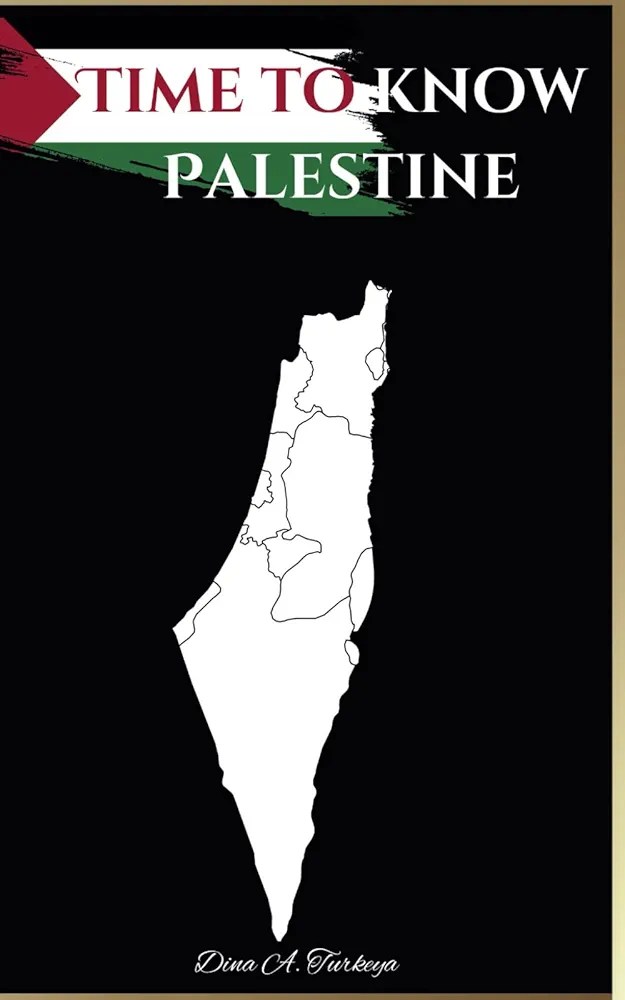
The book cover for Time to Know Palestine

DT: After surviving the war in Gaza, I was trying to recover from the trauma and writing was my way of healing. It was so difficult to turn all the indescribable emotions into words. I was initially unable to concentrate or communicate properly. My family encouraged me to start writing, and I am very grateful to my friend Ana for her unwavering support. She connected me to incredible people from Palestine (West Bank and 48 Lands). They answered all my inquiries and showed me pictures and videos of the places that brought tears to my eyes. It’s so unfair when you can’t visit your homeland while everyone else, including the occupiers, can freely explore its beauty, stroll along its streets and visit all its attractions.

Time To Know Palestine is my way of showing love, pride and respect for Palestine and Palestinians. It’s a message to humanity to see the beauty of my country and know about its long-standing history and vibrant culture. It acknowledges each voice that has been silenced.

This book is for all the lucky people who had or will have the opportunity to live the most beautiful days and memories of their lives in Palestine. And for every Palestinian who is deprived of seeing the beauty of his homeland because of the occupier’s unjust policies.

I will take you on a journey through my words, which I wrote with love and sincerity so that you receive the complete true picture of Palestine, despite all the desperate attempts of the occupier to Judaize and erase its history and geography. This book represents the voice of Palestine that will echo through the centuries, the voice of truth and the voice of the awaited freedom. Time To Know Palestine

GS: What types of international support for Palestine would you like to see happening at this point?

DT: People worldwide have shown great solidarity for Palestine and its people, starting from the Boycott, Divestment and Sanctions (BDS) movement, which proved its effectiveness. Activism and solidarity campaigns to raise international awareness about the Palestinian issue, the human rights abuses in the occupied Palestinian territories and the victims of the genocide. Grassroots campaigns and protests to support the Palestinian people’s struggle for freedom, justice and equality are growing. 

I believe that civil society and social movements play a crucial role in influencing decision-making by applying pressure on governments to implement policies that address the needs and aspirations of everyday people. Many think that providing humanitarian aid and donations to Palestine suffices. However, the real solution lies in tackling the root causes of this ongoing suffering: ending the occupation and halting the genocides.

GS: As one of the places this interview will be published is a zine that will be circulated among young people who like electronic music, I am wondering what types of music you like? What are two of your favourite songs right now?

DT: I like classical music because of its ability to evoke deep emotions and transport me to another world. There is something incredibly calming about the sound of the piano, it helps me unwind and clear my mind. My musical preferences vary depending on my mood and what I’ve been going through recently. Right now, my favourite songs are “I’m Coming Home” by Skylar Grey, and “Gonna Be Okay” by Brent Morgan. They describe the nostalgia I feel for my homeland, my efforts to overcome difficult times and the pursuit of hope.

GS: What are you currently reading?

DT: Most of what I read currently is about dentistry to ensure I don’t forget the knowledge I’ve gained over the past few years and stay updated with new advancements.

GS: What message would you like to send to your generation internationally?

DT: To my generation internationally, I would say: we hold the power to create a more just, compassionate and peaceful world, but it demands collective action, empathy and a genuine willingness to listen and understand each other. In this era of global connectivity, it’s easy to feel overwhelmed by the obstacles we face, but we must remember that we are also better equipped than ever to make a meaningful impact.

We must advocate for human rights, justice, and equality, recognising that the struggles of one community affect us all. Let’s leverage our platforms, education and resources, not only to improve our own lives but also to stand in solidarity with those enduring oppression and hardship. Let’s actively seek diverse perspectives, build connections, and act with empathy and courage.

Our generation has the potential to transform the narrative — from division to unity and from indifference to proactive compassion. The future hinges on how we engage with the world today and each of us plays a vital role in making it brighter.

GS: Describe what you most admire about Palestine.

DT: At this point in history, what I find most admirable about Palestine is the resilience of its people. Despite enduring decades of hardship, displacement and conflict, Palestinians continue to exhibit remarkable strength and determination. Our capacity to preserve our culture, traditions and sense of identity in the face of adversity is genuinely inspiring.

I am also impressed by the younger generations in Palestine who are actively embracing education, technology and activism to amplify their voices on a global platform. We demonstrate creativity, resourcefulness and a passionate commitment to shaping a brighter future, often employing art, literature, and social media to convey our hopes and challenges.

Furthermore, I have great respect for how Palestinian communities worldwide have managed to maintain their identity, fostering a strong sense of solidarity and pride in our shared heritage, even while in the diaspora. The enduring spirit of perseverance and the continual hope for justice and freedom serve as a powerful testament to the strength of the Palestinian people.

GS: What future do you envisage for Palestine?

DT: The future I wish for Palestine is one where its people enjoy freedom and independence, liberated from the oppression of occupation, living in a secure and culturally and economically prosperous state. I wish for Palestine to reclaim its status as a beacon of knowledge, creativity and peace, just as it was before the onset of occupation.

This interview was conducted in English with Dina Turkeya by Gaele Sobott in September 2024.

Purchase a Copy of Time To Know Palestine

Connect with Dina Turkeya on LinkedIn

Read this interview in Arabic

Gaele Sobott writing, culture, social & economic justice by Gaele Sobott is licensed under Creative Commons Attribution-NonCommercial-NoDerivatives 4.0 International 

commutare

I dance. I fly – dog paddle upwards, a vertical take-off like a helicopter (great for escaping danger), and breaststroke through the sky or glide on updrafts. There is joy in the journey. But back down on earth, leaving the reverie, my physical and attitudinal surroundings are not so conducive to travel. I use a mobility scooter or wheelchair to get around and commuting on public transport from Blacktown to Wynyard Station is closer to a nightmare.

To travel to Sydney’s CBD by train, I load my wheelchair into the back of the car using a hoist. It only takes me about ten minutes to drive to the station, then the search for parking begins. There are notoriously few public car parks near Blacktown Station, let alone disability spaces. At Boys Ave there are 130 spots, and eight of those are for disabled commuters. Say I’m lucky enough to find parking. Then I unload my chair, negotiate holes in the footpath, humps, bumps, and kerbs to get to the station. Wait my turn in front of the lift. The doors open and close. It’s overflowing with impatient commuters. I wait a while before the doors open finally to reveal a space for me. I wait for an attendant to let me through the ticket gate. Wait again for rail staff, who are often stressed and grumpy, to organise the ramp to get me over the gap between the platform and onto the train. Over 6000 commuters pass through the Blacktown station turnstiles on a typical workday during morning peak time, 15,800 people during an average 24-hour day.

In a 2019 9News report, Blacktown residents interviewed said they hardly ever get a seat on the train going to or from work. Standing room only, they’re packed like battery hens on the way to the slaughterhouse. Often the train is too crowded for me to board. When I can get on, I need to manoeuvre my way through the crush of bodies and find a place to hold onto a handrail so my chair doesn’t slide when the train brakes. At Wynyard, there’s another wait. The station attendant needs to put a ramp down and help me off the train. Even if a support worker accompanies me, I’m exhausted by the time I get to work and have a raging headache. My joints and muscles scream in pain.

Generally, I avoid public transport, choosing instead to load my scooter into my car and drive calmly through Blacktown’s asbestos jungle. With lockdown, I rarely travelled to the city and now I’m self-isolating, I work from home as much as I can. Today, however, I need to meet with other creatives in person at the start-up hub where our small arts organisation has a desk. The haunting voice of Karen Chilton reverberates through my car. She narrates the story of Sorrowland by Rivers Solomon, the latest book to satisfy my craving for Afrofuturism and Black speculative fiction. Suburban homes flick by, some just starting their gentrification journeys, moving away from the perceived stigma of working-class existence, to maybe one day, achieve the affluent, leafy, suburban bliss of Castle Hill. I glide past Kings Park Industrial Estate, a car and truck rental, and left onto Sunnyholt Road. Turn right, gathering speed, 100 kilometres per hour to merge onto the M7.

Read More

Dignity is essential. It means we are viewed by the other as a human being : an interview with Alice Cherki

A recent black and white photograph of Alice Cherki, sitting at a table, smiling.

Alice Cherki

ALICE CHERKI is a psychiatrist, psychoanalyst and author. Born in Algiers, 1936. She knew Frantz Fanon well, working by his side in Algeria and Tunisia as a psychiatrist, and sharing his political commitment during the war of independence in Algeria.

Alice Cherki has lived in France since 1965. She is co-author of the books, Retour à Lacan (Fayard, 1981) and Les Juifs d’Algérie (Editions du Scribe, 1987), and author of La frontière invisible (Editions des Crépuscules, 2009) Frantz Fanon, portrait (Seuil, 2000) translated into English by Nadia Benabid and published as Frantz Fanon: A Portrait (Cornell University Press, 2006) and Mémoire anachronique (Editions De L’aube, 2016).

Gaele Sobott: Can you talk a little about the history of your family, your place of birth and your childhood?

Alice Cherki: I was born in a family of Jewish Algerians who were in Algeria since the Romans or before the Romans. My parents were born in the small towns of Medea and Ksar Bukhari but they met in Algiers. I was born and I lived in Algiers. I am Algerian, voilà!

Some of my family are Jewish Berbers.

GS: Were there Jewish people in Algeria before the Arabs?

AC: Yes, the majority were there well before. Some came later in 1492 from Spain through Morocco, others from Italy, and then Alsatian Jews, but at that point it was already colonial Algeria.  Many of those left again and went elsewhere. But most of the Jews of Algeria had been there for a very, very, very long. Some of them were Berbers who converted to Judaism. I belong to that history.

GS: Did you speak Arabic?

AC: Very little. I’m not very good at languages. I come from the same environment as Derrida. at school, we learnt Latin and Greek.

GS: Did you know Derrida?

AC: I knew Derrida very well. He was eight or nine years older than me and that represents a big difference but yes I knew Derrida well.

Like Hélène Cixous and Derrida, my childhood was marked by the Vichy anti-Jewish legislation which excluded Jews born in Algeria, denied us French nationality, the right to go to school, the right for Jews to work in government administration. This was hugely traumatic for me as a child.

One Christmas, I was 4 or 5 years old, my teacher said, “Tell your mother that after the break you must not come to school anymore.”

When I asked her the reason, the only answer I got was, “It’s because you’re Jewish.”

I didn’t know what that meant.  So, I gathered my courage and asked, “What’s Jewish?”

She replied, “It’s you with your big eyes, big mouth and big ears.”

Each of us, as Derrida also relates, was excluded from school, our parents could no longer work.

GS: How has this experience affected your adult life?

AC: It opened my eyes to the injustices of the world in which we live; a world marked by colonial ideology.  In Algiers in the 1950s, there was no intersection between Europeans, the Jews and Arabs –  the so-called natives. I didn’t experience it at home but we were caught up in all that. I talk about it a little in my book, Mémoire anachronique.  Everyone lived in their own sphere. Some of us would meet each other outside these spheres.

During my early years at primary school there was no mixing at all. In Grade 6, there were some girls; Rachida, Malika.  For the whole of my secondary schooling I only knew of one Algerian woman student even though my school was not the most snobbish high school in Algiers.

GS: It was the same principle as Apartheid?

AC: The same principle except that it was more camouflaged. Algerians were contained in their own neighbourhoods. Even the bourgeois had their areas. The Algerians passed like shadows in the European neighbourhoods

GS: What area of Algiers did you live in?

AC: I first lived on the border of a working-class suburb, near the boys’ school, known then as Lycée Bugeaud, now it’s called Lycée Abdel Kader. Later, at the age of 17, we moved to Central Boulevard in Hydra. Our house was on a piece of land owned by my uncle –  my father’s brother, my father’s sister, and my father. After some years, they managed to build a three-storey house there for the three families.

GS: What did your father do for a living?

AC: My father traded in cereal. He carried out transactions with farmers for the export and import of chickpeas and lentils.

GS: How did your interest in psychiatry come about?

AC: Firstly, it was a struggle for me as a woman to study. After I passed my baccalaureate, even though I was from the middle-class, it was not usual for women to continue their education. Women were expected to marry and so on. I had an older brother and a younger brother and was the only girl. Neither of my parents continued their studies. My father, a brilliant student, was pulled out of school at age 16 by his father. He was the eldest of ten children There were two or three girls before him so he had to work. I believe my mother chose to leave school to get married. When she met my father, she dropped out.

My parents were both very intelligent and relatively progressive. My father spoke Arabic, but they did not have a higher education.

I already had a certain outlook on society and I was more inclined towards literature. I wasn’t a good student and had never received any awards for excellence. I was impertinent and people always told me I would make an excellent actress. With no one to advise me, in those days, if I had decided I wanted to be an actress, it would have been worse than deciding to be a prostitute. Having said that, I did later have the luck to meet many people who became involved in theatre.

So, I found myself first in hypokhâgne and then khâgne. You know what they are?

GS: No.

AC: Preparatory literary classes for the grandes écoles. The equivalent also exists in the scientific field. I was interested in studying philosophy but decided that would mean cutting myself off from the real world. I made up my mind that I wanted to be useful so I chose to study medicine. But very soon I realized medicine didn’t meet my needs. It was all about identifying symptoms and responding with treatments. I remember a teacher saying, “But Mademoiselle, you ask too many questions.”

We never say, “Why” in medicine. Instead we talk about, “How to fix it.”

So, I was part of two cultures; one of interest for human beings and their psyche, and the other a group culture which stemmed from my medical studies.

GS: Were there other women you knew of who were studying medicine then?

AC: There were a few, but they were a definite minority.

There was a saying that summarized the situation quite well. It relates to sitting the intern examination:

If you are white, European and male, you have an 80% chance of sitting the exam. If you are female and European, you have a 60% chance. If you are Jewish and male, you have a 50% chance. If you are female and Jewish, you have a 25% chance. If you are Muslim and male, you have a 10% chance. As for being Muslim and a woman, you are not even mentioned because you just don’t get the opportunity.

Some managed to study medicine or become trainees but none got to sit the intern examination, voilà!

GS: When did you meet Fanon for the first time?

AC: I was part of a youth movement called AJASS (Association of Algerian Youth for Social Action) and Fanon was invited to give a lecture by a friend of mine, Pierre Chaulet, who died recently. It was a lecture on fear and anxiety in 1955. I must have been 19 or 20 at the time and had to leave my parents’ home where I’d been living. Most of the interns at the hospital were French-Algerian and because of my opinions I faced all kinds of problems. My car tyres were punctured, my white doctor’s coat soiled, my files stolen. So, when Fanon found out I wanted to do psychiatry, he told Pierre Chaulet I should come and intern under him at Blida psychiatric hospital.

GS: So you lived at the hospital in Blida?

AC: Yes, as an intern. That’s where I met my husband, Charles Géronimi. He shared my ideas, but having Corsican parents, teachers but Corsicans, they had trouble accepting a little Jew in their family, especially my mother-in-law.

GS: What were your first impressions of Fanon?

AC: My first impressions, at 20, I found everything he had to say very interesting and didn’t think of him as black. He analysed the subjectivity of racism which was very different from the discourse of the time. On the one hand, we had Existentialism and on the other, Marxist materialism which didn’t include questions of subjectivity. It was the first time I’d met someone who was only 10 years older than me but had immense experience, and a developed understanding of these two worlds, of the two ‘ideologies’.  He was neither on one side nor the other which met my expectations, answered my questions.

GS: He had practical ideas?

AC: Yes, he was a hands-on kind of man.

GS: That’s to say, the development of his thought was founded not only on the theoretical but also on his lived-experience?

AC: On his experience, yes. And that also pleased me. It was from his lived-experience that he elaborated his ideas. But he also had very advanced psychiatric training.

GS: What were some of the work experiences during your time with Fanon in Blida that influenced your practice of psychiatry?

AC: Everything he brought to psychiatry, especially his critique of the School of Algiers’ theory of primitivism. He also introduced social therapy, institutional psychotherapy.

GS: How do you define institutional psychotherapy?

AC: Institutional psychotherapy, as developed by Tosquelles, took off in France with the support of Oury and Bonnafé. It encourages the residents of psychiatric institutions to share things with their caregivers. Through humanising the functions of these institutions, it allows understanding not only of patient symptoms but also the roots of these symptoms. There are still two or three people in France who are struggling to create places that foster institutional psychotherapy, but it is becoming more and more difficult.

GS: Why is it becoming more difficult?

AC: Because of the prevailing ideology. Now we have DCM 3, DCM 4, DCM 5. It is a performative ideology that absolutely bypasses all subjective aspects of alienation.

GS: Did you have any significant experiences in the hospital setting as a female doctor caring for patients in that historical and social context?

AC: What do you mean by significant experiences?

GS: For example, when you worked at Joinville-Blida Hospital, were there certain events that affected you?

AC: Yes, of course.

GS: What were they?

AC: So many things. For example, I saw women hospitalised after childbirth for postpartum, transitory delirium. Some doctors didn’t understand and sometimes even people in the women’s families said, “It’s the djnoun who came to inhabit her.”

It affected me deeply because  I wanted to ascertain their experience of the delivery because it influences their relationship to the newborn baby.  It’s a complicated relationship.

GS: Did you have your own children at that time?

AC: No, I had no children at the time. I now have a son who is 40 years old. He studied political science and then he got involved in theatre.

GS: So, he is fortunate?

AC: Well there you have it.

Black and white photograph of Alice Cherki as a young women. She has short, dark hair, is wearing a white, V-neck dress and a necklace, and she is smiling.

GS: As a female doctor, what were your professional relationships like with your colleagues at the hospital?

AC: Amongst us interns at the psychiatric hospital of Blida, I was considered an equal.

I married an intern from the hospital. No, I can’t say I had any problems. On the other hand, before that when I was at the Mustapha Hospital in Algiers, I was very young, I did my hair in a bun and put on big glasses to make myself look older so I’d be left in peace.

GS: Was your husband originally from Blida?

AC: No, he was also from Algiers but he was an intern with Fanon in Blida. They wrote a paper together on Algerian women and the cultural specificity of TATs (Thematic Apperception Tests).

GS: In your book, Fanon, Portrait, you mention a meeting between Fanon and Jeanson. (1)

AC: Yes.

GS: In that meeting Fanon expressed his wish to go beyond certain ideas so that readers can experience aspects of life that they could never know firsthand.  You talk about Fanon exploring the sensory dimension of language. Do you think that this approach to writing could enable us to communicate experiences around difference, to understand our differences from an egalitarian point of view – not superior or even inferior?

AC: Yes, I think this type of writing is essential. In my experience, sensory writing starts from perceptions, sensations to try to improve communication with the other, I think it is very, very necessary.

GS: Do you know any writers today who write like that?

AC: I’m not qualified to say. I don’t know today’s writers that well. But Kateb Yacine wrote like that.

GS: Do you see difference as a dialectical space that can trigger creativity and imagination?

AC: Yes, that’s what I call the relationship to the other, the recognition of the outside, the stranger. It is important. I wrote another book called La frontière invisible, in which I insist on the relationship to the other. This allows you to accept the outsider in yourself.

GS: In your book, La frontière invisible, you link psychoanalysis and politics. I understand colonial violence, violence of displacement, violence against the subject in the social context, the context of specific historical and political circumstances, for example, those of Algeria and France. But when I try to analyse this violence from a psychoanalytic point of view, I find it difficult to understand.

AC: It is complicated. But you have sought out strangers?

GS: Always, yes.

AC: Perhaps it’s not by chance.

GS: Perhaps not.

Did you know Fanon outside his work, in his family life? What kind of man was he as husband and father?

AC: Yes, of course I had the opportunity to know Fanon outside his work. I knew his wife well and I know his son very well. As a dedicated husband and father. At the same time, he was a very busy man. But he was very dedicated to his family. When his father left for Africa, Olivier didn’t see him that often only from time to time when Fanon came back from working there.  Olivier was only five when his father died.

Fanon loved life. He liked to go out to dinner, go dancing, things like that.

GS: What type of dancing did he like?

AC: All the dances of that time, le slow, the rhumba . . .

GS: Did you like to dance?

AC: It has been a long time since I really danced but yes at the time I loved it.

GS: At friends’ places?

AC: Yes.

GS: What type of music did Fanon like?

AC: He especially loved Caribbean music.

GS: And you?

AC: Back then my tastes were very eclectic. I liked the Arab-Andalusian, Jewish-Andalusian music right through to Bach, Beethoven, Mozart and then Jean Ferrat, Barbara, Montand. More and more now I love Musique Concrète.

GS: Tell me more. 

AC: When I was a psychoanalyst, I was working very hard. In the evening, when I had finished working and my head was full of words, words, words, I’d play the likes of Kurtág and Blériot. The music is largely based on the sonority of the human body. It defies the normality of melody. It’s best to listen to it alone. There are not many people who love and desire that genre of music. It scares them.

GS: What kind of a sense of humour did Fanon have? What made him laugh?

AC: He had a great sense of humour, Fanon. It was humour that made him laugh.

GS: People who are very involved in revolutionary struggle often dedicate huge amounts of time and energy to the cause, and I suppose that doesn’t allow them to be very good parents.

AC: That’s true, yes. Especially at the time because the people involved in the struggle were very young.

GS: Have you met children whose parents were not only very involved but who were tortured, wounded or killed as part of the struggle?

AC: Yes, children who became orphans.

GS: Regarding the children of revolutionaries, what observations have you made?

AC: It was very variable. For example, Fatma Oussedic, her father was a great militant and she has good memories of her relationship with him. In addition, many families did not only consist of the father and mother, there were, aunts, uncles, cousins etc. They weren’t nuclear families. If we’re talking about orphans this helps a little. But when you see your parents killed before your eyes, that’s not the same thing. As for the children of the surviving revolutionaries following independence, the notion that their fathers are heroes has weighed heavily on many of them.

GS: Would you mind giving me a brief definition of your concept of alienation and the ways it may be experienced in countries marked by colonisation.

AC: That’s a big question. Both the coloniser and countries who achieved their independence, like Algeria, deny in various ways the colonial wars that have taken place. Algeria swept a large part of the past away by claiming the national story begins at the time of Independence. Generations have been taught that they have one history, one language, one origin. This kind of discourse has done a lot of damage. There are many young people who now don’t know who they are.

GS: How does that manifest psychologically?

AC: It varies considerably and is different in Algeria and in France. Here in France these young people are excluded from participating in the inner circle, In Algeria they are divided. There is group of social conformists who represent the youth, and another group of which no one ever speaks but which gnaws away at the heart and soul of the country.  Young people are suffering a great deal, even those who are socially successful. Many young people ask, “What was Algeria like before 1962?” Many are Berbers. The heterogeneity of their roots has been hidden from them. It is as if these roots don’t exist but they are longing for what I call multiple identification … not to be cast in a single mould.

In France there are many young people who describe their lives very well and write novels. Some are very interesting, written in the language of the suburbs. For example, Sabri Louatah, Les Sauvages.

GS: What is your definition of dignity, especially the dignity of colonised people, people considered mentally ill or disabled?

AC: Dignity is essential. Dignity means we are viewed by the other as a human being.

GS: In revolutionary situations, when a group of people can no longer withstand massive pressure and extreme violence, they react violently to create a change in the power structure. This changeover is often quick, lasts for a moment, the objective is specific: to get rid of the immediate cause of the violence that oppresses them. Beyond this moment of revolutionary violence, what measures do you think people can use to get rid of the everyday violence that continues?

AC: Firstly, to speak.

GS: To whom?

AC: Speak, tell, write. . . I think there are many forms of expression, of creation. Because we must get by. We must get out of the stupor. The essential thing is to get out of it, including through collective struggle.

GS: What for you is the most urgent task required to change human relations in the future? What needs to be done to update and develop new definitions of power?

AC: We need to do work in many areas if we are going to change human relations and bring about new definitions of power. Each person should focus on their own domain, the place where they live. It’s true, like many people, I feel I am very active and committed. At the same time, I denounce all modes of liberalism and things like that.

GS: How do you define liberalism?

AC: It is being governed by financial capitalism which transforms the subject into an object.

GS: Is it enough to denounce? Sometimes I get the impression that it is useless.

AC: I know it well. Organisations are important. There are organisations, people who are militant. I am fortunate to have a son, and nephews who are politically engaged in their fields. Me, everyone knows my positions, my writings. My son works in theatre. They go to schools, to high schools. I am not against the revolution.

GS: Do you think that as individuals, we are afraid of revolutionary violence, afraid of revolutionary confrontation?

AC: It depends. There are many people who are afraid of violence. In my case, I’m not afraid. Many French people want to stay in their little cocoons. In Europe, the French are very much like that, withdrawn on their plots of land, and yet they made a revolution.

But I believe violence is . . . for example, what happened in 2005 in the housing estates, with Sarkozy insulting everyone. People called them riots but I called them revolts. Those young people were not afraid.

GS: It is temporary, a moment?

AC: Revolution is always like that. It’s a moment. But moments that produce difference. Every revolutionary moment must be seen as the introduction of change.

GS: Even if it takes a long time to get to that point.

AC: Yes, like psychoanalysis.

GS: Why did you choose to become a psychoanalyst?

AC: Because I found it was the best way to understand the psyche and help people. It’s exciting, I love it, yes, I like it very much.

GS: You must undergo psychoanalysis for several years to be a psychoanalyst?

AC: Yes, you do. It’s experience. You see, even you talk to an 80-year-old woman who is a psychoanalyst and it’s fine.

GS: Yes, it’s been good.

AC: I have lots of stories to tell. I am attentive to other human beings.

GS: Ah yes, but not all psychoanalysts are like you.

AC: That’s true.

GS: Did you have any conversations with Fanon about the ‘Jewish question’ or the events that led to the establishment of the State of Israel?

AC: Of course, Algerian Jews, like myself and Jacques Azoulay, worked with Fanon in Blida. Fanon had very close Jewish friends in Tunis. The subject of the establishment of the State of Israel was far from our concerns. Fanon was profoundly atheist. I, too, am an atheist. We were part of the struggle for Algerian independence, there was never any conversation about the existence of God for example. Those questions and discussions were not on our radar.

GS: But religious discourse was there nonetheless with Messali . . .

AC: Oh, yes. Those discussions took place within the independence movement. It was very heterogeneous. There were plenty of different poles of thought, different ideas. For example, Fanon, returning from sub-Saharan Africa, jokingly said to his colleagues, to the revolutionary friends of the mujahidin, that they should follow the example of Islamic Africans, their wives can walk topless. He said that jokingly. I mean the issue of Islam as a fundamental direction was probably underestimated, but religion was not ubiquitous in our workplace. I think, even Messali, he was for independence from France, he was married to a French woman, he wasn’t a religious Iman.

GS: When and why did you leave Algeria? Do you consider yourself a woman in exile?

AC: I did not really leave Algeria. I settled in Paris but with frequent trips to Algeria and back. I’m not in national exile and I think exile of the psyche is the hallmark of any successful human life.

Notes:

1. Alice Cherki refers to a meeting  between Fanon and Jeanson in her book, Fanon, portrait (Seuil, 2000), however the English translation, Fanon: A Portrait, (Cornell University Press, 2006) refers to a letter.

Alice Cherki was interviewed by Gaele Sobott in Paris, 26 September 2015 and by email between 18 and 20 November 2016.

Translated from French by Gaele Sobott

Creative Commons License
“Dignity is essential. Dignity means we are viewed by the other as a human being”: an interview with Alice Cherki by Gaele Sobott is licensed under a Creative Commons Attribution-NoDerivatives 4.0 International License.