
Zubeida ‘Juby’ Mayet (1937 – 2019) was a journalist who dedicated her life to fighting for a free press in South Africa, gender justice and an end to the Apartheid regime. She began writing for the Golden City Post in 1957 and worked for Drum magazine. In 1977 she joined The Voice, in Lenasia, Johannesburg, where she was appointed Deputy Chief Sub-Editor, a first for black women journalists. She was a founding member of the Union of Black Journalists (UBJ), serving as its assistant secretary-treasurer, a member of the Writer’s Association of South Africa, and contributed a great deal to the Media Workers’ Association of South Africa (MWASA). Juby also wrote for UBJ Bulletin Asizothula and The Worker. She was detained in 1979 and upon her release, served with a five-year banning order under the Internal Security Act. She and her family suffered continued police harassment and surveillance
Cecilie Palmer (1944 – 2019) was a stateswoman, active in the struggle against the South African Apartheid regime and in fighting for the emancipation of women. She served in many organisations including, the United Democratic Front, the Federation of Transvaal Women, the Legal Resource Centre and Sizoya Sibuye, a platform for raise public awareness of women’s experiences of torture and jail during the struggle and counselling ex-prisoners. Before her arrest in 1976, she was active in the National Union of South African Students on the University of the Witwatersrand campus. Cecilie was also one of the founders of the Women’s Institute for Leadership, Development and Democracy (WILDD). She and her family experienced continued police harassment and surveillance after her release from prison.
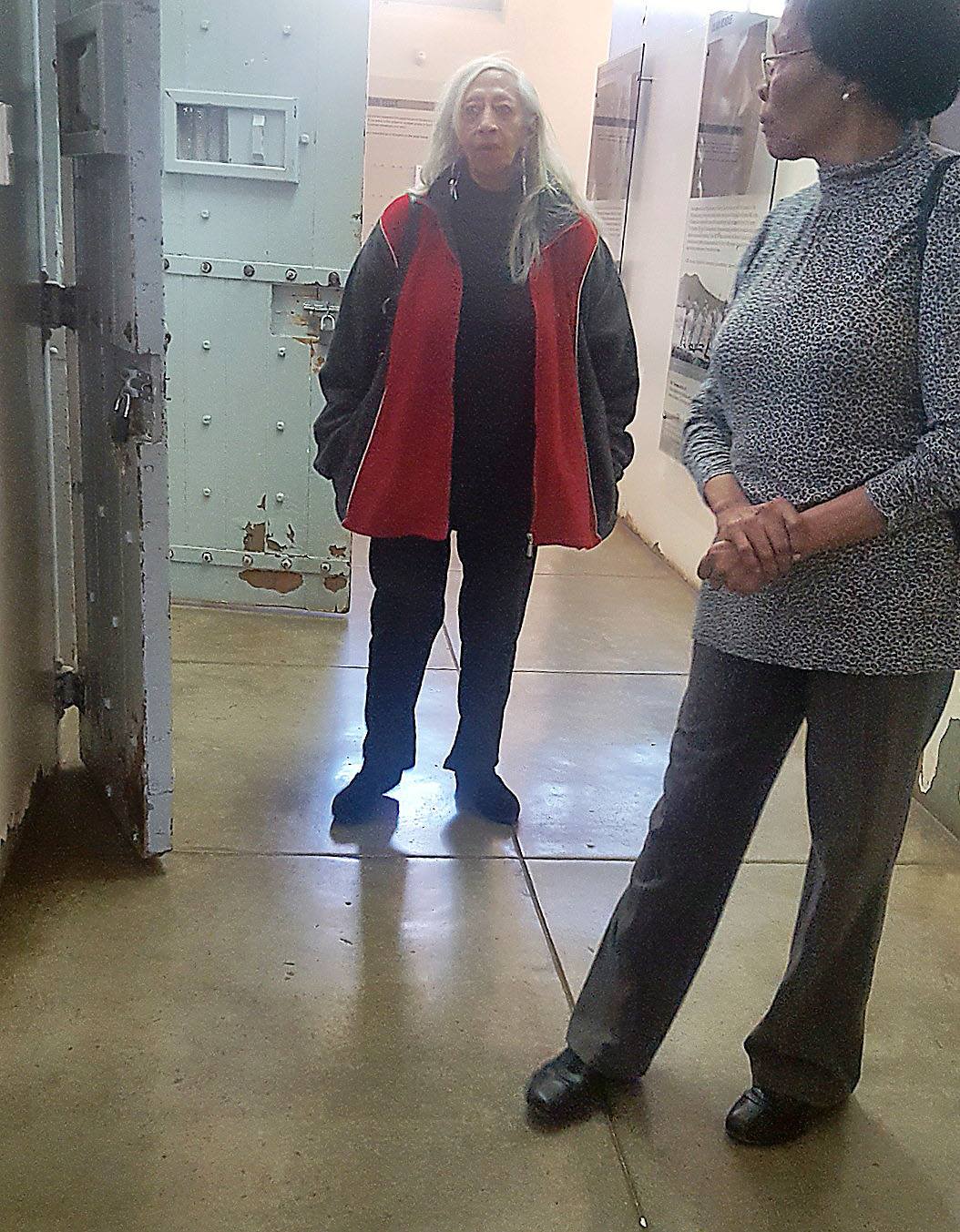
Gaele Sobott: We have just visited the Constitution Hill Women’s Prison, where you were both detained in the 70s. You’ve described the torture of women in the prison and the mental scars that have plagued you and the other women who were detained from the time of their release onward. Cecilie, you had two children and you were pregnant when you were detained and your mother, Vesta Smith, was also detained in the same prison. Juby you relied on friends to look after your children while you were detained. You were both involved in your different ways in the struggle against Apartheid and to bring about a more just society in South Africa.
In the years leading up to 1994, I am wondering how you balanced or negotiated the need for a hierarchical leadership to overthrow the old Apartheid regime and establish a new regime with the need to broaden and deepen the education of the general population?
Cecilie Palmer: I remember the time, years ago, I think it was 1982 or 1983, when the President’s Council presented its proposals for the reform of government structures, and we were having debates about whether to go into that Council under the new constitution or not to go in. I was sitting with Professor Mohammed and Firoz Cachalia and some others in the UDF office. We were debating and we were dead against going into the Council. Firoz and them were trying to push us to change. That was the kind of consultation that went on. We debated in the branches and the decisions were taken from there up. It’s true, education, that kind of education stopped, that kind of mix of people, it stopped when the exiles arrived back here and they said, ‘This is how it’s going to be done!’
GS: When was that?
Juby Mayet: They started coming back late eighties, early nineties. Sorry I have almost lost my voice. It’s a bit difficult for me to speak. I’ll whisper.
CP: Ja, they built a different structure and they said, ‘This is how you will fight.’ So then you had this structure where the country was really being ruled by six people sitting in Luthuli House.
GS: How did they gain the power to do that?
CP: I don’t know. What ever they did, it was very cleverly done. Remember, people used to trust each other. We were all comrades in the struggle. Some of us were mixed, right.
GS: What do you mean by mixed?
CP: In the sense that I didn’t really belong to the African National Congress (ANC). I didn’t belong to the Black Consciousness Movement (BCM).
JM: Yes.
CP: I didn’t belong to anybody. I went where it was necessary to fight a battle. That was how I operated. Then they came with the UDF and at that time, I remember we were asked very specifically, because we had a very good women’s movement at that time, the Federation of Transvaal Women. Each province had their own women and we saw ourselves as women working towards common goals. Then we were told no, we had to choose whether we Charterists or whether we were BC. I remember one ANC woman asked me that question and I stood back and said, ‘None. I like to work where I’m needed most.’ But when the ANC was unbanned, people positioned themselves where they knew or thought the power was going to be …
JM: Where they thought their bread was going to be buttered.
CP: For instance, in Eldorado Park, which is a township just on the other side of Lens.
JM: Ja, we passed it. I pointed it out to you.
GS: Yes.
CP: We worked very hard there. We had established a really strong activist community where we had an advice centre, a women’s group, we had women against the abuse of women, we had a pre-school programme. The pre-school programme was designed by one of the women in Eldorado Park who was a pre-school specialist and that programme was designed on a non-sexist, non-racist basis. It was assessed by a professor from Rhodes University who said the programme should expand right through Africa. We replicated that programme from Eldorado Park throughout the Transvaal.
GS: By we, you mean the Eldorado Park women’s group?
CP: Yes. We had a strong movement going. We also had a civic association. Our belief and my belief was that civic associations belong to the people of the community that starts those associations, irrespective of what their political affiliations are.
JM: Yes, absolutely.
CP: Then we were asked by the ANC, because they had regrouped, to spearhead the formation of the South African National Civic Association (SANCO) and that was affiliated directly to the ANC. We said, ‘No, we’re not going to do that.’ Our pre-school programme had established pre-schools in the Transvaal and those pre-schools each had parent bodies. We taught the women in those parent bodies politics, not party politics but community activism, so they knew about political, social and economic injustice and they were figuring out ways to build alternatives in their communities. This all grew from the strong community activism in Eldorado Park, so we brought those Eldorado women and the women from the pre-school parent groups into the Federation of Transvaal Women. We didn’t realise the ANC and those leaders who decided to identify with them, were positioning themselves for future power. The ANC started choosing people for their executive committees in Eldorado Park. They were lobbying.
JM: Manipulating.
CP: Ja, so, none of the activists, the youth groups, the women’s group, none of those activists were chosen for the executive committees. Anyone who wasn’t ANC was kicked out of those groups. We were very innocent then. Not skilled in that kind of politicking.
GS: Do you think the ANC saw those people, those activists on the ground who did not want to join them, as a threat and if so why?
CP: I really don’t know why they saw them as a threat but they did. I think they were scared of people who had experience in the struggle but were refusing to join the ANC, probably because they were a stumbling block to those who were opportunists, those people who joined the ANC to climb. Those activists were wise and they expected the organisations to be run on same lines as they had been run on before. I think that’s probably what it was. I don’t know. One needs to think very deeply about this time and what happened.
JM: It was the ANC state capture. They rode roughshod over all these people and groups, like they were the only ones who fought to liberate us. The Pan African Congress (PAC), Azanian People’s Organisation (AZAPO), all the rest, were just thrown to the wayside. I’ve never been a card carrying member of any political party. I was labelled a sickly humanist. I worked for the human rights committee which had ANC members and Liberal Party members, then after I covered the South African Student Organisation (SASO) trial in Pretoria, Sathasivan Cooper, Sivalingam Moodley, Audrey Mokoape, I became kind of involved with, not involved but enamoured of the Black Consciousness Movement and of course when I met people like Sobukwe, he was such a lovely man, and Joe Tlholoe who was so young when he was sent to jail for so-called PAC activities, so I never really had a particular inclination towards any political party, I just felt I had to do a typical sickly humanist’s job.
GS: As an individual do you resent being dominated in a job or within a community?
JM: Not really. If I am dominated by anybody who thinks they are better than me, yes. I think I am as good as the next person.
CP: In other words, you refuse to be bullied.
GS: There is bullying and there is sometimes the need for hierarchical leadership. Do you think it is possible for South Africa to change existing social and economic conditions without hierarchical leadership?
JM: It has got to come from the younger generation.
CP: Exactly.
JM: I don’t know if they are better educated. They go to varsity and vandalise the school structures, the very place of learning. I don’t understand that mentality.
CP: I think our education system doesn’t teach people to think. It teaches them to regurgitate stuff without thinking.
JM: I went on protest marches but I never threw a stone through anybody’s window or set fire to any buildings. We marched with our banners and we sang our freedom songs without vandalising or damaging people’s cars or property. I cannot understand that mentality, especially when they go and burn down schools.
CP: Twenty eight schools burnt just a few months ago.
GS: Why? What caused that anger?
CP: Municipal demarcation. Dividing the wards up. The local government structures are divided in to wards. It affects voting. That’s why they keep changing it. They changed the boundaries and the community didn’t want it. Like Vuwani, where the community withdrew their children from school as a form of protest. Then they burnt the schools. The schools become the targets.
JM: That is why I say it is because of a lack of education. Those parents obviously did understand that this is not the right way to protest and make change. We need those schools. We are depriving our children of education.
CP: If you look at the age group of those people, it’s the age group that went to school after 1994. They are keeping their children out of school. They are the ones who are throwing stones. The ones who were born in the mid-eighties. That’s my view. Yes, we had Bantu education, Coloured education, Indian education but I swear that was one-hundred-and-ten-times better than the education we have today.
GS: During that period of change, how do you think it could have been done differently in terms of education?
JM: It would help if we had a president who was actually literate. Our education system is terrible. They keep saying how young people must be educated to become future leaders but it has become empty rhetoric, just words, no substance.
CP: It was during his time, that education started deteriorating. With every step, the education system seems to deteriorate further with every change they make. The very last change was the curriculum assessment policy called CAPS, a system that came in 2013. Plus the mentality of the new teachers is not good. We need better teacher training.
GS: What happened to AZAPO, PAC leaders?
CP: They were just pushed out and ignored.
JM: I meet up with those guys and we talk. There was a group of students from SOWETO and they were quite surprised by the way I spoke. I make it quite clear that the ANC sucks! They irritate the hell out of me. I don’t have anything to do with them. I tell them that. I don’t vote for the ANC. Sometimes I say why don’t you guys form a coalition. Can you imagine if AZAPO and the BC people came together then the ANC would be seriously challenged, voted out in elections.
CP: They pushed out a lot of leaders, extremely well educated people, some died, like Percy Qoboza, but none of them are anywhere in government structures. Brilliant people were pushed aside.
GS: What do you think can be done to stop the party that is about to take power in a situation like that from isolating or silencing intellectuals?
CP: They didn’t just sideline intellectuals they also preached that the older people who stayed in the country, that we were stupid and didn’t know what we were doing. Some children are extremely angry because their parents have been treated so badly. We’ve got this inter-generational dialogue and it’s all about talking with the younger people and not at them. Some of them are extremely angry at Nelson Mandela.
GS: Why?
CP: Because he sold out. I sit there and I think, yes, it is true what you say but I cannot say that. So, I go the other way and say, ‘Look, he had to do what he did otherwise violence would have consumed the country.’ That’s true. There was Eugene Terre Blanche and Inkatha and all that but if you go further back they had been negotiating with Mandela a very long time before his release without the other prisoners being involved. They actually moved him from Robben Island and took him to Pollsmoor and Pollsmoor wasn’t private enough so they took him to Victor Verster where he was living in a house. So that is the truth of the matter and that is where a lot of the anger comes from. That is why they are saying, “We are struggling today because our parents are not living any differently than before apartheid, look at my mother living in a little pondotjie somewhere and so on. All those things are boiling. We can’t pay bills. Even when people study where are they going to get jobs.
JM: We should suggest to them that the next time they want to go on a burning spree, they should start with Luthuli House.
GS: How were the big corporations positioned during the transition from Apartheid?
JM: Big business just kept going like a steam roller.
CP: The same white bosses and even though black Joe might be the CEO, he still doesn’t really control the business. They are definitely not going to change our society for the better. I told you the story of Eldorado Park, now also in Eldorado Park we were working with UNISA against violence and that kind of thing and then they came and told us that they had been funded by the police. Imagine, funded by the police during the time of Apartheid! We said, ‘Oh oh, no thank you. Within a week, I was summoned to Luthuli House, Ralph phoned me and said, come in to see us because we want to talk to you about the UNISA program. I said, ‘No, I will not come to Luthuli House. You come to the township!’ I mean that was where the group started. He could talk to the board there were we all operated. Then they also asked us to spearhead the formation of the ANC women’s league in Eldorado Park. We said no to that too. Like I said, our belief about the women’s group was that we were all working together, no matter what party women supported. We were combining our strengths to make change happen. But from then on we were totally isolated by the ANC. We founded the Women’s Institute for Leadership, Development and Democracy (WILDD) in 1994 and we were being funded by the Swedes so what the ANC did about the second or third year after they came into power, they ruled on bilateral funding so it then had to be government to government funding. So any foreign funding had to go through the government. That is how they destroyed a lot of the NGOs. So they were quite clever. They managed to destroy independent community organisations and thinkers. Through the WILDD, we used to help women’s groups in townships. Let’s say a group was working against gender violence, we would write a proposal that might include establishing shelters for women, things like that and that was one of the ways we increased the consciousness, the awareness and the education of women and men. We had a women’s cooperative that was a successful community enterprise. So, we would write the proposals and the women would get money. Then we would teach them to draw up progress reports and insist that they prepared and submitted regular reports to us. We needed those reports to get more funding and train more women. Very, very soon, the women began to say that the government was giving them funding because of this new government to government funding I spoke about. So the ANC was the one giving them the funding not foreign sources and the women did not need to report to us anymore. They could not be expected to bite the hand that feeds them. We as community leaders were isolated that way too. The original structures we had all built were destroyed. The government gave the groups money once, they gave twice, then they deserted the women and other civic groups.
So now we work very quietly.
GS: How do you think that kind of scenario can be prevented before it gets to that point?
CP: I don’t know. It is a very hard question to answer. But I think also what happens in people’s minds is that they saw the ANC as their liberators and they were told that they were their liberators.
JM: If the propaganda, the lie, is told often enough, people believe it.
CP: It’s like starting again right from the beginning which means starting in the house, starting in the street, in the factory, in the mines. It’s important to work within the community.
JM: I think we need a true revolution. It won’t be difficult to build up to a proper revolution because people have not settled into this so-called solution. They do not accept this life of entitlement that ANC officials and black CEOs and the like are living. The top guys are treating the country’s assets as if everything is there for the taking. That becomes the attitude. If they are doing, what is wrong with me doing it too.
CP: And the jargon is there all the time, you know, I can tell you now, let’s say I was going to a Women’s Day celebration, and the speaker gets on the stage. Before she opens her mouth, I know exactly what she is going to say. It will be the same thing that is repeated all the time, the same jargon, the propaganda repeated over and over again. Empty rhetoric. No real analysis. No encouragement of independent thinking. It’s also more difficult because before with Apartheid, the enemy was clearer. If you criticise the ANC, they say that you want to bring the white oppressor back.
JM: That’s another thing. We had Apartheid but there wasn’t the same yackety yack that there is now about racism. It’s used now for small things, almost like a diversion from the bigger picture, the economic problems, the economic system.
CP: The economic oppression is still very much there. We have a lot of black people in charge now of administration and the running of government but they treat other black people badly.
JM: You see it in the shops and the cafes and the post office. People are not there to serve. They are there to fill their pockets and stuff you Jack. I remember going to Ackermans with my late mother. She was struggling because my daddy left us and we were ten children. She somehow made friends with an Afrikaner lady working there. That woman used to assist my mother by putting extra items into the bag when she was buying school shirts or trousers for the boys. Sometimes my mother used to send me to Ackermans to buy items. I can’t remember that woman’s name now but I can see her face, a stylish woman and she would treat me in such a friendly way. She’d ask me how my mother was. Whatever I was buying, underwear or socks for the boys, she would always manage to sneak extra into the bag.
CP: Strangely, Juby, some of the Afrikaner people were very human, very genuine. An Afrikaner either liked you or hated you. It was clear cut. Where with the English you never knew. And Afrikaner children even up to today will respect an older person. They will say Tannie to me. That is how they are brought up. But if they don’t like you, they don’t like you and they make no bones about it. You knew exactly what your place was with them.
But going back to your question about what could be done differently, I don’t know but many people change. I cannot understand how they can change like that because it must be very uncomfortable.
JM: The day I landed in Number Four (Constitution Hill Prison), Debs wasn’t there at that time. Thenjiwe and Joyce and other women were. A white warden was taking me through to my cell, my new living quarters, and she was stunned when those other women prisoners broke into cheers and yelling Amandla and hey Juby what took you so long? The warden took me to my cell and she asked, ‘How do you know those women?’ I knew some of them personally, most of them knew me because I was a journalist but she couldn’t figure it out, ‘Die Coolie met dai Kaffir.’ When we were in there we had political discussions, we celebrated June 16. So then Thenji and all of them were released and I was left there with Gladys Manzi from Kwazulu and then they brought Debs from Maritzburg. She was in a bad way.
CP: Oh God.
JM: She’d been tortured. Her hair was falling out. Eventually I was released. We were all released. Some of us kept in touch. Some of us wrote to each other. Some moved on with their lives. The next time I saw one of the woman I had got close to in prison was at some journalism awards event at one of the conference rooms at the South African Broadcasting Commission but you know, she didn’t acknowledge me. We were so close in Number Four but by then she had become ambassador or something like that. I looked directly at her and she looked directly at me. No smile. Nothing. I thought, God, what have I done? She just refused to acknowledge me. I was going to go up to her and ask her how she was but then I thought okay I won’t. You give me a cold shoulder like that, I will ignore you. But I couldn’t believe it and I was hurt. From the person I knew in Number Four to this. She’s now up there and I am just the same old Juby.
CP: So why should she associate with you?
JM: Exactly. So, I thought, well stuff you, buddy boy!
CP: Yes, you can walk away and feel good about it. I must say, I feel free. I don’t owe anyone anything. I live on my one thousand five hundred Rand pension and I’m comfortable with it. I don’t owe anybody. I feel free but those people we are talking about have no vision. That is the sad part. They go into these positions. In 1994, nobody knew how to govern and we accept that. They employed consultants and what have you. They chased the Boer out who were in those positions. They didn’t want to learn from them. I think they should have first learnt from those people. Taken advantage of their knowledge and experience and then made them move over. They could have said, ‘Okay, we will make you consultant in this department for five years.’ They decided to chase those people out and employ consultants but up to today, they haven’t learned. About four years ago I spoke to one of the ANC women and told her what I saw happening in our communities. They don’t go to their constituents. They don’t know what’s really going on. I told her that communities are fragmenting more and more along lines of race, religion, political party and all that. We need to get these people back together. She agreed and suggested we involve other people in government and she did that. She got them in and I presented a proposal which we discussed. I emphasised that this drive to get people back together has to start by the ANC admitting their mistakes. The next thing, they were talking about fragmentation of communities and that the SACC was going to do this and that. They didn’t involve me nonetheless, I was happy it seemed to be going ahead. But it fell apart because they didn’t have the same vision. If you don’t have the vision for going forward, it is just not going to work. They stole people’s projects. A group would write a proposal to them with what they wanted. Then they would call those people in and ask for more detail. The group would give them all their ideas. Four weeks later they’d see someone from government announcing those very ideas on TV as a government initiative.
Juby, you know the saga about registering children on-line for school?
JM: Yes.
CP: The education department has announced the idea of registering children on-line from grade one to grade eight. It’s an idea that they have stolen. Somebody presented this proposal to them around 2008. They dismissed her saying it was nonsense. Thank heaven she is taking it up with them. She’s not letting them get away with it. NGOs don’t stand a chance with the government stealing ideas like that. That lack of vision is terrible. They took over our women’s groups and now the gender violence is getting worse not better. Another peculiar thing that is happening most of our experts are whites and people who do not live in the townships. They are on TV telling us what we need. So we are asking, why is it always about us but we are not leading. We know what is happening in the township. We know what is happening in our communities because we still live here. We don’t live in a big house in the white suburbs with high fences and security guards. But no, those experts have all the answers.
JM: The statisticians.
CP: We must sound like bitter people.
GS: You sound like people with many years of experience.
CP: When I do a tour or give talks, people sometimes ask me, ‘But don’t you hate the people who have done these things?’ No I don’t.
JM: Hatred is a waste of energy.
CP: Hatred to me is a wasted emotion, a waste of energy. I don’t hate but I also haven’t forgotten and I’m not going to forget because it did happen. Actually, I’m not sure at this moment that I don’t hate the people who are sitting in Luthuli House. I’m not sure I don’t hate them for what they are doing to this country.
JM: My remedy is laugh it off and say stuff you lot!
CP: Like there is Kenny Motsamai who they have only just released from jail. Nearly twenty eight years in jail. Yet, they let Eugene de Kock out who tortured and murdered so many people who fought against Apartheid. There are still other PAC cadre sitting in jail.
JM: Now we have black on black Apartheid. That’s what it has come down to. Economic.
CP: They spent over a billion rand on the ANC campaign for the local government elections. Where did they get that money from?
JM: Exactly and why not use it on something more constructive? Building houses, schools, medical facilities. Prioritising the education of teachers. They did away with teacher training.
CP: They closed nursing colleges. They are trained at university with no practical experience. They come into the wards and will not take advice from the older nurses who did the proper training including the practical internships and the like. They are starting to privatise the services.
JM: Like the prisons are semi-privatised now.
CP: And the bureaucracy is getting bigger and bigger. It’s messed up. There’s no getting away from it.
JM: We need to teach that the ANC were not the only liberators of the country. Campaign to change voting patterns.
CP: I think we really need to get back to thorough and committed community activism, community responsibility and confidence. I work with the women from the inner city. They are eager to jump when the ANC Women’s League says jump, the rent a crowd kind of thing. Their responses and their problems are different to our problems in the townships. You know another thing we don’t have is an alternative media. We were lucky because we used to have the Vrye Weekblad, an Afrikaans newspaper which was really helpful, one of the best newspapers.
JM: Ja, Max du Preez.
CP: It was run by Max du Preez. We need that kind of newspaper back. The Weekly Mail was also there. Those newspapers tried but they were never free to do what they wanted. The Post used to have ugly stories that didn’t educate anybody.
JM: Like the Sun today.
CP: Like the Daily Sun. Now that’s the only newspaper that people can afford. The Daily Sun will tell you that the rat ate the cat. Like the TV. Keep the masses uneducated and you can do whatever you want.
JM: That is why I read books. Our young people need to read more.
CP: Reading is very important. Education for our young people has to improve. Over half of our children cannot read fluently. We should be working on basic literacy and numeracy. We are condemning a huge majority of young people to unemployment and poverty. You know, we are a depressed country at the moment. You don’t see people smiling and laughing. We used to laugh and talk and scream and sing even during the time of Apartheid. We’ve stopped. I definitely don’t think we would be better off under Apartheid. We still need to rid ourselves of the legacy of Apartheid. We really need to sit and talk and analyse what has not worked in the struggle. The ANC has to admit its mistakes. Maybe then we will begin to smile again.
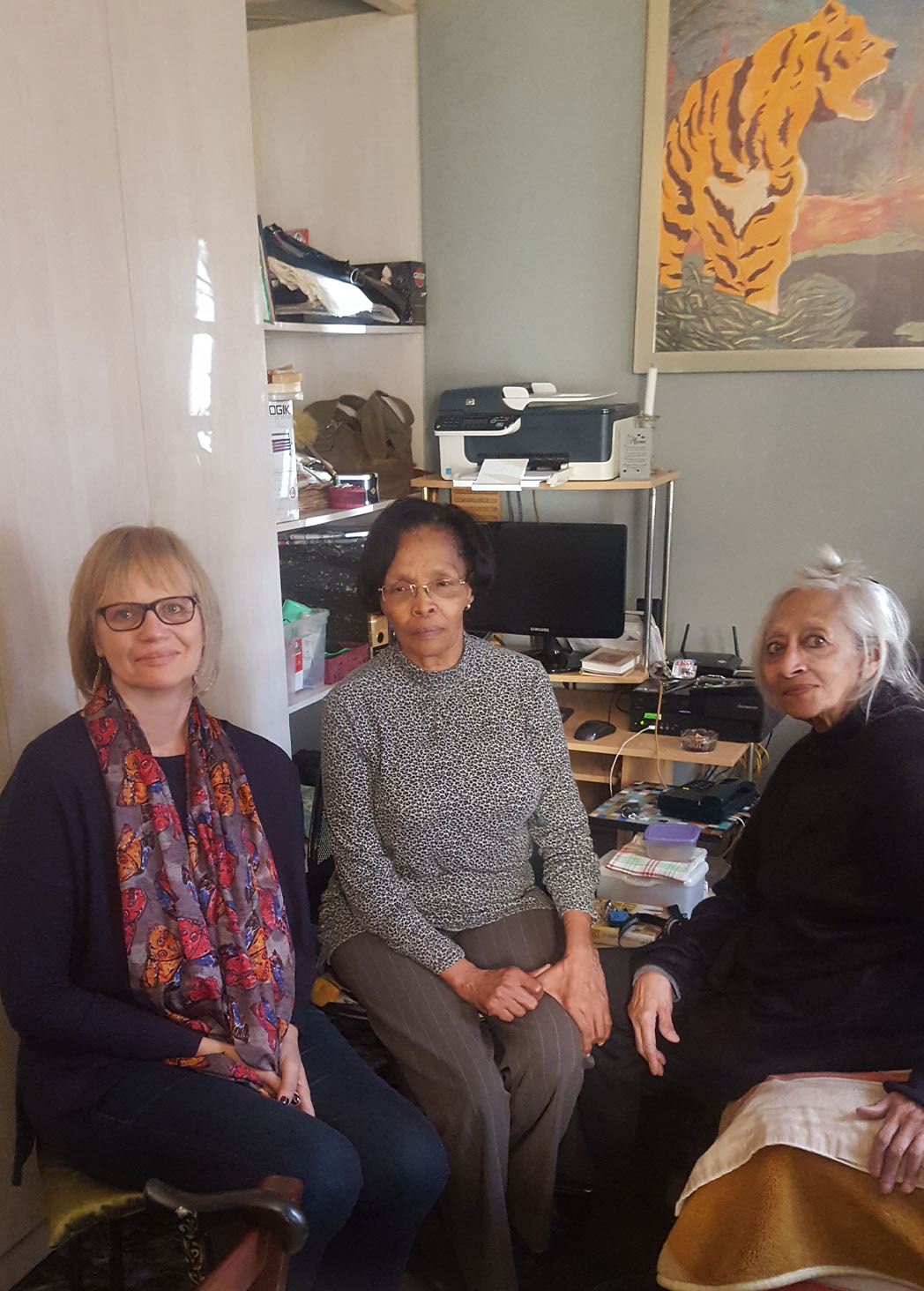 Interview conducted with Juby Mayet and Cecilie Palmer in Lenasia, 2016 – May you rest in peace and power my friends.
Links:
Black Wednesday, the day the Apartheid government banned 18 Black Consciousness Movement organisations and three newspapers (featuring Juby Mayet)
Interview with Cecilie Palmer in the Constitution Hill Women’s Jail
 This work is licensed under a
 Gaele Sobott