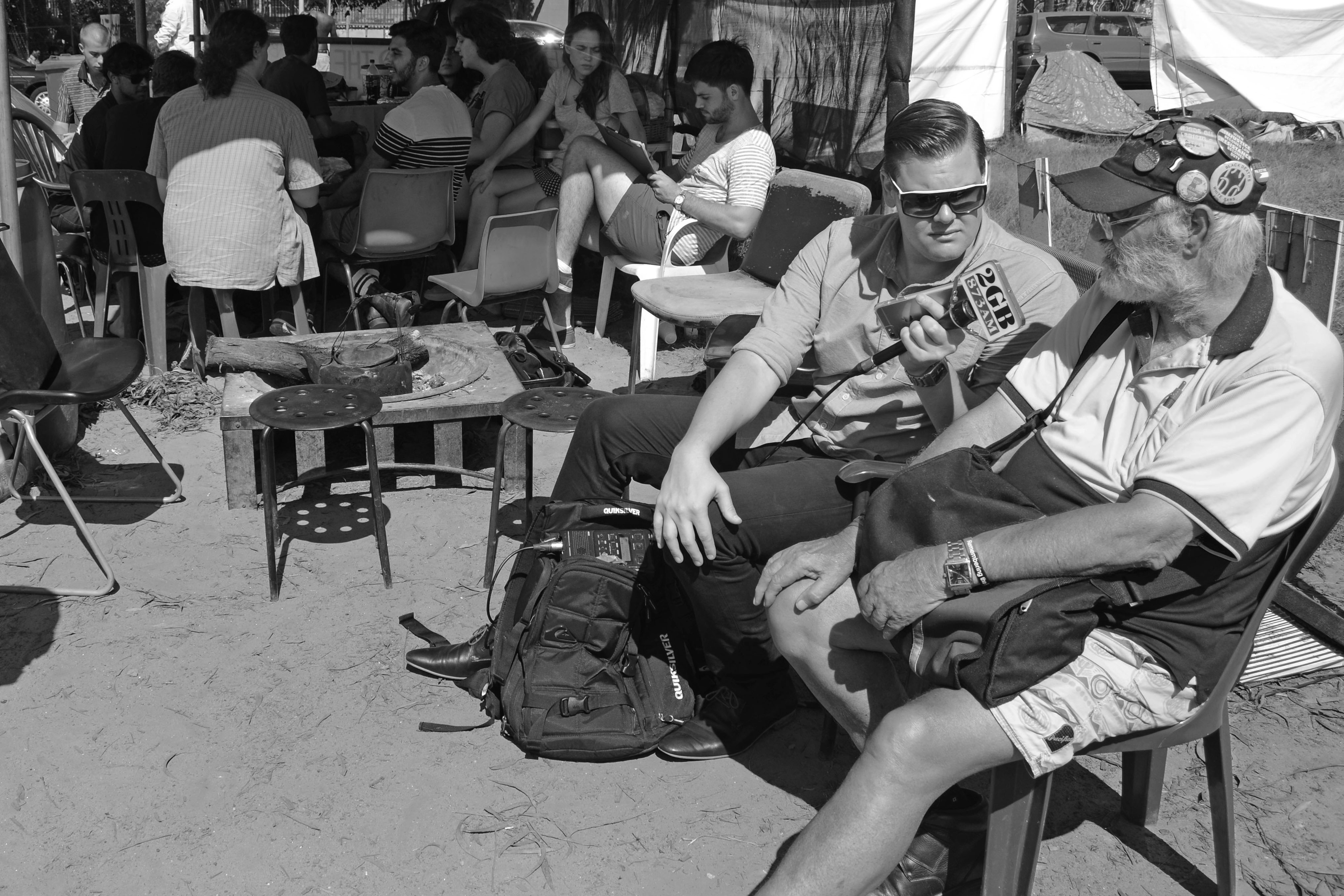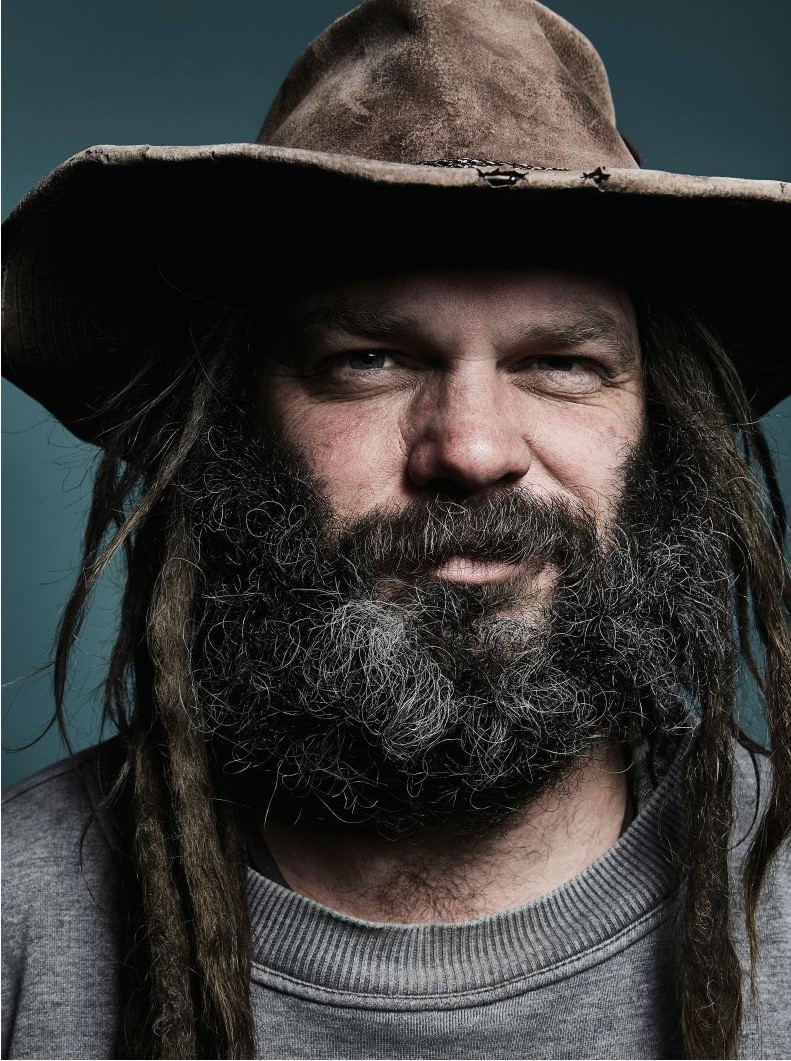
Head shot of Scotty Foster. He has a beard and dreadlocks and is wearing a wide-brimmed, leather hat

An Interview with Scotty Foster

Now is the time, with climate disaster upon us, to stop concentrating on fighting the boss and make the changes we want to see.

Scotty Foster is a solar powered, radio broadcasting, organic growing, co-operative creating, earth and people-protecting worker from Canberra, Australia. He currently earns a meagre living doing on and off-grid solar and general electrical work. Scotty is creating a co-operative commonwealth, through community groups, and on Community Radio 2XXFM98.3 with the ‘Behind the Lines’ show.

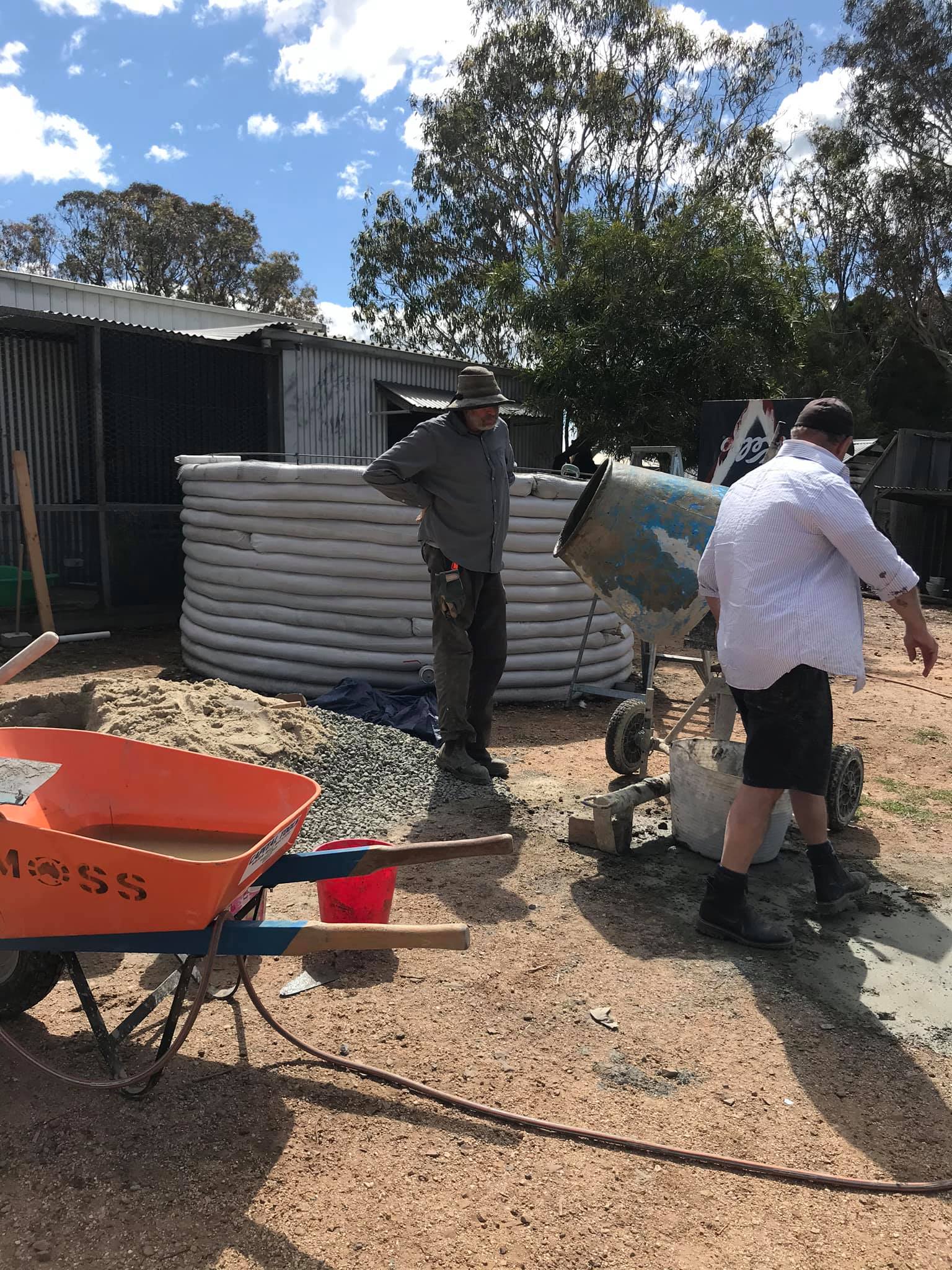
This interview is the fourth of four interviews with volunteers involved in the building of an earthbag water tank at Lucky Stars Sanctuary, Bywong. Vanuatu Earthbag Building assisted in this project. They have provided free plans, support and the materials required to build water tanks for people in need in fire zones in NSW Australia, cyclone zones in Vanuatu and Pacifica.

Gaele Sobott: How did you hear about this earthbag tank building project?

Scotty Foster: I heard through my dad. Someone told the Rural Fire Service that the project was happening. He’s with them, so he passed it on to me in case I was interested.

GS: Does the Rural Fire Service support this type of project?

SF: Yeah, I reckon they would love it. The more places that have tanks next to them specifically for fire protection, the easier their job is.

GS: Was the lack of water a problem in the last fires?

SF: It’s always been a problem around here, yeah.

GS: Why did you decide to get involved?

SF: Well, I can see that it is a simple construction technique that anybody can do. It’s not costly, and all you need is to raise some of your community to come and give a bit of a hand. It’s a very useful method of construction to know about.  We’ve got a block out in the bush but we don’t want to be out there in fire season. Given the right conditions, it will go up in flames just like the last fires. We used to go there but now it’s too dangerous. In the previous ten years, fire danger conditions and the ferocity of fires have increased. We now have the new classification of ‘catastrophic’ fire danger. This earthbag technique would be perfect for building a fire shelter that meets the increased fire danger.  

GS: How? Tell me more.

SF: The massive, thick walls would hold a lot of heat before transferring it through to the centre of the building. We need that mass in the walls and the sturdiness of the structure. It’s very strong and fireproof.
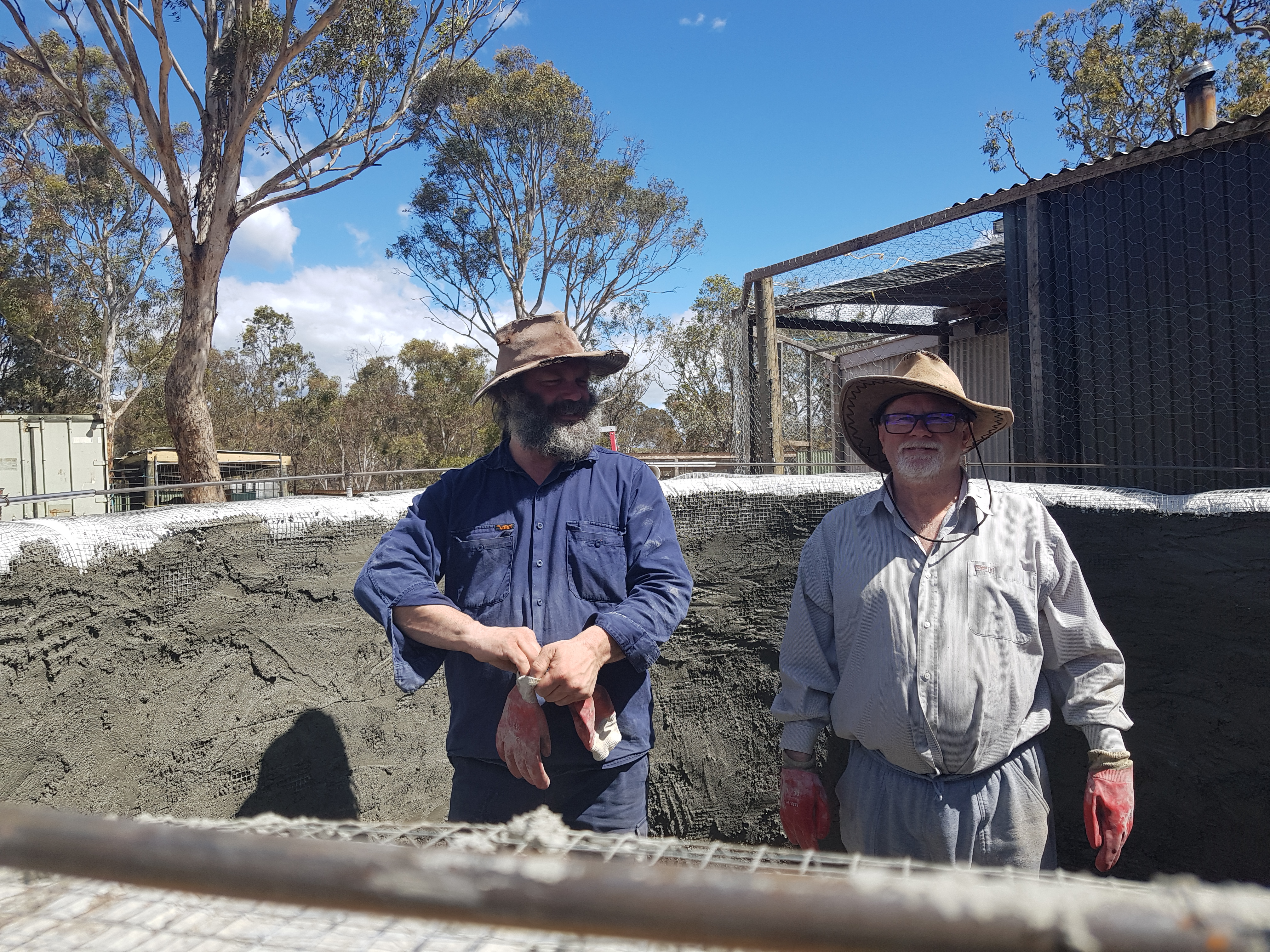
Working on the tank at Lucky Stars Sanctuary

GS: Do you see other applications for this method of building?

SF: Yeah, it is now almost a year since the last fires began in NSW and there are still a lot of people down the south coast living in tents and caravans. Perhaps this method of building would be useful down there as well and help people to help themselves. If you look back 150 years, communities had building societies, where a bunch of people would get together and pool their resources. They’d then build one house after another after another until everybody had a home. It was a cheap and efficient way for the community to come together, and building codes weren’t such an issue back then.

GS: Are there currently barriers, laws, etc., that make it difficult for communities to go ahead and build as you are suggesting?

SF: Yes, there are many. The Extinction Rebellion mob have come up with a concept called a  ‘dilemma action’ where a group of people take some form of action like blocking a road, or in this case building unapproved houses. If the government acts against the group, it will end up looking heavy-handed and idiotic.  If they leave the group alone, then it sets a precedent. Building sturdy houses at this time for people who have been forced by fire and lack of government action to live in tents and caravans, is a great moment for that sort of action.  I can’t see anything wrong with people getting together and just building their own good-quality houses. The need is huge. If you do it well enough, you can always come back with an engineer who says, ‘Yeah, that’s alright’.

GS: Some politicians are saying as far as climate emergency goes, we just have to adapt. What does adaption mean to you?

SF: Well if we keep putting carbon into the air, there is no adaption. We can’t cope with a climate that is three degrees hotter, let alone six degrees. I don’t know why they are doing this. There is no logic to it. They either deny that climate disasters are happening or they’re like Scott Morrison, who is part of a brand of Christianity which believes in the ‘rapture’, where the world ends and god takes all the true believers to heaven, leaving all the unbelievers to an eternity of hellfire. Of course their church is the only true one. There’s a possibility they believe that it’s time to end the world. Who knows what the motivations of these people are, but they do need to be stopped.

GS: What do you think the alternatives are?

SF: Adaption is one part of survival. Climate change is happening in a significant way, and we are locked into that. They talk about geoengineering. Most of those schemes are extremely risky and pretty crazy but there is one form of geoengineering that would be a really sound way forward. That is to convert the world’s agriculture into organic techniques that take the carbon out of the atmosphere and store it in the soil. We could take all of the world’s agriculture and use it to take carbon out of the atmosphere and to put that carbon back in the soil where it came from. That would go a long way. But we also need to stop damaging our habitat as a way of life.

GS: For this local area and the south coast, what do you think the immediate ways forward are?

SF: We need to change our building techniques for one thing. The way we keep building these crazy English houses here in Australia, particularly with the climate getting way out of control with fire season, bloody pyro cumulus nimbus clouds and firestorms. The earthbag design used to build this water tank protects against fire. Bring it on. Build houses, animal shelters, bunkers. You could build a house by bulldozing up four dam walls in a square, and put a roof on it, if you wanted to. Site it properly of course. 

GS: What work do you do? What are you working on at the moment?

SF: I’m an electrician. I have been an organic farmer for many years. I’ve been a blockader and an activist. At the moment I’m building co-operatives to try and create a new economy that will make this crazy one, that is eating the earth and eating people, obsolete. Build an economy that is good for people and good for the planet.

GS: I had the impression that various regulatory hurdles and laws constrained co-operatives in Australia. Is that the case?

SF: It used to be that the co-operative laws were different in every state, which made it quite difficult to trade across state boundaries. That’s been fixed now.  The Co-operatives National Law has reduced red tape and simplified financial reporting for smaller co-operatives. I mean you can use any form of governance as long as the registrar lets you do it.

GS: How are your co-ops going?

SF: So far, so good. We’re still in the set-up stage of the community-run farming co-op. We’ve got a renewable energy co-op which has put in one set of solar panels already. It’s called the Pre Power One Renewable Energy Co-operative. It’s designed to enable people who have a roof with a lot of sun shining on it but no money, access to solar energy. It also allows people in the area who would like to take their money out of fossil fuels and put it into something that is reasonably ethical, to do so.

GS: How does the investment bring a return?

SF: So the way it works is that when you become a member of the co-operative, you get the right to do one of two things or both. If you have a roof that you would like the co-op to install solar equipment on, then you can put up your hand and ask for that. We will come around and make sure your house is suitable, for example,  check that there is not a great big blue gum on the north side or something basic like that. If it’s good to go, then we will get a couple of quotes. Then we open up an investment opportunity for the other members who can choose to invest. We get the equipment installed for that member. That gets paid back to the investor when people pay their bills. A portion of that bill will go straight to the investor, and another portion will go to the co-op. The investor will double their money over about twenty years which is a lot better than super.  It’s different from perpetual investment which is what most companies offer where if you invest once, you get the right to profits from that company forever. In our case, we prearrange precisely how much we will pay you back. We pay that amount, and the deal is done. You can invest again if you like. The beauty is that all the equipment winds up under the ownership of the people who are using it. That is a major problem in our society. Almost all the productive assets are owned by people who are either extremely rich or completely imaginary, i.e. a corporation. The purpose of corporate ownership is to extract as much wealth out of the community as possible.

First Pre Power installation – Dunlop, ACT

GS: How do you maintain the solar units?

SF: There are two ways. You can either put a surcharge, a couple of cents on each payment. As hundreds of people are paying regular bills, we will have a pool of money that we can dip into. Or we can just raise another investment opportunity when the time arises that we need to buy something.

GS: How do you manage the co-operative?

SF: Management is critical. Currently in our society, management is almost always a very top-down, hierarchical, do-as-I-say model. We reckon that it is one of the leading causes of a lot of problems, certainly a lot of mental health problems. If we’re spending a large part of our time at a workplace where we have no control over our work situation, it’s going to affect us. We go through school under that model, and we leave school and face that model again in the workplace. Our families are that model because our parents were taught that model, and their parents too. So how do we do it differently? Luckily, people have been thinking about this for quite a while. We didn’t have to come up with an answer by ourselves. The intentional communities movement uses the sociocracy method of governance and decision making.

This is a system whereby the people who are involved in the community make the rules.  The organisational units in the group are “circles” of people who have a defined way of meeting. A lot of the political and power problems that arise in groups these days are from a lack of structure in decision making. There is a lack of knowledge about how the organisation works. So, what happens is the members of the group have to make it up as they go along. Of course, the people who are very forceful and perhaps manipulative tend to rise to the top of that sort of organisation. Sociocracy and holacracy, which I’ll talk about later, are both flatter forms of organisation than the usual hierarchical forms of decision making we find in our society. Meetings are very structured and use a form of decision making called consent which is quite different from consensus. Consensus is where you all need to agree on something before it can go ahead. It can take a lot of negotiation. It is easily stalled by someone who is bent on getting their own way and doesn’t care about anybody else. It’s good for certain things. If people want to form the purpose of their organisation. Then it might be important to use consensus, so everybody is on the same page. Consent is slightly different. A proposal is put forward, and members ask themselves if it is good enough for now and if it is safe enough to try. It is an iterative process. If there are no objections, then the proposal can go ahead. If there is some doubt, the group can say, well let’s try it and come back to assess in a week or six months or a year.

GS: Are there cases where the iterative process should be applied regularly, anyway?

SF: Many of the newer organisational models that have come out of the tech revolution use iteration frequently. Lean methodology is an example of that type of management, but I’m not really up on that. I believe they use iteration a lot.

GS: I imagine it allows for more experimentation, but also it would assist with transparency and accountability.

SF: Absolutely. Our current organisational models do not make transparency and accountability a priority. Transparency and accountability are crucial to creating more humanised ways of organising where people are comfortable and in control.

GS: You said you are also starting up a community-owned farming co-operative. What management model are you applying to that group?

SF: We will be using holacracy which evolved from sociocracy. Sociocracy is an effective form of self-management in situations where there is a community of people living together, like housing co-operatives and other intentional communities. Holacracy is more structured and business-focused. It uses documentation and software, so it’s clear to everybody what the organisation is about. A new member can join the organisation, look up the website and know exactly what the group is about. 

GS: Did you establish the purpose of the co-operatives before starting? 

SF: We’ve tried both ways now. I came into the Pre power co-op as a bit of a ring-in. It was after the business people involved couldn’t get the concept of a co-op not being for-profit and needing to be controlled by the community. They graciously dipped their lids and bowed out, but then they needed to find someone else to be on the board, who was more aligned with the ideas we are now putting into practice. So, I wound up taking the position. We did have a few things to sort out like a purpose that really fits the bill. There are four of us involved and a couple of other people who come in and out, so it’s taking some time. There’s a lot of work to do in setting up a business.

GS: How do you protect yourselves from burn out?

SF: We make sure that if it is too much to do, we do it next week. We don’t pressure each other with timelines or anything but burn out is a real issue. Part of the model is to ensure that the structure will be easily replicable, so it will be easy for other co-ops to join in. A co-op is a business, and running a business is a pain in the arse and running a business as a volunteer after work is just ridiculous. It’s draining, especially if you’re working long hours. So the model we are working with envisages lots of local co-ops. Pre Power One is the first local co-op we’ve set up, and twenty per cent of the revenue from this co-op will go straight up to what we call Pre Power Central. That is a co-op that is owned by all of the local co-ops. Its sole job is to make life easy for the local co-ops. The central co-op will employ people with that twenty per cent of the revenue, whose job it is to assist with running a local co-op. They will be mentoring. There will be templates for co-op policies, insurance, arrangements with installers, basically all of the hard stuff.  It makes it easier for a local co-op to set itself up. All that is left for the local co-ops to do is to hold a certain amount of board meetings per year, run the AGM and figure out what to do with the profits they make.

GS: Are the local co-ops volunteer-run? Are they able to pay themselves? 

SF: The locals are basically volunteer run. We use twenty percent of a local co-op’s revenue to pay the central co-op to do most of the work. If a local decides that it needs to pay someone to do something the central coop is not doing, they can do that by agreement amongst the members. The effect would be that the extra wages bill would come out of the discounts received by the members of that particular local co-op.

GS: Earlier you asked, how we organise in a different way when all we know in our families, schools, businesses, government is top-down decision making with little transparency and less and less accountability. How do you think we can start organising differently?

SF: Well, sociocracy and holacracy is one aspect, but it is a huge task to change the existing systems and culture. Sociocracy has been successfully used in family situations before, but we are also going to have to start implementing these processes through education by opening up schools. How we fund those is going to be interesting. 

GS: How do you see that happening on the ground say in this area?

SF: I see it as a later stage. The first stage we open co-ops like the renewable energy and the farming co-ops, where the people involved pay their bills. People already pay bills. We are encouraging them to stop paying bills to outside entities that make a profit from them. We want them to start paying bills to an organisation that is owned by them and controlled by them. A form of organisation where they get to decide how to spend any profit in a way which will benefit the community.

We are using a  participatory budgeting scheme to distribute our profits. That’s where you have a pool of profits made by the organisation, and the members get to vote and decide how that money is spent. We will have a set of criteria for applicants to pass, and members can vote according to how much they want to give to who.  For example, some of those profits could go to building and staffing a school, and some to say, elder care. These are services that are not suited to privatisation or to purely profit-making concerns.
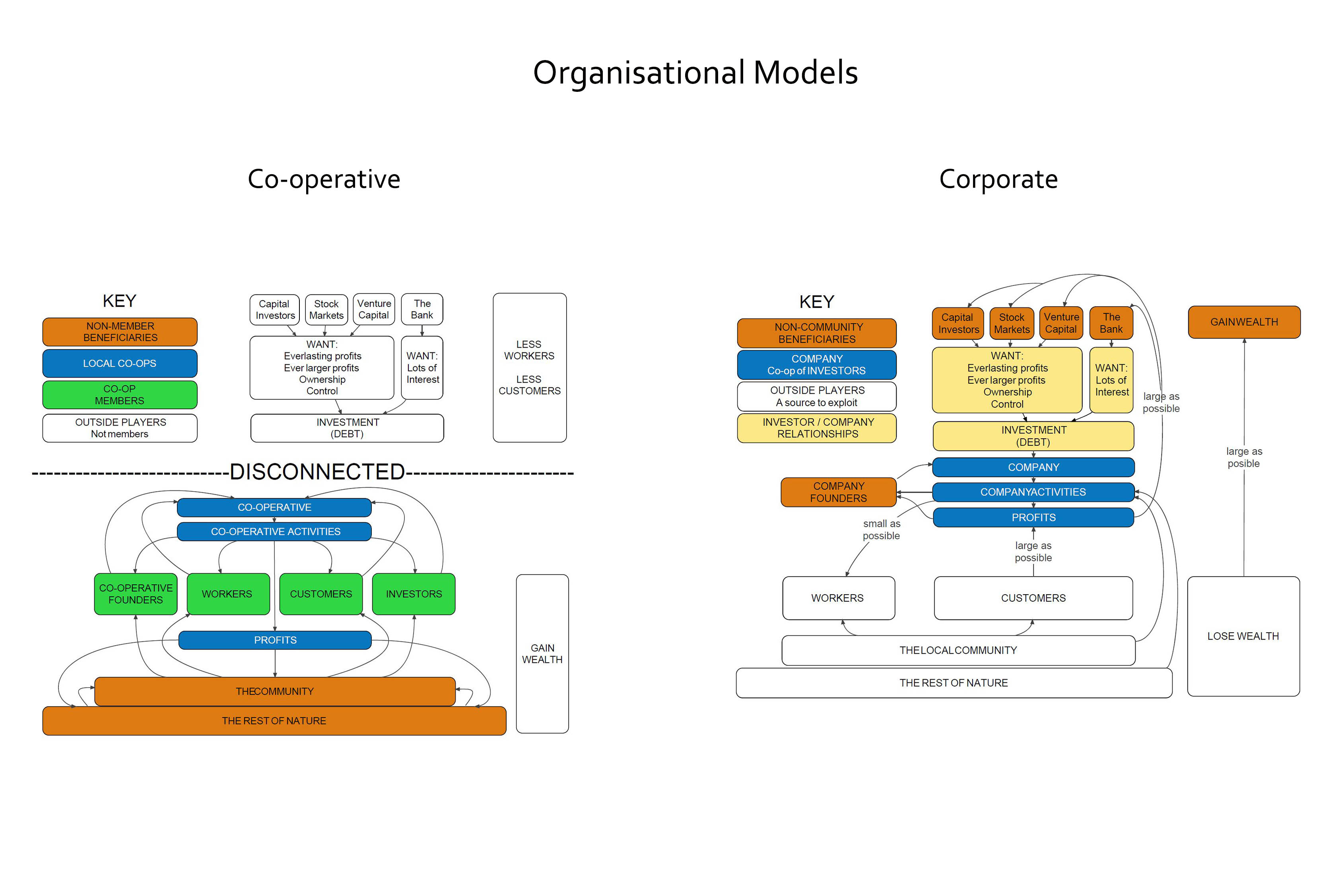
Comparative diagrams showing climate co-operative and corporate organisational models

GS: If as a community, you are taking on the responsibility of care and education of your members, does that mean you assume that the responsibility for these services does not lie at a state or national level, or do you envisage starting locally in order to make changes at state or federal government level?

SF: I guess the structure of responsibility that we want to build here is called subsidiarity. It means that decisions are made at the smallest possible level, so if your school can make a decision, that’s great, that’s where it should be made. Suppose there is a circle for cleaning within the sociocratic or holacratic structure of the school, and a decision needs to be made about cleaning. In that case, the cleaning circle should make the decision. If there is a kitchen circle, that is who should make decisions about the food. If you have a complaint about the food, go and see the kitchen circle. From there, you work outwards in a federal manner. You make formal arrangements with other entities that are doing the same thing, so with other schools. Anything that needs doing at a broader level like negotiating with the government or raising funds for particular projects can be done by all those schools agreeing to work together. This method or organising has been successful in northern Syria with democratic confederalism in the Kurdish areas. They spent seven years running a system that was working in exactly that way.

GS: I imagine it takes a fair bit of time to build the structures and culture required to run a system like that effectively.

SF: Major changes like this can really only happen where there is a power vacuum. For example, when Assad deployed all his troops to the south of the country to fight the Arab Spring. The Kurds, who have been fighting Turkey, Iraq, Iran and Syria, were well-armed and ready to build alternatives. They’ve been preparing for this for a very long time. Abdullah Öcalan has been around for a long time. He was one of the founders of the Kurdistan Workers’ Party (PKK) in 1978. The party was not aligned with Russia when it started, and it didn’t take the official communist line as gospel. Because of this they were shunned by the communist world. They evolved towards democratic confederalism. In their guerrilla camps, they’d have a yarn around the campfire analysing how oppression arose historically and decided the first instance of oppression is probably the oppression of women by men. Gender equality is central to their organisational principles. The Kurds are known for their women’s army, which is also democratically run.

Sovereignty is held at the neighbourhood level. That is the ability to make and enforce rules. Within each neighbourhood, sub-communities are represented. The neighbourhood meetings work on a majority vote basis.

GS: How do you see this type of system dealing with exploitation?

SF: Okay, for example, there’s also a women’s council for each neighbourhood. So when decisions are to be made, the information goes out to a group of women in each sub-community. So, there are parallel structures at work in their social contracts.

GS: And wage exploitation?

SF: Well, the Kurdish example covers a very poor area. Historically, under Assad, it was mainly primary production, a lot of crops but no processing of the crops. It was all exported—the extraction of fossil fuels and that sort of thing. Everything gets taken out and shipped away. They have set up a whole system of co-operatives now to do that work. The local communities are federated. Say you’ve got a town with ten communities in it, they band together to organise water and electricity and all of that through co-ops they create in common.

GS: How do they meet their social needs?

SF: Through neighbourhood meetings, I suppose.

GS: Are you saying there is no need for wages?

SF: Oh, I see. I’m not sure. I haven’t managed to get a source about how the economic system works yet. But they have achieved an enormous amount, very inspiring, much longer-lasting and more peaceful than what the Spanish Civil War achieved. The Kurdish example illustrates to me that the federalist model with local sovereignty is entirely possible. It is a way to create a peaceful, sustainable society out of an absolutely turbulent  situation.

GS: Here in Canberra, what do you do about the role of media which generally supports and enforces current power structures?

SF: We run a radio show, Behind the Lines on community radio 2XX and make a podcast called Align in the Sound. That is a three-way podcast between the New Economy Network of Australia (NENA), Behind the Lines and a group called Co-operatives, Commons and Communities Canberra (CoCanberra). So if there is something we want to learn, we do it in a public manner. We record it and leave it as a public record and information source that anybody can look up at any time. What a lot of people lack at this point are ideas. We don’t even know that alternative ways of organising and living exist. Who has heard of sociocracy or holacracy or what’s going on in northern Syria? Almost nobody.

GS: Tell me a bit about the organisations, CoCanberra and NENA you just mentioned.

SF: Every month CoCanberra and NENA Canberra region combine to hold a community information or study group night. For instance, we recently invited the National Health Co-op and a co-op from Sydney, called The Co-operative Life, who do aged-care and disability help. We sat the video conference TV on the couch at the food co-op, everyone else sat around it, and they talked about their models, with Q&A afterwards. One is a worker co-op, and the other is a consumer co-op. We were able to explore how they work and why, and what problems they face. We also do asset-based community development training. The idea here is that the community is an asset. The strengths and passions of the community need to be uncovered and used to build solutions to whatever problems that community is experiencing. When we discover or come up with new ideas, we run a workshop.

The New Economy Network of Australia is an Australia-wide networking organisation of people who are essentially trying to build a new economy. CoCanberra is about starting up co-ops and getting things implemented on the ground. The Pre Power and Community Owned Farming co-ops are projects that CoCanberra is deeply involved in. Radio Behind the Lines does long format interviews with anyone who is trying to make the world a better place.

Buckminster Fuller said, “You never change things by fighting the existing reality. To change something, build a new model that makes the existing model obsolete.” That’s what we are all doing.

Of course, we do have to fight the old system as well because it’s very quickly munching its way through the planet. The New Economy Network is a co-operative devoted to building a new economy. They’ve been around since 2016 when a conference was held in Sydney by the University of New South Wales law school and the Australian Earth Laws Alliance. At that point, there was no peak body in Australia, so they decided to form one. You can become a member of NENA. It’s got a really good website. They have geographic hubs, and they also have sectoral hubs like an education hub, a First Nations economics hub, housing, food, you name it. There’s a long list. You might live in a regional area, and you’ve got a passion or in-depth knowledge of renewable energy; you can hook up with people from around Australia who have similar values and skills. Behind the Lines is a community radio show that has been going for thirty-two years. I’ve been doing it for fifteen years. We work together with CoCanberra, and have recorded a lot of the New Economy Network conferences. If it’s appropriate to record the CoCanberra / NENA meetups, we will record them. We run editing training workshops over the web, building a team to polish up all that raw audio. Once we finally get them edited, We put them all up as podcasts.

GS: Do you work with unions?

SF: We’ve been trying to, but we haven’t had the numbers to form what they call a union co-op yet. There is interest in Canberra, and there’s a mob in Melbourne called the Earthworker Co-op. They bring together trade unionists, environmentalists, small business people and others in common cause. They began as a coalition of what was left of the Builders Labourers Federation after they got banned, alongside parts of the Green movement. Earthworker operates parallel to us trying to create a co-operative commonwealth on the ground. We are moving towards meeting our needs and capturing the profits rather than letting them go up to all the crazies who currently run the world.

GS: What are the main problems you see with trade unions in Australia.

SF: I think their principal problem is that they are stuck fighting the boss rather than working to make the boss obsolete. They are stuck in a perpetual fight, and that’s not good for culture, spirit or anything else. From being in the system, you become like that system no matter what principles and community support you start with. 

GS: What is the main message you would like to pass on to people?

SF: We cannot afford to muck around with slow change any more. Now is the time, with climate disaster upon us, to stop concentrating on fighting the boss and make the changes we want to see by ourselves. We cannot wait for big capital to do it or for the government to do it. We have to do it ourselves; otherwise, it’s just not going to happen. We only have a few years, so we better figure out new ways of organising ourselves to displace the system that is currently ruining the world. Care for people, care for the earth. We can create economic systems that support socially just and ecologically sustainable communities. We can do it, but we have to act now to get it done in time.

Interview conducted with Scotty Foster by Gaele Sobott at Lucky Star Sanctuary, Bywong, 11 October 2020.

Links:

Interview 1 in the series: Kerrie Carroll

Interview 2 in the series: Helen Schloss
Interview 3 in the series: Liz Sherborne

Behind the Lines

Align in the Sound

CoCanberra

New Economy Network Australia

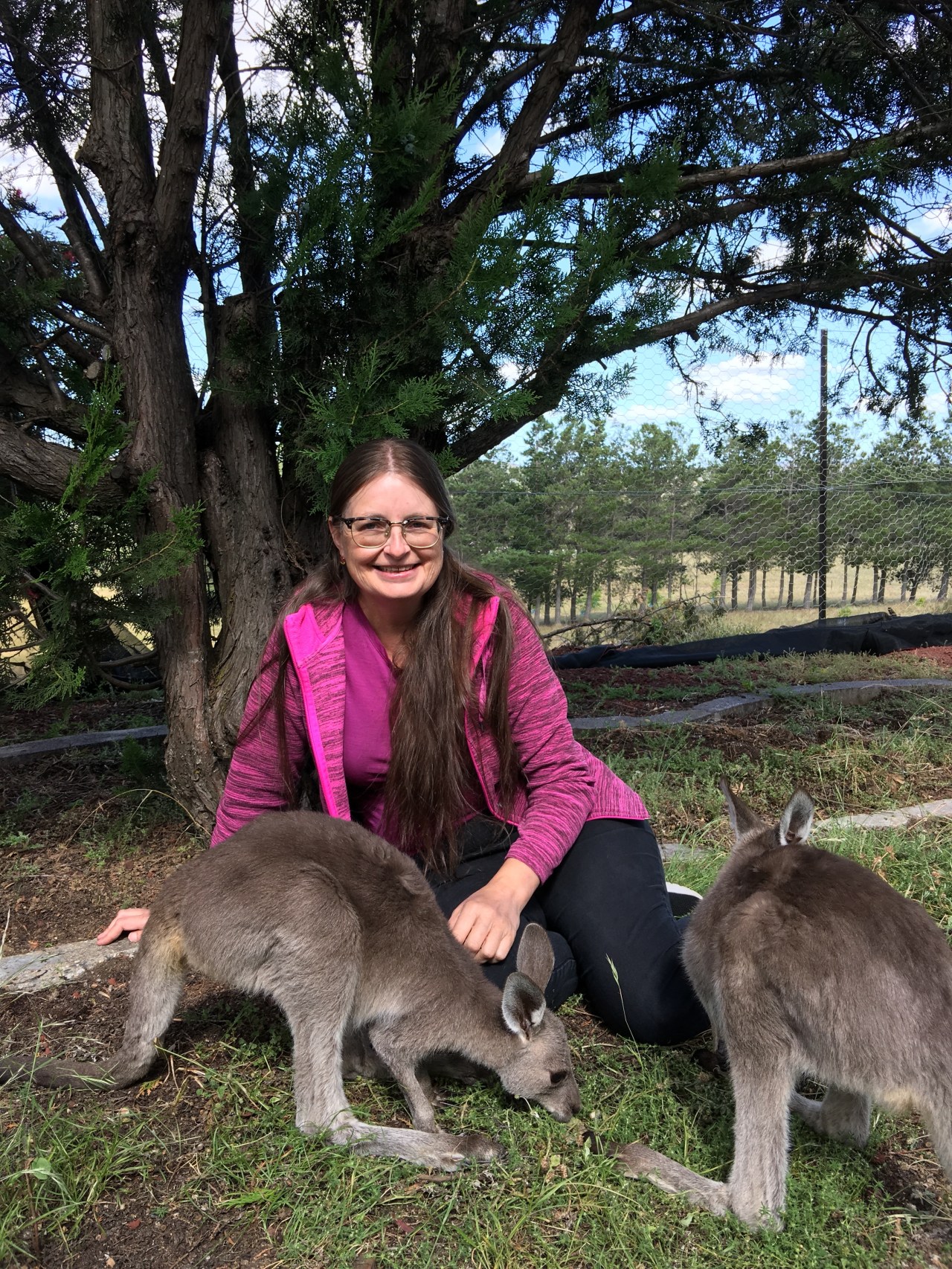
Helen Schloss sitting outside with two Eastern Grey joeys in her care. She is wearing a pink jacket and she is smiling.

An Interview with Helen Schloss

I was gobsmacked by the melted tanks I saw on telly. People lost their homes and there has been a long waiting time for them to receive assistance, especially the wait to get a roof over their heads. I was concerned by the need for water, and I thought, surely if you can build a house out of earthbags, you can make a water tank using the same methods.

Helen Schloss lives on a small property in Bywong, New South Wales, near Canberra. A primary caregiver and dedicated wildlife volunteer, Helen prides herself on her strong work ethic and animal rights principles. Some of her voluntary work includes producing ‘Tuesday Tips’ for Lucky Stars Sanctuary. Her passion drives her to help others help and protect the less fortunate.

This interview is the second of four interviews with volunteers involved in the building of an earthbag water tank at Lucky Stars Sanctuary, Bywong. Vanuatu Earthbag Building assisted in this project. They have provided free plans, support and the materials required to build water tanks for people in need in fire zones in NSW Australia, cyclone zones in Vanuatu and Pacifica.

Gaele Sobott: I believe you were the person who instigated the building of the earthbag tank. What gave you the idea, and how did you go about finding the expertise to commence this project?

Helen Schloss: I already had an understanding of the sustainability and affordability of earthbag building. I was interested in building a second home from earthbags on our property. Then we experienced the bushfires from early December 2019 and January 2020. I was gobsmacked by the melted tanks I saw on telly. People lost their homes and there has been a long waiting time for them to receive assistance, especially the wait to get a roof over their heads. I was concerned by the need for water, and I thought, surely if you can build a house out of earthbags, you can make a water tank using the same methods.  So I put a few words into Google, and one of the first things I found was the Vanuatu Earthbag Facebook page. That was early February this year. I saw a post that Liz Sherborne had written saying they had been using earthbag-building methods in Vanuatu. She noted that earthbag water tanks would be a valuable resource in fire-prone areas of Australia.  Helpful in protecting people’s properties, their lives and the lives of animals. I wrote a comment asking if they would be interested in doing a workshop down our way at some point. She instantly messaged me, and the project evolved from there. Liz said that if we could find ten people to assist with the building, they would come to Bywong. In some ways, it was serendipity.

GS: You found ten people and provided food for everybody, anything else?

HS: Yes, so I rounded up the volunteers to do the work. Initially, we were going to start building around early March, but then COVID hit, and the restrictions meant people couldn’t travel from Sydney or gather together. We had to postpone it, which meant I had to keep those volunteers interested throughout that time, sending them links and chatting with them online. 

GS: What previous organisational and networking experience do you have in gathering people together for projects like this one? Not everyone would know the importance of keeping that group of volunteers interested.

HS: I have some past experience. My family and I were in Papua New Guinea for a while, and I did fundraising events for various organisations. Maybe through the trial and error of that process, I learned that if you don’t keep your communication going, not everyone, but some people will lose interest. I’m pretty sure now, knowing this crew, if I had put them on hold and not had any contact with them, it probably wouldn’t have mattered. Most of them have got properties. Potentially they could use the earthbag building skills on their properties and help neighbours and their communities. But I believe in communication. I’m not fantastic with my friends and family. But when organising events for the animal sanctuary or for people in Papua New Guinea; the hospital there, I feel there’s a lot at stake. Last summer, it was scary because the bushfires were near Lucky Stars Sanctuary at Tallaganda forest and there were various other spot fires around the place. It was really worrying and very stressful for Kerrie and Yee, the founders of the Sanctuary. I think the contingency plan was if a bushfire reached them, they were going to stay and defend. It would be next to impossible to evacuate three hundred animals. That was one of the reasons I felt an affordable, fireproof water tank was necessary. The tank is fitted with a STORZ outlet so fire trucks can connect to it.

Some volunteers building the earthbag tank.

GS: How did you first get involved with the Sanctuary?

HS: In 2017, a year after they opened, I was looking for something to help my daughter, who has been unwell for some time now. She loves animals; in fact, she probably loves them more than most humans. I was looking around for animal sanctuaries and found Lucky Stars on the Internet. We live not too far from the Sanctuary, so I contacted Kerrie and asked her if she would mind if my daughter came over. I remember Kerrie saying, ‘You know it’s not just animals we look after, we look after humans as well.’ My daughter is thrilled working there and now Kerrie and I feel like we’ve known each other a lifetime.

GS: Many people who experienced the bushfires complain that they are still waiting for assistance that was promised by the federal government. I know finding funding for the Sanctuary has been a battle. How do you think a project like building this earthbag tank helps in this regard?

HS: It definitely helps. Earlier in the year, Liz was saying that they like to teach communities the skills involved in the building so that those people can pay it forward. Hopefully, one or two people from each tank-building project can do that. It is one way of getting through this deficit of government funding and developing ways to protect ourselves in the future, especially with sanctuaries. It’s really frustrating that animal sanctuaries don’t get government help, like drought assistance. That’s one way the tank building helps, and I think, also, it helps by promoting awareness. We now have an extra eight or ten people who are aware of Lucky Stars Sanctuary. Hopefully, not only do they know the Sanctuary is here, but they know that we need help from time to time. They also have increased awareness about animals, animal rights, and how tough it is for the animals, especially during bushfire season. Workshops like the tank building initiative serve to increase awareness through social media and word of mouth. More people might contribute to helping financially or by giving Lucky Stars a hand.

GS: Many community projects are continually battling time and funding constraints. People have little time to theorise about what they do, how they do it and where they are heading. How do you think we can solve that problem? How do we begin gathering the data needed to understand our impact and the choices we need to make in the future? 

HS: Hmmm, that’s a really good question. Time and money are always going to be an issue. There are various organisations and government departments that collect data, for example, the Australian Charities and Not-for-profit Commission and the Australian Bureau of Statistics. But whether it’s accessible to charities and communities … I don’t know. A tool that’s simple, affordable and standardised across the sector, could be the answer, like a smartphone app. The majority of people have smartphones now, although not everyone likes mobile apps, I guess they suck up valuable space on their phones. So maybe a website app that has the same functionality as smartphone apps. All the relevant data can be just a fingertip away, no painful paperwork and time saved as a result.

Lucky Stars Sanctuary could gather data such as volunteer info, animal health, fundraising, infrastructure problems or improvements, seasonal conditions. Even information, including photos of soil degradation would be useful for analysis, reporting, planning and decision making. It needs to be well designed, intuitive and easy to use, of course. All the data is there, no more hunting for it down the track. More time saved! Tick!

There’s an app called Farm Tracker, developed by the Department of Primary Industries. It helps farmers collect similar data, including geotagged photo diaries to monitor seasons and dam levels. Some of this information isn’t made public. Perhaps this could be retrofitted to suit charity or community-based work. Then you have the question, who’s going to commission and pay for it? Maybe the Australian Charities and Not-for-profit Commission is a place to start.

Interview conducted with Helen Schloss at Lucky Stars Sanctuary by Gaele Sobott, 11 October 2020.

Links:

Interview 1 in the series: Kerrie Carroll

Interview 3 in the series: Liz Sherborne

Interview 4 in the series: Scotty Foster

The Struggle Continues: An interview with Juby Mayet and Cecilie Palmer

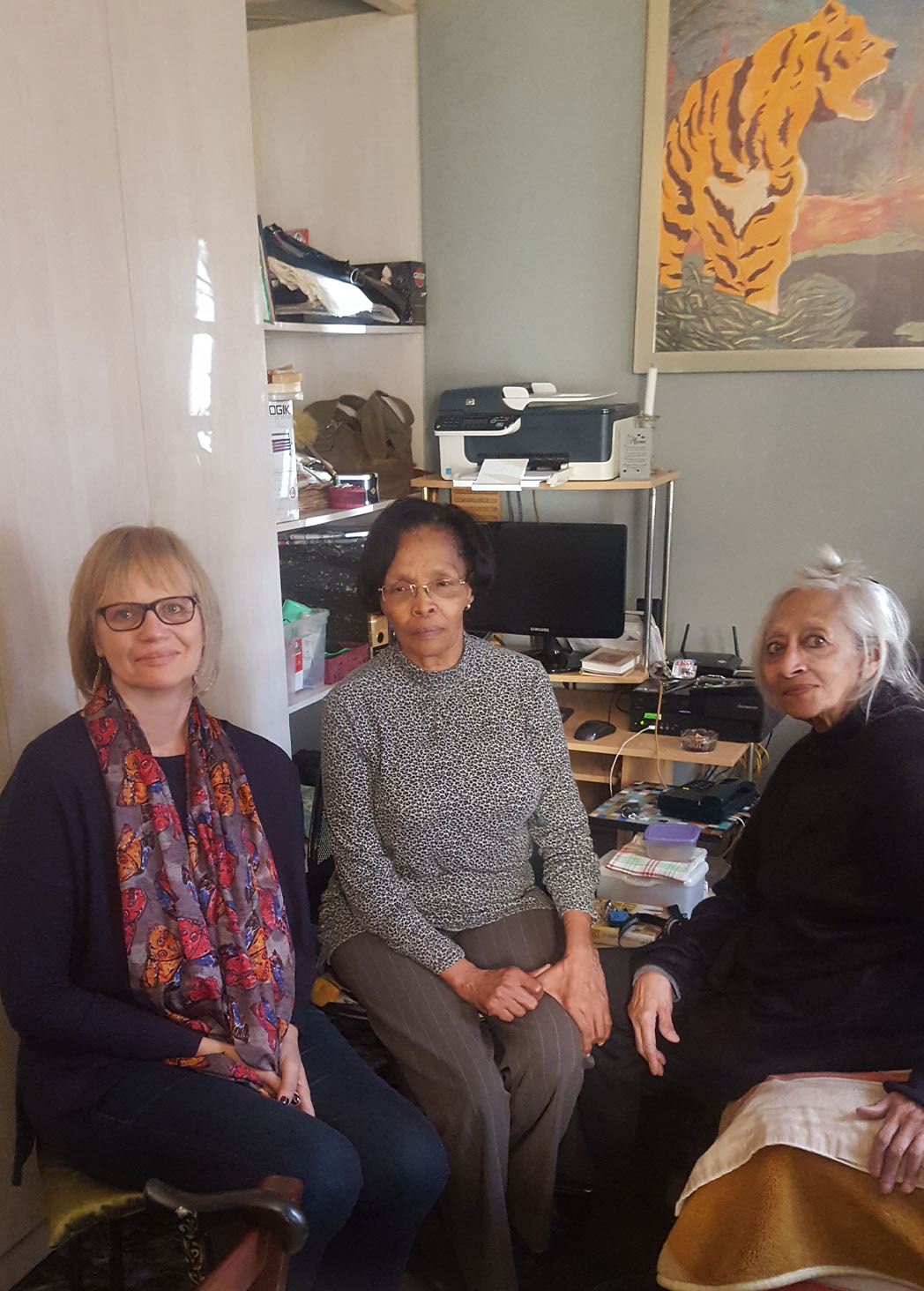
Juby Mayet and Cecilie Palmer standing in front of Constitution Hill Women's Prison

Zubeida ‘Juby’ Mayet (1937 – 2019) was a journalist who dedicated her life to fighting for a free press in South Africa, gender justice and an end to the Apartheid regime. She began writing for the Golden City Post in 1957 and worked for Drum magazine. In 1977 she joined The Voice, in Lenasia, Johannesburg, where she was appointed Deputy Chief Sub-Editor, a first for black women journalists. She was a founding member of the Union of Black Journalists (UBJ), serving as its assistant secretary-treasurer, a member of the Writer’s Association of South Africa, and contributed a great deal to the Media Workers’ Association of South Africa (MWASA). Juby also wrote for UBJ Bulletin Asizothula and The Worker. She was detained in 1979 and upon her release, served with a five-year banning order under the Internal Security Act. She and her family suffered continued police harassment and surveillance

Cecilie Palmer (1944 – 2019) was a stateswoman, active in the struggle against the South African Apartheid regime and in fighting for the emancipation of women. She served in many organisations including, the United Democratic Front, the Federation of Transvaal Women, the Legal Resource Centre and Sizoya Sibuye, a platform for raise public awareness of women’s experiences of torture and jail during the struggle and counselling ex-prisoners. Before her arrest in 1976, she was active in the National Union of South African Students on the University of the Witwatersrand campus. Cecilie was also one of the founders of  the Women’s Institute for Leadership, Development and Democracy (WILDD). She and her family experienced continued police harassment and surveillance after her release from prison.

Gaele Sobott: We have just visited the Constitution Hill Women’s Prison, where you were both detained in the 70s. You’ve described the torture of women in the prison and the mental scars that have plagued you and the other women who were detained from the time of their release onward. Cecilie, you had two children and you were pregnant when you were detained and your mother, Vesta Smith, was also detained in the same prison. Juby you relied on friends to look after your children while you were detained. You were both involved in your different ways in the struggle against Apartheid and to bring about a more just society in South Africa.

In the years leading up to 1994, I am wondering how you balanced or negotiated the need for a hierarchical leadership to overthrow the old Apartheid regime and establish a new regime with the need to broaden and deepen the education of the general population?

Cecilie Palmer: I remember the time, years ago, I think it was 1982 or 1983, when the President’s Council presented its proposals for the reform of government structures, and we were having debates about whether to go into that Council under the new constitution or not to go in. I was sitting with Professor Mohammed and Firoz Cachalia and some others in the UDF office. We were debating and we were dead against going into the Council. Firoz and them were trying to push us to change. That was the kind of consultation that went on. We debated in the branches and the decisions were taken from there up. It’s true, education, that kind of education stopped, that kind of mix of people, it stopped when the exiles arrived back here and they said, ‘This is how it’s going to be done!’

GS: When was that?

Juby Mayet: They started coming back late eighties, early nineties. Sorry I have almost lost my voice. It’s a bit difficult for me to speak. I’ll whisper.

CP: Ja, they built a different structure and they said, ‘This is how you will fight.’ So then you had this structure where the country was really being ruled by six people sitting in Luthuli House.

GS: How did they gain the power to do that?

CP: I don’t know. What ever they did, it was very cleverly done. Remember, people used to trust each other. We were all comrades in the struggle. Some of us were mixed, right.

GS: What do you mean by mixed?

CP: In the sense that I didn’t really belong to the African National Congress (ANC). I didn’t belong to the Black Consciousness Movement (BCM).

JM: Yes.

CP: I didn’t belong to anybody. I went where it was necessary to fight a battle. That was how I operated. Then they came with the UDF and at that time, I remember we were asked very specifically,  because we had a very good women’s movement at that time, the Federation of Transvaal Women. Each province had their own women and we saw ourselves as women working towards common goals. Then we were told no, we had to choose whether we Charterists or whether we were BC. I remember one ANC woman asked me that question and I stood back and said, ‘None. I like to work where I’m needed most.’ But when the ANC was unbanned, people positioned themselves where they knew or thought the power was going to be …

JM: Where they thought their bread was going to be buttered.

CP: For instance, in Eldorado Park, which is a township just on the other side of Lens.

JM: Ja, we passed it. I pointed it out to you.

GS: Yes.

CP: We worked very hard there. We had established a really strong activist community where we had an advice centre, a women’s group, we had women against the abuse of women, we had a pre-school programme. The pre-school programme was designed by one of the women in Eldorado Park who was a pre-school specialist and that programme was designed on a non-sexist, non-racist basis. It was assessed by a professor from Rhodes University who said the programme should expand right through Africa. We replicated that programme from Eldorado Park throughout the Transvaal.

GS: By we, you mean the Eldorado Park women’s group?

CP: Yes. We had a strong movement going. We also had a civic association. Our belief and my belief was that civic associations belong to the people of the community that starts those associations, irrespective of what their political affiliations are.

JM: Yes, absolutely.

CP: Then we were asked by the ANC, because they had regrouped, to spearhead the formation of the South African National Civic Association (SANCO) and that was affiliated directly to the ANC. We said, ‘No, we’re not going to do that.’ Our pre-school programme had established pre-schools in the Transvaal and those pre-schools each had parent bodies. We taught the women in those parent bodies politics, not party politics but  community activism, so they knew about political, social and economic injustice and they were figuring out ways to build alternatives in their communities. This all grew from the strong community activism in Eldorado Park, so we brought those Eldorado women and the women from the pre-school parent groups into the Federation of Transvaal Women. We didn’t realise the ANC and those leaders who decided to identify with them, were positioning themselves for future power. The ANC started choosing people for their executive committees in Eldorado Park. They were lobbying.

JM: Manipulating.

CP: Ja, so, none of the activists, the youth groups, the women’s group, none of those activists were chosen for the executive committees. Anyone who wasn’t ANC was kicked out of those groups. We were very innocent then. Not skilled in that kind of politicking.

GS: Do you think the ANC saw those people, those activists on the ground who did not want to join them, as a threat and if so why?

CP: I really don’t know why they saw them as a threat but they did.  I think they were scared of people who had experience in the struggle but were refusing to join the ANC, probably because they were a stumbling block to those who were opportunists, those people who joined the ANC to climb. Those activists were wise and they expected the organisations to be run on same lines as they had been run on before. I think that’s probably what it was. I don’t know. One needs to think very deeply about this time and what happened.

JM: It was the ANC state capture. They rode roughshod over all these people and groups, like they were the only ones who fought to liberate us. The Pan African Congress (PAC), Azanian People’s Organisation (AZAPO), all the rest, were just thrown to the wayside. I’ve never been a card carrying member of any political party. I was labelled a sickly humanist. I worked for the human rights committee which had ANC members and Liberal Party members, then after I covered the  South African Student Organisation (SASO) trial in Pretoria, Sathasivan Cooper, Sivalingam Moodley, Audrey Mokoape, I became kind of involved with, not involved but enamoured of the Black Consciousness Movement and of course when I met people like Sobukwe, he was such a lovely man, and  Joe Tlholoe who was so young when he was sent to jail for so-called PAC activities, so I never really had a particular inclination towards any political party, I just felt I had to do a typical sickly humanist’s job.

GS: As an individual do you resent being dominated in a job or within a community?

JM: Not really. If I am dominated by anybody who thinks they are better than me, yes. I think I am as good as the next person.

CP: In other words, you refuse to be bullied.

GS: There is bullying and there is sometimes the need for hierarchical leadership. Do you think it is possible for South Africa to change existing social and economic conditions without hierarchical leadership?

JM: It has got to come from the younger generation.

CP: Exactly.

JM: I don’t know if they are better educated. They go to varsity and vandalise the school structures, the very place of learning. I don’t understand that mentality.

CP: I think our education system doesn’t teach people to think. It teaches them to regurgitate stuff without thinking.

JM: I went on protest marches but I never threw a stone through anybody’s window or set fire to any buildings. We marched with our banners and we sang our freedom songs without vandalising or damaging people’s cars or property. I cannot understand that mentality, especially when they go and burn down schools.

CP: Twenty eight schools burnt just a few months ago.

GS: Why? What caused that anger?

CP: Municipal demarcation. Dividing the wards up. The local government structures are divided in to wards. It affects voting. That’s why they keep changing it. They changed the boundaries and the community didn’t want it. Like Vuwani, where the community withdrew their children from school as a form of protest. Then they burnt the schools. The schools become the targets.

JM: That is why I say it is because of a lack of education. Those parents obviously did understand that this is not the right way to protest and make change. We need those schools. We are depriving our children of education.

CP: If you look at the age group of those people, it’s the age group that went to school after 1994. They are keeping their children out of school. They are the ones who are throwing stones. The ones who were born in the mid-eighties. That’s my view. Yes, we had Bantu education, Coloured education, Indian education but I swear that was one-hundred-and-ten-times better than the education we have today.

GS: During that period of change, how do you think it could have been done differently in terms of education?

JM: It would help if we had a president who was actually literate. Our education system is terrible. They keep saying how young people must be educated to become future leaders but it has become empty rhetoric, just words, no substance.

CP: It was during his time, that education started deteriorating. With every step, the education system seems to deteriorate further with every change they make. The very last change was the curriculum assessment policy called CAPS, a system that came in 2013. Plus the mentality of the new teachers is not good. We need better teacher training.

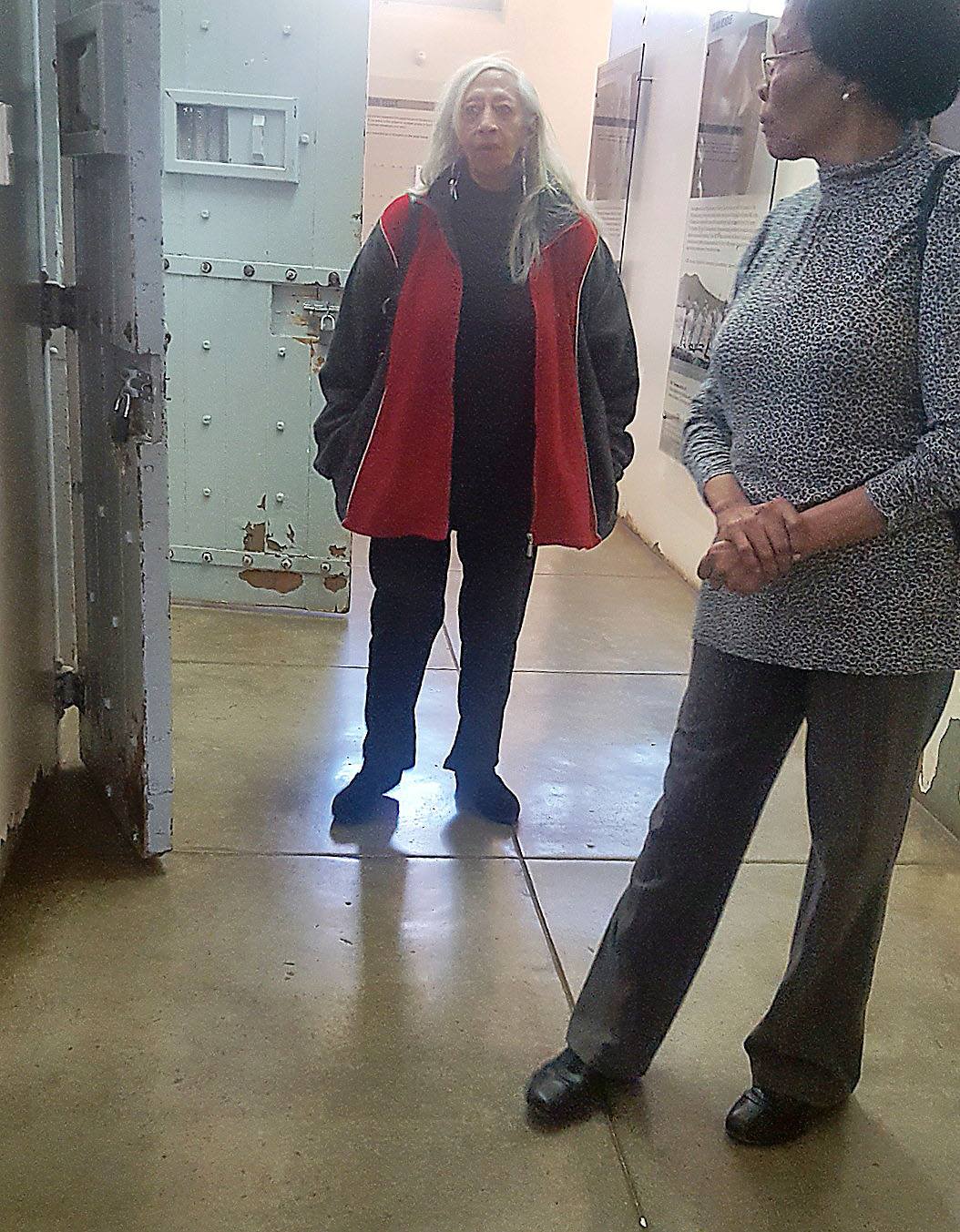
Juby Mayet and Cecilie Palmer standing in front of cells in Constitution Hill women's prison

GS: What happened to AZAPO, PAC leaders?

CP: They were just pushed out and ignored.

JM: I meet up with those guys and we talk. There was a group of students from SOWETO and they were quite surprised by the way I spoke. I make it quite clear that the ANC sucks! They irritate the hell out of me. I don’t have anything to do with them. I tell them that. I don’t vote for the ANC. Sometimes I say why don’t you guys form a coalition. Can you imagine if AZAPO and the BC people came together then the ANC would be seriously challenged, voted out in elections.

CP: They pushed out a lot of leaders, extremely well educated people, some died, like Percy Qoboza,   but none of them are anywhere in government structures. Brilliant people were pushed aside.

GS: What do you think can be done to stop the party that is about to take power in a situation like that from isolating or silencing intellectuals?

CP: They didn’t just sideline intellectuals they also preached that the older people who stayed in the country, that we were stupid and didn’t know what we were doing. Some children are extremely angry because their parents have been treated so badly.  We’ve got this inter-generational dialogue and it’s all about talking with the younger people and not at them. Some of them are extremely angry at Nelson Mandela.

GS: Why?

CP: Because he sold out. I sit there and I think, yes, it is true what you say but I cannot say that. So, I go the other way and say, ‘Look, he had to do what he did otherwise violence would have consumed the country.’  That’s true. There was Eugene Terre Blanche and Inkatha and all that but if you go further back they had been negotiating with Mandela a very long time before his release without the other prisoners being involved. They actually moved him from Robben Island and took him to Pollsmoor and Pollsmoor wasn’t private enough so they took him to Victor Verster where he was living in a house. So that is the truth of the matter and that is where a lot of the anger comes from. That is why they are saying, “We are struggling today because our parents are not living any differently than before apartheid, look at my mother living in a little pondotjie somewhere and so on. All those things are boiling. We can’t pay bills. Even when people study where are they going to get jobs.

JM: We should suggest to them that the next time they want to go on a burning spree, they should start with Luthuli House.

GS: How were the big corporations positioned during the transition from Apartheid?

JM: Big business just kept going like a steam roller.

CP: The same white bosses and even though black Joe might be the CEO, he still doesn’t really control the business. They are definitely not going to change our society for the better. I told you the story of Eldorado Park, now also in Eldorado Park we were working with UNISA against violence and that kind of thing and then they came and told us that they had been funded by the police. Imagine, funded by the police during the time of Apartheid! We said, ‘Oh oh, no thank you. Within a week, I was summoned to Luthuli House, Ralph phoned me and said, come in to see us because we want to talk to you about the UNISA program. I said, ‘No, I will not come to Luthuli House. You come to the township!’ I mean that was where the group started. He could talk to the board there were we all operated. Then they also asked us to spearhead the formation of the ANC women’s league in Eldorado Park. We said no to that too. Like I said, our belief about the women’s group was that we were all working together, no matter what party women supported. We were combining our strengths to make change happen. But from then on we were totally isolated by the ANC. We founded the Women’s Institute for Leadership, Development and Democracy (WILDD) in 1994 and we were being funded by the Swedes so what  the ANC did about the second or third year after they came into power, they ruled on bilateral funding so it then had to be government to government funding. So any foreign funding had to go through the government. That is how they destroyed a lot of the NGOs. So they were quite clever. They managed to destroy independent community organisations and thinkers. Through the WILDD, we used to help women’s groups in townships. Let’s say a group was working against gender violence, we would write a proposal that might include establishing shelters for women, things like that and that was one of the ways we increased the consciousness, the awareness and the education of women and men. We had a women’s cooperative that was a successful community enterprise. So, we would write the proposals and the women would get money. Then we would teach them to draw up progress reports and insist that they prepared and submitted regular reports to us. We needed those reports to get more funding and train more women. Very, very soon, the women began to say that the government was giving them funding because of this new government to government funding I spoke about. So the ANC was the one giving them the funding not foreign sources and the women did not need to report to us anymore. They could not be expected to bite the hand that feeds them. We as community leaders were isolated that way too. The original structures we had all built were destroyed. The government gave the groups money once, they gave twice, then they deserted the women and other civic groups.

So now we work very quietly.

GS: How do you think that kind of scenario can be prevented before it gets to that point?

CP: I don’t know. It is a very hard question to answer. But I think also what happens in people’s minds is that they saw the ANC as their liberators and they were told that they were their liberators.

JM: If the propaganda, the lie, is told often enough, people believe it.

CP: It’s like starting again right from the beginning which means starting in the house, starting in the street, in the factory, in the mines. It’s important to work within the community.

JM: I think we need a true revolution. It won’t be difficult to build up to a proper revolution because people have not settled into this so-called solution. They do not accept this life of entitlement that ANC officials and black CEOs and the like are living. The top guys are treating the country’s assets as if everything is there for the taking. That becomes the attitude. If they are doing, what is wrong with me doing it too.

CP: And the jargon is there all the time, you know, I can tell you now, let’s say I was going to a Women’s Day celebration, and the speaker gets on the stage. Before she opens her mouth, I know exactly what she is going to say. It will be the same thing that is repeated all the time, the same jargon, the propaganda repeated over and over again. Empty rhetoric. No real analysis. No encouragement of independent thinking. It’s also more difficult because before with Apartheid, the enemy was clearer. If you criticise the ANC, they say that you want to bring the white oppressor back.

JM: That’s another thing. We had Apartheid but there wasn’t the same yackety yack that there is now about racism. It’s used now for small things, almost like a diversion from the bigger picture, the economic problems, the economic system.

CP: The economic oppression is still very much there. We have a lot of black people in charge now of administration and the running of government but they treat other black people badly.

JM: You see it in the shops and the cafes and the post office. People are not there to serve. They are there to fill their pockets and stuff you Jack. I remember going to Ackermans with my late mother. She was struggling because my daddy left us and we were ten children. She somehow made friends with an Afrikaner lady working there. That woman used to assist my mother by putting extra items into the bag when she was buying school shirts or trousers for the boys. Sometimes my mother used to send me to Ackermans to buy items. I can’t remember that woman’s name now but I can see her face, a stylish woman and she would treat me in such a friendly way. She’d ask me how my mother was. Whatever I was buying, underwear or socks for the boys, she would always manage to sneak extra into the bag.

CP: Strangely, Juby, some of the Afrikaner people were very human, very genuine. An Afrikaner either liked you or hated you. It was clear cut. Where with the English you never knew. And Afrikaner children even up to today will respect an older person. They will say Tannie to me. That is how they are brought up. But if they don’t like you, they don’t like you and they make no bones about it. You knew exactly what your place was with them.

But going back to your question about what could be done differently, I don’t know but many people change. I cannot understand how they can change like that because it must be very uncomfortable.

JM: The day I landed in Number Four (Constitution Hill Prison), Debs wasn’t there at that time. Thenjiwe and Joyce and other women were. A white warden was taking me through to my cell, my new living quarters, and she was stunned when those other women prisoners broke into cheers and yelling Amandla and hey Juby what took you so long? The warden took me to my cell and she asked, ‘How do you know those women?’ I knew some of them personally, most of them knew me because I was a journalist but she couldn’t figure it out, ‘Die Coolie met dai Kaffir.’ When we were in there we had political discussions, we celebrated June 16. So then Thenji and all of them were released and I was left there with Gladys Manzi from Kwazulu and then they brought Debs from Maritzburg. She was in a bad way.

CP: Oh God.

JM: She’d been tortured. Her hair was falling out. Eventually I was released. We were all released. Some of us kept in touch. Some of us wrote to each other. Some moved on with their lives. The next time I saw one of the woman I had got close to in prison was  at some journalism awards event at one of the conference rooms at the South African Broadcasting Commission but you know, she didn’t acknowledge me. We were so close in Number Four but by then she had become ambassador or something like that. I looked directly at her and she looked directly at me. No smile. Nothing. I thought, God, what have I done? She just refused to acknowledge me. I was going  to go up to her and ask her how she was but then I thought okay I won’t. You give me a cold shoulder like that, I will ignore you. But I couldn’t believe it and I was hurt. From the person I knew in Number Four to this. She’s now up there and I am just the same old Juby.

CP: So why should she associate with you?

JM: Exactly. So, I thought, well stuff you, buddy boy!

CP: Yes, you can walk away and feel good about it. I must say, I feel free. I don’t owe anyone anything. I live on my one thousand five hundred Rand pension and I’m comfortable with it. I don’t owe anybody. I feel free but those people we are talking about have no vision. That is the sad part. They go into these positions. In 1994, nobody knew how to govern and we accept that. They employed consultants and what have you. They chased the Boer out who were in those positions. They didn’t want to learn from them. I think they should have first learnt from those people. Taken advantage of their knowledge and experience and then made them move over. They could have said, ‘Okay, we will make you consultant in this department for five years.’ They decided to chase those people out and employ consultants but up to today, they haven’t learned. About four years ago I spoke to one of the ANC women and told her what I saw happening in our communities. They don’t go to their constituents. They don’t know what’s really going on. I told her that communities are fragmenting more and more along lines of race, religion, political party and all that. We need to get these people back together. She agreed and suggested we involve other people in government and she did that. She got them in and I presented a proposal which we discussed. I emphasised that this drive to get people back together has to start by the ANC admitting their mistakes. The next thing, they were talking about fragmentation of communities and that the SACC was going to do this and that. They didn’t involve me nonetheless, I was happy it seemed to be going ahead. But it fell apart because they didn’t have the same vision. If you don’t have the vision for going forward, it is just not going to work. They stole people’s projects. A group would write a proposal to them with what they wanted. Then they would call those people in and ask for more detail. The group would give them all their ideas. Four weeks later they’d see someone from government announcing those very ideas on TV as a government initiative.

Juby, you know the saga about registering children on-line for school?

JM: Yes.

CP:  The education department has announced the idea of registering children on-line from grade one to grade eight. It’s an idea that they have stolen. Somebody presented this proposal to them around 2008. They dismissed her saying it was nonsense. Thank heaven she is taking it up with them. She’s not letting them get away with it. NGOs don’t stand a chance with the government stealing ideas like that. That lack of vision is terrible. They took over our women’s groups and now the gender violence is getting worse not better. Another peculiar thing that is happening most of our experts are whites and people who do not live in the townships. They are on TV telling us what we need.  So we are asking, why is it always about us but we are not leading. We know what is happening in the township. We know what is happening in our communities because we still live here. We don’t live in a big house in the white suburbs with high fences and security guards. But no, those experts have all the answers.

JM: The statisticians.

CP: We must sound like bitter people.

GS: You sound like people with many years of experience.

CP: When I do a tour or give talks, people sometimes ask me, ‘But don’t you hate the people who have done these things?’ No I don’t.

JM: Hatred is a waste of energy.

CP: Hatred to me is a wasted emotion, a waste of energy. I don’t hate but I also haven’t forgotten and I’m not going to forget because it did happen. Actually, I’m  not sure at this moment that I don’t hate the people who are sitting in Luthuli House. I’m not sure I don’t hate them for what they are doing to this country.

JM: My remedy is laugh it off and say stuff you lot!

CP: Like there is Kenny Motsamai who they have only just released from jail. Nearly twenty eight years in jail. Yet, they let Eugene de Kock out who tortured and murdered so many people who fought against Apartheid. There are still other PAC cadre sitting in jail.

JM: Now we have black on black Apartheid. That’s what it has come down to. Economic.

CP: They spent over a billion rand on the ANC campaign for the local government elections. Where did they get that money from?

JM: Exactly and why not use it on something more constructive? Building houses, schools, medical facilities. Prioritising the education of teachers. They did away with teacher training.

CP: They closed nursing colleges. They are trained at university with no practical experience. They come into the wards and will not take advice from the older nurses who did the proper training including the practical internships and the like. They are starting to privatise the services.

JM: Like the prisons are semi-privatised now.

CP: And the bureaucracy is getting bigger and bigger. It’s messed up. There’s no getting away from it.

JM: We need to teach that the ANC were not the only liberators of the country. Campaign to change voting patterns.

CP: I think we really need to get back to thorough and committed community activism, community responsibility and confidence. I work with the women from the inner city. They are eager to jump when the ANC Women’s League says jump, the rent a crowd kind of thing. Their responses and their problems are different to our problems in the townships. You know another thing we don’t have is an alternative media. We were lucky because we used to have the Vrye Weekblad, an Afrikaans newspaper which was really helpful, one of the best newspapers.

JM: Ja, Max du Preez.

CP:  It was run by Max du Preez. We need that kind of newspaper back. The Weekly Mail was also there. Those newspapers tried but they were never free to do what they wanted. The Post used to have ugly stories that didn’t educate anybody.

JM: Like the Sun today.

CP: Like the Daily Sun. Now that’s the only newspaper that people can afford. The Daily Sun will tell you that the rat ate the cat. Like the TV. Keep the masses uneducated and you can do whatever you want.

JM: That is why I read books. Our young people need to read more.

CP: Reading is very important. Education for our young people has to improve. Over half of our children cannot read fluently. We should be working on basic literacy and numeracy. We are condemning a huge majority of young people to unemployment and  poverty. You know, we are a depressed country at the moment. You don’t see people smiling and laughing. We used to laugh and talk and scream and sing even during the time of Apartheid. We’ve stopped. I definitely don’t think we would be  better off under Apartheid. We still need to rid ourselves of the legacy of Apartheid. We really need to sit and talk and analyse what has not worked in the struggle. The ANC has to admit its mistakes. Maybe then we will begin to smile again.

Gaele Cecilie JubyInterview conducted with Juby Mayet and Cecilie Palmer in Lenasia, 2016 – May you rest in peace and power my friends.
Links:

Black Wednesday, the day the Apartheid government banned 18 Black Consciousness Movement organisations and three newspapers (featuring Juby Mayet)

Interview with Cecilie Palmer  in the Constitution Hill Women’s Jail

People love stories: An interview with Amit Sharma

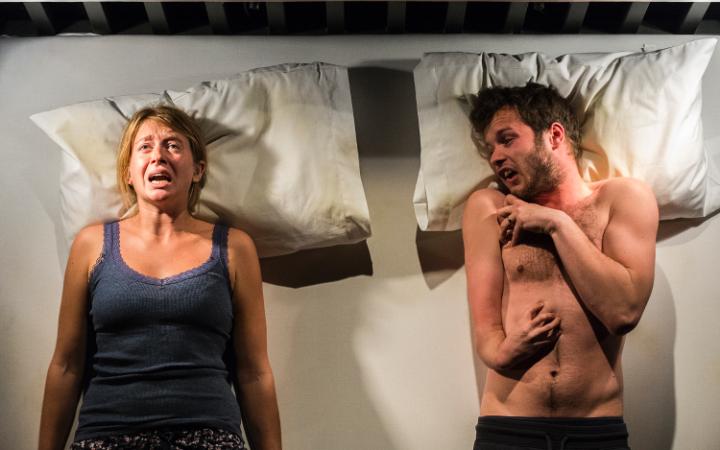
A young woman wearing a blue singlet lying on a bed with an anxious expression on her face. Next to her is a young man also lying on his back. He is only wearing black shorts.

GENEVIEVE BARR AND ARTHUR HUGHES AS ALICE AND PHIL IN THE SOLID LIFE OF SUGAR WATER BY JACK THORNE CREDIT: PATRICK BALDWIN


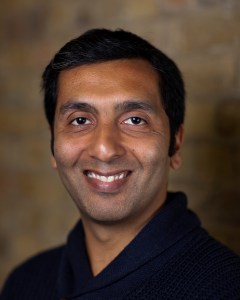
Amit Sharma 2Credit-Matt Cetti-RobertsAmit Sharma has been the Associate Director of Graeae Theatre Company, London, since 2011. He recently directed The Solid Life of Sugar Water, a Graeae Theatre Company and Theatre Royal Plymouth production, gaining unanimous acclaim at the 2015 Edinburgh Festival Fringe, leading to a 2016 UK tour including a run at the National Theatre.
Amit is a graduate from Graeae’s Missing Piece actor training course. In 2012, he co-directed the outdoor spectacle Prometheus Awakes (with La Fura dels Baus/co-commissioned by GDIF and SIRF), marking the first large-scale outdoor production to be artistically led by Deaf and disabled people in the UK. Also for Graeae, he directed Ted Hughes’ The Iron Man, which toured both nationally and internationally and co-directed Graeae’s Rhinestone Rollers in Sequins and Snowballs with Jenny Sealey at the Southbank Centre. As Assistant Director, he has worked on Graeae’s productions of The Threepenny Opera, The Changeling and on The Four Fridas for Greenwich and Docklands International Festival 2015. Amit currently leads on Write to Play, Graeae’s flagship new-writing programme in partnership with venues across the UK.


GaeleSobott: Can we start by talking about the set design in The Solid Life of Sugar Water. The bed is central, upstage, vertical with the actors standing against it. From the audience perspective it is as if they are looking down on the characters lying on the bed.

Amit Sharma: The thing about Sugar Water and the aspect that I was really interested in was the relationship between the two characters, Alice and Phil, how much they were or weren’t communicating. The style, as it was written by Jack Thorne, consists of two monologues essentially inter-dispersed with both the characters’ dialogue. Well it is much more intricate and clever than how I’ve just described it to you, but the nature of them not talking to each other and addressing the audience set up something which is immediately striking, irrespective of the subject matter. There is some form of subtext that is going on between the two characters, which is very exciting. When we did our original set design it was very abstract, very sparse actually. Then we did a reading of it and the designer said to me, ‘I think we’ve got this wrong. I think the audience needs to be placed in the bedroom. The bed is missing.’

She was absolutely right. The bed was like the third element of the relationship within the text. So then we needed to decide how to be artistic about it. We didn’t want the bed to be literal. The piece isn’t naturalistic. We jump from the past to the present and then back again. So we developed the idea of looking down into the couple’s bedroom.

GS: What is that perspective? What does it give to the play?

AS: I really wanted the audience to feel that they couldn’t get away from being privy to and a part of the couple’s life. I don’t know about you, but when I visit a friend’s house the bedroom is always the last place I look. It would be a bit weird to go and look in their bedroom. That’s because it’s private and you’d feel as if you were prying into someone’s very personal space, even if they’re not in the room. I wanted the audience to feel like they were able to be in that space.

GS: How does this position the audience? Are they voyeurs or perhaps fly on the wall?

AS: I think more fly on the wall. I think voyeurism has an element of choice about it. Maybe fly on the wall does too. I just wanted the audience to really feel the pressure cooker of the couple’s relationship and be a part of that. Not able to separate themselves from it. That’s what the play does. You fall into it and by the end you’re feeling all kinds of emotions because of the performances but also because of Jack’s writing. The writing and the set. That’s why I wanted the audience to be together in the bedroom with the couple. I wanted them to be with them in their private moments without feeling they were intruding. At the end I wanted the audience to feel they have been through so much with this couple. It’s actually about healing both for the couple and also for the audience.

GS: The audience are looking down on the bed but they are also being spoken to directly by the characters. It is not possible for the audience to position themselves as just observers. They have to participate. What are your thoughts on this?

AS: That’s the good thing about theatre. You can set up a convention and then just totally break it. So whenever the characters were on the floor, that was like the wall of their bedroom but it became less about the bedroom, it was the post office, the bridge, even though the bed was always present. As a creative team we wanted it to be subtle, so yes the bed was always in the background because there was always that big question of them trying to have sex.

GS: There are many disabled artists and directors who feel there is a need to explore sex and disability, for various reasons including societal attitudes, the infantilisation of disabled people. What is the importance of sex in disabled art? What is the relation of this play to the exploration of sex and disability?

AS: The most interesting thing coming out of Sugar Water is that question has not been asked. It has not been unpacked. What the play does is almost normalise that very question of sex and disability. It is such a huge topic for so many different reasons. Perhaps it is because of the performers, one performer is Deaf and one performer has a physical impairment, but not to the extent where it impacts on their sex lives. What I mean by that is that if, say, one of the characters was a wheelchair user who had 24 hour personal care then that dynamic shifts. I was reading an article today about the Independent Living Fund and this guy saying how it can be difficult to live independently for example to go out and chat up girls because you’ve got someone else there all the time. So you have to negotiate that relationship. This play doesn’t go there. People have picked up on the element of communication between the couple, but the sex element not so. I also think it is because of how Jack as a writer was playing with the idea of sex. There’s a lot of comedy with some really graphic descriptions.

GS: Well yes there is comedy and there are very serious moments, a fine line.

AS: Yes, Jack Thorne gets that fine line absolutely right. In rehearsals we spoke about how graphic we should get or if we should get graphic at all. If we were brave enough to show our naked bodies and those kinds of discussions. It quickly became apparent that it wasn’t about that. It would have become alienating, as opposed to the audiences going: ‘Come on, we’re theatre audiences. We’re pretty smart. We can go whichever way you want us to go. We don’t have to see nudity to get what you’re talking about.’

It felt like we could just tell the story. The most interesting thing is the intricacy of communication between the audience and the performers. The couple think they are talking to each other and they’re not really, and they do the direct address where there is a conceit between each character and the audience. There are many different levels of communication.

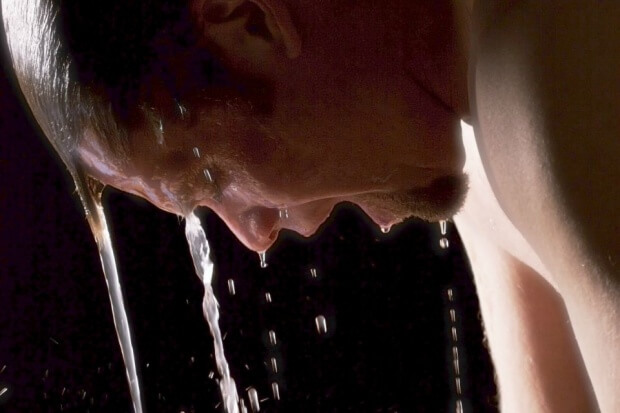
A close up of a man's head, profile looking down with streams of water flowing over his head and face.

GS: Can you talk a little about the quality of the reviews the play has received?

AS: Well I think the journey of journalism and the way this show, and other shows at the Edinburgh Fringe by Deaf and disabled artists, have been reviewed has really shifted. It’s really come a long way. The art is now being reviewed as opposed to the performers and their physical shapes and sizes and what have you. It is really refreshing to see the work being reviewed in this way.

Talking about Sugar Water the reviews spoke about the subject matter as happening to two human beings not to two disabled people. In relation to Genevieve, being a Deaf performer, the discourse was quite intelligent as opposed to talking about a Deaf person blah blah blah, it was more sophisticated in both the reviewing and the conversation around it. That hasn’t always been the case.

GS: What comments did reviewers make in relation to Genevieve being a Deaf performer and character?

AS: The discussions were linked to the idea of communication. Naturally if your partner doesn’t sign then you have to rely on lip reading and you may not catch all the communication. Phil can’t sign so he is not able to get what he feels across all the time. The scene when he’s on the bridge and he tries to sign and gets it completely wrong really resonated and got the biggest laugh every time. By that point the audience realises Alice and Phil are not communicating on a number of levels. It was about them as individuals and what they felt for each other, what they wanted and needed from each other. Phil had never had a huge number of relationships before hand. Alice had just come out of a very difficult relationship. So that makes two very vulnerable people in a position where they are wondering if the relationship can work, can they get along. Can they get married and try to have a baby. Is their relationship driven by their love and passion for each other or by their insecurities? Sometimes the best art doesn’t answer the questions it poses. It poses the questions for the audience to consider.

GS: Do you think Alice and Phil’s relationship is resolved in the end?

AS: I don’t want to say. Some people are unsure whether they continue or they don’t and I intended for that to happen. In my head they do, yeah. But I didn’t want to answer that. I spoke to Jack about it. He really wanted a happy ending and I really didn’t want a happy ending. I said, “Ok if we’re going to have a happy ending we have to hint and suggest the possibility.”

GS: I do think the play ends with them understanding and respecting each other.

AS: It’s only at the end that they actually say, ‘I love you’ to each other. Having been through the trauma of losing a baby. Jack’s a smart dude!

GS: There seems to be some relationship and similarities between The Solid Life of Sugar Water and Lungs, which also played at 2015 Edinburgh Fringe. Can you explain this?

AS: We had read the script about three or four years ago. When we got the script we were really interested. Duncan Macmillan is a great writer. We were thinking of doing a double bill but then Paines Plough went ahead with the commission so we didn’t.

GS: I found the story quite similar.

AS: Yes that’s why we had the idea that the two plays could work together.

GS: Where are you taking the play next?

AS: We’re putting a tour together. We’re going to be at the National Theatre for three weeks, which is superb. It’s the first time Graeae has been there and we’re incredibly proud. We hope the momentum builds from there.

It’s one of those plays. I remember reading it for the first time, here as a company, and the kind of silence at the end of the reading, everyone taking deep breaths. We knew it was a huge impact type of play. Audience reactions to the play have been emotional and deep. One woman stopped watching half way through. She sat there with her head down and just wouldn’t watch. There was obviously something that really connected with her. She started watching again a bit later. She was with a group of her friends and I saw her at the end. She was just in complete floods of tears. I don’t really feel bad about too many things but I did then.

GS: Why did you feel bad?

AS: I felt for her because I didn’t know her story and didn’t know what it was that she was relating to. I went over and asked her and her friends if they were alright and did as much as I could, offered her a gin and tonic. Theatre is such a powerful thing. I think people sometimes forget the impact theatre can have.

GS: Why do you think theatre powerful as opposed to other mediums of storytelling?

AS: It’s so immediate. You’re there. You can connect, relate to the work. You are immersed in the play for the length of the piece. People love stories.

GS: You can watch a series on TV and experience stories. What is it specifically about theatre?

AS: The craft of theatre is important, the putting together of the story although you can also do that with film and TV. There is something unique about theatre in showing that passage of time. I think the immediacy of you as a member of the audience and your relationship with the performers is so unique to you in an environment where there are other people as well. That is very special. You can watch television or a film in a cinema however the screen allows you to be one step removed from it. You can’t really do that with theatre. It is more interactive. It’s more immediate.

The question in theatre is – Why now? What’s important about telling the story now? With TV and film you can go back to it again and those performances won’t change but with theatre they will. You can go one night and the next night there will be subtle differences, something may have shifted – become more superficial, something may have become deeper. There’s an unknown quality. There’s that thing also where if something ‘goes wrong’ the performers just have to pick up the baton and carry on and audiences love those moments when it doesn’t all go to plan. Film and TV are created where it all goes to plan so with theatre there’s a different type of freedom and an improvisational quality.

It’s about creating the story. The performers grab the audience very quickly, in a vital and stark way, asking them to empathise with them.

GS: Did the actors contribute to Jack Thorne’s script during rehearsal. Were changes made for any reason?

AS: Well the actors didn’t really suggest changes but we did shift the script around them. We didn’t have any idea who we wanted to work with so in the beginning in Jack’s script the character, Alice, wasn’t Deaf. When we cast Genevieve as the actor for that part, Jenny Sealey, the Artistic Director of Graeae, and I had a conversation and we gave notes to Jack saying there are elements relating to Genevieve that should have some representation in the script. But in contrast, the Post Office scene about Phil not being very strong wasn’t adapted for him because of Arthur’s arm or anything. That was the original script.

GS: I didn’t take that scene as being about his arm.

AS: Well some people do you see. They think that was where his impairment was being referenced because he had this big box that he couldn’t quite carry. That was always there. But Phil signing on the bridge wasn’t there before we cast the actors. Jack did a couple of rewrites based on Jenny’s and my notes.

The stuff that happens behind the scenes may change according to the actor you cast. At the beginning we had created a soundscape and every now and then there’d be a heartbeat noise as a cue for the actors to shift position. There was also a sound cue for the actors to know the audience was seated and we’d got clearance from front of house. It was a dog bark. Genevieve has hearing aids so she could feel the vibrations of the heartbeats, the shift and the change, because there was a speaker close to her. What became slightly tricky was her trying to listen to the dog barking because of the frequency and because there were so many people in the room all making noise. So we discussed a better way of cueing and her feeling comfortable within the cueing system.

Also because there is so much direct address, I said, ‘You have permission to look at Arthur whenever you want. We’re not asking you to play hearing.’ But Genevieve got around that by learning Arthur’s script as well and picked up on his rhythms, picked up on how he delivered the text. That was her process. She wanted the same access and freedom as him and decided on her own cues. That didn’t mean Arthur had to do it exactly the same way each time. So there was that kind of negotiation going on during rehearsal.

GS: How do you cast at Graeae? How did you cast the actors for this play?

AS: For this play I got a casting director in. We work with some amazing performers and some amazing actors. I just felt this time round it would be really healthy for the Company to audition new people and add to our expanding pool of performers.

GS: Do you specifically cast disabled actors?

AS: For this play I decided the casting breakdown. Irrespective of impairment this is what I’m looking for. Just by the nature of the play we needed people who would be good at delivering text. I don’t mean in the classical sense, I mean it’s such a wordy play. There is a demand that Jack’s writing presents itself. That doesn’t mean being quick or slow or whatever. That’s what Graeae does – we say this is the play and this is what we are looking for. Let’s see who we can get through the door.

GS: I believe Graeae practises some form of affirmative action in casting performers and actors who identify as Deaf and disabled. How does this work?

AS: Yeah in our plays we’ve got at least fifty percent actors who identify as Deaf or disabled. For the two-hander I thought we had to have two performers who identify. We couldn’t have one. It just didn’t feel right. It was such a small company. But when we did the Threepenny Opera there were something like twenty performers so ten were disabled and ten were non-disabled. As it transpired, we got to the end of rehearsals and three of the people who previously didn’t identify said, Oh yeah, I’m deaf in this ear or I’ve got this impairment. So the Deaf and disabled were staring to outnumber the non-disabled. It was interesting. One of the reasons is that if people declare their impairment jobs shut down.

GS: But not here at Graeae?

AS: Yeah exactly, absolutely not at Graeae. For Sugar Water we were conscious we wanted new blood and we found it. The other thing is that we will use some of the people who auditioned but didn’t get involved in Sugar Water for other projects. So we did pull in a new pool of actors. We are good at that.

GS: What’s the next project?

AS: At the moment we’ve got the Write to Play initiative, nurturing new writing talent. We’re also developing a new adaptation of The Hunchback of Notre Dame for production in 2017. There is also a verbatim play around the Incapacity Benefit, the Employment and Support Allowance, that’s under commission.

GS: Whose voices are represented? Those who apply for or receive the benefit, or those in the bureaucracy who assess people, hand out the benefit.

AS: A bit of both but mostly people on the receiving end of decisions. We’ve got a doctor. We’ve got a legal aid person, a variety. We’re doing a taster session at the moment in aerial training building up to a project with war veterans in 2018 – an outdoor piece I think. It’s linked into the recent 1914-1918 reflections on the First World War. There’s a big artistic element to it all. We are very fortunate to be working in this profession on great projects with wonderful people. It’s a really odd time because for a lot of Deaf and disabled people at the moment they don’t know whether they’re coming or going.

GS: Are you referring to government austerity measures?

AS: Yeah but the profile of Graeae is really accelerating. The Company is being recognised for the work that we’re doing. We’ve got Ensemble starting next week. It’s an eight-month, work-based, professional-development programme for six young artists. They’re nineteen to twenty-five year olds and we’re training them as theatre makers. Jodi Alissa Bickerton is our Creative Learning Director. She’s running that programme. It’s in response to barriers faced by many Deaf and disabled artists, as well as a lack of diversity within the current theatre climate.

GS: How do you choose the participants?

AS: We get the information out there. There’s an application process. We audition, then we interview them and go from there.It’s difficult at the moment because the austerity drive is seriously impacting disabled people on a number of levels, work, living, health.

GS: Do you think disabled artists have a responsibility to reflect this in their art?

AS: I think disabled artists have a responsibility to their art. It’s a tricky one. I think it’s about choice. Some artists are deciding to reflect in their work what’s happening socially, economically in our society. Other artists feel that the art itself, no matter what it’s about, will create the shift, create the change. It’s a difficult choice but I don’t begrudge anyone for whatever the choice is that they make. I really resist the idea of hierarchical disability. Disability includes such a wide range of circumstances. It can mean so many different things to people. The wider the experience and the subject matter of our art, the better it is for changing perspectives. Graeae does a lot of advocacy work but it can be really relentless. The cuts are creating a lot of insecurity.

GS: How important do you feel disability-led writing and directing is to changing public perceptions around disability?

AS: I think everything needs to be driven by the story that the writer or the director is trying to convey. Sometimes that feeling of importance can be restricting and uncreative. Audiences are smart, open and intelligent. If you take them on a journey then they’ll go with it. If everything about a play or a show becomes agenda driven then it can fail in changing those perceptions. The story is the thing.

Further Information:

Interview with Genevieve Barr & Arthur Hughes

Information on Graeae and the tour of The Solid Life of Sugar Water  or

The interview was conducted by Gaele Sobott on 28th September 2015 at Graeae Theatre Company in London

Creative Commons License
People Love Stories – an Interview with Amit Sharma by Gaele Sobott is licensed under a Creative Commons Attribution-NoDerivatives 4.0 International License.

THE COURAGE TO COME FORWARD – An Interview with Colin Hambrook

Black and White headshot of Colin Hambrook, a middle-aged, white man wearing glassesColin Hambrook was educated at Dartington College of Arts in South West England. Knitting Time, his exhibition of paintings, drawings and poetry about the experience of psychosis is on show at The Hub, East London until 15 November. The work was previously shown at Pallant House, Chichester and the Impact Arts Fair 2013. Colin’s first collection of poetry, 100 Houses was published by DaDaSouth in 2011, followed by Knitting Time (Waterloo Press ISBN 978-1-906742-65-2). He is the founding editor of Disability Arts Online

The interview was conducted by Gaele Sobott on 28th September 2015 at the Barbican Centre in London just before Colin attended the Creative Future Literary Awards at the Free Word Centre in Holborn.

Drawing by Colin Hambrook. Blue sky with clouds above green hills, a large ball of yellow wool sits just below the hills. Brown knitting needles are stuck in the ball of wool. A thick yellow line runs down the left side of the picture like a river, and green and yellow squiggly lines run parallel to this yellow band. To the right of the picture there is another thick band of yellow intersected by thin meandering green curves that creates what looks like an aerial view of plots of land or small farms. There a two faces, one squashed between the ball of wool and the yellow band on the left and one just below the ball of wool. In the bottom right-hand corner there is a woman wearing a green beret type hat and green coat. She is holding a sheep.

Call of the Ancient by Colin Hambrook

Gaele Sobott: In Australia the visual arts and now dance appear to be surging ahead in terms of developing platforms and exposure for disabled artists. Literature is quite a way behind. In the UK disabled writers and literature seem to be better placed. What are the Creative Future Literature Awards and how is Disability Arts Online involved?
Colin Hambrook: Creative Future is a Brighton-based organisation looking to promote careers of ‘marginalised’ writers and artists. Amongst those they support with their annual Literary Award are a certain number of disabled writers. Disability Arts Online is a partner. We have signed up to help them promote the program, get information out, reach people. In terms of literature in the UK, Survivors’ literature has led the way.
GS: Please explain what Survivors’ Literature is.
CH: The key organisation is called Survivors’ Poetry, founded in 1990 by four poets with direct experience of the mental health system in the UK. In a really short space of time it mushroomed into a huge phenomenon. It was a UK network of groups that all became affiliated, some of them became registered charities or not-for-profit companies in their own right and I would say between ’94 to ‘96 it exploded and was reported on in the media and really picked up on. It was important that the people who ran the organisation and wrote for Survivors’ poetry come from a mental health background. They had experienced mental distress, been through or had an intimate knowledge of the mental health system.
GS: What kind of work were they producing?
CH: In the 90s there was a kind of performance poetry format, going into day centres, resource centres, organisations working with people who had come through the mental health system, and producing workshops and giving people the opportunity to perform. So typically the first half of an event would be open mic encouraging people to get up and perform their writing and the second half would be more experienced performance poets. The organisation still exists with a core force of people in London but it has become less prominent elsewhere in the UK over the last ten years.
GS: Why do you think that has happened?
CH: Survivors’ Poetry’s strength was in its Community Arts ethos, but it has become harder to find funding for grassroots work. It’s hard to keep integrity, supporting individual artists creativity at a grassroots level whilst maintaining support for ‘professional’ artists. Survivors’ Poetry turned to producing a literary output, which has been fairly successful. As part of the Unlimited showcase at London’s Southbank Centre last year, Disability Arts Online and Survivors’ Poetry celebrated the achievement of the organisation with a reading by some of the Survivors’ founding poets in the Saison Poetry Library in the Royal Festival Hall. The library contains twenty-seven titles under the Survivors’ Press imprint.
GS: Has Disability Arts Online managed to keep its integrity?
CH: Disability Arts Online in the last ten or twelve years has kind of managed. It’s a bit like a dance, you want to keep your core constituency on board and to nurture that talent, but also you’ve got to watch out, keep an eye on the priorities linked to where financial support can be found to ensure funders’ demands are satisfied.
For instance we have a modest contract with Unlimited to report on all of the artists and all of the projects that come out of Unlimited. It’s a fantastic opportunity to spread the word about this important initiative. Much of Unlimited’s aims and values concur with those of Disability Arts Online, working to support the development of art by disabled artists within the UK cultural sector. Disability Art Online’s brief is to interview the artists, review the shows, comment on the work as it progresses, and where possible, to commission copy for other online magazines and press in order to facilitate the reach of Unlimited to new audiences. Unlimited had a fairly substantial presence at the Edinburgh Fringe Festival this year, with several pieces of work in the British Council Edinburgh Showcase. Unlimited is spearheaded by two organisations: Shape and ArtsAdmin and they’ve received support from the British Council in facilitating the artists taking their work outside the UK. In many ways it is a bright, shiny success story.
We have to work hard to ensure our integrity isn’t compromised, which means creating projects that support and create opportunities for our core constituency and looking to remain disabled-led as much as possible, whilst also working with the high-profile initiatives. Without the support of Unlimited many of the artists we work with would never have got the profile they’ve achieved. For example Jess Thom was unknown as a performer before her company Touretteshero received an Unlimited research and development commission for Backstage in Biscuitland. After a year or so of touring she has been commissioned by Channel 4 with a version of the show made for television, Broadcast in Biscuitland.
GS: So does your core constituency consist of disabled artists at grassroots level?
CH: Yes, disabled artists, writers, who are what the Arts Council term as emerging artists. They are people who create because they’ve got to create, not because they’re making a living out of being artists, necessarily.
GS: Is it possible some of these artists could find themselves forever classified as emerging because of the nature of the market and the value system used to categorise their art?
CH: Yes but that’s just the label that the Arts Council puts on it. People are creative because they need to be creative and creativity isn’t a commodity. We have this schism in our society that divides creativity up into commodity and art. It’s nonsense really.
GS: You mentioned that much of the art by disabled performers at this year’s Edinburgh Fringe Festival focused on the body. Can you please talk more about that?
CH: Yes that’s not necessarily a bad thing. Culturally it’s very different from disability arts of possibly ten, certainly fifteen years ago where the focus on impairment was frowned on.
GS: Was that in defence of the Social Model of Disability?
CH: Defending the Social Model but also it was much more then about community and about people raging against the machine, standing up against discrimination, being a collective force. What’s happened is that as the focus for disability arts has moved away and broken up into impairment-focused issues, which I think are important . . .
GS: Why do you think these issues are important?
CH: Because the key problem with what I would call the first wave of disability arts from the mid 80s to the end of the 90s was that it was very much inward-looking and there was a very powerful community of disabled people who were very clear in their aims and making strong art for and by disabled people. Indeed we got the DDA (Disability Discrimination Act 1995). Not the DDA we wanted but we got the DDA. What happened then was that the very clear, concise stand against discrimination got diluted and the Social Model as a source of inspiration and power for people to find a voice kind of hit a brick wall because impairment within the Social Model wasn’t really addressed in a very strong way. So all the slogans like, Nothing About us Without us, the focus on things being disability-led, kind of fell apart when certain disabled leaders, say for example a wheelchair user, didn’t understand all the politics around Deaf issues or blind issues. Having disabled leaders is important but having that broad understanding of access and the issues faced by people with different impairments is more important.
GS: Isn’t it possible to have disabled leaders with a more complex understanding of disability, Deaf experiences, impairment?
CH: Yes that is the ideal, yes.
GS: Why hasn’t that developed or has it?
CH: There’s a choice that happens in either developing the politics or developing the arts. They can go hand in hand and work with each other and they can also work against each other. The emphasis from the funders has been that if you want the money you have got to develop the aesthetic, you’ve got to develop the art. The politics have been sacrificed to a large extent. A big part of that politics is the importance and value of work being disability-led, because at the end of the day, it’s the experience of being disabled by society that motivates us.
GS: With this huge austerity drive and all these cuts do you think there is more of a need now to develop disability political leadership and action?
CH: Yes there is more of a need now than ever. Absolutely.
GS: How do you see that developing given what you have just said?
CH: It needs people with courage to come forward and start demonstrating on the streets again.
GS: Do you see the march to Downing Street on Saturday protesting the changes being made to Access to Work as an example of this?
CH: I’m really angry that the government are cutting Access to Work. In this case the government said they will cap what any one BSL interpreter can earn at $40 000 a year. But who the hell in the arts is earning forty grand a year? Very few I would say. So the demonstrators were protesting the cuts in Access to Work with this cap on how much an individual can earn. There are thousands of disabled people dying because of cuts. The government is playing a game of divide and rule. On the one hand they are saying they want to get all disabled people into work, but on the other they’re denying means to make working an option. There needs to be a clearer focus in standing up to these issues.
GS: So are you saying that political leadership and analysis are lacking?
CH: Yes
GS: When you say there is a need for people with courage to come forward, the courage to do what?
CH: What the hell do we do in this political climate? I got very involved in supporting the 10 000 Cuts and Counting protest. At the end of 2013 we were working with Michael Meacher MP and the Dean of St Paul’s Cathedral. We met Michael Meacher in his office in Downing Street. He had a mass of files of printouts, of emails and letters of people who had written to him of their plight, their family’s plight, what was happening as a result of austerity, what was happening as a result of cuts in disability benefits. The main focus was that over ten thousand people had died within six weeks of being declared fit for work because their benefits had been cut and they’d been left with no money. Those individuals didn’t necessarily pass away because of the cut in their benefits, but equally, many did. Can you imagine the indignity of being on your deathbed and getting an official letter from the Department of Work and Pensions telling you that you are fit for work? And this has happened to many thousands of individuals and their families. There has been a very dangerous shift in attitude that as an individual living in this society you have to prove that you are financially contributing to it for your existence to be valid. We’ve gone back to the Victorian age within a few short years with the ruling class and their bastard politics. They’ve got every evil connivance of screwing the tax payer and they’ve got the media sewn up so they can infest everyone’s brains that it’s disabled people who have brought austerity upon us, that have brought down the economy. It’s evil!
GS: So do you think it is the responsibility of disabled artists to identify as part of the community and bring the politics into their art in some way?
CH: I personally think it is but then who am I to demand that of an individual? I encourage individuals to get involved in Disability Arts Online who have that ethos. I would say though that generally this time around people are finding it much harder to stand up for their rights.
GS: Why do you think that is?
CH: Well I would include myself in this criticism and say after the DDA was established, the disability movement never really went out of its way to include younger people. So we’ve still got the same old codgers now trying to make a stand like they did twenty or thirty years ago. People are older and frailer.
GS: The older people may no longer have the physical strength but they have knowledge. Do you think younger people are separated from that history, that knowledge of what has gone before them? Are they expected to reinvent the wheel?
CH: Yes and the tendency of Neoliberalism is to encourage people into their own little camps, individualism, losing sight of the larger collective.
GS: Do we need to theorise how to change that and if so how?
CH: It has to happen. I think going back to what we were saying earlier there is a value and an importance in the work that has become the key focus for disability arts – the relaying of stories about the body, stories of people’s experiences of individual impairment, of discrimination.
GS: How does art play a role in changing public perceptions?
CH: Art has a key role to play. You might not call an ITV soap opera, art, but in terms of popular culture, it’s much more wide-reaching than most art.  And so for example, Liam Bairstow who trained with Mind the Gap has recently got a lead role in ITV’s Coronation Street. I think that a young actor with learning difficulties being seen on TV is definitely going to change attitudes, make a lot of people think and those changes are really important.
GS: It seems you are saying that change needs to take place on many levels.
CH: That’s where disability arts is at now I think, certainly within the performing arts, and within the visual arts. In the visual arts there is possibly a bit more politics.
GS: Going back to individual courage – someone may have the courage needed to come forward but if others don’t join with that person it could be very demoralising. What is your experience in this regard?
CH: Well yes, for me, we went to all that effort with 10 000 Cuts and Counting and none of the media turned up and it was all forgotten very quickly. No one took any notice. Nobody seems to care that many thousands of disabled people died because of cuts. Nobody thinks that could be me, or that could be a member of my family.
GS: You said the media didn’t pick up on the story. Disability Arts Online plays an important role in providing an alternative media source.
CH: Yes we do provide an alternative media and we keep plugging away.
GS: You started Disability Arts Online in 2002, and in 2004 you set it up as a not-for-profit company limited by guarantee. So it’s been running for over eleven years. How do you fund the organisation?
CH: We’re constantly working on funding applications for projects. We have a broad vision for how we operate in terms of raising debate about disability arts practice and supporting the work of individuals and organisations across art forms.
We’ve recently received funding from Arts Council’s Grants for the Arts scheme for Viewfinder over the next eighteen months. Viewfinder will see us working in partnership with Wikimedia UK, Sick! Festival, SPILL Festival, Carousel, the New Wolsey Theatre and Goldsmiths Disability Research Centre. It’s very exciting. Wikimedia UK are keen for us to populate Wikipedia with pages dedicated to disabled artists and a history of the movement. The Disability Research Centre at Goldsmiths University is supporting us in running a series of workshops.
We’re producing a video platform and commissioning disabled artists/filmmakers to curate a selection of disability work from the archives of Sick! Festival in Brighton, SPILL Festival in Ipswich/London and Carousel’s Oska Bright Festival. We will produce videos commenting on the importance of the selection in advancing the practice of disabled artists. So, for example Matthew Hellett, who is a learning disabled filmmaker on the Oska Bright committee will be making a film about what makes for good representation; how the committee judge the best films for Oska Bright. We’ve also got another year of core funding from the Esmée Fairbairn Foundation, which is renowned for funding organisations with a community remit.
GS: Have you come up with ideas for sustaining Disability Arts Online on a more long-term, financial basis? Have you tried financing the group by any means other than government funding or philanthropy?
CH: We’ve tried a few experiments. We recently worked with Stopgap Dance Company. They produced the Independent Fringe platform in Edinburgh. Disability Arts Online produced a crowd-funding platform for one of the younger artists, Rowan James. That was successful. We raised £1500 towards getting him to the Edinburgh Fringe Festival. We want to do more of that.
GS: You have described how outside funding can determine the path you take. So if you want to be independent of those demands and priorities in terms of changing the political situation how do you achieve financial independence and sustainability?
CH: Well yes sometimes you feel that the odds are stacked against you. It is a constant struggle. We need time and energy and imagination to come up with strategies. We have a shared knowledge and experience that can be incredibly useful to many industries, so we are also working to find ways to be more sustainable through consultancy and media partnerships.
GS: You have shared your childhood and some challenging personal experiences through your poetry in a way that must be quite confronting but hugely important in terms of supporting people within the Survivors Movement and people who may feel isolated. Would you like to comment on how art can provide a form of community solidarity and empowerment, especially in reference to your latest collection of poetry, Knitting Time?

A drawing of a small boat knitted from yellow wool, sailing on a blue sea with stylised waves against a bright blue sky

Knitting Time by Colin Hambrook

CH: I’d like to think that Knitting Time had value in giving a voice to issues around mental distress. Mostly, psychiatry condemns individuals to the judgement of a medical imperative, which locates mental health problems in the head divorced from the individual’s life experience and circumstances or indeed from any emotional impact located in the body. It treats the individual as having a separate, disconnected body and mind and introduces powerful and potentially harmful drugs to suppress experience deemed as mental health problems. Often, those experiences can be exhilarating and creative even if they can make it harder to function in the ‘real world’. Often mental health ‘issues’ are a matter of an individual having the confidence to be comfortable with who they are.
So in sharing some of my own journey I would hope to break some of the isolation people feel. There is empowerment in hearing others’ stories, others’ expression. There are poets like John Clare and William Blake whose names come up frequently in terms of writers whose core work continues to inspire empowerment within a survivors’ community. There was a poem by Ellen Link that I go back to again and again that inspires my sense of the value of connection; and connection with nature as a healing force in contradistinction to this narrow framework we are meant to fit in with when it comes to being seen as valid, mentally healthy members of society: “In the woods they blast/ your courage to tell you/ you are not a tree, that the wild wind /and the grey skies are not your cousins/ though their atoms be like yours. . .”

For further reading:

Colin Hambrook’s Art and Poetry Blog

Celebrating the Survivors’ Movement

Jess Thom’s Tourettes Hero

10 000 Cuts and Counting 1

10 000 Cuts and Counting 2

10 000 Cuts and Counting 3

Creative Commons License
The Courage to Come Forward – an Interview with Colin Hambrook by Gaele Sobott is licensed under a Creative Commons Attribution-NoDerivatives 4.0 International License.

LOVE & SUPPORT AT REDFERN ABORIGINAL TENT EMBASSY


Creative Commons Licence This work is licensed under a Creative Commons Attribution-NonCommercial-NoDerivs 3.0 Australia License.