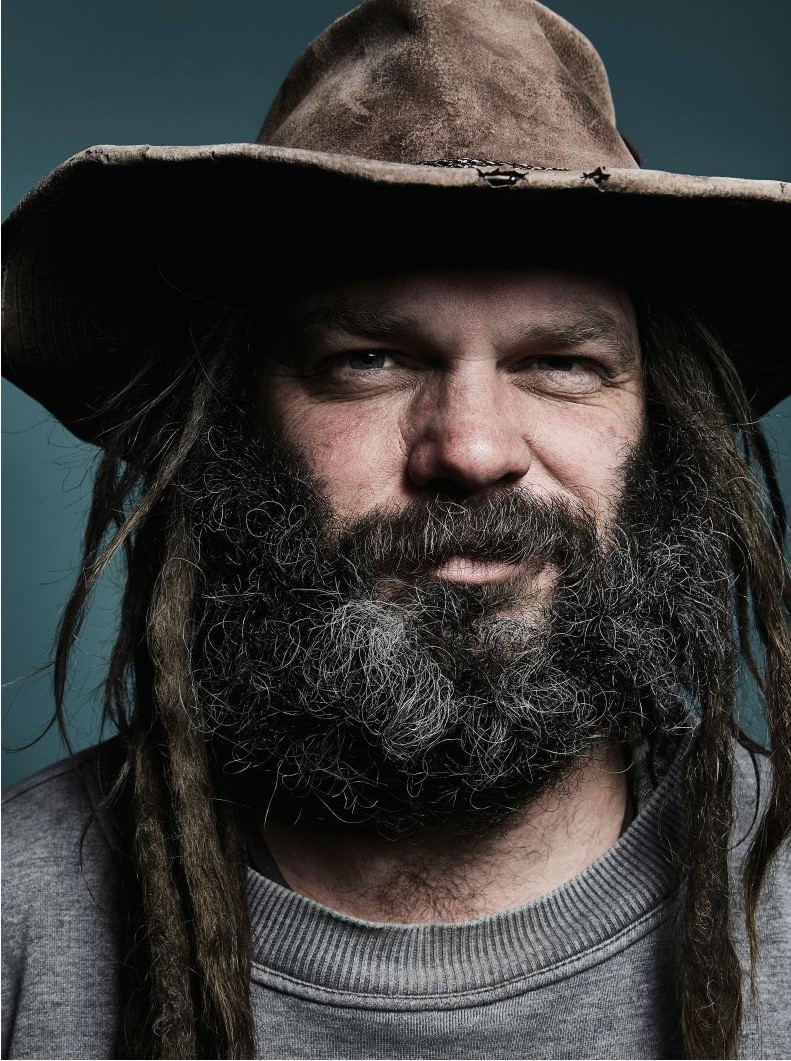
Head shot of Scotty Foster. He has a beard and dreadlocks and is wearing a wide-brimmed, leather hat

An Interview with Scotty Foster

Now is the time, with climate disaster upon us, to stop concentrating on fighting the boss and make the changes we want to see.

Scotty Foster is a solar powered, radio broadcasting, organic growing, co-operative creating, earth and people-protecting worker from Canberra, Australia. He currently earns a meagre living doing on and off-grid solar and general electrical work. Scotty is creating a co-operative commonwealth, through community groups, and on Community Radio 2XXFM98.3 with the ‘Behind the Lines’ show.

This interview is the fourth of four interviews with volunteers involved in the building of an earthbag water tank at Lucky Stars Sanctuary, Bywong. Vanuatu Earthbag Building assisted in this project. They have provided free plans, support and the materials required to build water tanks for people in need in fire zones in NSW Australia, cyclone zones in Vanuatu and Pacifica.

Gaele Sobott: How did you hear about this earthbag tank building project?

Scotty Foster: I heard through my dad. Someone told the Rural Fire Service that the project was happening. He’s with them, so he passed it on to me in case I was interested.

GS: Does the Rural Fire Service support this type of project?

SF: Yeah, I reckon they would love it. The more places that have tanks next to them specifically for fire protection, the easier their job is.

GS: Was the lack of water a problem in the last fires?

SF: It’s always been a problem around here, yeah.

GS: Why did you decide to get involved?

SF: Well, I can see that it is a simple construction technique that anybody can do. It’s not costly, and all you need is to raise some of your community to come and give a bit of a hand. It’s a very useful method of construction to know about.  We’ve got a block out in the bush but we don’t want to be out there in fire season. Given the right conditions, it will go up in flames just like the last fires. We used to go there but now it’s too dangerous. In the previous ten years, fire danger conditions and the ferocity of fires have increased. We now have the new classification of ‘catastrophic’ fire danger. This earthbag technique would be perfect for building a fire shelter that meets the increased fire danger.  

GS: How? Tell me more.

SF: The massive, thick walls would hold a lot of heat before transferring it through to the centre of the building. We need that mass in the walls and the sturdiness of the structure. It’s very strong and fireproof.
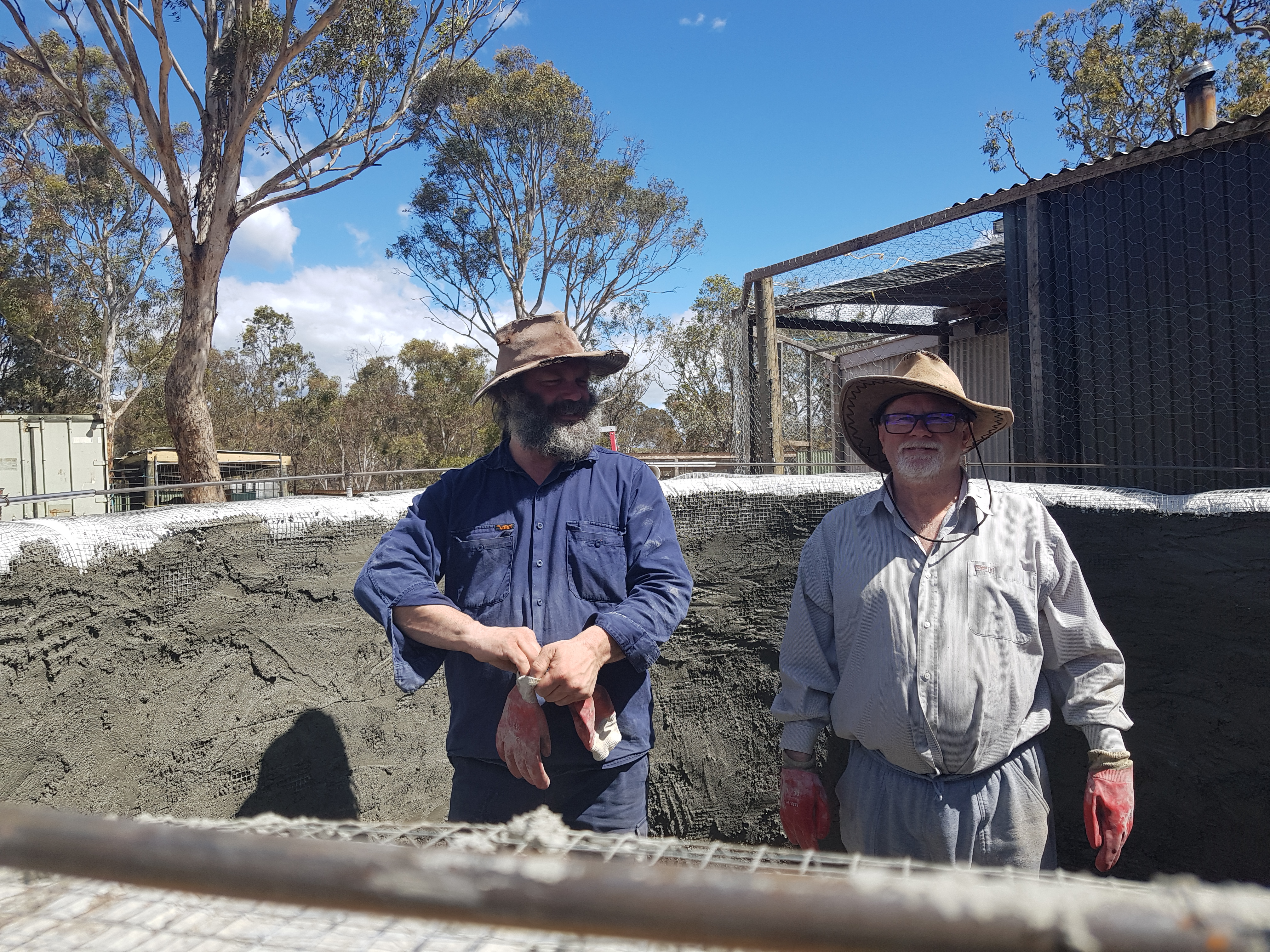
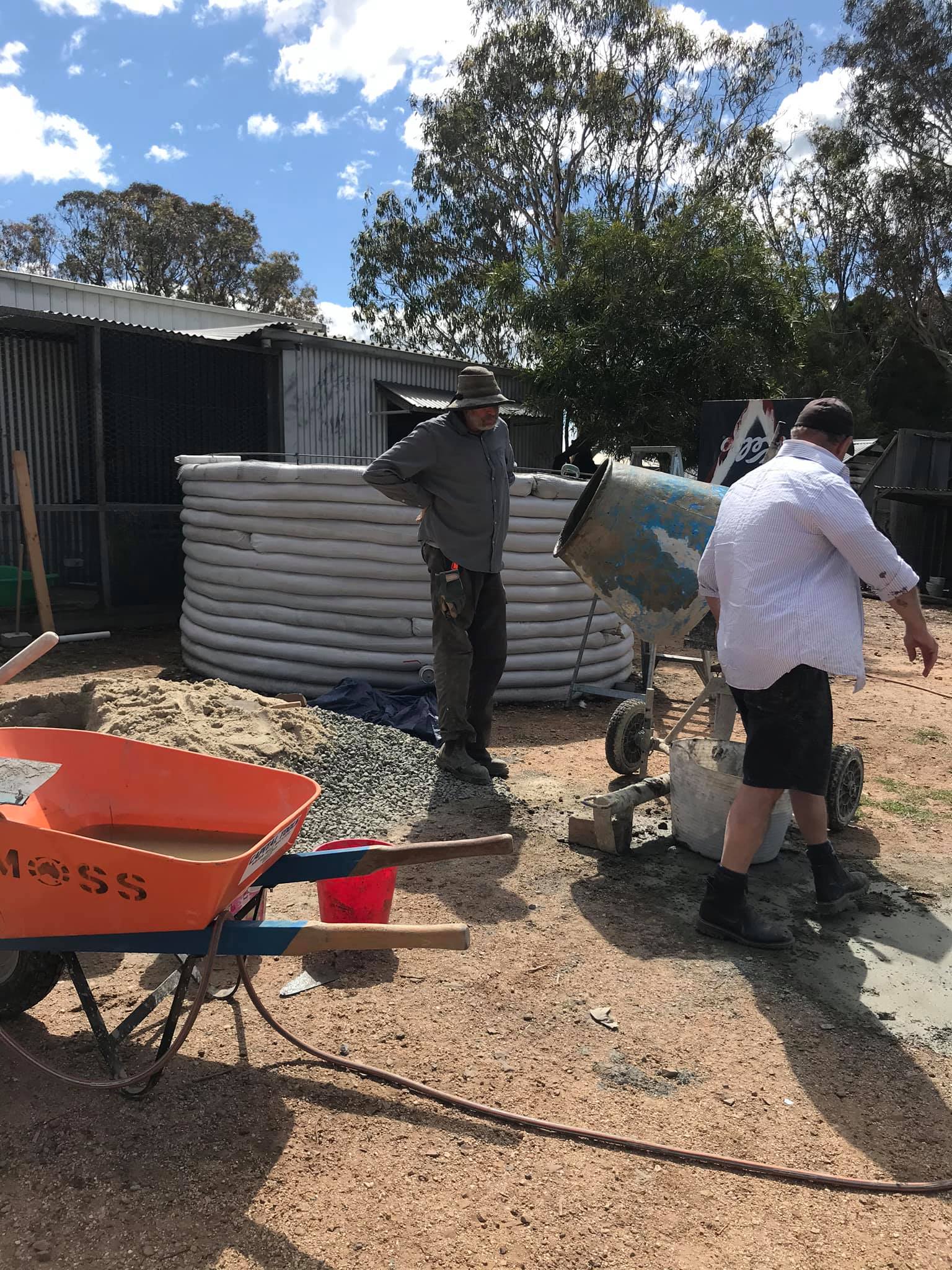
Working on the tank at Lucky Stars Sanctuary

GS: Do you see other applications for this method of building?

SF: Yeah, it is now almost a year since the last fires began in NSW and there are still a lot of people down the south coast living in tents and caravans. Perhaps this method of building would be useful down there as well and help people to help themselves. If you look back 150 years, communities had building societies, where a bunch of people would get together and pool their resources. They’d then build one house after another after another until everybody had a home. It was a cheap and efficient way for the community to come together, and building codes weren’t such an issue back then.

GS: Are there currently barriers, laws, etc., that make it difficult for communities to go ahead and build as you are suggesting?

SF: Yes, there are many. The Extinction Rebellion mob have come up with a concept called a  ‘dilemma action’ where a group of people take some form of action like blocking a road, or in this case building unapproved houses. If the government acts against the group, it will end up looking heavy-handed and idiotic.  If they leave the group alone, then it sets a precedent. Building sturdy houses at this time for people who have been forced by fire and lack of government action to live in tents and caravans, is a great moment for that sort of action.  I can’t see anything wrong with people getting together and just building their own good-quality houses. The need is huge. If you do it well enough, you can always come back with an engineer who says, ‘Yeah, that’s alright’.

GS: Some politicians are saying as far as climate emergency goes, we just have to adapt. What does adaption mean to you?

SF: Well if we keep putting carbon into the air, there is no adaption. We can’t cope with a climate that is three degrees hotter, let alone six degrees. I don’t know why they are doing this. There is no logic to it. They either deny that climate disasters are happening or they’re like Scott Morrison, who is part of a brand of Christianity which believes in the ‘rapture’, where the world ends and god takes all the true believers to heaven, leaving all the unbelievers to an eternity of hellfire. Of course their church is the only true one. There’s a possibility they believe that it’s time to end the world. Who knows what the motivations of these people are, but they do need to be stopped.

GS: What do you think the alternatives are?

SF: Adaption is one part of survival. Climate change is happening in a significant way, and we are locked into that. They talk about geoengineering. Most of those schemes are extremely risky and pretty crazy but there is one form of geoengineering that would be a really sound way forward. That is to convert the world’s agriculture into organic techniques that take the carbon out of the atmosphere and store it in the soil. We could take all of the world’s agriculture and use it to take carbon out of the atmosphere and to put that carbon back in the soil where it came from. That would go a long way. But we also need to stop damaging our habitat as a way of life.

GS: For this local area and the south coast, what do you think the immediate ways forward are?

SF: We need to change our building techniques for one thing. The way we keep building these crazy English houses here in Australia, particularly with the climate getting way out of control with fire season, bloody pyro cumulus nimbus clouds and firestorms. The earthbag design used to build this water tank protects against fire. Bring it on. Build houses, animal shelters, bunkers. You could build a house by bulldozing up four dam walls in a square, and put a roof on it, if you wanted to. Site it properly of course. 

GS: What work do you do? What are you working on at the moment?

SF: I’m an electrician. I have been an organic farmer for many years. I’ve been a blockader and an activist. At the moment I’m building co-operatives to try and create a new economy that will make this crazy one, that is eating the earth and eating people, obsolete. Build an economy that is good for people and good for the planet.

GS: I had the impression that various regulatory hurdles and laws constrained co-operatives in Australia. Is that the case?

SF: It used to be that the co-operative laws were different in every state, which made it quite difficult to trade across state boundaries. That’s been fixed now.  The Co-operatives National Law has reduced red tape and simplified financial reporting for smaller co-operatives. I mean you can use any form of governance as long as the registrar lets you do it.

GS: How are your co-ops going?

SF: So far, so good. We’re still in the set-up stage of the community-run farming co-op. We’ve got a renewable energy co-op which has put in one set of solar panels already. It’s called the Pre Power One Renewable Energy Co-operative. It’s designed to enable people who have a roof with a lot of sun shining on it but no money, access to solar energy. It also allows people in the area who would like to take their money out of fossil fuels and put it into something that is reasonably ethical, to do so.

GS: How does the investment bring a return?

SF: So the way it works is that when you become a member of the co-operative, you get the right to do one of two things or both. If you have a roof that you would like the co-op to install solar equipment on, then you can put up your hand and ask for that. We will come around and make sure your house is suitable, for example,  check that there is not a great big blue gum on the north side or something basic like that. If it’s good to go, then we will get a couple of quotes. Then we open up an investment opportunity for the other members who can choose to invest. We get the equipment installed for that member. That gets paid back to the investor when people pay their bills. A portion of that bill will go straight to the investor, and another portion will go to the co-op. The investor will double their money over about twenty years which is a lot better than super.  It’s different from perpetual investment which is what most companies offer where if you invest once, you get the right to profits from that company forever. In our case, we prearrange precisely how much we will pay you back. We pay that amount, and the deal is done. You can invest again if you like. The beauty is that all the equipment winds up under the ownership of the people who are using it. That is a major problem in our society. Almost all the productive assets are owned by people who are either extremely rich or completely imaginary, i.e. a corporation. The purpose of corporate ownership is to extract as much wealth out of the community as possible.

First Pre Power installation – Dunlop, ACT

GS: How do you maintain the solar units?

SF: There are two ways. You can either put a surcharge, a couple of cents on each payment. As hundreds of people are paying regular bills, we will have a pool of money that we can dip into. Or we can just raise another investment opportunity when the time arises that we need to buy something.

GS: How do you manage the co-operative?

SF: Management is critical. Currently in our society, management is almost always a very top-down, hierarchical, do-as-I-say model. We reckon that it is one of the leading causes of a lot of problems, certainly a lot of mental health problems. If we’re spending a large part of our time at a workplace where we have no control over our work situation, it’s going to affect us. We go through school under that model, and we leave school and face that model again in the workplace. Our families are that model because our parents were taught that model, and their parents too. So how do we do it differently? Luckily, people have been thinking about this for quite a while. We didn’t have to come up with an answer by ourselves. The intentional communities movement uses the sociocracy method of governance and decision making.

This is a system whereby the people who are involved in the community make the rules.  The organisational units in the group are “circles” of people who have a defined way of meeting. A lot of the political and power problems that arise in groups these days are from a lack of structure in decision making. There is a lack of knowledge about how the organisation works. So, what happens is the members of the group have to make it up as they go along. Of course, the people who are very forceful and perhaps manipulative tend to rise to the top of that sort of organisation. Sociocracy and holacracy, which I’ll talk about later, are both flatter forms of organisation than the usual hierarchical forms of decision making we find in our society. Meetings are very structured and use a form of decision making called consent which is quite different from consensus. Consensus is where you all need to agree on something before it can go ahead. It can take a lot of negotiation. It is easily stalled by someone who is bent on getting their own way and doesn’t care about anybody else. It’s good for certain things. If people want to form the purpose of their organisation. Then it might be important to use consensus, so everybody is on the same page. Consent is slightly different. A proposal is put forward, and members ask themselves if it is good enough for now and if it is safe enough to try. It is an iterative process. If there are no objections, then the proposal can go ahead. If there is some doubt, the group can say, well let’s try it and come back to assess in a week or six months or a year.

GS: Are there cases where the iterative process should be applied regularly, anyway?

SF: Many of the newer organisational models that have come out of the tech revolution use iteration frequently. Lean methodology is an example of that type of management, but I’m not really up on that. I believe they use iteration a lot.

GS: I imagine it allows for more experimentation, but also it would assist with transparency and accountability.

SF: Absolutely. Our current organisational models do not make transparency and accountability a priority. Transparency and accountability are crucial to creating more humanised ways of organising where people are comfortable and in control.

GS: You said you are also starting up a community-owned farming co-operative. What management model are you applying to that group?

SF: We will be using holacracy which evolved from sociocracy. Sociocracy is an effective form of self-management in situations where there is a community of people living together, like housing co-operatives and other intentional communities. Holacracy is more structured and business-focused. It uses documentation and software, so it’s clear to everybody what the organisation is about. A new member can join the organisation, look up the website and know exactly what the group is about. 

GS: Did you establish the purpose of the co-operatives before starting? 

SF: We’ve tried both ways now. I came into the Pre power co-op as a bit of a ring-in. It was after the business people involved couldn’t get the concept of a co-op not being for-profit and needing to be controlled by the community. They graciously dipped their lids and bowed out, but then they needed to find someone else to be on the board, who was more aligned with the ideas we are now putting into practice. So, I wound up taking the position. We did have a few things to sort out like a purpose that really fits the bill. There are four of us involved and a couple of other people who come in and out, so it’s taking some time. There’s a lot of work to do in setting up a business.

GS: How do you protect yourselves from burn out?

SF: We make sure that if it is too much to do, we do it next week. We don’t pressure each other with timelines or anything but burn out is a real issue. Part of the model is to ensure that the structure will be easily replicable, so it will be easy for other co-ops to join in. A co-op is a business, and running a business is a pain in the arse and running a business as a volunteer after work is just ridiculous. It’s draining, especially if you’re working long hours. So the model we are working with envisages lots of local co-ops. Pre Power One is the first local co-op we’ve set up, and twenty per cent of the revenue from this co-op will go straight up to what we call Pre Power Central. That is a co-op that is owned by all of the local co-ops. Its sole job is to make life easy for the local co-ops. The central co-op will employ people with that twenty per cent of the revenue, whose job it is to assist with running a local co-op. They will be mentoring. There will be templates for co-op policies, insurance, arrangements with installers, basically all of the hard stuff.  It makes it easier for a local co-op to set itself up. All that is left for the local co-ops to do is to hold a certain amount of board meetings per year, run the AGM and figure out what to do with the profits they make.

GS: Are the local co-ops volunteer-run? Are they able to pay themselves? 

SF: The locals are basically volunteer run. We use twenty percent of a local co-op’s revenue to pay the central co-op to do most of the work. If a local decides that it needs to pay someone to do something the central coop is not doing, they can do that by agreement amongst the members. The effect would be that the extra wages bill would come out of the discounts received by the members of that particular local co-op.

GS: Earlier you asked, how we organise in a different way when all we know in our families, schools, businesses, government is top-down decision making with little transparency and less and less accountability. How do you think we can start organising differently?

SF: Well, sociocracy and holacracy is one aspect, but it is a huge task to change the existing systems and culture. Sociocracy has been successfully used in family situations before, but we are also going to have to start implementing these processes through education by opening up schools. How we fund those is going to be interesting. 

GS: How do you see that happening on the ground say in this area?

SF: I see it as a later stage. The first stage we open co-ops like the renewable energy and the farming co-ops, where the people involved pay their bills. People already pay bills. We are encouraging them to stop paying bills to outside entities that make a profit from them. We want them to start paying bills to an organisation that is owned by them and controlled by them. A form of organisation where they get to decide how to spend any profit in a way which will benefit the community.

We are using a  participatory budgeting scheme to distribute our profits. That’s where you have a pool of profits made by the organisation, and the members get to vote and decide how that money is spent. We will have a set of criteria for applicants to pass, and members can vote according to how much they want to give to who.  For example, some of those profits could go to building and staffing a school, and some to say, elder care. These are services that are not suited to privatisation or to purely profit-making concerns.
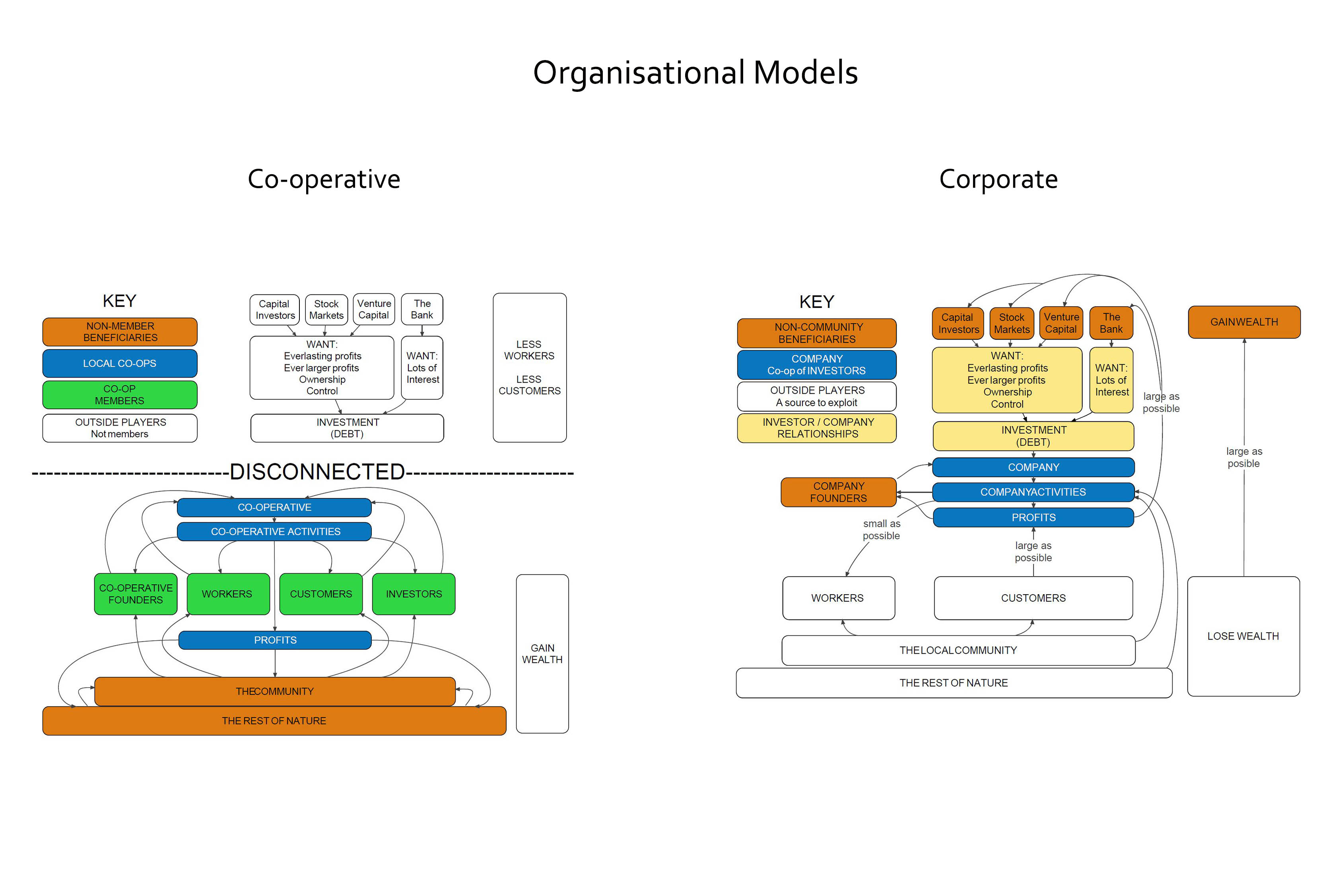
Comparative diagrams showing climate co-operative and corporate organisational models

GS: If as a community, you are taking on the responsibility of care and education of your members, does that mean you assume that the responsibility for these services does not lie at a state or national level, or do you envisage starting locally in order to make changes at state or federal government level?

SF: I guess the structure of responsibility that we want to build here is called subsidiarity. It means that decisions are made at the smallest possible level, so if your school can make a decision, that’s great, that’s where it should be made. Suppose there is a circle for cleaning within the sociocratic or holacratic structure of the school, and a decision needs to be made about cleaning. In that case, the cleaning circle should make the decision. If there is a kitchen circle, that is who should make decisions about the food. If you have a complaint about the food, go and see the kitchen circle. From there, you work outwards in a federal manner. You make formal arrangements with other entities that are doing the same thing, so with other schools. Anything that needs doing at a broader level like negotiating with the government or raising funds for particular projects can be done by all those schools agreeing to work together. This method or organising has been successful in northern Syria with democratic confederalism in the Kurdish areas. They spent seven years running a system that was working in exactly that way.

GS: I imagine it takes a fair bit of time to build the structures and culture required to run a system like that effectively.

SF: Major changes like this can really only happen where there is a power vacuum. For example, when Assad deployed all his troops to the south of the country to fight the Arab Spring. The Kurds, who have been fighting Turkey, Iraq, Iran and Syria, were well-armed and ready to build alternatives. They’ve been preparing for this for a very long time. Abdullah Öcalan has been around for a long time. He was one of the founders of the Kurdistan Workers’ Party (PKK) in 1978. The party was not aligned with Russia when it started, and it didn’t take the official communist line as gospel. Because of this they were shunned by the communist world. They evolved towards democratic confederalism. In their guerrilla camps, they’d have a yarn around the campfire analysing how oppression arose historically and decided the first instance of oppression is probably the oppression of women by men. Gender equality is central to their organisational principles. The Kurds are known for their women’s army, which is also democratically run.

Sovereignty is held at the neighbourhood level. That is the ability to make and enforce rules. Within each neighbourhood, sub-communities are represented. The neighbourhood meetings work on a majority vote basis.

GS: How do you see this type of system dealing with exploitation?

SF: Okay, for example, there’s also a women’s council for each neighbourhood. So when decisions are to be made, the information goes out to a group of women in each sub-community. So, there are parallel structures at work in their social contracts.

GS: And wage exploitation?

SF: Well, the Kurdish example covers a very poor area. Historically, under Assad, it was mainly primary production, a lot of crops but no processing of the crops. It was all exported—the extraction of fossil fuels and that sort of thing. Everything gets taken out and shipped away. They have set up a whole system of co-operatives now to do that work. The local communities are federated. Say you’ve got a town with ten communities in it, they band together to organise water and electricity and all of that through co-ops they create in common.

GS: How do they meet their social needs?

SF: Through neighbourhood meetings, I suppose.

GS: Are you saying there is no need for wages?

SF: Oh, I see. I’m not sure. I haven’t managed to get a source about how the economic system works yet. But they have achieved an enormous amount, very inspiring, much longer-lasting and more peaceful than what the Spanish Civil War achieved. The Kurdish example illustrates to me that the federalist model with local sovereignty is entirely possible. It is a way to create a peaceful, sustainable society out of an absolutely turbulent  situation.

GS: Here in Canberra, what do you do about the role of media which generally supports and enforces current power structures?

SF: We run a radio show, Behind the Lines on community radio 2XX and make a podcast called Align in the Sound. That is a three-way podcast between the New Economy Network of Australia (NENA), Behind the Lines and a group called Co-operatives, Commons and Communities Canberra (CoCanberra). So if there is something we want to learn, we do it in a public manner. We record it and leave it as a public record and information source that anybody can look up at any time. What a lot of people lack at this point are ideas. We don’t even know that alternative ways of organising and living exist. Who has heard of sociocracy or holacracy or what’s going on in northern Syria? Almost nobody.

GS: Tell me a bit about the organisations, CoCanberra and NENA you just mentioned.

SF: Every month CoCanberra and NENA Canberra region combine to hold a community information or study group night. For instance, we recently invited the National Health Co-op and a co-op from Sydney, called The Co-operative Life, who do aged-care and disability help. We sat the video conference TV on the couch at the food co-op, everyone else sat around it, and they talked about their models, with Q&A afterwards. One is a worker co-op, and the other is a consumer co-op. We were able to explore how they work and why, and what problems they face. We also do asset-based community development training. The idea here is that the community is an asset. The strengths and passions of the community need to be uncovered and used to build solutions to whatever problems that community is experiencing. When we discover or come up with new ideas, we run a workshop.

The New Economy Network of Australia is an Australia-wide networking organisation of people who are essentially trying to build a new economy. CoCanberra is about starting up co-ops and getting things implemented on the ground. The Pre Power and Community Owned Farming co-ops are projects that CoCanberra is deeply involved in. Radio Behind the Lines does long format interviews with anyone who is trying to make the world a better place.

Buckminster Fuller said, “You never change things by fighting the existing reality. To change something, build a new model that makes the existing model obsolete.” That’s what we are all doing.

Of course, we do have to fight the old system as well because it’s very quickly munching its way through the planet. The New Economy Network is a co-operative devoted to building a new economy. They’ve been around since 2016 when a conference was held in Sydney by the University of New South Wales law school and the Australian Earth Laws Alliance. At that point, there was no peak body in Australia, so they decided to form one. You can become a member of NENA. It’s got a really good website. They have geographic hubs, and they also have sectoral hubs like an education hub, a First Nations economics hub, housing, food, you name it. There’s a long list. You might live in a regional area, and you’ve got a passion or in-depth knowledge of renewable energy; you can hook up with people from around Australia who have similar values and skills. Behind the Lines is a community radio show that has been going for thirty-two years. I’ve been doing it for fifteen years. We work together with CoCanberra, and have recorded a lot of the New Economy Network conferences. If it’s appropriate to record the CoCanberra / NENA meetups, we will record them. We run editing training workshops over the web, building a team to polish up all that raw audio. Once we finally get them edited, We put them all up as podcasts.

GS: Do you work with unions?

SF: We’ve been trying to, but we haven’t had the numbers to form what they call a union co-op yet. There is interest in Canberra, and there’s a mob in Melbourne called the Earthworker Co-op. They bring together trade unionists, environmentalists, small business people and others in common cause. They began as a coalition of what was left of the Builders Labourers Federation after they got banned, alongside parts of the Green movement. Earthworker operates parallel to us trying to create a co-operative commonwealth on the ground. We are moving towards meeting our needs and capturing the profits rather than letting them go up to all the crazies who currently run the world.

GS: What are the main problems you see with trade unions in Australia.

SF: I think their principal problem is that they are stuck fighting the boss rather than working to make the boss obsolete. They are stuck in a perpetual fight, and that’s not good for culture, spirit or anything else. From being in the system, you become like that system no matter what principles and community support you start with. 

GS: What is the main message you would like to pass on to people?

SF: We cannot afford to muck around with slow change any more. Now is the time, with climate disaster upon us, to stop concentrating on fighting the boss and make the changes we want to see by ourselves. We cannot wait for big capital to do it or for the government to do it. We have to do it ourselves; otherwise, it’s just not going to happen. We only have a few years, so we better figure out new ways of organising ourselves to displace the system that is currently ruining the world. Care for people, care for the earth. We can create economic systems that support socially just and ecologically sustainable communities. We can do it, but we have to act now to get it done in time.

Interview conducted with Scotty Foster by Gaele Sobott at Lucky Star Sanctuary, Bywong, 11 October 2020.

Links:

Interview 1 in the series: Kerrie Carroll

Interview 2 in the series: Helen Schloss
Interview 3 in the series: Liz Sherborne

Behind the Lines

Align in the Sound

CoCanberra

New Economy Network Australia

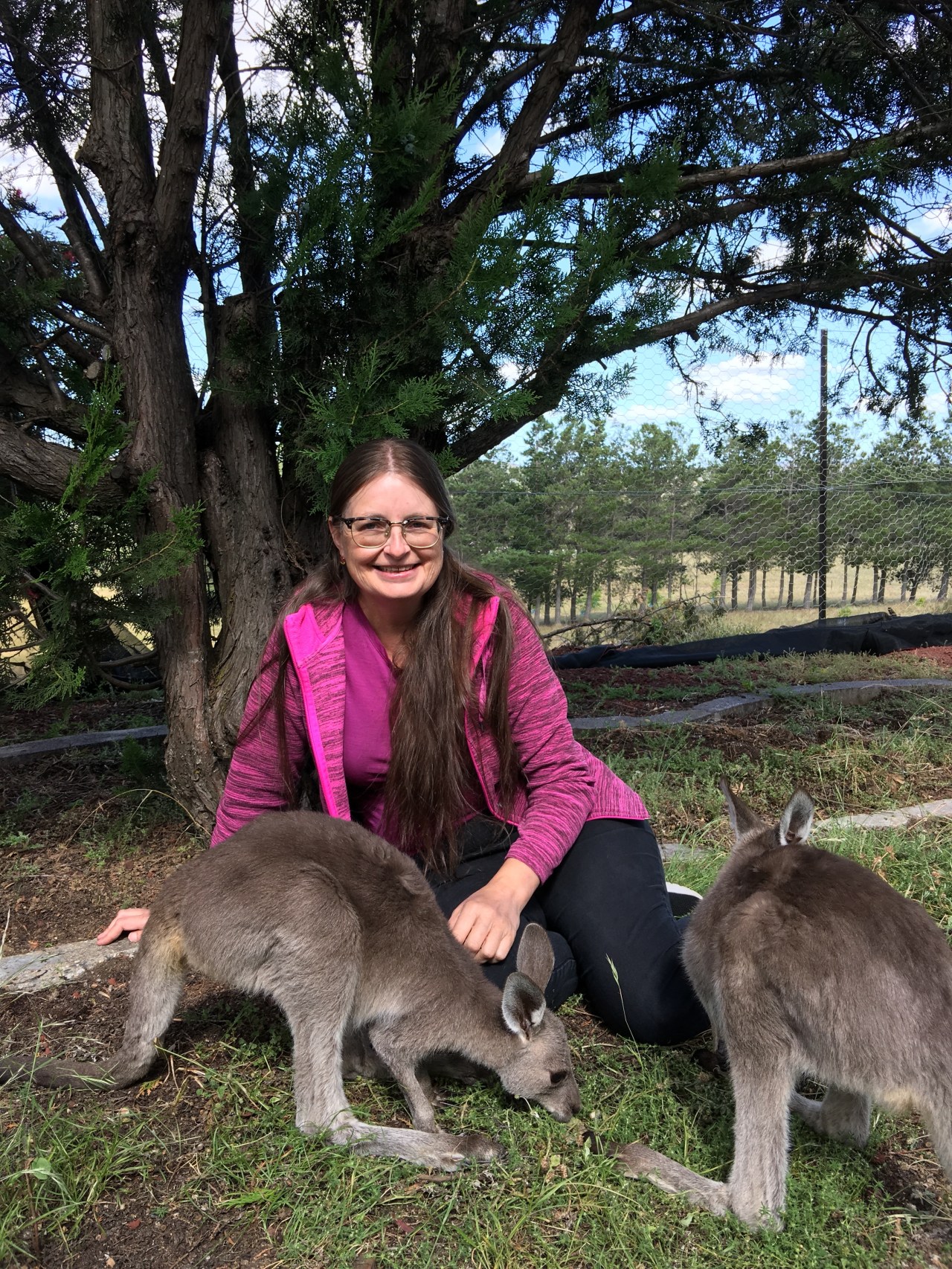
Helen Schloss sitting outside with two Eastern Grey joeys in her care. She is wearing a pink jacket and she is smiling.

An Interview with Helen Schloss

I was gobsmacked by the melted tanks I saw on telly. People lost their homes and there has been a long waiting time for them to receive assistance, especially the wait to get a roof over their heads. I was concerned by the need for water, and I thought, surely if you can build a house out of earthbags, you can make a water tank using the same methods.

Helen Schloss lives on a small property in Bywong, New South Wales, near Canberra. A primary caregiver and dedicated wildlife volunteer, Helen prides herself on her strong work ethic and animal rights principles. Some of her voluntary work includes producing ‘Tuesday Tips’ for Lucky Stars Sanctuary. Her passion drives her to help others help and protect the less fortunate.

This interview is the second of four interviews with volunteers involved in the building of an earthbag water tank at Lucky Stars Sanctuary, Bywong. Vanuatu Earthbag Building assisted in this project. They have provided free plans, support and the materials required to build water tanks for people in need in fire zones in NSW Australia, cyclone zones in Vanuatu and Pacifica.

Gaele Sobott: I believe you were the person who instigated the building of the earthbag tank. What gave you the idea, and how did you go about finding the expertise to commence this project?

Helen Schloss: I already had an understanding of the sustainability and affordability of earthbag building. I was interested in building a second home from earthbags on our property. Then we experienced the bushfires from early December 2019 and January 2020. I was gobsmacked by the melted tanks I saw on telly. People lost their homes and there has been a long waiting time for them to receive assistance, especially the wait to get a roof over their heads. I was concerned by the need for water, and I thought, surely if you can build a house out of earthbags, you can make a water tank using the same methods.  So I put a few words into Google, and one of the first things I found was the Vanuatu Earthbag Facebook page. That was early February this year. I saw a post that Liz Sherborne had written saying they had been using earthbag-building methods in Vanuatu. She noted that earthbag water tanks would be a valuable resource in fire-prone areas of Australia.  Helpful in protecting people’s properties, their lives and the lives of animals. I wrote a comment asking if they would be interested in doing a workshop down our way at some point. She instantly messaged me, and the project evolved from there. Liz said that if we could find ten people to assist with the building, they would come to Bywong. In some ways, it was serendipity.

GS: You found ten people and provided food for everybody, anything else?

HS: Yes, so I rounded up the volunteers to do the work. Initially, we were going to start building around early March, but then COVID hit, and the restrictions meant people couldn’t travel from Sydney or gather together. We had to postpone it, which meant I had to keep those volunteers interested throughout that time, sending them links and chatting with them online. 

GS: What previous organisational and networking experience do you have in gathering people together for projects like this one? Not everyone would know the importance of keeping that group of volunteers interested.

HS: I have some past experience. My family and I were in Papua New Guinea for a while, and I did fundraising events for various organisations. Maybe through the trial and error of that process, I learned that if you don’t keep your communication going, not everyone, but some people will lose interest. I’m pretty sure now, knowing this crew, if I had put them on hold and not had any contact with them, it probably wouldn’t have mattered. Most of them have got properties. Potentially they could use the earthbag building skills on their properties and help neighbours and their communities. But I believe in communication. I’m not fantastic with my friends and family. But when organising events for the animal sanctuary or for people in Papua New Guinea; the hospital there, I feel there’s a lot at stake. Last summer, it was scary because the bushfires were near Lucky Stars Sanctuary at Tallaganda forest and there were various other spot fires around the place. It was really worrying and very stressful for Kerrie and Yee, the founders of the Sanctuary. I think the contingency plan was if a bushfire reached them, they were going to stay and defend. It would be next to impossible to evacuate three hundred animals. That was one of the reasons I felt an affordable, fireproof water tank was necessary. The tank is fitted with a STORZ outlet so fire trucks can connect to it.

Some volunteers building the earthbag tank.

GS: How did you first get involved with the Sanctuary?

HS: In 2017, a year after they opened, I was looking for something to help my daughter, who has been unwell for some time now. She loves animals; in fact, she probably loves them more than most humans. I was looking around for animal sanctuaries and found Lucky Stars on the Internet. We live not too far from the Sanctuary, so I contacted Kerrie and asked her if she would mind if my daughter came over. I remember Kerrie saying, ‘You know it’s not just animals we look after, we look after humans as well.’ My daughter is thrilled working there and now Kerrie and I feel like we’ve known each other a lifetime.

GS: Many people who experienced the bushfires complain that they are still waiting for assistance that was promised by the federal government. I know finding funding for the Sanctuary has been a battle. How do you think a project like building this earthbag tank helps in this regard?

HS: It definitely helps. Earlier in the year, Liz was saying that they like to teach communities the skills involved in the building so that those people can pay it forward. Hopefully, one or two people from each tank-building project can do that. It is one way of getting through this deficit of government funding and developing ways to protect ourselves in the future, especially with sanctuaries. It’s really frustrating that animal sanctuaries don’t get government help, like drought assistance. That’s one way the tank building helps, and I think, also, it helps by promoting awareness. We now have an extra eight or ten people who are aware of Lucky Stars Sanctuary. Hopefully, not only do they know the Sanctuary is here, but they know that we need help from time to time. They also have increased awareness about animals, animal rights, and how tough it is for the animals, especially during bushfire season. Workshops like the tank building initiative serve to increase awareness through social media and word of mouth. More people might contribute to helping financially or by giving Lucky Stars a hand.

GS: Many community projects are continually battling time and funding constraints. People have little time to theorise about what they do, how they do it and where they are heading. How do you think we can solve that problem? How do we begin gathering the data needed to understand our impact and the choices we need to make in the future? 

HS: Hmmm, that’s a really good question. Time and money are always going to be an issue. There are various organisations and government departments that collect data, for example, the Australian Charities and Not-for-profit Commission and the Australian Bureau of Statistics. But whether it’s accessible to charities and communities … I don’t know. A tool that’s simple, affordable and standardised across the sector, could be the answer, like a smartphone app. The majority of people have smartphones now, although not everyone likes mobile apps, I guess they suck up valuable space on their phones. So maybe a website app that has the same functionality as smartphone apps. All the relevant data can be just a fingertip away, no painful paperwork and time saved as a result.

Lucky Stars Sanctuary could gather data such as volunteer info, animal health, fundraising, infrastructure problems or improvements, seasonal conditions. Even information, including photos of soil degradation would be useful for analysis, reporting, planning and decision making. It needs to be well designed, intuitive and easy to use, of course. All the data is there, no more hunting for it down the track. More time saved! Tick!

There’s an app called Farm Tracker, developed by the Department of Primary Industries. It helps farmers collect similar data, including geotagged photo diaries to monitor seasons and dam levels. Some of this information isn’t made public. Perhaps this could be retrofitted to suit charity or community-based work. Then you have the question, who’s going to commission and pay for it? Maybe the Australian Charities and Not-for-profit Commission is a place to start.

Interview conducted with Helen Schloss at Lucky Stars Sanctuary by Gaele Sobott, 11 October 2020.

Links:

Interview 1 in the series: Kerrie Carroll

Interview 3 in the series: Liz Sherborne

Interview 4 in the series: Scotty Foster

My freedom is writing. My freedom is my peace of mind. My freedom is building a good relationship – An Interview with Ken Canning

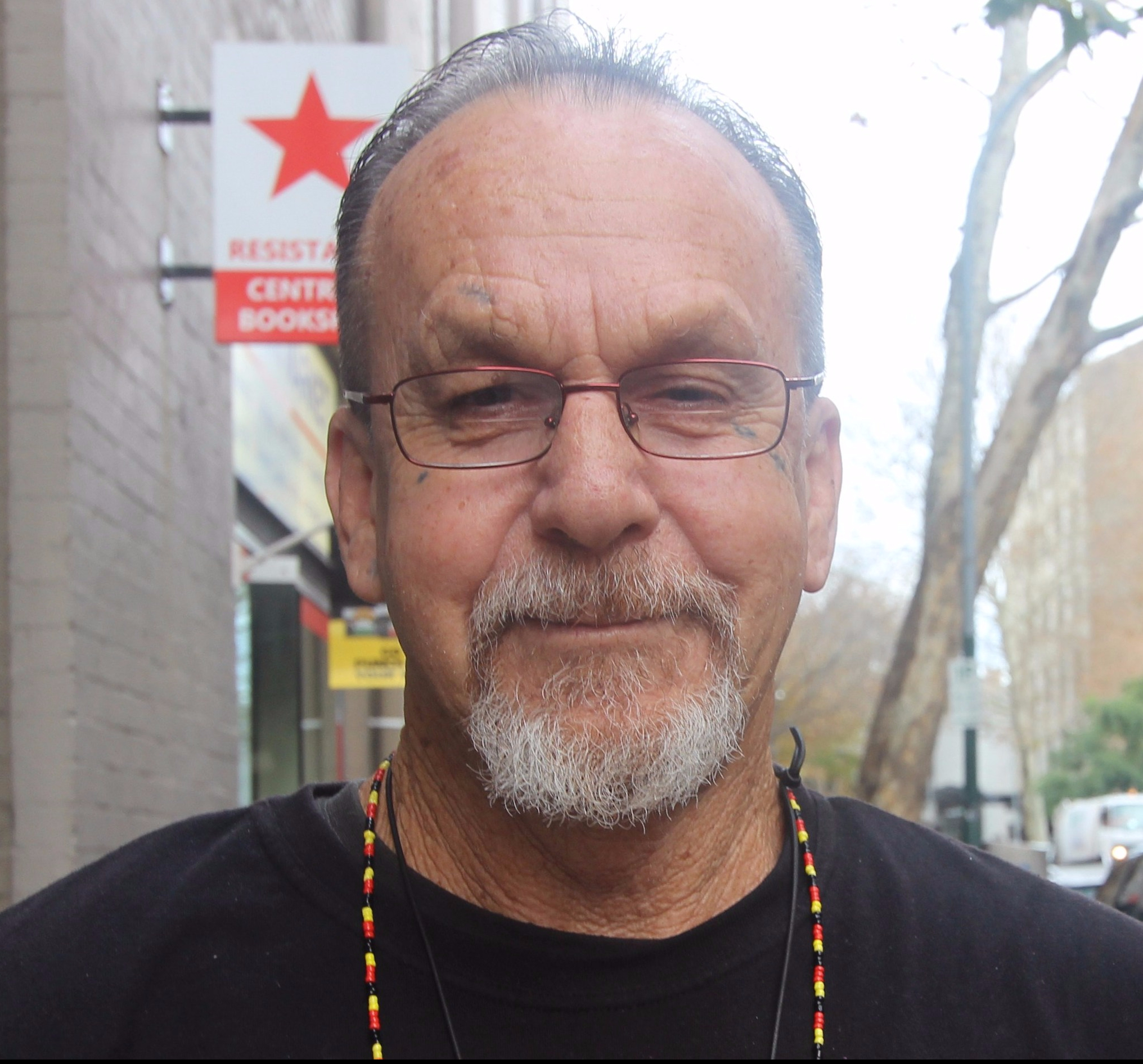
Head shot of Ken Canning. He is wearing glasses, and a long necklace of small, red, gold and black beads (Aboriginal colours). He has a greying mustache and beard, and he is smiling.

Credit: Socialist Alliance

Ken Canning is a Murri activist, writer and poet. His people are from the Kunja Clan of the Bidjara Nation in south west Queensland, Australia. His Bidjara name is Burraga Gutya. Ken has lived in Sydney for over 30 years. He worked as an academic and cultural adviser at the University of Technology Sydney and is currently a support worker at the Judge Rainbow Memorial Fund, where he assists people who have experienced the criminal justice system.

Ken’s poetry has been translated into several languages. His publications include Ngali Ngalga, Breakout Press,1990 and Yimbama, Vagabond Press, 2015. His first major play, 49 Days a Week, was showcased at the Yellamundie National First Peoples Playwriting Festival 2017. He has also written a half-hour film script called Cocky on a Biscuit Tin.

Gaele Sobott: Let’s start with your birth. There’s information on the Internet stating you were born on Bribie Island, Queensland.

Ken Canning: I spent some time on Bribie Island as a kid but I wasn’t born there. I was born in Frankston, Victoria. My mother’s family come from Charleville in Queensland.  Dad was stationed in Victoria when Mum was pregnant with me.

GS: Where was your father from?

KC: He was from Toowoomba. My Dad was a whitefella. The family was Irish from County Cork. They were very rich and very powerful. My grandfather’s name was Bob Canning.

GS: Where did you parents meet?

KC: Granddad worked out at Charleville. My father was in the navy and when he got leave, he went out to see his father. That’s where he met my mother. When they decided to marry, the Canning family didn’t want anything to do with us because they were against inter-racial marriage.

My grandfather said, ‘My son can marry who he wants.’

So, the family disowned both my father and Granddad. Any wealth, any land my father and grandfather were entitled to was stripped from them. They were outcasts. Granddad was disappointed with his family. He said they were traitor Irish. They took part in some of the massacres of Aboriginal people. I researched it years later with Dr Carroll Graham at University of Technology Sydney (UTS). They didn’t come here like your average Irishman who didn’t like authority. One of granddad’s uncles even became a policeman.

The reason I was born in Frankston was a bit random because while Mum was pregnant with me, she accidentally trod on a Red-Belly Black snake and got bitten on the foot. An old fella reacted quickly, got a sharp knife, cut her foot open and sucked the poison out. She was lucky, she was only a bit crook but after that she wanted to be with my father so she went and stayed in Frankston. About six months after I was born, we headed to Narrabeen in Sydney and then we took off to Queensland.

GS: So, you may have a bit of Red-belly Black venom in you?

KC: Well I might. I was fascinated by snakes growing up. There were snakes everywhere on Bribie Island. One time I was hiding from my cousins behind a tree, waiting to scare them and a snake crawled across my foot. I froze. I knew if I kept still it would leave me alone and it did. It took off when my cousins came running up the road. I admire snakes but I don’t really want them crawling on me!

I used to stalk kangaroos as a kid. I knew I couldn’t catch them. They were too clever for me. I’d chase goannas too then one evening a goanna turned on me. Jeez, I tell you what, I reckon if it had been an Olympic trial, I would’ve won. I ran home and slammed the door. My brother and I were looking through the front window and it was sitting there waiting for me to come out. It was much bigger than what I’d initially thought. They can give you a nice bite. The funny thing about a goanna bite is that every year to the day the bite mark will come back.

GS: Can you talk a little about your mother’s family?

KC: I don’t know the traditional names but my great, great granny was called Jane Boyd by the whites who invaded the area. I read a police document on her – ‘Jane Boyd, Aboriginal woman, associate of Chinese gardeners. Likes opium, is armed and will shoot at police.’ The Chinese came to the area because they were being persecuted. They lived with our people.

My great, great grandfather walked down from Tenant Creek right into the middle of the wars, the Forty-Year war. He married Jane Boyd. He was given the name Edward Prince. There are still Princes out West but he originally came from the Northern Territory, Carpet Snake Dreaming. My mother’s side are Magpie Dreamers. My great granny looked after me. She used to tell me stories about how her mother would stand up to the police. They were very strong people. Granny got kicked in the hip by a horse out West and the doctors wouldn’t come to see her. The family mended the hip bone as best they could but she had trouble with it all her life. So, a lot of the time she was bedridden. She was addicted to morphine. She passed when I was about fifty-six.

It was confusing growing up because Mum had me when she was young and when I was little, I thought she was my sister and called her Joan. I thought my grandmother was my mother. I used to call her Mum, and I thought my great grandmother was my grandmother. That still sticks in my mind today. Often when I talk about my gran, I’m actually talking about my great grandmother.

GS: Tell me more about the Forty-Year war.

KC: The Forty-Year War was one of the longest wars in Australian history. Not the whole Bidjara people but our clan group, the Kunja clan, fought for forty years. That war went from the 1860s right up to the 1900s when they allegedly defeated our people. Men, women and children were fighting against the British. After that a lot of my great uncles went off with the bushrangers to continue fighting for another twenty years.

My great, great grandmother was carrying a gun around everywhere she went, shooting at police. We were a people who travelled on foot then. We didn’t take to horses until the cattle stations started using us as labour. Some of people rode horses but basically our guerrilla warfare was on foot. We only have oral history records of that war. My cousin, Sam Watson, found some information in the archives in Brisbane. There was a box just sitting there collecting dust and he started reading through some fascinating documents, but the archive staff told him the material wasn’t for public viewing and he should come back. When he went back the whole box was gone.

There is no official acknowledgement that the Kunja clan of the Bidjara people fought for forty years. That’s two generations and no recognition. When you look at our society today, we’re coming up to Anzac Day where people beat their chests and say, ‘My grandfather fought to save this country.’ I don’t have that right. It’s a denial of history. Like the very first boys’ home I was put into, does not exist. It’s been wiped from history.

GS: Where was the boys’ home?

KC:  It was in Scarborough, run by the Catholics behind a boarding school for white kids. The building was full of Aboriginal kids who had allegedly committed crimes. They were totally brutalised. There is no record of that place ever existing. The Catholic Church denies it ever existed. It does not exist but I was there. I know other people who were there too. I knew people who committed suicide in there. It’s as though I fabricated eighteen months of my life. Our history is denied.

GS: How old were you when you went to Scarborough?

KC: I was ten, almost eleven. It was just after my great gran died. There were a lot of kids my age there and kids up to sixteen, seventeen-years. The place was run by brothers who were mad brutal rapists. They did some terrible things. They didn’t care what damage they caused. When they tried to take me, I’d jump up on the bed and scream, bite, kick. I was too much trouble for them. But they did bed checks every day so they set me up by putting two cigarettes under my pillow. I was flogged, every single day for the two cigarettes they’d find.

I was christened a Catholic. My parents were Catholic. Then I remembered Granddad talking about a cousin of his, called Archbishop Duhig, the archbishop of Brisbane at that time. I told one of the brothers. They must have checked it out and then there was a big change in attitude towards me.

GS: Why were you put in the boys’ home?

KC: I was living on Bribie Island and there was a shop I wasn’t allowed into because I was Aboriginal. The place was all bush back then. It was beautiful. Not like now. It’s disgusting. All built up. Multi-million dollar homes.  I was waiting on the road up from the shop for my cousin. Some white boys came out of the shop. I knew them. They were older than me.

They said, ‘Do you want a bag of lollies Johnny?’

That’s my middle name. Anyway, I said, ‘Yeah, thanks.’

So, I was standing there with the bag of lollies when the shopkeeper came out and accused me of stealing them. He knew I wasn’t allowed in the shop.

I said, “I’m not allowed in the shop. How could I have stolen them?’

He took me to the policeman who put me in the cells. Twice a week a priest came to Bribie from the mainland. He was there too. The shopkeeper, the policeman and the priest made the decision without any consultation with my family, to send me to Scarborough. My family didn’t know where I was. They assumed I’d been taken to Brisbane. Everyone was looking for me in Brisbane. Some of my relatives went to the boys’ home in Scarborough but there were only records for orphans. The people in the office didn’t know who was in the home. Most of us kids were taken there illegally.

When stories started circulating about the place, and blokes in jail started talking about the treatment they’d received at the home, the Catholics closed it down. No record of anything ever happening there.

GS: You came from Frankston in Victoria, stayed for a while in Sydney and then came back to Queensland. Where did you live? Was it Bribie Island?

KC: We came from Sydney back to Charleville.

GS: What are your memories of that time?

KC: I was a funny little kid. I was fair. The old people in the family who lived inland, didn’t have any contact with white people, they’d come and visit, and every time they left, I’d follow them back out to the desert. Those men and women laughed at me and gave me the nick name, Myal. In our region that means an Aboriginal person who doesn’t want anything to do with white ways. The whites changed the meaning to a wild Blackfella. I later heard that all the family were killed by white people.

West Queensland in those days was lawless. It was brutal towards Aboriginal people but we had some good fighters in our family. We had some victories. My uncle Bill Bailey was a big, powerful man, huge. Any time we’d work for the white man, he wouldn’t pay us. It didn’t stop Blackfellas from working to try and make a living. My Uncle didn’t accept it.

He said, ‘I don’t care if I go to jail. You pay me or you’ll be in your grave.’

They paid him. We weren’t allowed to have bank accounts so he saved his money in an old Sunshine Milk tin that he buried in different places. No one ever knew where. Aboriginal people weren’t allowed in Charleville. He’d walk up the main street. Blackfellas weren’t allowed in the pub. He’d go in and demand to be served and they served him. The local police couldn’t get him into the jail. He was too powerful.

He saved enough money to buy a block of land just out of Charleville. We weren’t allowed to own land but they sold him the land. It’s still in the family. He made history. I loved Uncle Bill.

GS: When did you move to Bribie Island?

KC: We were hounded out of West Queensland. My old gran, my mother’s mum, wanted us to go. The government didn’t let blackfellas go to school and because of my complexion, I would have been taken by Welfare. We moved around South-West Queensland for a while then we stayed in Brisbane. We lived at a hotel under the Story Bridge. Unfortunately, by then, Mum had become an alcoholic. I was about five years old and I wandered off and nearly fell into the Brisbane River. The authorities put me in an orphanage. Two years later Dad came out of the navy. Because he was white, he was allowed to take me from the orphanage. He was a violent man.

One time, I was sitting on the beach with my granddad when he was dying of leukemia in the 80s and I asked him, ‘Have you got any regrets?’

The old fella said, ‘Yes, one regret, your father!

I got on well with Granddad. We lived in Redcliff for a while. I was seven or eight when Grandad got me into a Catholic school but they kicked me out because I was disruptive. I stood on the desk and hit people on the head with a ruler so they gave me a warning. Not long after that I got up on the roof of the boys’ toilets, jumped down onto a group of people and got stuck into them. I had a lot of rage by then. After that we moved to Bribie Island.

GS:  Where did that rage come from?

KC:  The rage came from a whole lot of things. There was a lot of violence in the home and alcoholism had taken my Mum. I found my grandfather on my mother’s side dead at the kitchen table. That shocked me. I was starting to understand the attitudes of white people towards my mother, towards Aboriginal people, racism. The police, and white people in general would call my mother names like whore, slut. Those things affect you as a little kid.

 GS: You’ve said you chased kangaroos and goannas, how else did you like to spend your time as a kid?

KC: Yeah, I played in the bush but I’d also take time and go and sit with my Gran. She’d tell me stories about what was happening in her day and her mother’s day. She talk about which family groups were related to other family groups and where they went to when they were hunted out. She told me a whole lot of things. She told me stories about the black servicemen from the States stationed in Charleville during the Second World War. She didn’t like them. Stories of rape and violence towards our women. She experienced it personally.

In our land before white people came we were very much matriarchal. Gran and my old Granny Boyd, they had several husbands. They were open about their views that if a man started playing up, getting silly after he’d done his job, given them kids, they’d show them the door. Our lands were matriarchal. That didn’t mean that men were demeaned or exploited.

Another thing I liked doing was listening to the wireless. I used to listen to radio plays, the news, BBC programs.

GS: So, you were taken to the boys’ home in Scarborough from Bribie Island. How long were you in that home?

KC: I was in there for about one year or so. When I got out, the authorities took me back to Bribie Island and dumped me in the middle of the road outside an abandoned house. I was twelve going on thirteen-years-old. I went around to my old boxing trainer. He told me the family had gone to Brisbane looking for me. He drove me to Brisbane and I asked him to drop me at Musgrave Park. I sat with all the Blackfellas there and people took me in. They looked around and found Mum living at Wilston.

I was only in Brisbane for a little while and the local police grabbed me and took me to Windsor police station. They were screaming at me about a heap of break and enter crimes. Mum came in and tried to set the record straight. They called her every filthy name under the sun and threatened to lock her up. She got Granddad and he demanded to see the charge sheets.

He said, “My grandson was in the boy’s home in Scarborough for most of these.’ The coppers weren’t about to argue with Granddad and they let me go.

After the boys’ home in Scarborough, I made a habit of being alone. I didn’t want any ties for a long time. I got into a lot of trouble in Brisbane and ended up in Westbrook, another boy’s home. I ran away from there and stole a car. Police cars surrounded me down near Roma street and ran me off the road. They were shooting at me, bullets flying everywhere. One went through the door straight into my leg near the knee. I jumped out of the car and collapsed.

They put straight into the men’s prison, Boggo Road, Two Division. That was illegal because I was only sixteen. When Two Division was eventually closed in 1989, the Australasian Post, described it as the most notorious division in Australia. It was a hell hole. They had a young offenders’ yard but they put me in the men’s yard. I came in on crutches. My Uncle Vic was in there. He said, ‘You’ll be right. Settle down.’

Everyone knew Vic. Because I was his nephew, they left me alone. I only did a couple of months and I was let out. I told Mum I was going bush for a while. I had a bit of money because I was working hot so I caught the train to Sydney. Then went to Melbourne, across to Adelaide and on to Perth. I got knocked over there with a mini minor full of stolen property. How stupid was I then? You’d think I would’ve got a bigger truck.

The authorities contacted the Queensland authorities about me. They told them that they’d put me in Boggo Road because the boys’ homes couldn’t handle me. So, Western Australia put me straight into Freemantle adult prison. I was alright there because all the Blackfellas knew me. Again, I wasn’t there long. When I got out, the police put me on the train handcuffed. Just before it pulled out they took the cuffs off and said, ‘If you come back to WA we’ll put a bullet in you.’

None of the passengers would talk to me on the trip across the Nullarbor. It was a very spooky little trip.

I got to Sydney and found out that a member of our family had been shot to death by the police in Melbourne. Cuz and I went mental. We were already working hot but after that we made sure we were armed with sawn-off shot guns coxnd pistols wherever we went.

GS: I’d like to talk about your play 49 Days a Week.  I saw the reading at Yellamundie 2017. The story is very powerful, moving, thought-provoking.  Could you tell me a bit about the creative development process?

KC: I started writing that play years ago when I was at uni. I wrote a piece for a prisoner radio program. It was stream of consciousness, the thoughts of a bloke walking up and down his cell and I added some sound effects. That was the genesis but I changed it for Yellamundie reading. I set it in the cages at Bogo Road jail not the cells. That was the focus of the story, what the cage does to your mind. I had a lot of bad experiences in Long Bay jail too but I couldn’t set the Yellamundie play in two environments so I just kept it to the Boggo Road cages.

I wore myself down to the ground doing the writing. I was working, arranging the Invasion Day march at the same time and sitting up every night doing re-writes. I really wore myself out and I got ill. That sort of shut everything down. I’ve had a break now and I’m ready to write again.

Yesterday I was at the bus stop and along comes Fred Copperwaite, the director. He told me they are interested in developing the play further. He liked it because his father and his uncle had been in jail.  I was scared that audiences wouldn’t like it, that they wouldn’t get it, they wouldn’t get why it had to be so intense.  But the reception it got at Yellamundie was really good. The play means a lot to me because my friend was actually executed by the police in 1984. He was thirty-five.

GS: He was of Irish origin?

KC:  Yes.

GS: Can you tell me more about him?

KC: Well, he was a professional armed robber. We met when we were kids. He had a great sense of humour. Me and Cuz were up and coming and the older robbers took to us. Our friend was one of the people from that era who got in with the old guard of armed robbers.

GS: 1970s?

KC: Yeah, the late 60s going into the 70s. I started doing stick-ups in Brisbane when I was very young and got mixed up with older fellas. When I escaped, I did jobs in Sydney, then I’d head off to Adelaide to live quietly. That was a little recipe I had. Come back and do some more. I got to know some good people. They were good at their trade. They liked me and Cuz because we were naturals. We started when we were sixteen. We got knocked when we were eighteen but in those couple of years we did some big jobs. When we escaped, people saw exactly how willing and how good we were at the work.

GS: What makes a good armed robber?

KC: I used to talk to my best mates who were armed robbers about this subject. One of them is a whitefella with a long surname. I don’t know if it’s German or what. He was the most infamous escapee we had in this country and the most proficient armed robber we’ve ever seen. The authorities described him as a modern-day Ned Kelly, only better. I liked him. So, we’d spend hours discussing these sorts of things. Once you escape, the authorities always say, ‘He’s armed and dangerous and will shoot at police. Do not approach.’

So, the public gets the idea that you’re a raving lunatic and a killer. The consensus is that we’re low in intellect but my mates were all deep thinkers.

We talked about our early lives and how those experiences influenced what we did for a living. Whatever happened to one man must have been traumatic. He had no memory of anything before he was eight. He couldn’t remember what his parents or aunties or uncles looked like. Not one memory from his childhood. Completely blank. Another came from a poor Irish family. His father refused to assimilate, refused to obey authority. From the start, my friend was targeted because he was the son of a mad Irishman who hated the authorities and liked blackfellas. When he was about seventeen, he moved in with an Aboriginal woman. They had a baby together. He told me he had thought his life was hard but once he started living with a Murri woman, the police were breaking down the door, putting a gun to his head, calling her all sorts of filthy names, even putting guns at the baby’s head. It was like a horror story.

When you have those kinds of experiences, you can go two ways. You can take the anti-social path where you are reckless or the anti-social path where you want to beat them. We were driven by the desire to beat them. We were all thorough planners. We all had a mad survival instinct and a sixth-sense for trouble. Every one of us were experts at counter surveillance. If we were under surveillance, we knew it.

When one mate escaped from Katingal, he was out for eleven years. That’s a phenomenal amount of time to be on the run. He was the smartest of us all. In all aspects of criminality, he was an absolute genius. The other commonality we had was, we didn’t think we were doing anything wrong.

To be a good armed robber you need to be able to plan. A well-thought-out escape route is the most important aspect of the planning. you’ve got to be able to think on your feet. Something might go wrong. Someone in the crowd might try to rush you. It’s best to work by yourself or as a pair. Three people gets too complicated. We were a close circle of friends. We trusted and knew each other. Fitness was another requirement. We all worked-out very hard. Even in jail. Exercise was illegal in Boggo Road but I worked out in my cell all night. Fitness for when I escaped. We didn’t like drugs and alcohol.

GS: Can you briefly describe a typical job?

KC: We re-enacted one in the play. You run through the front door. You’re wearing overalls, gloves and balaclavas. One puts everyone on the ground, the other jumps the bank counter and takes the money. That’s easy to do.

We were the first groups to hit armoured trucks in the seventies. We’d wait for then to come out with the money. Then we’d come from behind, put them on the ground, take their weapons, take the money and get out. You’ve got to do your homework. I’d watch a place for five or six weeks. During the seventies and eighties and into the nineties vans were being done over left, right and centre. The insurance premiums were going through the roof. You can’t do it now. They’ve tightened up now, invested in better security in the banks, back-up people and back-up cars for the vans. Those cassettes they put in the ATMs hold A$200,000. I know that because even after I’ve done my time and retired, I still observe these things. If I see a van pull up I look at the time and note the location. I automatically go ding, ding, ding and start figuring out how to do the job. It’s a habit. I’m not remotely interested in robbing a place but I can’t help observing.

One of the smartest robberies was done by the late Jack Wilson and Don Flanders in the mid-seventies. They ran a postal van off the road, coming from the Sunshine Coast to the Reserve Bank. It was full of old bank notes but still legal tender. They got over a quarter of a million. In those days, it was a lot of money. Jackie Wilson was as smooth as a cucumber. We used to call him Hungry Jack because he’d be sitting on a fortune but he was as tight as they come. He’d open his wallet and moths would fly out. A cunning old bugger. He wouldn’t give away a thing but Donny got knocked and the coppers verballed Jackie.

GS: What does verballed mean?

KC:  It’s when an unsigned record of interview was used to convict suspects. I got convicted on unsigned records of interview. I never got convicted on evidence, neither did Cuz, or our mates. Brett Collins was one of my old colleagues. He started up the Prisoners Action Group and they worked hard to get verbals outlawed. You’d say nothing but the coppers would just type up a confession. They’d present it in court saying this man confessed then refused to sign the confession. It was accepted as evidence.

Before I first got verballed, we were in Sydney working, I was only young, and the armed robbery squad got hold of us and told us that if we gave them twenty-five percent of our earnings, we could do what we liked. Our answer was, ‘What earnings?’

They’d say, ‘We know you’re running hot.’

We’d say, ‘The only thing we’ve got going is a hot shower.’

No way we’d work with them. There were people that did work with them and they got free range but we hated them. They also gave up other criminals. Part of the deal was dropping other crooks in. They were dogs, informers. Barking to the coppers. I had so much contempt for people like that. All of us who refused to work with the police, when we got shopped, we were in for a very long time, but at least we had our honour. We chose a certain life and we stuck by what we thought were the rules.

We used to talk about all kinds of things in the cages. When I first tried to read Foucault, I wasn’t used to the language and it didn’t make much sense but once I did get the language, I sat down in the class at UTS and said, ‘You know, this is very ordinary.’

They said, ‘What?’

I told them I was sitting in a cage for years and we used to talk about this stuff. We were uneducated men talking about prison structures. Two Division was a circular design. You could see everybody at once. At any given time, you could be observed.

We didn’t call it the Panopticon but we did talk about how the prison meant you were under constant surveillance and that you ended up surveilling yourself and everyone else. You became your own jailer. We worked that out and we were one step ahead of the system because we deliberately allowed ourselves to fuck up. It was as simple as that. I was considered a very violent inmate. But all my life I have acted intentionally. I was violent intentionally. I don’t deny that sometimes I’d blow up. I’d lose my temper but most of the time it was planned and there was purpose to it. I saw what I was doing as part of the war against the invaders. My mate saw it as the continuing war against the British. We were aware that the surveillance was happening but we were not going to let them control us.

I’ve always felt that defiance, that wilfulness. I think that goes back to my old gran. Granny was strong willed too. Well before the Black Panthers came on the scene, she gave me my first taste of Black Power. It was on Queens Street in Brisbane. She wanted to go to a shop across the road. My cousins told her she had to walk down to the lights to cross.

She said, ‘Why would I want to go all the way down there and back when the place I want to go is just opposite?’

My cousins said, ‘That’s what it’s like in the city Gran,’ and they all ran off to the lights.

I was stuck with my grandmother. So, she just crossed the road there and then with me following behind. A car beeped its horn and she smashed the walking stick straight into the bonnet of the car.

She yelled, ‘I’m walking on my land. You don’t do that!’

It was in the middle of Brisbane where black people were locked up and shot at the drop of a hat. To use a biblical analogy, it was like Moses parting the Red Sea. The traffic stopped. She walked across her walking stick in the air, yelling, ‘I’ll go where I want to go.’

She didn’t speak very good English. I was in a sort of daze. I felt like I was floating a foot off the ground. It was an amazing thing for me after seeing so much oppression, then here was this black woman standing up to a city. She was my hero. The feeling that surged through me at that point was pure strength.

When I was in Sydney’s Long Bay we had some very bad things happen to us. We had an attempted breakout. It backfired and we took over the amenities block. The screws grabbed us, stripped us naked and flogged us. It got that bad some of the screws dropped their batons and went to get the senior to stop the others belting us. We were taken to the cells and dumped naked. The ones who stopped the beating insisted the prison doctor should come. He said we were alright. We weren’t alright. The sweepers could hear our groans. Other prisons knew we were not alright. They threatened to burn the jail down unless an independent doctor came in. There was an inquiry and that independent doctor gave evidence saying the four men he examined nine days after the beatings resembled four lumps of raw meat in a butcher shop. Heaven knows how we survived.

I was in and out of consciousness.  I couldn’t move and the only way I could breathe was taking lots of short breaths through my mouth. Later the pain of taking a drink of water was unbearable. One guy was found dead in his cell months later. We got sent back to Queensland and put in the cages. Cuz was put in the intractable section in Parramatta. They had him in a cage for five years. It was a horrific period of time but it taught me a lot.

GS: What did it teach you?

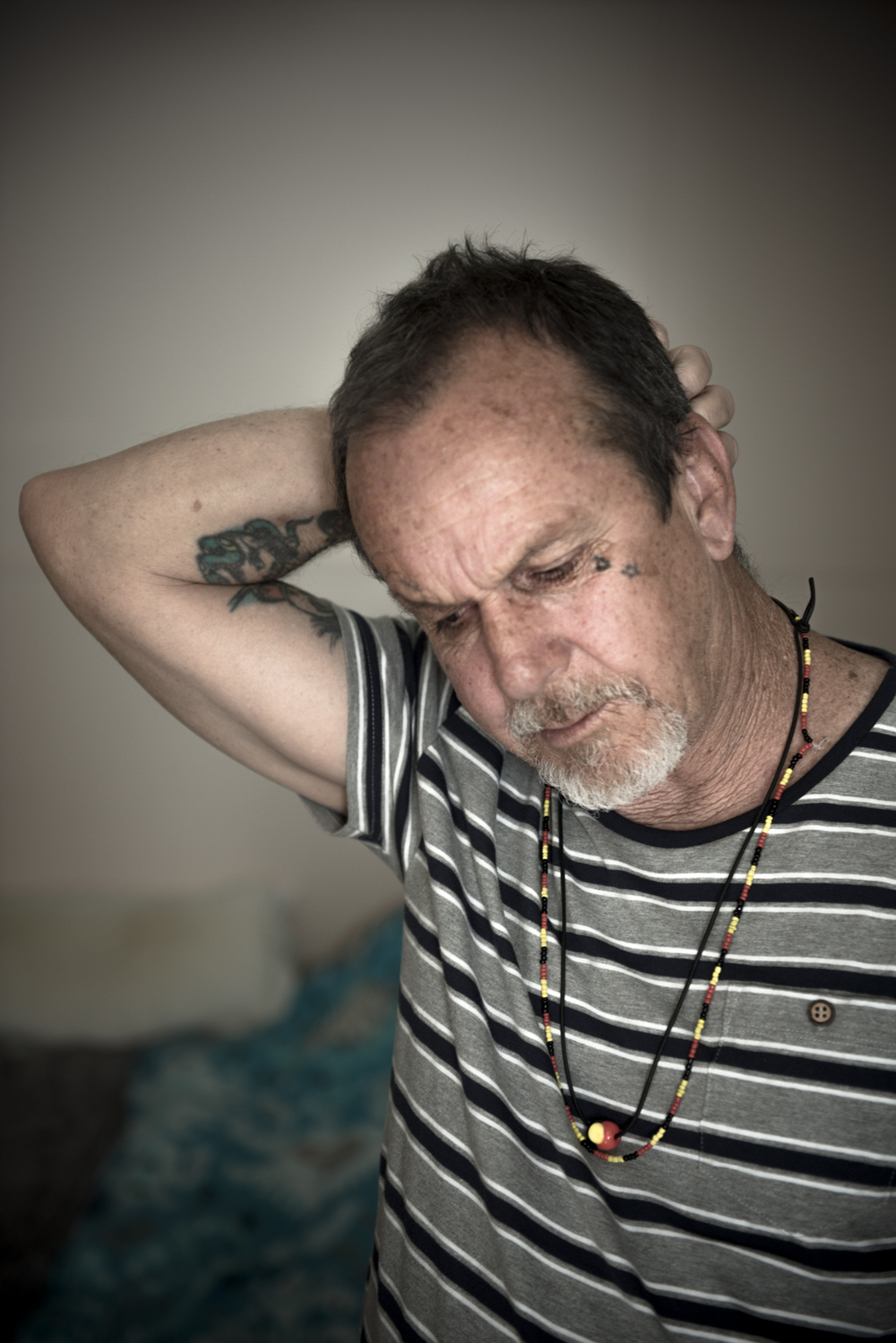
Colour photograph, interior, mid shot of Ken Canning standing in his apartment. Right hand clasped around the back of his head. He wears a striped grey, white and black T-shirt and two necklaces in the colours of the Aboriginal flag.

Credit: John Janson-Moore

KC: I know more about the world by being in there than I probably would if I was out. I know how peoples’ minds work. When you’re in there you’re seeing the most brutal aspects of mankind and you must work out how to survive. How to come out with your sanity intact? I developed some mental health issues but I learnt how to survive. When you get out, it’s worse. We didn’t do medium security or minimum security, it was all maximum. When you get out, you’re a lunatic. How do you survive that? The first few years I was completely off my head. Mad!

GS: When did you get out?

KC: In 1979. My parole was transferred to NSW. I was hallucinating, seeing things, screaming. By 1982 I was starting to calm down.

GS: Did the hallucinating start after you got out?

KC: No, I started hallucinating in jail. When I came out of the cages, I was in the mess hall getting my food, walking with my plate looking at one of the other prisoners and he turned into a creature. That was alarming.

GS: Can you describe the cages?

KC: They built six cages onto the walls in one corner of the yard where it narrowed into a point. Metal bars in front, to the sides and across the top. Small barred, rectangles joining each other.  A rough concrete floor and a seat built out of the same iron bars.  We’d get escorted down from the cells. We were in the cells at night. In the morning at about seven-thirty, the screws would drop the flap on the cell door, we’d put our hands out to get handcuffed. The screws would not enter the cell unless we were handcuffed and facing the back wall. Four small paces square. Because we were classified as intractables, they had to have a minimum of four prison officers to take one of us out.

GS: What are intractables?

KC: We didn’t accept the prison discipline and kept on escaping.  I was classified as an intractable not long after I first went to prison. That classification doesn’t exist anymore. Once your papers were stamped, intractable, they could isolate and brutalise you, put you in the cages for as long as they wanted.

GS: You were saying a minimum of four prison officers were required to take you out of the cell.

KC: Yes, the first thing they did when they entered was smash our head so our face would hit the wall. That was how every day started. Then they’d turn the cell upside down, go away and leave you to clean up the mess. They’d come back in ten minutes and escort the prisoner out of the wing, down a passage way and through the yard. The blokes in the yard were not allowed to talk to us.

Some refused to obey and would say, ‘How you goin’ Bra?’

We’d be carrying our toilet tub. When we got to the cages yard, there were three security doors to go through. The detail would grab the toilet tub and it’d be back outside the cell when we returned. Once in the cages, we’d put our hands out a little square in the door and they take the cuffs off. That was our outside time. They’d take us back about three o’clock. There was a cold shower at the front of the cages but for a while they wouldn’t let me shower. That’s why I’m fanatical about showering now.

GS: What was the worst thing about being in the cells?

KC: No space. As much as we got on together, sometimes we really got on each other nerves, wanting to kill each other. Most blokes were put in the cages for a couple of months, we were in there for years. For extra punishment, we’d be taken to the underground cells.

GS: You kept escaping?

KC: Yes, I liked to escape.

GS: Why did you like it?

KC:  It was like doing stick-ups, there was an adrenaline rush and it was defiance. There were cruel, despicable, white people in control in the jail. A hardened, inhuman bunch of people. I was not going to accept their authority over me.  I was always in maximum security. Escaping from maximum meant I only got three months on top of my sentence. Medium was twelve months and minimum was eighteen months. Every minute of every day, I’d be planning my escape. I was obsessed.

I talked to a criminologist, Dr Tony Vincent, about this. He believed that my obsession with getting out, stopped me becoming institutionalised mentally. If you go along with the daily routine and the surveillance, your mind becomes part of the system. Bodily I was pretending to go along with it most of the time but not in my mind. It was continual defiance on my part.

My initial sentence was thirty-two years. I’d just turned nineteen and I was given thirty-two years for four armed robberies. That’s unheard of. Every morning I’d come out of my cell and look at my cell card, my name, crime and sentence – thirty-two years. I was going to get out when I was fifty-one. When you’re nineteen, that’s like a death sentence. I appealed and got one of the sentences reduced to eight years so I ended up doing seventeen years, but when I was on appeal, I escaped from the courthouse. I’ve got a photo of me when I was on the run. It’s in a nightclub. I look like an office worker.

The next time I escaped, I faked a broken ankle, dropped my crutches and ran from the hospital. The time after that I turned a big garden sprinkler into a grappling hook, plaited sheets for a rope, jumped out of the yard and over the wall at Boggo Road. I escaped from maximum security three times.

Before that I escaped from police cells, and police cars, and I escaped from boys’ homes. There were a couple of attempted escapes too. One from Long Bay and one in Brisbane. I was working in the bake house in Boggo Road and watching their security when they send the bread out to the hospitals. They were slack. I got the blokes to pack me in the back of the truck with the loafs of bread. But the screws  did a random check in between gates and found me. I was laughing. If you’re busted, you’re busted.

Another time, it cost me a couple of grand but I got a little, diamond-tipped, flexible hacksaw smuggled in. I’d almost sawed through the top hinge of my door and was half way through the bottom hinge. I had no idea what I would do once I got out of my cell. Maybe I’d get out of the wing but then what? Hide somewhere until I figured out how to get out of the prison. But the guards came to do their usual check and one of them dragged his baton across the door. I was lying in bed and the door started wobbling. All hell broke loose. This was about two or three in the morning. They left me in the cell and cleared the rest of the wing out, tear-gassed it. Everyone was in the yards and it was cold. Then they came in armed, wearing their gas masks, the whole rigmarole.

I was put in the underground cells for that. They can only keep you underground for four days at a time because it’s brutally inhumane. They unscrew a big metal flap and lift it up then walk you down the stairs. There’s no light and hardly any air. Every day they give you a piece of bread and a jug of water but mix up the time so you are disoriented. Men go mad in those cells after two days and just start talking gibberish. They never came back from that. I knew some of those men. It broke them, I was afraid I might be next.

There was no bed in there just a toilet tub. I didn’t want to lay down because they don’t clean those places. People don’t always get the tub when they go to the toilet. I’d sleep sitting on top of the tub with my head against the wall. It stank and it was pitch black. If they wanted to keep me in longer than the four days, they’d wait until the middle of the day, run down, drag me up into the bright sunlight and order me to stand to attention and salute the Australian flag. I couldn’t. It was impossible. I was so disoriented and couldn’t handle the glare. So, then they picked me up, ran me over to the superintendent’s office, charge me with disobedience and took me for another four days down the hole. One time I was down there for almost twenty days.

GS: You’ve spoken about mental illness. How did you cope?

KC: I say to people, I went mad one hundred times but I came back ninety-nine times.

GS: One bit of madness is still hanging in there. When did you learn to read and write?

KC: Before I was in the cages, a whitefella, called Keith, who was in for fraud, taught me. He was a white-collar criminal but he gave the superintendent lip. One of the blokes who worked in the office told us. So, the super chucked him in our yard, Two Division, where all the ratbags were. The first day he walked in he had his hands behind his back. His hair was slicked down and he had an upper-class accent and he appeared arrogant. Normally, a bloke like that would get slaughtered. It didn’t happen. There was something about the guy and people just left him alone.

One day he sat down and asked, ‘Anybody have trouble reading or writing?

A couple of blackfellas said, ’Yeah.’

He asked, ‘You want to learn?’

It ended up he was a good teacher. He taught Aboriginal prisoners because only white prisoners could go to the education courses. We were in the middle of a campaign to change that.  So, this old bloke put the word out that we need equipment. The whitefellas who were going to the courses started knocking stuff off. Bringing back stencils and rulers and pencils. But in max the prisoners are not the only ones with instincts. The screws have instincts too. When something is going on, they know it. They were running around checking the cells then they did a big bust on Keith Edwards’ cell. It was the biggest bust they’d done for a long time. They were upending everything looking for contraband. We laughed because all they found was educational material. He went to solitary for seven days because of that.

It took a lot of years before Aboriginal prisoners were allowed education in prison. I was writing poetry by then and short stories.

The screws came to my cell and said, “Poetry’s considered a hobby and to do a hobby you’ve got to have permission. You don’t have a permission slip. This is an illegal hobby.’

They gathered up all my writing, handcuffed me, took me down to the incinerator and burnt all my work. That hurt far more than the floggings they gave me. I retaliated that night. Some of the poems were in my memory. I had a spoon in the cell and the concrete walls were old and a bit damp and soft, so I engraved a poem on the wall.

GS: Sometime after you were released, you went to UTS. What did you study?

KC: Yes, I went to UTS and studied Communications and then Oral History. Oral history became a battle in the politics of history. I was fighting to do my master’s thesis orally. I wanted to carry on the traditions of oral history in my work. They didn’t recognise oral history as history unless whatever was said, was proven to be true by someone else. After that Social Sciences developed a new master’s degree that allowed students to incorporate their cultural and socio-economic experiences.

GS: You were one of the founding members of Jumbunna Indigenous House of Learning at UTS. Tell me about that.

KC: Franny Peters-Little, Uncle Norm Newlin and I were the founders. It was called the Aboriginal Education Centre then. We did a lot of other things at UTS. The appointment of Debbie Stoddard as the first overseas students’ officer was because of a campaign we initiated. She became human rights coordinator for the ALTSEAN, the regional human rights group. We campaigned hard for more people from Non-English Speaking Backgrounds to study at UTS as well as Aboriginal students. We were responsible for the first anti-racism policy at UTS. The first policy aimed at hiring Aboriginal staff was drawn up by me and a non-Aboriginal man called Michael Refshauge.

GS: Were you one of the first Aboriginal students to enroll at UTS?

KC: There were other Aboriginal students before us but they didn’t sit it out. I finished in 1987 and I was the first Aboriginal student to graduate. Francis Peters-Little was the second. She was the first Aboriginal woman to graduate.  I graduated in 1988 and I pulled out the Aboriginal flag, wrapped myself in it, ran up and gave the black power salute. There was shock horror. Everyone was disgusted in what I did. At the reception. It was like I had spiders all over me. People just kept away. Twenty years later the University has used footage they have of that graduation to celebrate diversity at UTS. I didn’t realise they had filmed it.

GS: You published your first collection of poems in 1990, Ngali Ngalga: Let’s Talk.

KC: Yes, it was published by Breakout Press. The first poem I ever wrote is in that book. I eventually got permission to write and I wrote down the poems I remembered, the ones the screws destroyed, and I wrote other poems. A lot of those poems were rubbish some were so romantic, they were sick but writing was important to me. It was my survival. One bloke told me I had to have rhythm and rhyming schemes and all that and I was doing it but driving myself a bit mad. Then I thought oh bugger this. I was looking for words at the expense of feeling and emotion so I decided to just write what I think. I started writing my own patterns. Long lines then bang, one word. I liked that style. Sometimes it’s a bit disjointed. I like that too. Visually my poems are not square or rectangular.

GS: What is your favourite poem in Ngali Ngalga?

KC: ‘Black Baby’ is my favourite in that collection.  ‘Small soft baby, thrust from the womb . . . ‘

GS: Your second collection, Yimbanna, was published by Vagabond Press in 2015.

KC: Yes, Yimbanna means to understand. So, we’ve already talked in the first collection and now it’s time to understand. One of my favourite poems in the collection is ‘We Said.’ It’s about listening and understanding, about relationships. It’s a simple poem but deeper than what I originally thought when I wrote it. If everyone lived by this poem, we’d have world peace. You’ve got to listen to each other.

. . . LISTEN – To what
You said, I said, you said.
We both said instead,
I did, you did, I did – you.
Neither of us did,
Understand –
A word.
A sentence.
A thought.
A feeling.
A rejection.
A misperception
Of
each other.

YimbamaIt’s not about blaming anyone. There’s a degree of fault all around. It’s about solving disagreements. You’ve got to sit back and look at each other, listen to each other. All parties need to engage. I’ve learnt to develop that skill of listening and talking with Cheryl, my wife. We have definite commonalities but we don’t always think alike. At times we are opposites. Our politics can be different but we have learnt how to co-exist. We have respect for each other.
I learnt about valuing other people’s opinions from my gran. She was really against putting people down because of their beliefs. She made that very clear to me. Once my cousin, Peter, called someone, I still can’t say the word, a W.O.G, she flogged him.

She said, ‘You don’t like people calling us bad names, you don’t call anybody bad names!’

GS: How would you describe the focus of your writing?

KC: I write about a diverse range of topics. I’m an Aboriginal man in my 60s who has seen a lot of oppression, my personal experiences and the experiences of my people. I write about the horror of these experiences, our strength and our survival, about the love of our culture and I write about our respect for mother earth.

GS: There are poems in Yimbama about mental distress. One is called ‘Psychotic Serenade.’ Why did you write that poem? What was going on in your life?

KC: I was living in Merrylands when I realised I had a serious mental health issue going on. It wasn’t just episodes where I was a bit off. The doctors had diagnosed PTSD, I wasn’t sleeping and I was a bit of a nervous wreck but I hadn’t been diagnosed with anything else. I was sitting on the veranda and I went straight inside and wrote that poem to describe what I was feeling.

Sing – high sing loud
the songs of the silent
musical mayhem,
suicidal symphonies.
Sprinkle sprinkle cyanide star
now I know how disturbed you are.

That’s the last stanza.

Realising I was experiencing some kind of mental distress was one thing but getting something done about it was another thing. I was picked up a lot in the Parramatta area. The police would take me in, give me the knuckle then let me go. It escalated and I got really disorientated.

One time the police took me in and where giving me a hiding in the cells. One copper came in and told them to stop. He realised I need help not a flogging. He had joined the police force in his thirties and worked as a plumber before that so he had a different perspective to the kid who came straight out of Goulburn Police Academy.

I was in hospital for a long time and I went in and out a few times after that. One of those times I was picked up by the police again and sitting in the back of the paddy van, handcuffed and one copper said, ‘You’ll have to wait a while, these other nut-jobs are getting booked in.”

I didn’t like that. That same copper who used to be a plumber heard him and saw my reaction. He intervened and told off the other copper.

The fact that someone who I saw as the enemy was understanding was a big part of my healing. Sometimes it just takes that one person.

I was diagnosed with Schizo-affective Disorder.  But if I allow the mental health diagnosis to define who I am, I’m allowing my life experiences of oppression and brutality to define me. I have always had very strong self-awareness. The psychiatrist who treated me was a wonderful woman. She said one of the saving graces was my awareness of my illness and where it came from. She believed I wouldn’t need to be on medication for the rest of my life.

At first the doctors at Rozelle told me I’d never be able to work again. When they let me out, I agreed to come back as an outpatient but made it clear that I fully intended going back into the workforce. I got my job back at UTS. I’m not saying it was easy but I got through it.

GS: You just said, ‘Sometimes it just takes that one person.’ Can you talk a bit more about that?

KC: Every other policeman was giving it to me, but that one policeman understood. In my journey since day one, there have been a lot of strange, undesirable people but I’ve also been fortunate enough to meet some of the most amazing people you’d ever want to know. Like the late Uncle Jimmy Little.  In his life time, he was called a Living National Treasure. He was Mr Smooth in his nice suits up on the stage but at home he’d be dressed in old ragged shorts and an old singlet, eating damper and because he couldn’t find a cup big enough to drink his tea. He was a big influence on me. Jimmy wasn’t as calm as everyone thought. He was radical in his way of thinking.

He said to me, ‘If you’re going to take a hard line, don’t take a backward step. Keep to that line. It’s your path.

GS: Do you see yourself as unflinching once you take a stand?

KC: Yes, and at the same time, I’m good at identifying the enemy. The enemy is not the woman next door, not the bloke who lives up the road, the enemy is bad government. The enemy is oppressive government and people who buy into racism like the United Patriots Front and groups like that. I don’t want to focus on the bloke who’s doing his job to earn a wage. I focus on the leadership, the heads of power. Even individual coppers, I’m not going to hate them. I don’t like coppers but I focus on the system that creates and uses them. There are some coppers out there saving people, running into house fires, things like that. I forged my political beliefs and direction in prison. I learnt a hard edge but a rational edge. I also developed a softness for people victimised by the system. In prison, we witnessed people being beaten to death. In my play, Mick hears Ray being beaten to death. I heard a very close friend of mine being beaten to death in the cell next to me. That experience has never left me. In those days when a prisoner was beaten to death, it didn’t require a coronial inquiry. All that was required was a doctor’s signature on the death certificate. Like I said before, the prison doctors were alcoholics who did whatever the jail wanted. The screws told the doctor the prisoner had a heart attack and that’s what the doctor signed. So, I was hardened by those experiences but sometimes I’d sit and cry. The authorities never succeeded in crushing my humanity. But jail does snuff out the humanity of some inmates. That’s sad too.

My saving grace was writing. I was so confused when I got out. Writing saved me.

GS: How do you define freedom?

KC: When they turn that key to let you out of prison, that’s not freedom. Cuz and I found the key to freedom. After we were brutalised and kept in institutions, from a young age, where within those mechanisms you had to be violent to survive, we didn’t continue to be violent. We didn’t go out of our way to hurt anyone. The very fact that I am not a violent person means I am free.

The authorities, the state, the society failed to turn me into a monster. I am a human being. That is freedom. If they turn me into a monster, I belong to them.

When Cuz and I got out, we talked about it a lot.

He said, ‘Now we’re out, we can’t afford to inflict our anger on those around us. I know there are times you feel like just giving it to everyone in the street.’

I said, ‘Yeah, I do.’

He said, ‘Well, we can’t cross that line. If we do, the authorities, the screws, own our minds, our hearts and our souls.’

There are good white people. There are also a lot of white people who have a history of despicable behaviour against our people. For me, freedom is not allowing that to cloud my thinking, not to be pre-judgmental towards all white people. If I say to myself, every problem we have as Aboriginal people in this country has come at the hands of white invasion, so therefore every white person is the enemy, then I’m still in prison. Racism wants us to think that way. But once we think that way, we cannot have conversations. Once we cannot converse, we can’t learn what happened, how it happened, how it continues.

Freedom for me is my old gran telling me, ‘Think what you want.’

My freedom is writing. My freedom is my peace of mind. My freedom is building a good relationship.

Ken Canning was interviewed by Gaele Sobott in Glebe, Sydney, 22 April, 2017

Creative Commons License
My freedom is writing. My freedom is my peace of mind. My freedom is building a good relationship – An Interview with Ken Canning by Gaele Sobott is licensed under a Creative Commons Attribution-NoDerivatives 4.0 International License.

LOVE & SUPPORT AT REDFERN ABORIGINAL TENT EMBASSY


Creative Commons Licence This work is licensed under a Creative Commons Attribution-NonCommercial-NoDerivs 3.0 Australia License.


Gallery

WHO LET THE DOGS OUT . . .


Black and white photograph of two men, Bulldogs fans, sitting at a table on the street in Belmore. A bulldog on a leash sits under the table.


Black and white photograph of Bulldogs fans in a car. The driver is flying a Bulldogs flag out the window as he drives.


Black and white photograph of white van with 'dogs', 'doggies', 'doggy style' spray painted across the side, streamers hanging off it driving one direction and a biker driving the other direction. The street is full of fans, waving flags.


NRL Bulldog fans on Burwood Road, Belmore the day before the 2014 grand final between South Sydney Rabbitohs and Canterbury Bulldogs.


© Gaele Sobott 2014. Unauthorized use and/or duplication of this material without express and written permission from this blog’s author and/or owner is strictly prohibited. Excerpts and links may be used, provided that full and clear credit is given to Gaele Sobott with appropriate and specific direction to the original content.

ENLIGHTENING THE GATEKEEPERS… some thoughts on the Scribbler Literature Forum

Image Description: Books on a bookshelf. Titles include Persepolis, Of Grammatology, Radical Sydney, AfroCuba


One of the more well-known slogans of the disability rights movement is “Nothing About Us Without Us” – the recent closure of ABC’s “Ramp Up” accentuates the fact that there are very few of “US” in the Australian media, literature and writing sector.

For many years, South Australia was the only state to run a program, through the SA Writers’ Centre, for writers with disability. In 2012 Arts Access Victoria and Writers Victoria took up the baton by launching the Write-ability project, supporting Victorian writers with disability to develop their skills and writing careers. At the 2014 Emerging Writers Festival in Melbourne, Write-ability proudly showcased six of its emerging writers.

Accessible Arts NSW began the process of addressing the barriers faced by writers with disability in NSW by organising the SCRIBBLER – Literature Forum at the NSW State Library, on 24th June this year. I was pleased to be invited to convene this event. Writers with disability gathered together with industry professionals to hold critical conversations around what we see as key concerns. Examples of these concerns are leadership opportunities in the sector, inclusion in festivals and on writing platforms, and changing the culture surrounding disability in the arts.

The keynote speaker at the Forum, Writer and Editor, Gayle Kennedy described in detail some of the access barriers she has faced as an award-winning writer who uses a wheelchair. One example she quoted was organisers refusing to pay her carer’s airfare, which meant Gayle was prevented from attending major events:

[As a] David Unaipon Award winner ‑ I did not get to go to any other  writers’ festivals. Year in and out every award winner is invited to the  festivals. But I didn’t. I didn’t get to go to Melbourne. I didn’t get to  go to Adelaide. I didn’t get to go to Perth.

The presenters on the “Writing the Boundaries” panel gave specific examples of the discrimination that effectively nullifies or hinders equal opportunity within their chosen occupation of writing. The experiences are complex and varied. Georgia Cranko, a writer and performing artist talked about privilege and oppression in her life, “…I am often marginalised in situations, but I have been fortunate to be equipped with tools that allow me to push through that oppression and neither be crippled by it nor defined by it. My intellect has always been doubted by strangers.” She feels lucky that she can prove her capability through her academic work and writing, not only to others but also to herself. She related how the physical manifestation of her impairment sometimes offers her privilege in comparison to people whose impairment is invisible but “It also underscores the social issues that I deal with. If employers were willing to hire someone like me, I wouldn’t need to rely on the government for the pension or be terrified that it will be cut…”

Amanda Yeo, a writer from Sweatshop Western Sydney Literacy Movement, refuses to be defined by her impairment, and does not accept the limiting inspirational, tragic or superpower tropes that are used to characterise people with disability in the media and literature. She has found writing to be an excellent way to explore her identity and learn to be comfortable in her own skin. She said,

I’m not saying we should write about people who find their disability a constant factor or concern, and I’m not saying we should only write about people with disability…I’m not saying we have to write about people with disability all the time; I’m just saying write about people.

In describing our embodied experiences of trying to work within a disabling world, the writers rejected posturing on disability by writers without disability. Historically people with disability have been the objects of research, not the researchers. We have not been seen as writers but have been written about and acted upon. The obvious way to change this is for writers with disability to write about disability themselves.

Gayle Kennedy called for affirmative action in relation to creating disability leadership opportunities, and dedicated disability access and arts funding. Affirmative action is a concept that is shied away from when discussing solutions to disabling experiences of discrimination in the arts. It is possibly the idea of quotas and succession plans that scare organisations. I think there should be a focus in Australia at this time on meaningful employment targets for artists, arts managers, arts organisers and arts workers with disability. I think we should also be focusing on effective leadership succession plans for people with disability in arts organisations, especially arts and disability organisations. But I would also emphasise that affirmative actions include training programs, outreach efforts, and many other positive steps. Jane McCredie, Executive Director of the NSW Writers’ Centre suggested that writing and literature organisations should include an access component in their budgets. I would love to see the creation of a national literary prize for writers with disability. Some publishers are beginning to actively seek out manuscripts by writers with disability. Every small step is a welcome contribution to shifting attitudes, and to creating a critical mass of people with disability in key positions in literature organisations, performing on literature festival platforms, and publishing their work.

To bring about change to the disabling aspects of our industry, I think we also need to develop a more precise understanding of how gatekeepers determine who becomes literate, who learns to write, who gets funded, what the funding criteria are, who publishes, who gets publicised, promoted, invited to read. The gatekeepers are in the media, in schools, community centres and arts organisations. They are publishers, festival directors, book reviewers and event organisers. Gatekeepers may also include parents, carers and community capacity officers. They are the people who decide. They are the people who assist in forming understandings of disability, the value and often the content of our work. They form the dominant norms of the system we live in. Gatekeeping can be subtle or blatant. We hear story after story of young people with disability being told by a parent or a teacher that they can never be a writer. Many publishers are known to prefer promoting an author who fits snugly into the narrow physical realm of normalised beauty. Festival organisers prefer a writer who can travel freely without extra accessibility costs rather than a wheelchair user. By understanding how gatekeeping works we are in a better position to design affirmative actions. In terms of creating leadership that will bring about change it is already clear that writers and arts workers with disability need to access positions of power. These include positions such as publishing editor, publicist, festival director and policy maker. We need to be on the employment interview and funding assessment panel, and the board of arts organisations.

Although I’m not sure how literature as an art form fares, the Australia Council for the Arts is leading the field at the moment in providing dedicated funding for artists with disability and a focus on leadership and disability. The Council sponsored the UK based artist and disability activist, Jo Verrant’s recent talks on the transformational potential of employing disabled people in leadership roles within the cultural sector – not just for those individuals themselves, but for the invigoration of cultural strategy, and for the benefit of all. By including writers with disability we are opening up literature to diverse perspectives, writing that stretches beyond the boundaries of traditional literary form, writing that defies genre, and the way we receive and understand normalised bodies and language. Joanna Agius, a writer and Deaf Arts Officer at AARTS NSW argued the case for writing in AUSLAN and creating AUSLAN books, which brings a whole new dimension to the category of “literature”.

I recognise that discrimination is not always intentional. It can come about through fear and ignorance. In this respect writers with disability are crucial to shifting the culture that surrounds disability in the arts and in society in general. The power of literature lies in its ability to gradually shift perception, consciousness and then reality. To paraphrase the Belgian-Egyptian writer, Khaled Diab, the culture of power can at least be rattled by the power of culture.

There is a lot to be done. Many possibilities emerged from the Forum, including more genre specific discussions, regional forums, writer-with disability-led initiatives, the creation of writing resources for writers with disability, exploration and replication of the S.A. and Victorian mentoring programs, advocate/agents who approach publishers on behalf of writers with complex communication requirements, the development of diversity action plans. Many writers at the Forum commented on Executive Director of the Australian Society of Authors, Angelo Loukakis’, reference to the Women’s Liberation Movement of the 60s and 70s when “sisters were doing it for themselves”. There is a move amongst writers with disability to create their own writing groups, their own networks and their own performance and publication platforms. While writers with disability would like to find ways of sustaining these initiatives themselves, there is also a desire to agitate for taxpayers’ money to be distributed more justly across the arts.

It is essential for writers with disability, our allies in the sector, Accessible Arts NSW and industry professionals to follow up on the ideas and the momentum created by the Scribbler forum.

Sam Twyford-Moore, the director of the Emerging Writers Festival finished his presentation at the Scribbler Forum with a quote, “Festival directors are gatekeepers, but most enlightened gatekeepers take on the role because they relish opening the gates, not because they like slamming them shut. Most responsible festival directors are acutely aware of accessibility and diversity issues, and are driven by a desire to transcend those limitations, not to cement them.”

For the benefit of literature, the arts and society in general, let us now enlighten the gatekeepers. More importantly let “US” too become enlightened gatekeepers, attuned to the specific manner disability discrimination operates in the industry, and also to the form, content and location of discrimination against writers and arts workers who belong to other sections of society.

Links to organisations mentioned in this blog:

Accessible Arts NSW

Arts Access Victoria

Australia Council for the Arts

Australian Society of Authors

Emerging Writers’ Festival

NSW Writers’ Centre

SA Writers’ Centre

Sweatshop Western Sydney Literacy Movement

Writers Victoria


Video

Georgia Cranko Presentation at Sweatshop WS Artists with Disability Seminar

Highlights from the November 2013 Sweatshop WS Artists with Disability Seminar held at Writing and Society Research Centre, University of Western Sydney, Bankstown Campus, facilitated by Dr Gaele Sobott. The seminar was a chance for artists to discuss their stories and experiences, and the politics of disability.

Video

Highlights Sweatshop Western Sydney Artists with Disability Seminar

Highlights from the November 2013 Sweatshop WS Artists with Disability Seminar held at Writing and Society Research Centre, University of Western Sydney, Bankstown Campus, facilitated by Dr Gaele Sobott. The seminar was a chance for artists to discuss their stories and experiences, and the politics of disability.