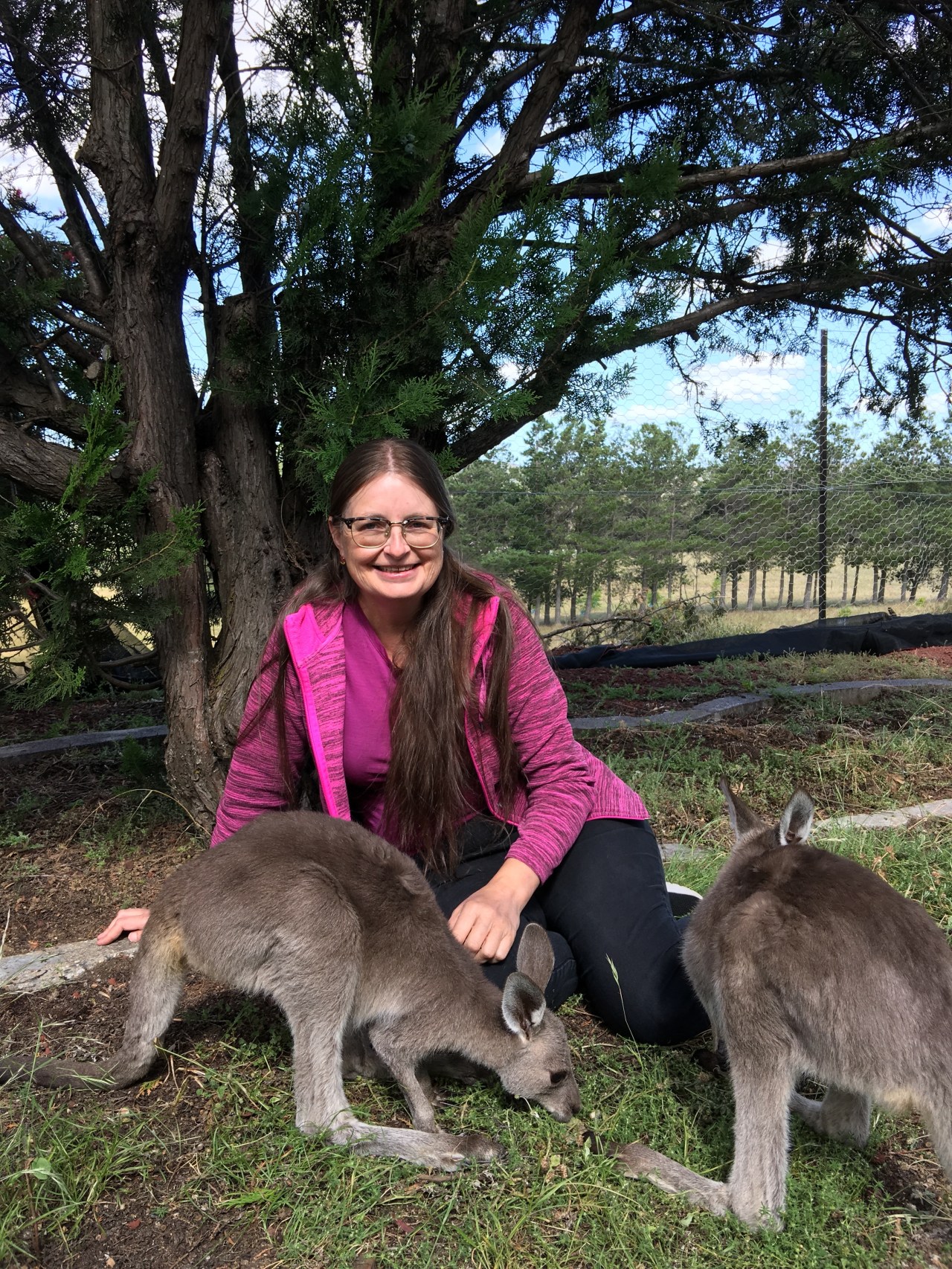
Helen Schloss sitting outside with two Eastern Grey joeys in her care. She is wearing a pink jacket and she is smiling.

An Interview with Helen Schloss

I was gobsmacked by the melted tanks I saw on telly. People lost their homes and there has been a long waiting time for them to receive assistance, especially the wait to get a roof over their heads. I was concerned by the need for water, and I thought, surely if you can build a house out of earthbags, you can make a water tank using the same methods.

Helen Schloss lives on a small property in Bywong, New South Wales, near Canberra. A primary caregiver and dedicated wildlife volunteer, Helen prides herself on her strong work ethic and animal rights principles. Some of her voluntary work includes producing ‘Tuesday Tips’ for Lucky Stars Sanctuary. Her passion drives her to help others help and protect the less fortunate.

This interview is the second of four interviews with volunteers involved in the building of an earthbag water tank at Lucky Stars Sanctuary, Bywong. Vanuatu Earthbag Building assisted in this project. They have provided free plans, support and the materials required to build water tanks for people in need in fire zones in NSW Australia, cyclone zones in Vanuatu and Pacifica.

Gaele Sobott: I believe you were the person who instigated the building of the earthbag tank. What gave you the idea, and how did you go about finding the expertise to commence this project?

Helen Schloss: I already had an understanding of the sustainability and affordability of earthbag building. I was interested in building a second home from earthbags on our property. Then we experienced the bushfires from early December 2019 and January 2020. I was gobsmacked by the melted tanks I saw on telly. People lost their homes and there has been a long waiting time for them to receive assistance, especially the wait to get a roof over their heads. I was concerned by the need for water, and I thought, surely if you can build a house out of earthbags, you can make a water tank using the same methods.  So I put a few words into Google, and one of the first things I found was the Vanuatu Earthbag Facebook page. That was early February this year. I saw a post that Liz Sherborne had written saying they had been using earthbag-building methods in Vanuatu. She noted that earthbag water tanks would be a valuable resource in fire-prone areas of Australia.  Helpful in protecting people’s properties, their lives and the lives of animals. I wrote a comment asking if they would be interested in doing a workshop down our way at some point. She instantly messaged me, and the project evolved from there. Liz said that if we could find ten people to assist with the building, they would come to Bywong. In some ways, it was serendipity.

GS: You found ten people and provided food for everybody, anything else?

HS: Yes, so I rounded up the volunteers to do the work. Initially, we were going to start building around early March, but then COVID hit, and the restrictions meant people couldn’t travel from Sydney or gather together. We had to postpone it, which meant I had to keep those volunteers interested throughout that time, sending them links and chatting with them online. 

GS: What previous organisational and networking experience do you have in gathering people together for projects like this one? Not everyone would know the importance of keeping that group of volunteers interested.

HS: I have some past experience. My family and I were in Papua New Guinea for a while, and I did fundraising events for various organisations. Maybe through the trial and error of that process, I learned that if you don’t keep your communication going, not everyone, but some people will lose interest. I’m pretty sure now, knowing this crew, if I had put them on hold and not had any contact with them, it probably wouldn’t have mattered. Most of them have got properties. Potentially they could use the earthbag building skills on their properties and help neighbours and their communities. But I believe in communication. I’m not fantastic with my friends and family. But when organising events for the animal sanctuary or for people in Papua New Guinea; the hospital there, I feel there’s a lot at stake. Last summer, it was scary because the bushfires were near Lucky Stars Sanctuary at Tallaganda forest and there were various other spot fires around the place. It was really worrying and very stressful for Kerrie and Yee, the founders of the Sanctuary. I think the contingency plan was if a bushfire reached them, they were going to stay and defend. It would be next to impossible to evacuate three hundred animals. That was one of the reasons I felt an affordable, fireproof water tank was necessary. The tank is fitted with a STORZ outlet so fire trucks can connect to it.

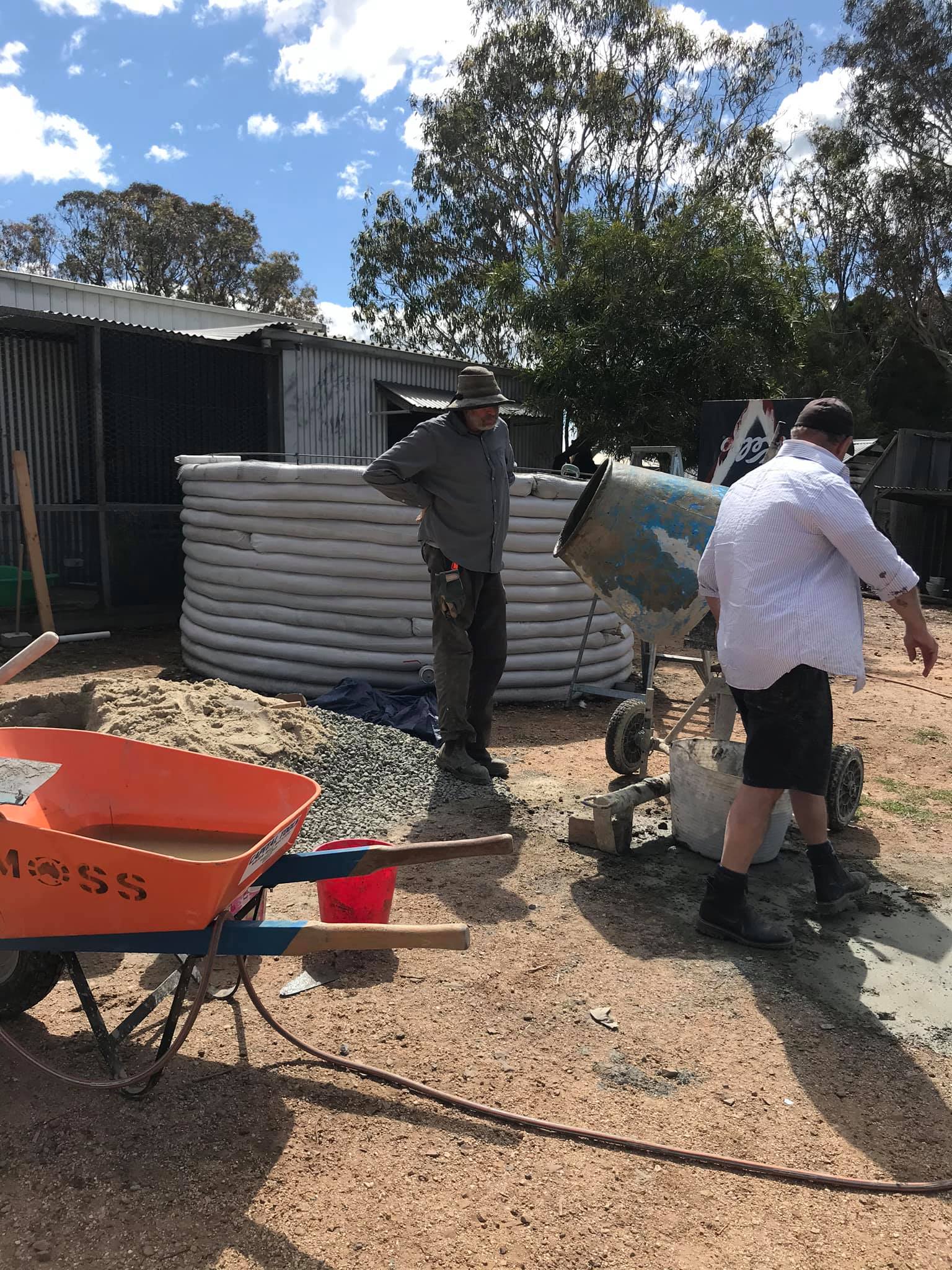
Some volunteers building the earthbag tank.

GS: How did you first get involved with the Sanctuary?

HS: In 2017, a year after they opened, I was looking for something to help my daughter, who has been unwell for some time now. She loves animals; in fact, she probably loves them more than most humans. I was looking around for animal sanctuaries and found Lucky Stars on the Internet. We live not too far from the Sanctuary, so I contacted Kerrie and asked her if she would mind if my daughter came over. I remember Kerrie saying, ‘You know it’s not just animals we look after, we look after humans as well.’ My daughter is thrilled working there and now Kerrie and I feel like we’ve known each other a lifetime.

GS: Many people who experienced the bushfires complain that they are still waiting for assistance that was promised by the federal government. I know finding funding for the Sanctuary has been a battle. How do you think a project like building this earthbag tank helps in this regard?

HS: It definitely helps. Earlier in the year, Liz was saying that they like to teach communities the skills involved in the building so that those people can pay it forward. Hopefully, one or two people from each tank-building project can do that. It is one way of getting through this deficit of government funding and developing ways to protect ourselves in the future, especially with sanctuaries. It’s really frustrating that animal sanctuaries don’t get government help, like drought assistance. That’s one way the tank building helps, and I think, also, it helps by promoting awareness. We now have an extra eight or ten people who are aware of Lucky Stars Sanctuary. Hopefully, not only do they know the Sanctuary is here, but they know that we need help from time to time. They also have increased awareness about animals, animal rights, and how tough it is for the animals, especially during bushfire season. Workshops like the tank building initiative serve to increase awareness through social media and word of mouth. More people might contribute to helping financially or by giving Lucky Stars a hand.

GS: Many community projects are continually battling time and funding constraints. People have little time to theorise about what they do, how they do it and where they are heading. How do you think we can solve that problem? How do we begin gathering the data needed to understand our impact and the choices we need to make in the future? 

HS: Hmmm, that’s a really good question. Time and money are always going to be an issue. There are various organisations and government departments that collect data, for example, the Australian Charities and Not-for-profit Commission and the Australian Bureau of Statistics. But whether it’s accessible to charities and communities … I don’t know. A tool that’s simple, affordable and standardised across the sector, could be the answer, like a smartphone app. The majority of people have smartphones now, although not everyone likes mobile apps, I guess they suck up valuable space on their phones. So maybe a website app that has the same functionality as smartphone apps. All the relevant data can be just a fingertip away, no painful paperwork and time saved as a result.

Lucky Stars Sanctuary could gather data such as volunteer info, animal health, fundraising, infrastructure problems or improvements, seasonal conditions. Even information, including photos of soil degradation would be useful for analysis, reporting, planning and decision making. It needs to be well designed, intuitive and easy to use, of course. All the data is there, no more hunting for it down the track. More time saved! Tick!

There’s an app called Farm Tracker, developed by the Department of Primary Industries. It helps farmers collect similar data, including geotagged photo diaries to monitor seasons and dam levels. Some of this information isn’t made public. Perhaps this could be retrofitted to suit charity or community-based work. Then you have the question, who’s going to commission and pay for it? Maybe the Australian Charities and Not-for-profit Commission is a place to start.

Interview conducted with Helen Schloss at Lucky Stars Sanctuary by Gaele Sobott, 11 October 2020.

Links:

Interview 1 in the series: Kerrie Carroll

Interview 3 in the series: Liz Sherborne

Interview 4 in the series: Scotty Foster

Dignity is essential. It means we are viewed by the other as a human being : an interview with Alice Cherki

A recent black and white photograph of Alice Cherki, sitting at a table, smiling.

Alice Cherki

ALICE CHERKI is a psychiatrist, psychoanalyst and author. Born in Algiers, 1936. She knew Frantz Fanon well, working by his side in Algeria and Tunisia as a psychiatrist, and sharing his political commitment during the war of independence in Algeria.

Alice Cherki has lived in France since 1965. She is co-author of the books, Retour à Lacan (Fayard, 1981) and Les Juifs d’Algérie (Editions du Scribe, 1987), and author of La frontière invisible (Editions des Crépuscules, 2009) Frantz Fanon, portrait (Seuil, 2000) translated into English by Nadia Benabid and published as Frantz Fanon: A Portrait (Cornell University Press, 2006) and Mémoire anachronique (Editions De L’aube, 2016).

Gaele Sobott: Can you talk a little about the history of your family, your place of birth and your childhood?

Alice Cherki: I was born in a family of Jewish Algerians who were in Algeria since the Romans or before the Romans. My parents were born in the small towns of Medea and Ksar Bukhari but they met in Algiers. I was born and I lived in Algiers. I am Algerian, voilà!

Some of my family are Jewish Berbers.

GS: Were there Jewish people in Algeria before the Arabs?

AC: Yes, the majority were there well before. Some came later in 1492 from Spain through Morocco, others from Italy, and then Alsatian Jews, but at that point it was already colonial Algeria.  Many of those left again and went elsewhere. But most of the Jews of Algeria had been there for a very, very, very long. Some of them were Berbers who converted to Judaism. I belong to that history.

GS: Did you speak Arabic?

AC: Very little. I’m not very good at languages. I come from the same environment as Derrida. at school, we learnt Latin and Greek.

GS: Did you know Derrida?

AC: I knew Derrida very well. He was eight or nine years older than me and that represents a big difference but yes I knew Derrida well.

Like Hélène Cixous and Derrida, my childhood was marked by the Vichy anti-Jewish legislation which excluded Jews born in Algeria, denied us French nationality, the right to go to school, the right for Jews to work in government administration. This was hugely traumatic for me as a child.

One Christmas, I was 4 or 5 years old, my teacher said, “Tell your mother that after the break you must not come to school anymore.”

When I asked her the reason, the only answer I got was, “It’s because you’re Jewish.”

I didn’t know what that meant.  So, I gathered my courage and asked, “What’s Jewish?”

She replied, “It’s you with your big eyes, big mouth and big ears.”

Each of us, as Derrida also relates, was excluded from school, our parents could no longer work.

GS: How has this experience affected your adult life?

AC: It opened my eyes to the injustices of the world in which we live; a world marked by colonial ideology.  In Algiers in the 1950s, there was no intersection between Europeans, the Jews and Arabs –  the so-called natives. I didn’t experience it at home but we were caught up in all that. I talk about it a little in my book, Mémoire anachronique.  Everyone lived in their own sphere. Some of us would meet each other outside these spheres.

During my early years at primary school there was no mixing at all. In Grade 6, there were some girls; Rachida, Malika.  For the whole of my secondary schooling I only knew of one Algerian woman student even though my school was not the most snobbish high school in Algiers.

GS: It was the same principle as Apartheid?

AC: The same principle except that it was more camouflaged. Algerians were contained in their own neighbourhoods. Even the bourgeois had their areas. The Algerians passed like shadows in the European neighbourhoods

GS: What area of Algiers did you live in?

AC: I first lived on the border of a working-class suburb, near the boys’ school, known then as Lycée Bugeaud, now it’s called Lycée Abdel Kader. Later, at the age of 17, we moved to Central Boulevard in Hydra. Our house was on a piece of land owned by my uncle –  my father’s brother, my father’s sister, and my father. After some years, they managed to build a three-storey house there for the three families.

GS: What did your father do for a living?

AC: My father traded in cereal. He carried out transactions with farmers for the export and import of chickpeas and lentils.

GS: How did your interest in psychiatry come about?

AC: Firstly, it was a struggle for me as a woman to study. After I passed my baccalaureate, even though I was from the middle-class, it was not usual for women to continue their education. Women were expected to marry and so on. I had an older brother and a younger brother and was the only girl. Neither of my parents continued their studies. My father, a brilliant student, was pulled out of school at age 16 by his father. He was the eldest of ten children There were two or three girls before him so he had to work. I believe my mother chose to leave school to get married. When she met my father, she dropped out.

My parents were both very intelligent and relatively progressive. My father spoke Arabic, but they did not have a higher education.

I already had a certain outlook on society and I was more inclined towards literature. I wasn’t a good student and had never received any awards for excellence. I was impertinent and people always told me I would make an excellent actress. With no one to advise me, in those days, if I had decided I wanted to be an actress, it would have been worse than deciding to be a prostitute. Having said that, I did later have the luck to meet many people who became involved in theatre.

So, I found myself first in hypokhâgne and then khâgne. You know what they are?

GS: No.

AC: Preparatory literary classes for the grandes écoles. The equivalent also exists in the scientific field. I was interested in studying philosophy but decided that would mean cutting myself off from the real world. I made up my mind that I wanted to be useful so I chose to study medicine. But very soon I realized medicine didn’t meet my needs. It was all about identifying symptoms and responding with treatments. I remember a teacher saying, “But Mademoiselle, you ask too many questions.”

We never say, “Why” in medicine. Instead we talk about, “How to fix it.”

So, I was part of two cultures; one of interest for human beings and their psyche, and the other a group culture which stemmed from my medical studies.

GS: Were there other women you knew of who were studying medicine then?

AC: There were a few, but they were a definite minority.

There was a saying that summarized the situation quite well. It relates to sitting the intern examination:

If you are white, European and male, you have an 80% chance of sitting the exam. If you are female and European, you have a 60% chance. If you are Jewish and male, you have a 50% chance. If you are female and Jewish, you have a 25% chance. If you are Muslim and male, you have a 10% chance. As for being Muslim and a woman, you are not even mentioned because you just don’t get the opportunity.

Some managed to study medicine or become trainees but none got to sit the intern examination, voilà!

GS: When did you meet Fanon for the first time?

AC: I was part of a youth movement called AJASS (Association of Algerian Youth for Social Action) and Fanon was invited to give a lecture by a friend of mine, Pierre Chaulet, who died recently. It was a lecture on fear and anxiety in 1955. I must have been 19 or 20 at the time and had to leave my parents’ home where I’d been living. Most of the interns at the hospital were French-Algerian and because of my opinions I faced all kinds of problems. My car tyres were punctured, my white doctor’s coat soiled, my files stolen. So, when Fanon found out I wanted to do psychiatry, he told Pierre Chaulet I should come and intern under him at Blida psychiatric hospital.

GS: So you lived at the hospital in Blida?

AC: Yes, as an intern. That’s where I met my husband, Charles Géronimi. He shared my ideas, but having Corsican parents, teachers but Corsicans, they had trouble accepting a little Jew in their family, especially my mother-in-law.

GS: What were your first impressions of Fanon?

AC: My first impressions, at 20, I found everything he had to say very interesting and didn’t think of him as black. He analysed the subjectivity of racism which was very different from the discourse of the time. On the one hand, we had Existentialism and on the other, Marxist materialism which didn’t include questions of subjectivity. It was the first time I’d met someone who was only 10 years older than me but had immense experience, and a developed understanding of these two worlds, of the two ‘ideologies’.  He was neither on one side nor the other which met my expectations, answered my questions.

GS: He had practical ideas?

AC: Yes, he was a hands-on kind of man.

GS: That’s to say, the development of his thought was founded not only on the theoretical but also on his lived-experience?

AC: On his experience, yes. And that also pleased me. It was from his lived-experience that he elaborated his ideas. But he also had very advanced psychiatric training.

GS: What were some of the work experiences during your time with Fanon in Blida that influenced your practice of psychiatry?

AC: Everything he brought to psychiatry, especially his critique of the School of Algiers’ theory of primitivism. He also introduced social therapy, institutional psychotherapy.

GS: How do you define institutional psychotherapy?

AC: Institutional psychotherapy, as developed by Tosquelles, took off in France with the support of Oury and Bonnafé. It encourages the residents of psychiatric institutions to share things with their caregivers. Through humanising the functions of these institutions, it allows understanding not only of patient symptoms but also the roots of these symptoms. There are still two or three people in France who are struggling to create places that foster institutional psychotherapy, but it is becoming more and more difficult.

GS: Why is it becoming more difficult?

AC: Because of the prevailing ideology. Now we have DCM 3, DCM 4, DCM 5. It is a performative ideology that absolutely bypasses all subjective aspects of alienation.

GS: Did you have any significant experiences in the hospital setting as a female doctor caring for patients in that historical and social context?

AC: What do you mean by significant experiences?

GS: For example, when you worked at Joinville-Blida Hospital, were there certain events that affected you?

AC: Yes, of course.

GS: What were they?

AC: So many things. For example, I saw women hospitalised after childbirth for postpartum, transitory delirium. Some doctors didn’t understand and sometimes even people in the women’s families said, “It’s the djnoun who came to inhabit her.”

It affected me deeply because  I wanted to ascertain their experience of the delivery because it influences their relationship to the newborn baby.  It’s a complicated relationship.

GS: Did you have your own children at that time?

AC: No, I had no children at the time. I now have a son who is 40 years old. He studied political science and then he got involved in theatre.

GS: So, he is fortunate?

AC: Well there you have it.

Black and white photograph of Alice Cherki as a young women. She has short, dark hair, is wearing a white, V-neck dress and a necklace, and she is smiling.

GS: As a female doctor, what were your professional relationships like with your colleagues at the hospital?

AC: Amongst us interns at the psychiatric hospital of Blida, I was considered an equal.

I married an intern from the hospital. No, I can’t say I had any problems. On the other hand, before that when I was at the Mustapha Hospital in Algiers, I was very young, I did my hair in a bun and put on big glasses to make myself look older so I’d be left in peace.

GS: Was your husband originally from Blida?

AC: No, he was also from Algiers but he was an intern with Fanon in Blida. They wrote a paper together on Algerian women and the cultural specificity of TATs (Thematic Apperception Tests).

GS: In your book, Fanon, Portrait, you mention a meeting between Fanon and Jeanson. (1)

AC: Yes.

GS: In that meeting Fanon expressed his wish to go beyond certain ideas so that readers can experience aspects of life that they could never know firsthand.  You talk about Fanon exploring the sensory dimension of language. Do you think that this approach to writing could enable us to communicate experiences around difference, to understand our differences from an egalitarian point of view – not superior or even inferior?

AC: Yes, I think this type of writing is essential. In my experience, sensory writing starts from perceptions, sensations to try to improve communication with the other, I think it is very, very necessary.

GS: Do you know any writers today who write like that?

AC: I’m not qualified to say. I don’t know today’s writers that well. But Kateb Yacine wrote like that.

GS: Do you see difference as a dialectical space that can trigger creativity and imagination?

AC: Yes, that’s what I call the relationship to the other, the recognition of the outside, the stranger. It is important. I wrote another book called La frontière invisible, in which I insist on the relationship to the other. This allows you to accept the outsider in yourself.

GS: In your book, La frontière invisible, you link psychoanalysis and politics. I understand colonial violence, violence of displacement, violence against the subject in the social context, the context of specific historical and political circumstances, for example, those of Algeria and France. But when I try to analyse this violence from a psychoanalytic point of view, I find it difficult to understand.

AC: It is complicated. But you have sought out strangers?

GS: Always, yes.

AC: Perhaps it’s not by chance.

GS: Perhaps not.

Did you know Fanon outside his work, in his family life? What kind of man was he as husband and father?

AC: Yes, of course I had the opportunity to know Fanon outside his work. I knew his wife well and I know his son very well. As a dedicated husband and father. At the same time, he was a very busy man. But he was very dedicated to his family. When his father left for Africa, Olivier didn’t see him that often only from time to time when Fanon came back from working there.  Olivier was only five when his father died.

Fanon loved life. He liked to go out to dinner, go dancing, things like that.

GS: What type of dancing did he like?

AC: All the dances of that time, le slow, the rhumba . . .

GS: Did you like to dance?

AC: It has been a long time since I really danced but yes at the time I loved it.

GS: At friends’ places?

AC: Yes.

GS: What type of music did Fanon like?

AC: He especially loved Caribbean music.

GS: And you?

AC: Back then my tastes were very eclectic. I liked the Arab-Andalusian, Jewish-Andalusian music right through to Bach, Beethoven, Mozart and then Jean Ferrat, Barbara, Montand. More and more now I love Musique Concrète.

GS: Tell me more. 

AC: When I was a psychoanalyst, I was working very hard. In the evening, when I had finished working and my head was full of words, words, words, I’d play the likes of Kurtág and Blériot. The music is largely based on the sonority of the human body. It defies the normality of melody. It’s best to listen to it alone. There are not many people who love and desire that genre of music. It scares them.

GS: What kind of a sense of humour did Fanon have? What made him laugh?

AC: He had a great sense of humour, Fanon. It was humour that made him laugh.

GS: People who are very involved in revolutionary struggle often dedicate huge amounts of time and energy to the cause, and I suppose that doesn’t allow them to be very good parents.

AC: That’s true, yes. Especially at the time because the people involved in the struggle were very young.

GS: Have you met children whose parents were not only very involved but who were tortured, wounded or killed as part of the struggle?

AC: Yes, children who became orphans.

GS: Regarding the children of revolutionaries, what observations have you made?

AC: It was very variable. For example, Fatma Oussedic, her father was a great militant and she has good memories of her relationship with him. In addition, many families did not only consist of the father and mother, there were, aunts, uncles, cousins etc. They weren’t nuclear families. If we’re talking about orphans this helps a little. But when you see your parents killed before your eyes, that’s not the same thing. As for the children of the surviving revolutionaries following independence, the notion that their fathers are heroes has weighed heavily on many of them.

GS: Would you mind giving me a brief definition of your concept of alienation and the ways it may be experienced in countries marked by colonisation.

AC: That’s a big question. Both the coloniser and countries who achieved their independence, like Algeria, deny in various ways the colonial wars that have taken place. Algeria swept a large part of the past away by claiming the national story begins at the time of Independence. Generations have been taught that they have one history, one language, one origin. This kind of discourse has done a lot of damage. There are many young people who now don’t know who they are.

GS: How does that manifest psychologically?

AC: It varies considerably and is different in Algeria and in France. Here in France these young people are excluded from participating in the inner circle, In Algeria they are divided. There is group of social conformists who represent the youth, and another group of which no one ever speaks but which gnaws away at the heart and soul of the country.  Young people are suffering a great deal, even those who are socially successful. Many young people ask, “What was Algeria like before 1962?” Many are Berbers. The heterogeneity of their roots has been hidden from them. It is as if these roots don’t exist but they are longing for what I call multiple identification … not to be cast in a single mould.

In France there are many young people who describe their lives very well and write novels. Some are very interesting, written in the language of the suburbs. For example, Sabri Louatah, Les Sauvages.

GS: What is your definition of dignity, especially the dignity of colonised people, people considered mentally ill or disabled?

AC: Dignity is essential. Dignity means we are viewed by the other as a human being.

GS: In revolutionary situations, when a group of people can no longer withstand massive pressure and extreme violence, they react violently to create a change in the power structure. This changeover is often quick, lasts for a moment, the objective is specific: to get rid of the immediate cause of the violence that oppresses them. Beyond this moment of revolutionary violence, what measures do you think people can use to get rid of the everyday violence that continues?

AC: Firstly, to speak.

GS: To whom?

AC: Speak, tell, write. . . I think there are many forms of expression, of creation. Because we must get by. We must get out of the stupor. The essential thing is to get out of it, including through collective struggle.

GS: What for you is the most urgent task required to change human relations in the future? What needs to be done to update and develop new definitions of power?

AC: We need to do work in many areas if we are going to change human relations and bring about new definitions of power. Each person should focus on their own domain, the place where they live. It’s true, like many people, I feel I am very active and committed. At the same time, I denounce all modes of liberalism and things like that.

GS: How do you define liberalism?

AC: It is being governed by financial capitalism which transforms the subject into an object.

GS: Is it enough to denounce? Sometimes I get the impression that it is useless.

AC: I know it well. Organisations are important. There are organisations, people who are militant. I am fortunate to have a son, and nephews who are politically engaged in their fields. Me, everyone knows my positions, my writings. My son works in theatre. They go to schools, to high schools. I am not against the revolution.

GS: Do you think that as individuals, we are afraid of revolutionary violence, afraid of revolutionary confrontation?

AC: It depends. There are many people who are afraid of violence. In my case, I’m not afraid. Many French people want to stay in their little cocoons. In Europe, the French are very much like that, withdrawn on their plots of land, and yet they made a revolution.

But I believe violence is . . . for example, what happened in 2005 in the housing estates, with Sarkozy insulting everyone. People called them riots but I called them revolts. Those young people were not afraid.

GS: It is temporary, a moment?

AC: Revolution is always like that. It’s a moment. But moments that produce difference. Every revolutionary moment must be seen as the introduction of change.

GS: Even if it takes a long time to get to that point.

AC: Yes, like psychoanalysis.

GS: Why did you choose to become a psychoanalyst?

AC: Because I found it was the best way to understand the psyche and help people. It’s exciting, I love it, yes, I like it very much.

GS: You must undergo psychoanalysis for several years to be a psychoanalyst?

AC: Yes, you do. It’s experience. You see, even you talk to an 80-year-old woman who is a psychoanalyst and it’s fine.

GS: Yes, it’s been good.

AC: I have lots of stories to tell. I am attentive to other human beings.

GS: Ah yes, but not all psychoanalysts are like you.

AC: That’s true.

GS: Did you have any conversations with Fanon about the ‘Jewish question’ or the events that led to the establishment of the State of Israel?

AC: Of course, Algerian Jews, like myself and Jacques Azoulay, worked with Fanon in Blida. Fanon had very close Jewish friends in Tunis. The subject of the establishment of the State of Israel was far from our concerns. Fanon was profoundly atheist. I, too, am an atheist. We were part of the struggle for Algerian independence, there was never any conversation about the existence of God for example. Those questions and discussions were not on our radar.

GS: But religious discourse was there nonetheless with Messali . . .

AC: Oh, yes. Those discussions took place within the independence movement. It was very heterogeneous. There were plenty of different poles of thought, different ideas. For example, Fanon, returning from sub-Saharan Africa, jokingly said to his colleagues, to the revolutionary friends of the mujahidin, that they should follow the example of Islamic Africans, their wives can walk topless. He said that jokingly. I mean the issue of Islam as a fundamental direction was probably underestimated, but religion was not ubiquitous in our workplace. I think, even Messali, he was for independence from France, he was married to a French woman, he wasn’t a religious Iman.

GS: When and why did you leave Algeria? Do you consider yourself a woman in exile?

AC: I did not really leave Algeria. I settled in Paris but with frequent trips to Algeria and back. I’m not in national exile and I think exile of the psyche is the hallmark of any successful human life.

Notes:

1. Alice Cherki refers to a meeting  between Fanon and Jeanson in her book, Fanon, portrait (Seuil, 2000), however the English translation, Fanon: A Portrait, (Cornell University Press, 2006) refers to a letter.

Alice Cherki was interviewed by Gaele Sobott in Paris, 26 September 2015 and by email between 18 and 20 November 2016.

Translated from French by Gaele Sobott

Creative Commons License
“Dignity is essential. Dignity means we are viewed by the other as a human being”: an interview with Alice Cherki by Gaele Sobott is licensed under a Creative Commons Attribution-NoDerivatives 4.0 International License.
“I Think of Dance as My Most Honest and Purest Form of Expression . . .” An interview with Christelle Dreyer

Christelle Dreyer1

Credit: Marike Van Wyk

Christelle Dreyer is a freelance graphic designer and dancer who lives in Brackenfell, Cape Town.  She took up competitive ballroom and Latin dancing in 2004, then moved onto contemporary dance in 2010, performing in Dance Joint produced by Jazzart Dance Theatre and choreographed by Jackie Manyaapelo,  Infecting the City, choreographed by Tebogo Munyai, and Unmute Project, choreographed by Andile Vellum. She has worked on projects with various dance companies, including Jazzart Dance Theatre, Remix and Unmute. She recently performed in No Fun ction alL anguage, at South Africa’s National Arts Festival 2016 in Grahamstown.

Gaele Sobott: How did your passion for ballroom and Latin dancing initially develop?

Christelle Dreyer: As a child I loved listening to all kinds of music and watching people dance. I can`t really recall exact dates, but Jazzart Dance Theatre came to my school and I was lucky enough to be chosen as one of the kids to be part of a performance. It opened me up to realising that I actually could move and not just be on the side admiring people as they danced. After that I started Ballroom and Latin dancing.

GS: What then led you to contemporary dance?

CD: I started taking open dance classes as a way to keep fit and do something different. I enjoyed it so much I never stopped.

GS: How did you become involved in No Fun ction al Language?

CD: I received a phone call from Danieyella Rodin who works at The Chaeli Campaign, the organisation that produced No Fun ction al Language. She asked me if I’d like to audition for the show and then emailed me all the relevant information. I contacted Jayne Batzofin, the director, who was conducting the auditioning process over a two week period. So I auditioned and got a part in the show.

GS: Who are the other performers in the show?

CD: Andile Vellem Daniel Mpilo Richards, and Iman Isaacs are the other dancers. Dave Knowles is the musician.

GS: Tell me about your experience of working on the show.

CD: No Fun ction alL anguage has been an exceptional experience and an amazing opportunity. From the start of the creation process to the final production and the moments in between it’s been an incredible process of growth and discovery.

Jayne Batzofin and the cast, everyone involved, have been so open-hearted and open-minded. Some of them, before meeting me, hadn’t had any interaction with a disabled person but the way they approached the idea of disability is no less than amazing. I would like to think that we have become a little No Fun ction alL anguage family. I feel blessed to be part of the team. Together we created a work that has stimulated discussion around what happens if we don’t have the right words or any words to share our thoughts, discussion about our desperate search for meaning and about inclusivity for all members of our society. Each chapter of No Fun ction alL anguage encouraged different thought processes and emotional dialog within me. It was great being in a position to explore these things through performance. The response from audiences has been more than overwhelming.

GS: How did you contribute to the choreography of the piece?

CD:  When Jayne choreographs she uses a theme then allows us to improvise our body movements in relation to the theme. So we generated new movements and material. These were then incorporated into duets or into the larger choreography.  In chapter five of No Fun ction alL anguage, for example, that entire solo was created by me, and Jayne refined and detailed some moments.

GS: Please describe what Chapter Five is about.

CD: Chapter Five was about deception. How you experience deception, what it means to us. I looked at the emotions we feel when we are deceived and when we deceive and worked on translating that into movement. So Daniel explored the act of deceiving someone. His character was saying, “I love you” but not meaning it. Andile and Iman looked at how you can deceive yourself, and I worked on how sometimes you want to believe the deception. You know you are being deceived but you want to go ahead, for example, you believe that person loves you. So the choreography I developed was communicating that process of trying to hold on to what you know is not true but what somehow is pleasurable. Well it would be pleasurable if it was true. You try to hold onto that pleasurable non-reality for as long as you can. So my choreography was very quiet.

GS: How did you translate quiet into movement?

CD: Slow and controlled, under the radar.

GS: I think it was Silence, the chapter where you were on your back and moved your leg up very, very slowly.  That was a powerful moment.

CD: Yes that took extreme concentration, and the right breathing.

GS: Do you have control over your safety during the creative process?

CD: Complete control. If my body doesn’t want to do something, I don’t. But I try new moves. If that doesn’t suit me, I say so. I know what my body is capable of. Anyone who works with a disabled dancer knows that there are certain traditional ways of dancing that may be impossible. It’s a fine line between a director knowing when to push and when not to push you. At the same time you don’t want a director to be patronising and not get you to push boundaries.

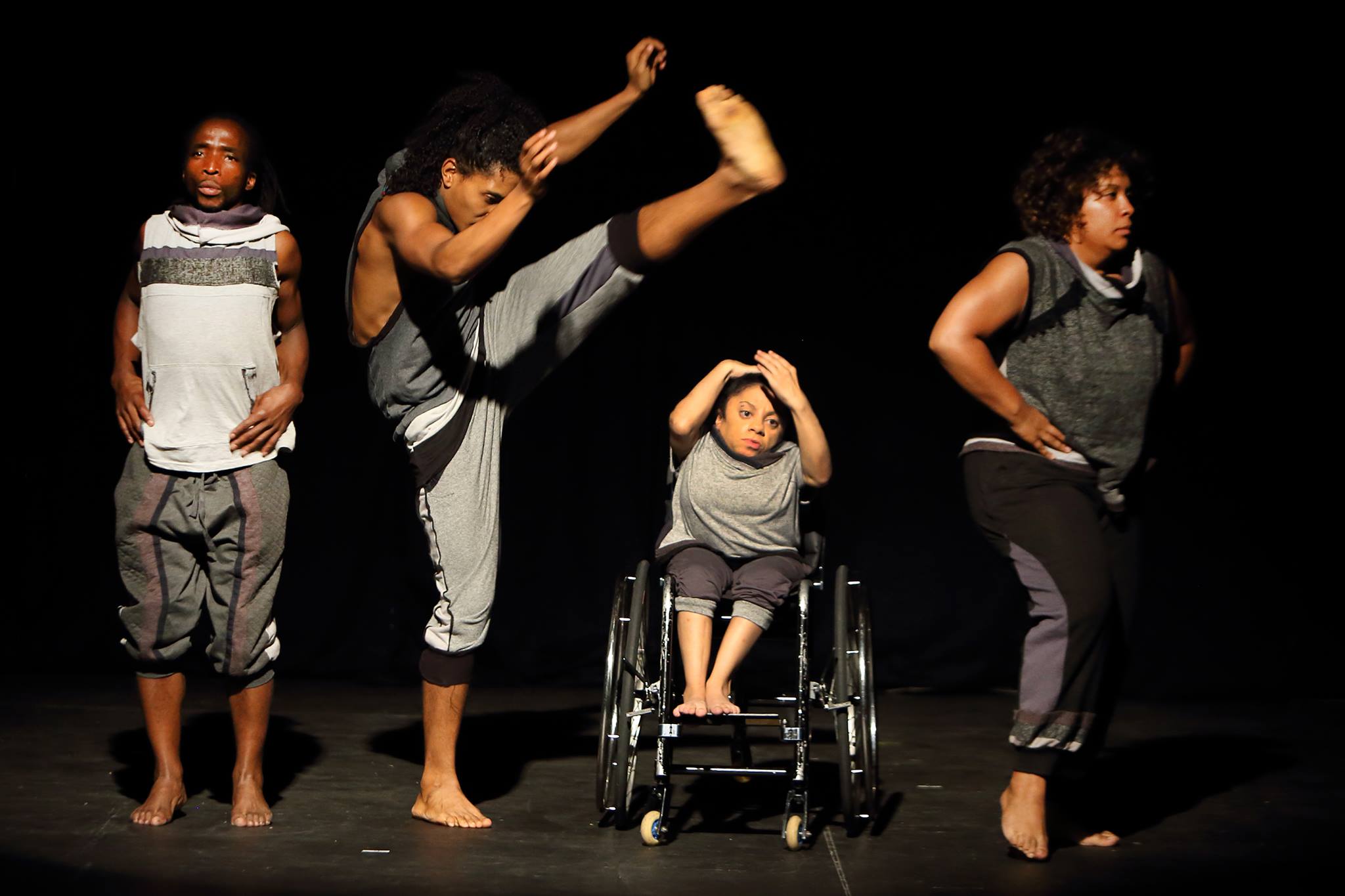
From left to right, two male dancers, one standing facing audience, the second lifting his arms and one leg high over the third dancer who is seated in a wheelchair. She leans away from him and holds her hands on her head. The last dancer, a woman, stands facing the away from the other dancers. They are all dressed in casual pants and tee shirts in various shades of grey.


GS: How do the themes of language and communication addressed in No Fun ction al Language relate to you personally?

CD: For me communication takes on many different forms. I think of dance as my most honest and purest form of expression and communication. In those moments of dance, the movement and the spaces between movement, I find what I really want to say to the world. I also communicate as a graphic designer. My work tends to be minimalist, which I feel expresses my easy-going personality.

I think the way I communicate with others is largely determined by the circumstances I’m presented with. For example, the way I communicate with Andile Vellem, who is Deaf, is different to how I communicate with the rest of the cast. My sign language is very bad, but somehow it’s often easier to convey information to him than to someone who can hear, other times we have big gaps in communication. I really need to work on my SASL (South African Sign Language). As far as spoken language goes I am fluent in English and Afrikaans. Not really sure about fluent as my vocabulary is not that large, in my mind at least. I find it difficult to learn new languages. But also I realise the value of discovering new forms of communication and maybe just maybe, I will be putting pen to paper more often.

GS: Afrikaans and English. How do these languages figure in your life? Do you consider either of these languages as your first language or mother tongue?

CD: Both languages are equally as strong as each other in my life. My parents raised me speaking English and I went to an English-speaking school but my family, my parents, aunts and uncles, also speak Afrikaans, and my community.

 GS: Afrikaans has historical significance in the context of the ant-Apartheid struggles and the 1976 student uprisings against the Afrikaans Medium Decree. Do you think the language still represents an oppressive force for some people? Tell me more about what the language means to you.

CD: I was a bit too young to fully understand what it was like during Apartheid. I don’t really have the experience. My parents are the ones who know about what happened then. But from what I observe now Afrikaans is becoming a more general language in Cape Town. There are a lot of Coloured people who speak Afrikaans but it’s a bit different to the way White people speak the language, not pure like in the text books.  Coloured people have their own slang, and it’s more musical. Also the humour in the way Coloureds speak the language is different. I enjoy that humour.

GS: What are the elements of your identity that have remained steadfast over the years, what has changed?

CD: Well my identity is not something I really think about in great depth. Apart from the more obvious things like the fact that I am a Coloured disabled artist. I think I have always been open to experiencing different things. Perseverance and persistence is something I’ve always had and I have a feeling that will not change anytime soon.

I never understood myself as unique. That was partly to do with me being a twin. I am a twin but actually my sister and I are completely different.  My immersion in creative processes demanded that I explore my sense of self. So that definitely helped me realise and embrace my uniqueness.

GS: I was recently at an event where the writer and journalist, Sylvia Vollenhoven was talking about her book, The Keeper of the Kumm. She said, you can be Zulu or Xhosa and it defines to some extent your history but Coloured is a more general term. She feels that people who identify as Coloured are largely excluded from the narratives of nationhood that South Africa is now constructing. What does this part of your identity mean to you?

CD: There are lots of divisions and classes in the Coloured community. The way you live as a Coloured person, where you live, the way you identify, the way you’re brought up. Generally yes, a Black person has a very strong sense of identity. The backstory of being Black or the backstory of being White is usually solid where they know their granny’s granny’s granny.  Many Coloured people haven’t answered the questions, Who am I? What is my history? Where do I belong? Like what exactly is a Coloured person? Yeah, it’s complex. I don’t think Coloureds really know how to define themselves. They don’t have resources to draw on. Like me, I don’t know the history of my grandparents or beyond them.

GS: Why do you think that is? The reasons why you don’t know?

CD: Maybe because the past has been painful and people haven’t wanted to talk about it. But I’m lucky at least I knew all my grandparents. I only have my grandfather left. He has dementia now so I can’t really ask him about our family history. My father’s parents died many years ago. My mother’s mother, Ma Yvonne Lopes, played a big role in encouraging me to be confident and proud of who I am. She was an amazing grandmother. My mother too, she instilled certain values in me and I don’t give her enough credit for all my successes. I am content with who I am and where I am in my life. My friends and family keep me grounded.

GS: Elaborate a little on your identity as a disabled artist?

CD: I was diagnosed with OI (Osteogenesis Imperfecta) when I was a baby. My sister also has OI, I mention this because I always get asked since we’re twins. Because of my OI I spent many of my childhood years with broken bones or in hospital. My mother has lost count of the number of operations I’ve had, at least twenty.  The amount of times I’ve broken my bones seems endless. My tolerance to pain has become so high that most of the time I don’t realise I have a broken bone and in some cases more than one.  I was born and grew up in Cape Town with my parents. I’ve always been surrounded by family and friends so apart from OI issues I’ve had a very normal childhood.  OI is one of the many layers that shapes who I am. I Matriculated in 2004 and started studying Graphic Design at Cape Peninsula University of Technology in 2006. I graduated with a Baccalaureus Technologie in 2011. During my years as a university student I never stopped working on my dance goals and dreams.

GS: Can you describe any barriers you have encountered as an artist with OI?

CD: The strangest thing to me is that artists are generally more open to individuality and people expressing their uniqueness. But somehow when people see disabled artists they have this preset idea that disabled people cannot produce the same high quality as them. I am not saying it is all arts practitioners and audiences but that bias is there. Yet in many cases the standard of work produced is of equal quality or even better.

I have experiences where I would go for graphic designer interview and I’d be told they could not hire me because I was not what they expected but I have a very good CV and portfolio. I don’t put the fact that I am disabled in my CV as that should not be the measure as to whether I get the job or not. Of course they know they can`t say to my face it is because I am disabled that they will not hire me, so they come up with polite and creative ways to tell me. It really is not fair.

It’s very satisfying when I get to prove people wrong and exceed their expectations of me as an artist. Like after performances of No Fun ction al Language when audiences are left not only in awe but with different perspectives of disability.

GS:  How did you find disability access at Grahamstown National Arts Festival 2016? What changes would you like to see?

CD: I feel that disability access was not taken into consideration at the Festival. This is really disappointing as there where disabled artists on the festival program. There is so much said in South Africa about human rights and treating people as equals, yet the basic needs of people using wheelchairs, deaf people, blind people are not being considered. I’m blessed to be able to walk for short periods of time, but what about disabled people who can`t walk at all and need their wheelchairs to get around? Access is not just needed for artists but also people attending the festival, audience members. It’s a national festival, disabled artists and audiences should be welcomed, not excluded.

I think disabled people are standing up for themselves more than in the past and that they are being integrated as part of their communities so much better. There is still however a long way to go.

Grahamstown National Arts Festival 2016 – No Fun ction alL anguage Trailer

This interview was conducted 21st July 2016

Creative Commons License
“I Think of Dance as My Most Honest and Purest Form of Expression . . .” An interview with Christelle Dreyer by Gaele Sobott is licensed under a Creative Commons Attribution-NoDerivatives 4.0 International License.
In Memory of Lauretta Ngcobo 1931-2015

Front cover of book. Close up photo of woman's eye, nose and mouth in orange tones. Title - And They Didn't Die Autor - Lauretta Ngcobo


Lauretta Gladys Nozizwe Duyu Ngcobo (née Gwina)  was born in the southern-most part of KwaZulu Natal in 1931. She was the first girl in a family of four. Her mother, Rosa Fisekile Cele, had a difficult time with the birth. Lauretta wrote,

On the night of the second day, my grandfather, who knew the white doctor personally, had managed to persuade him to venture into the black reserve, by night, to save the life of his elder daughter and her unborn child. And so he did.1

Lauretta was born into a family of storytellers, growing up in a rural setting where she valued her exposure to oral literary traditions. Commenting on how poetry informed all occasions she said,

It was performed to honour kings, to welcome newly born babies, and to rock them to their sleep. It is sung at weddings, at funerals and at war. It even heralds peace.2

She recalled her mother relenting in family arguments and reciting poetry at the doorway of the ‘great house’, ‘the maternal family line first, followed by the paternal line’ until the grandmother nodded her head and the argument was over.3

Lauretta’s mother would tell her African folk stories. Her great-grandmother narrated episodes of Zulu history. She composed poetry about her painful life as the least-loved wife of her husband’s four wives. She also created poetry for each child in the family including Lauretta who used to cry as a baby. ‘Apparently I had a very sharp voice . . . My poetry imitates the honey bird which is very insistent.’ 4

When Lauretta was seven years old her father, Simon Shukwana Gwina, died. Both he and Lauretta’s mother were teachers. Lauretta’s mother became the sole breadwinner in the family. Despite the difficulties, she was determined that all her children would be educated regardless of their gender.

The public openly condemned us, girls, who ‘demanded’ the same privileges as boys. In a family where mother had never made us aware of the preferences, the remarks were not only hurtful, but created a throbbing consciousness of one’s burdensome value.5

Lauretta went to primary school in Webbstown and Nokweja. In 1944 she was at a boarding school run by American missionaries in Dumisa and then in 1946 she went to Inanda Seminary. At home, she had gained a knowledge and interest in English literature and history from her mother.

My mother got me interested in her favourite writer, Montgomery, Anne of Green Gables. Her stories became my favourites too. From her I learned about Henry the Eighth. I was very fond of Thomas Hardy and his stories of rural England and I liked Charles Dickens.6

She enjoyed school but began to sense a ‘silent disapproval of the barefoot life-style and art that was part of my whole way of life’. The ‘borrowed culture of city girls’ was the dominant ethos and she found herself caught in a ‘tug of warring cultures’. She described how she felt a ‘disfigurement of outlook, a mutilation within’, a conflict that ‘persisted even against the most arduous efforts to strike a balance’.7

In 1950 Lauretta attended the University of Fort Hare and obtained a BA in Psychology, and Zulu Language and Literature. She also studied for a postgraduate University Education Diploma. Fort Hare had a ‘ratio of thirty-five women students to five hundred men in those days. In some classes the preference given to male students was disarming.’ 8

Her first job as a teacher was in Pietermaritzburg in 1954. One year later, she took up a position as a scientific research assistant for the CSIR. In 1957 she married Abednego Ngcobo and in 1960 went back to teaching in Durban. Lauretta always enjoyed writing. She wrote a number of articles and books which she discarded or burned mainly due to her assumption that nobody would be interested in reading anything she had to say, ‘not the men’ and not the ‘white people’.  She stated,

I don’t think I know why I write, I just know I must. I scribble a lot that I know will never be read by anyone, for since I was a little girl by conditioning, I never expected anyone to read anything that I wrote, outside my classroom assignments. I feel the need to communicate with myself. It is a duty to myself. Yet, by its very nature, writing is an outgoing channel of communication, no matter how private.9

She saw the Bantu Education Act of 1953 as the greatest limitation on Black writing in South Africa. 

Cut off from the mainstream of world literature which could otherwise act as a model and an inspiration. I have shared these limitations with all Black South Africans whether male or female.’10

Lauretta’s husband was imprisoned in 1960 for his political activities in the PAC and the Sharpeville uprising. In 1963 she was forced to leave South Africa.

I learned that there was a plan to have me arrested. It was the month of May. I had to escape and leave my two children with my mother. I decided to leave at once: the next day, at five in the morning, the police burst into my house to get me. I made it by the skin of my teeth.11

She spent the first six years of her exile in Swaziland and Zambia where she worked as a teacher. Her children were later able to join her in Swaziland. The family moved to England in 1969 and Lauretta began teaching in London at Tufnell Park Primary School. She then taught at Lark Hall Infant School where she became Deputy and then acting Head. She also began to write, spending ‘hours pinning my episodes together at the seams. I cannot think of a more time-consuming way to write . . . I had no time limit to my expression and no deadlines to meet.’ 12

In 1987, her novel, Cross of Gold, was published and time became very important her. She was invited to talk and write essays on a wide range of subjects,

I had to read a lot more widely. This factual diet does little for my creativity – especially considering how limited time is between my teaching job, my ‘factual’ reading and speechifying and creativity. What I need as a writer, more than anything, is time.13

Cross of Gold is told from the perspective of a young, male activist, Mandla. The women characters are silent and isolated. The only active, strong woman, Sindisiwe, dies in the first chapter of the book. She is shot by the South African border police while trying to flee apartheid South Africa into Botswana. Reflecting on the many questions that came from women readers, Lauretta realised that although she was actively occupied with gender issues in her life, ‘it hadn’t occurred to me that the book was not about me, was not about Sindisiwe, it was about a man!’14 She felt that this was a product of her socialisation and began to think of her construction as a rural, black South African woman growing up with the migrant labour system and the absence of men. ‘I was brought up by women. They were strong, independent and silent . . . it was inescapable that I should turn out very much like them: fertile and rich from within but silent or barren from without.’15

Lauretta edited a collection of essays, stories and poems, Let It Be Told: Black Women Writers in Britain, published in 1987.  The book aims to ’embody a largeness and a continuity’ extending beyond conventional race and gender stereotypes.16 She included a detailed introduction, an essay on her life and writing and an extract from Cross of Gold. In 1990, she published her second novel, And They Didn’t Die. Lauretta said,

I hadn’t written about women successfully, but at the same time I knew all about women. As I had shared so much of their pain, it could be that that was one of the reasons why I could write a different story in And They Didn’t Die.17

She presents active women characters and portrays the solidarity and strength that binds rural Black South African women. It is through the life of Jezile, a young rural woman, that we are made aware of women’s experiences under apartheid and the migrant labour system. Traditional Zulu power structures, especially that of the mother-in-law, and patriarchy are also problematised in what is a tragic yet tender tale of deep love, human strength and resilience. Her children’s story, Fiki Learns to Like Other People, published in 1993, is based in Southern Africa and aimed primarily at children learning English as a second language.

Lauretta taught Black Women’s Literature on a part-time basis in the Department of Extra-Mural Studies at the University of London. She lectured in Britain, the United States, Italy, Holland, Sweden, South Africa, Botswana and in Zimbabwe where she spoke on the problems of women in publishing at the International Book Fair. She published various essays under the name of Nomzamo. Her article, ‘Four Women Writers in Africa’, was published in South African Outlook in 1984. ‘Black African Women Writers’ was published in Cambridge Journal of Education in the same year. She wrote,

In our modern world, when women assert their right to self-determination and self-definition, it has become urgent for the African woman to write, to reverse the long-established opinions and beliefs that are prevalent today. It has become imperative for our schools to approach African women with enlightened curiosity. It is in the classrooms of our changing world that people must learn about the African women from the authentic voices of the African women themselves.18

In 1985 Kunapipi published ‘The African Woman Writer’, a speech given by Lauretta at the African Writers’ Conference in London in 1984, and an essay entitled ‘My Life and Writing’. ‘The Plight of Exiles’ appeared in African Concord and in 1990 ‘Black, Female, British and Free’ was published in For a Change. For many years Lauretta was president of ATCAL, the Association for the Teaching of Caribbean, African and Associated Asian Literatures.  She said, ‘We sought to persuade the Department of Education and Science through the inspectorate, to introduce into the various syllabi some text books from these rich literature sources.’19 She was also a founding member of the African women’s organisation, Akina Mama Wa Afrika which produced the journal, African Woman.

Lauretta felt strongly that ‘African writing should draw more from the African traditions of oral culture. I have not done much myself in this way but I feel it ought to be the way my writing goes’.20  She would like to write fictional works based on the lives of some of Southern Africa’s women leaders and spiritualists. After thirty years in exile, she returned to South Africa. She worked in education, and served on the KwaZulu-Natal provincial legislature until 2008.  It was in this year that she was awarded the Order of Ikhamanga by the South African government in recognition of her literary achievements. She edited an anthology of exiled South African women writers, Prodigal Daughters published in 2012. Lauretta Ngcobo died in Johannesburg on the 3rd November 2015. She is one of South Africa’s literary pioneers. A writer who fought tirelessly to give voice to her people, to Africans, to people of the African diaspora, to Black women. She specifically represented the experiences, resistance and power of Black, South African women. 

Hamba Kahle Mme Lauretta Ngcobo

Notes

1 ‘My Life and My Writing’. Kunapipi, Special Double Issue Colonial and Post-Colonial Women’s Writing, 7, 2 &3, 1985, p.83 Lauretta Ngcobo has published two articles entitled ‘My Life and My Writing’. One published in Kunapipi and republished in A Double Colonization: Colonial and Post-Colonial Women’s Writing, eds. K. Petersen and A. Rutherford. Oxford: Dangaroo Press. 1986 and another published in Let It Be Told, ed. Lauretta Ngcobo, London: Virago. 1988. The two articles are different.
2 ibid p.84
3 ibid
4 Interview with Lauretta Ngcobo’ by Anissa Talahite, Journal of Gender Studies, 1,3 1992, p.317
5 ‘My Life and My Writing’, Kunapipi, p.85
6 Letter from Lauretta Ngcobo to Gaele Sobott, June, 1993
7 ‘My Life and Writing’, Kunapipi, p.85
8 ibid
9 ‘My Life and Writing’. Let It Be Told. ed. Lauretta Ngcobo. London:Virago, 1988, p.134
10 ibidp.135
11 Interview with Lauretta Ngcobo by ltala Vivan, August, 1980, Between The Lines II. eds. Eva Hunter and Craig Mackenzie, Grahamstown: NELM, 1993, p.99
12 ‘My Life and Writing’, Let It Be Told, p.139
13 ibid
14 ‘Interview with Lauretta Ngcobo’ by Anissa Talahite, p.317
15 ibid. p.317
16 lntroduction to Let It Be Told, p.l
17 ‘Interview with Lauretta Ngcobo’ by Anissa Talahite, p.318
18 ‘Black African Women Writers’, Cambridge Journal of Education, 14, 3, 1984, p.17
19 Letter, June 1993
20 ibid

Bibliography

Books

Cross of Gold, London: Longman, 1981

Let it Be Told: Black Women Writers in Britain, ed. Lauretta Ngcobo, London: Pluto, 1987

And They Didn’t Die, London:Virago, 1990; Johannesburg: Skotaville, 1991; New York:

George Braziller Publishers, 1991

Fiki Learns to Like Other People, London: Macmillan, 1993

Prodigal Daughters, University of KwaZulu-Natal Press,  2012

Essays/Articles

‘Four Women Writers in Africa’, South African Outlook, May, 1984, p.16

‘Black African Women Writers’, Cambridge Journal of Education, 14,3 1984, p.17

‘The Plight of Exiles’, African Concord, May, 1987, p.32

‘The African Woman Writer’ and ‘My Life and Writing’, Kunapipi, Special Double Issue

Colonial and Post-Colonial Women’s Writing, 7, 2 & 3 1985 pp.83-86; A Double Colonization: Colonial and Post-Colonial Women’s Writing, eds. Petersen & Rutherford, Oxford: Dangaroo, 1986

‘Impressions and Thoughts on the Options of South African Women’, Kunapipi, Double Issue New Art and Literature From South Africa, 13, 1&2 1991, pp.165-169

Introduction to Like A House On Fire: Contemporary Women’s Writing, Art and Photography, Johannesburg: COSAW, 1994


This is an edited version of an entry written in 1994 for Wozanazo : A Bio-bibliographical Survey of Twentieth-Century Black South African Women Writers (University of Hull)

Creative Commons License
In Memory of Lauretta Ngcobo by Gaele Sobott is licensed under a Creative Commons Attribution-NoDerivatives 4.0 International License.


THE COURAGE TO COME FORWARD – An Interview with Colin Hambrook

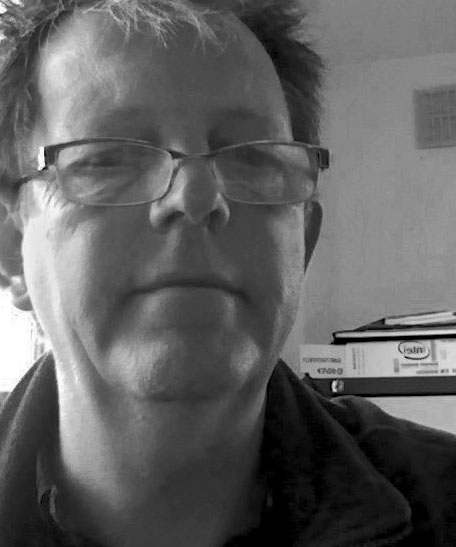
Black and White headshot of Colin Hambrook, a middle-aged, white man wearing glassesColin Hambrook was educated at Dartington College of Arts in South West England. Knitting Time, his exhibition of paintings, drawings and poetry about the experience of psychosis is on show at The Hub, East London until 15 November. The work was previously shown at Pallant House, Chichester and the Impact Arts Fair 2013. Colin’s first collection of poetry, 100 Houses was published by DaDaSouth in 2011, followed by Knitting Time (Waterloo Press ISBN 978-1-906742-65-2). He is the founding editor of Disability Arts Online

The interview was conducted by Gaele Sobott on 28th September 2015 at the Barbican Centre in London just before Colin attended the Creative Future Literary Awards at the Free Word Centre in Holborn.

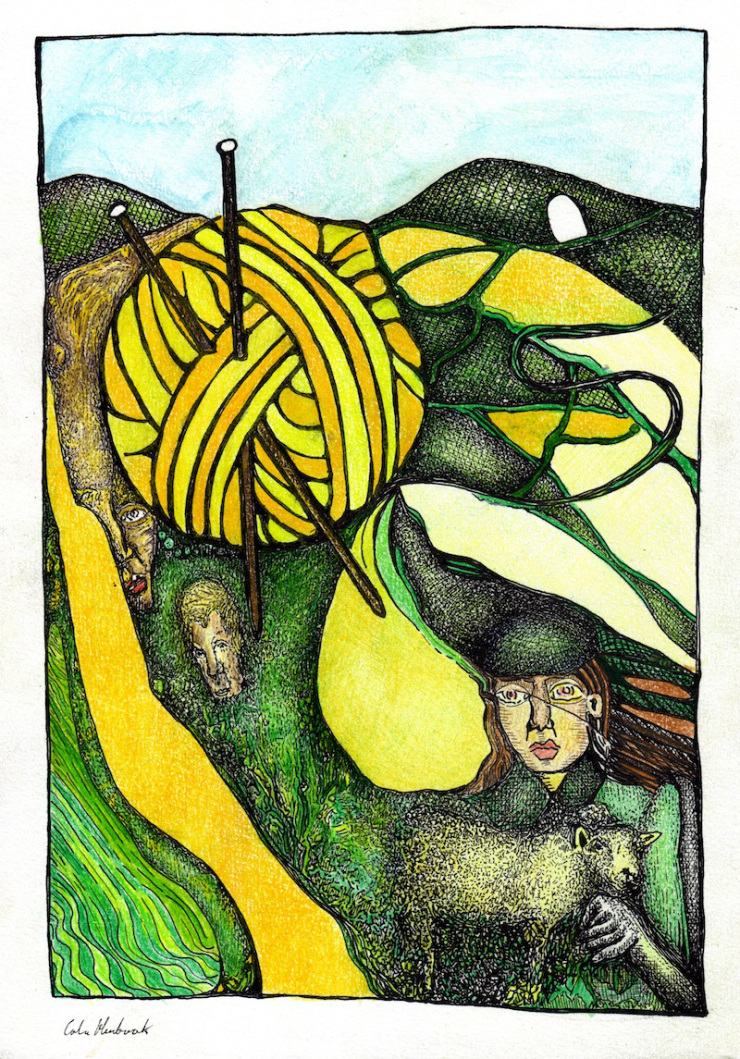
Drawing by Colin Hambrook. Blue sky with clouds above green hills, a large ball of yellow wool sits just below the hills. Brown knitting needles are stuck in the ball of wool. A thick yellow line runs down the left side of the picture like a river, and green and yellow squiggly lines run parallel to this yellow band. To the right of the picture there is another thick band of yellow intersected by thin meandering green curves that creates what looks like an aerial view of plots of land or small farms. There a two faces, one squashed between the ball of wool and the yellow band on the left and one just below the ball of wool. In the bottom right-hand corner there is a woman wearing a green beret type hat and green coat. She is holding a sheep.

Call of the Ancient by Colin Hambrook

Gaele Sobott: In Australia the visual arts and now dance appear to be surging ahead in terms of developing platforms and exposure for disabled artists. Literature is quite a way behind. In the UK disabled writers and literature seem to be better placed. What are the Creative Future Literature Awards and how is Disability Arts Online involved?
Colin Hambrook: Creative Future is a Brighton-based organisation looking to promote careers of ‘marginalised’ writers and artists. Amongst those they support with their annual Literary Award are a certain number of disabled writers. Disability Arts Online is a partner. We have signed up to help them promote the program, get information out, reach people. In terms of literature in the UK, Survivors’ literature has led the way.
GS: Please explain what Survivors’ Literature is.
CH: The key organisation is called Survivors’ Poetry, founded in 1990 by four poets with direct experience of the mental health system in the UK. In a really short space of time it mushroomed into a huge phenomenon. It was a UK network of groups that all became affiliated, some of them became registered charities or not-for-profit companies in their own right and I would say between ’94 to ‘96 it exploded and was reported on in the media and really picked up on. It was important that the people who ran the organisation and wrote for Survivors’ poetry come from a mental health background. They had experienced mental distress, been through or had an intimate knowledge of the mental health system.
GS: What kind of work were they producing?
CH: In the 90s there was a kind of performance poetry format, going into day centres, resource centres, organisations working with people who had come through the mental health system, and producing workshops and giving people the opportunity to perform. So typically the first half of an event would be open mic encouraging people to get up and perform their writing and the second half would be more experienced performance poets. The organisation still exists with a core force of people in London but it has become less prominent elsewhere in the UK over the last ten years.
GS: Why do you think that has happened?
CH: Survivors’ Poetry’s strength was in its Community Arts ethos, but it has become harder to find funding for grassroots work. It’s hard to keep integrity, supporting individual artists creativity at a grassroots level whilst maintaining support for ‘professional’ artists. Survivors’ Poetry turned to producing a literary output, which has been fairly successful. As part of the Unlimited showcase at London’s Southbank Centre last year, Disability Arts Online and Survivors’ Poetry celebrated the achievement of the organisation with a reading by some of the Survivors’ founding poets in the Saison Poetry Library in the Royal Festival Hall. The library contains twenty-seven titles under the Survivors’ Press imprint.
GS: Has Disability Arts Online managed to keep its integrity?
CH: Disability Arts Online in the last ten or twelve years has kind of managed. It’s a bit like a dance, you want to keep your core constituency on board and to nurture that talent, but also you’ve got to watch out, keep an eye on the priorities linked to where financial support can be found to ensure funders’ demands are satisfied.
For instance we have a modest contract with Unlimited to report on all of the artists and all of the projects that come out of Unlimited. It’s a fantastic opportunity to spread the word about this important initiative. Much of Unlimited’s aims and values concur with those of Disability Arts Online, working to support the development of art by disabled artists within the UK cultural sector. Disability Art Online’s brief is to interview the artists, review the shows, comment on the work as it progresses, and where possible, to commission copy for other online magazines and press in order to facilitate the reach of Unlimited to new audiences. Unlimited had a fairly substantial presence at the Edinburgh Fringe Festival this year, with several pieces of work in the British Council Edinburgh Showcase. Unlimited is spearheaded by two organisations: Shape and ArtsAdmin and they’ve received support from the British Council in facilitating the artists taking their work outside the UK. In many ways it is a bright, shiny success story.
We have to work hard to ensure our integrity isn’t compromised, which means creating projects that support and create opportunities for our core constituency and looking to remain disabled-led as much as possible, whilst also working with the high-profile initiatives. Without the support of Unlimited many of the artists we work with would never have got the profile they’ve achieved. For example Jess Thom was unknown as a performer before her company Touretteshero received an Unlimited research and development commission for Backstage in Biscuitland. After a year or so of touring she has been commissioned by Channel 4 with a version of the show made for television, Broadcast in Biscuitland.
GS: So does your core constituency consist of disabled artists at grassroots level?
CH: Yes, disabled artists, writers, who are what the Arts Council term as emerging artists. They are people who create because they’ve got to create, not because they’re making a living out of being artists, necessarily.
GS: Is it possible some of these artists could find themselves forever classified as emerging because of the nature of the market and the value system used to categorise their art?
CH: Yes but that’s just the label that the Arts Council puts on it. People are creative because they need to be creative and creativity isn’t a commodity. We have this schism in our society that divides creativity up into commodity and art. It’s nonsense really.
GS: You mentioned that much of the art by disabled performers at this year’s Edinburgh Fringe Festival focused on the body. Can you please talk more about that?
CH: Yes that’s not necessarily a bad thing. Culturally it’s very different from disability arts of possibly ten, certainly fifteen years ago where the focus on impairment was frowned on.
GS: Was that in defence of the Social Model of Disability?
CH: Defending the Social Model but also it was much more then about community and about people raging against the machine, standing up against discrimination, being a collective force. What’s happened is that as the focus for disability arts has moved away and broken up into impairment-focused issues, which I think are important . . .
GS: Why do you think these issues are important?
CH: Because the key problem with what I would call the first wave of disability arts from the mid 80s to the end of the 90s was that it was very much inward-looking and there was a very powerful community of disabled people who were very clear in their aims and making strong art for and by disabled people. Indeed we got the DDA (Disability Discrimination Act 1995). Not the DDA we wanted but we got the DDA. What happened then was that the very clear, concise stand against discrimination got diluted and the Social Model as a source of inspiration and power for people to find a voice kind of hit a brick wall because impairment within the Social Model wasn’t really addressed in a very strong way. So all the slogans like, Nothing About us Without us, the focus on things being disability-led, kind of fell apart when certain disabled leaders, say for example a wheelchair user, didn’t understand all the politics around Deaf issues or blind issues. Having disabled leaders is important but having that broad understanding of access and the issues faced by people with different impairments is more important.
GS: Isn’t it possible to have disabled leaders with a more complex understanding of disability, Deaf experiences, impairment?
CH: Yes that is the ideal, yes.
GS: Why hasn’t that developed or has it?
CH: There’s a choice that happens in either developing the politics or developing the arts. They can go hand in hand and work with each other and they can also work against each other. The emphasis from the funders has been that if you want the money you have got to develop the aesthetic, you’ve got to develop the art. The politics have been sacrificed to a large extent. A big part of that politics is the importance and value of work being disability-led, because at the end of the day, it’s the experience of being disabled by society that motivates us.
GS: With this huge austerity drive and all these cuts do you think there is more of a need now to develop disability political leadership and action?
CH: Yes there is more of a need now than ever. Absolutely.
GS: How do you see that developing given what you have just said?
CH: It needs people with courage to come forward and start demonstrating on the streets again.
GS: Do you see the march to Downing Street on Saturday protesting the changes being made to Access to Work as an example of this?
CH: I’m really angry that the government are cutting Access to Work. In this case the government said they will cap what any one BSL interpreter can earn at $40 000 a year. But who the hell in the arts is earning forty grand a year? Very few I would say. So the demonstrators were protesting the cuts in Access to Work with this cap on how much an individual can earn. There are thousands of disabled people dying because of cuts. The government is playing a game of divide and rule. On the one hand they are saying they want to get all disabled people into work, but on the other they’re denying means to make working an option. There needs to be a clearer focus in standing up to these issues.
GS: So are you saying that political leadership and analysis are lacking?
CH: Yes
GS: When you say there is a need for people with courage to come forward, the courage to do what?
CH: What the hell do we do in this political climate? I got very involved in supporting the 10 000 Cuts and Counting protest. At the end of 2013 we were working with Michael Meacher MP and the Dean of St Paul’s Cathedral. We met Michael Meacher in his office in Downing Street. He had a mass of files of printouts, of emails and letters of people who had written to him of their plight, their family’s plight, what was happening as a result of austerity, what was happening as a result of cuts in disability benefits. The main focus was that over ten thousand people had died within six weeks of being declared fit for work because their benefits had been cut and they’d been left with no money. Those individuals didn’t necessarily pass away because of the cut in their benefits, but equally, many did. Can you imagine the indignity of being on your deathbed and getting an official letter from the Department of Work and Pensions telling you that you are fit for work? And this has happened to many thousands of individuals and their families. There has been a very dangerous shift in attitude that as an individual living in this society you have to prove that you are financially contributing to it for your existence to be valid. We’ve gone back to the Victorian age within a few short years with the ruling class and their bastard politics. They’ve got every evil connivance of screwing the tax payer and they’ve got the media sewn up so they can infest everyone’s brains that it’s disabled people who have brought austerity upon us, that have brought down the economy. It’s evil!
GS: So do you think it is the responsibility of disabled artists to identify as part of the community and bring the politics into their art in some way?
CH: I personally think it is but then who am I to demand that of an individual? I encourage individuals to get involved in Disability Arts Online who have that ethos. I would say though that generally this time around people are finding it much harder to stand up for their rights.
GS: Why do you think that is?
CH: Well I would include myself in this criticism and say after the DDA was established, the disability movement never really went out of its way to include younger people. So we’ve still got the same old codgers now trying to make a stand like they did twenty or thirty years ago. People are older and frailer.
GS: The older people may no longer have the physical strength but they have knowledge. Do you think younger people are separated from that history, that knowledge of what has gone before them? Are they expected to reinvent the wheel?
CH: Yes and the tendency of Neoliberalism is to encourage people into their own little camps, individualism, losing sight of the larger collective.
GS: Do we need to theorise how to change that and if so how?
CH: It has to happen. I think going back to what we were saying earlier there is a value and an importance in the work that has become the key focus for disability arts – the relaying of stories about the body, stories of people’s experiences of individual impairment, of discrimination.
GS: How does art play a role in changing public perceptions?
CH: Art has a key role to play. You might not call an ITV soap opera, art, but in terms of popular culture, it’s much more wide-reaching than most art.  And so for example, Liam Bairstow who trained with Mind the Gap has recently got a lead role in ITV’s Coronation Street. I think that a young actor with learning difficulties being seen on TV is definitely going to change attitudes, make a lot of people think and those changes are really important.
GS: It seems you are saying that change needs to take place on many levels.
CH: That’s where disability arts is at now I think, certainly within the performing arts, and within the visual arts. In the visual arts there is possibly a bit more politics.
GS: Going back to individual courage – someone may have the courage needed to come forward but if others don’t join with that person it could be very demoralising. What is your experience in this regard?
CH: Well yes, for me, we went to all that effort with 10 000 Cuts and Counting and none of the media turned up and it was all forgotten very quickly. No one took any notice. Nobody seems to care that many thousands of disabled people died because of cuts. Nobody thinks that could be me, or that could be a member of my family.
GS: You said the media didn’t pick up on the story. Disability Arts Online plays an important role in providing an alternative media source.
CH: Yes we do provide an alternative media and we keep plugging away.
GS: You started Disability Arts Online in 2002, and in 2004 you set it up as a not-for-profit company limited by guarantee. So it’s been running for over eleven years. How do you fund the organisation?
CH: We’re constantly working on funding applications for projects. We have a broad vision for how we operate in terms of raising debate about disability arts practice and supporting the work of individuals and organisations across art forms.
We’ve recently received funding from Arts Council’s Grants for the Arts scheme for Viewfinder over the next eighteen months. Viewfinder will see us working in partnership with Wikimedia UK, Sick! Festival, SPILL Festival, Carousel, the New Wolsey Theatre and Goldsmiths Disability Research Centre. It’s very exciting. Wikimedia UK are keen for us to populate Wikipedia with pages dedicated to disabled artists and a history of the movement. The Disability Research Centre at Goldsmiths University is supporting us in running a series of workshops.
We’re producing a video platform and commissioning disabled artists/filmmakers to curate a selection of disability work from the archives of Sick! Festival in Brighton, SPILL Festival in Ipswich/London and Carousel’s Oska Bright Festival. We will produce videos commenting on the importance of the selection in advancing the practice of disabled artists. So, for example Matthew Hellett, who is a learning disabled filmmaker on the Oska Bright committee will be making a film about what makes for good representation; how the committee judge the best films for Oska Bright. We’ve also got another year of core funding from the Esmée Fairbairn Foundation, which is renowned for funding organisations with a community remit.
GS: Have you come up with ideas for sustaining Disability Arts Online on a more long-term, financial basis? Have you tried financing the group by any means other than government funding or philanthropy?
CH: We’ve tried a few experiments. We recently worked with Stopgap Dance Company. They produced the Independent Fringe platform in Edinburgh. Disability Arts Online produced a crowd-funding platform for one of the younger artists, Rowan James. That was successful. We raised £1500 towards getting him to the Edinburgh Fringe Festival. We want to do more of that.
GS: You have described how outside funding can determine the path you take. So if you want to be independent of those demands and priorities in terms of changing the political situation how do you achieve financial independence and sustainability?
CH: Well yes sometimes you feel that the odds are stacked against you. It is a constant struggle. We need time and energy and imagination to come up with strategies. We have a shared knowledge and experience that can be incredibly useful to many industries, so we are also working to find ways to be more sustainable through consultancy and media partnerships.
GS: You have shared your childhood and some challenging personal experiences through your poetry in a way that must be quite confronting but hugely important in terms of supporting people within the Survivors Movement and people who may feel isolated. Would you like to comment on how art can provide a form of community solidarity and empowerment, especially in reference to your latest collection of poetry, Knitting Time?

A drawing of a small boat knitted from yellow wool, sailing on a blue sea with stylised waves against a bright blue sky

Knitting Time by Colin Hambrook

CH: I’d like to think that Knitting Time had value in giving a voice to issues around mental distress. Mostly, psychiatry condemns individuals to the judgement of a medical imperative, which locates mental health problems in the head divorced from the individual’s life experience and circumstances or indeed from any emotional impact located in the body. It treats the individual as having a separate, disconnected body and mind and introduces powerful and potentially harmful drugs to suppress experience deemed as mental health problems. Often, those experiences can be exhilarating and creative even if they can make it harder to function in the ‘real world’. Often mental health ‘issues’ are a matter of an individual having the confidence to be comfortable with who they are.
So in sharing some of my own journey I would hope to break some of the isolation people feel. There is empowerment in hearing others’ stories, others’ expression. There are poets like John Clare and William Blake whose names come up frequently in terms of writers whose core work continues to inspire empowerment within a survivors’ community. There was a poem by Ellen Link that I go back to again and again that inspires my sense of the value of connection; and connection with nature as a healing force in contradistinction to this narrow framework we are meant to fit in with when it comes to being seen as valid, mentally healthy members of society: “In the woods they blast/ your courage to tell you/ you are not a tree, that the wild wind /and the grey skies are not your cousins/ though their atoms be like yours. . .”

For further reading:

Colin Hambrook’s Art and Poetry Blog

Celebrating the Survivors’ Movement

Jess Thom’s Tourettes Hero

10 000 Cuts and Counting 1

10 000 Cuts and Counting 2

10 000 Cuts and Counting 3

Creative Commons License
The Courage to Come Forward – an Interview with Colin Hambrook by Gaele Sobott is licensed under a Creative Commons Attribution-NoDerivatives 4.0 International License.