The Struggle Continues: An interview with Juby Mayet and Cecilie Palmer

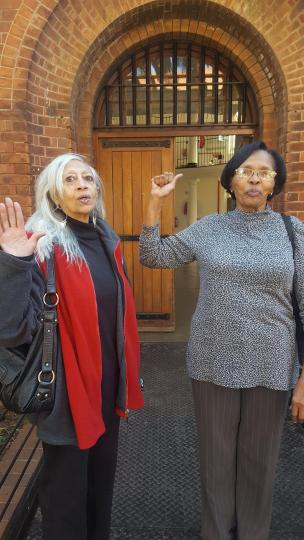
Juby Mayet and Cecilie Palmer standing in front of Constitution Hill Women's Prison

Zubeida ‘Juby’ Mayet (1937 – 2019) was a journalist who dedicated her life to fighting for a free press in South Africa, gender justice and an end to the Apartheid regime. She began writing for the Golden City Post in 1957 and worked for Drum magazine. In 1977 she joined The Voice, in Lenasia, Johannesburg, where she was appointed Deputy Chief Sub-Editor, a first for black women journalists. She was a founding member of the Union of Black Journalists (UBJ), serving as its assistant secretary-treasurer, a member of the Writer’s Association of South Africa, and contributed a great deal to the Media Workers’ Association of South Africa (MWASA). Juby also wrote for UBJ Bulletin Asizothula and The Worker. She was detained in 1979 and upon her release, served with a five-year banning order under the Internal Security Act. She and her family suffered continued police harassment and surveillance

Cecilie Palmer (1944 – 2019) was a stateswoman, active in the struggle against the South African Apartheid regime and in fighting for the emancipation of women. She served in many organisations including, the United Democratic Front, the Federation of Transvaal Women, the Legal Resource Centre and Sizoya Sibuye, a platform for raise public awareness of women’s experiences of torture and jail during the struggle and counselling ex-prisoners. Before her arrest in 1976, she was active in the National Union of South African Students on the University of the Witwatersrand campus. Cecilie was also one of the founders of  the Women’s Institute for Leadership, Development and Democracy (WILDD). She and her family experienced continued police harassment and surveillance after her release from prison.

Gaele Sobott: We have just visited the Constitution Hill Women’s Prison, where you were both detained in the 70s. You’ve described the torture of women in the prison and the mental scars that have plagued you and the other women who were detained from the time of their release onward. Cecilie, you had two children and you were pregnant when you were detained and your mother, Vesta Smith, was also detained in the same prison. Juby you relied on friends to look after your children while you were detained. You were both involved in your different ways in the struggle against Apartheid and to bring about a more just society in South Africa.

In the years leading up to 1994, I am wondering how you balanced or negotiated the need for a hierarchical leadership to overthrow the old Apartheid regime and establish a new regime with the need to broaden and deepen the education of the general population?

Cecilie Palmer: I remember the time, years ago, I think it was 1982 or 1983, when the President’s Council presented its proposals for the reform of government structures, and we were having debates about whether to go into that Council under the new constitution or not to go in. I was sitting with Professor Mohammed and Firoz Cachalia and some others in the UDF office. We were debating and we were dead against going into the Council. Firoz and them were trying to push us to change. That was the kind of consultation that went on. We debated in the branches and the decisions were taken from there up. It’s true, education, that kind of education stopped, that kind of mix of people, it stopped when the exiles arrived back here and they said, ‘This is how it’s going to be done!’

GS: When was that?

Juby Mayet: They started coming back late eighties, early nineties. Sorry I have almost lost my voice. It’s a bit difficult for me to speak. I’ll whisper.

CP: Ja, they built a different structure and they said, ‘This is how you will fight.’ So then you had this structure where the country was really being ruled by six people sitting in Luthuli House.

GS: How did they gain the power to do that?

CP: I don’t know. What ever they did, it was very cleverly done. Remember, people used to trust each other. We were all comrades in the struggle. Some of us were mixed, right.

GS: What do you mean by mixed?

CP: In the sense that I didn’t really belong to the African National Congress (ANC). I didn’t belong to the Black Consciousness Movement (BCM).

JM: Yes.

CP: I didn’t belong to anybody. I went where it was necessary to fight a battle. That was how I operated. Then they came with the UDF and at that time, I remember we were asked very specifically,  because we had a very good women’s movement at that time, the Federation of Transvaal Women. Each province had their own women and we saw ourselves as women working towards common goals. Then we were told no, we had to choose whether we Charterists or whether we were BC. I remember one ANC woman asked me that question and I stood back and said, ‘None. I like to work where I’m needed most.’ But when the ANC was unbanned, people positioned themselves where they knew or thought the power was going to be …

JM: Where they thought their bread was going to be buttered.

CP: For instance, in Eldorado Park, which is a township just on the other side of Lens.

JM: Ja, we passed it. I pointed it out to you.

GS: Yes.

CP: We worked very hard there. We had established a really strong activist community where we had an advice centre, a women’s group, we had women against the abuse of women, we had a pre-school programme. The pre-school programme was designed by one of the women in Eldorado Park who was a pre-school specialist and that programme was designed on a non-sexist, non-racist basis. It was assessed by a professor from Rhodes University who said the programme should expand right through Africa. We replicated that programme from Eldorado Park throughout the Transvaal.

GS: By we, you mean the Eldorado Park women’s group?

CP: Yes. We had a strong movement going. We also had a civic association. Our belief and my belief was that civic associations belong to the people of the community that starts those associations, irrespective of what their political affiliations are.

JM: Yes, absolutely.

CP: Then we were asked by the ANC, because they had regrouped, to spearhead the formation of the South African National Civic Association (SANCO) and that was affiliated directly to the ANC. We said, ‘No, we’re not going to do that.’ Our pre-school programme had established pre-schools in the Transvaal and those pre-schools each had parent bodies. We taught the women in those parent bodies politics, not party politics but  community activism, so they knew about political, social and economic injustice and they were figuring out ways to build alternatives in their communities. This all grew from the strong community activism in Eldorado Park, so we brought those Eldorado women and the women from the pre-school parent groups into the Federation of Transvaal Women. We didn’t realise the ANC and those leaders who decided to identify with them, were positioning themselves for future power. The ANC started choosing people for their executive committees in Eldorado Park. They were lobbying.

JM: Manipulating.

CP: Ja, so, none of the activists, the youth groups, the women’s group, none of those activists were chosen for the executive committees. Anyone who wasn’t ANC was kicked out of those groups. We were very innocent then. Not skilled in that kind of politicking.

GS: Do you think the ANC saw those people, those activists on the ground who did not want to join them, as a threat and if so why?

CP: I really don’t know why they saw them as a threat but they did.  I think they were scared of people who had experience in the struggle but were refusing to join the ANC, probably because they were a stumbling block to those who were opportunists, those people who joined the ANC to climb. Those activists were wise and they expected the organisations to be run on same lines as they had been run on before. I think that’s probably what it was. I don’t know. One needs to think very deeply about this time and what happened.

JM: It was the ANC state capture. They rode roughshod over all these people and groups, like they were the only ones who fought to liberate us. The Pan African Congress (PAC), Azanian People’s Organisation (AZAPO), all the rest, were just thrown to the wayside. I’ve never been a card carrying member of any political party. I was labelled a sickly humanist. I worked for the human rights committee which had ANC members and Liberal Party members, then after I covered the  South African Student Organisation (SASO) trial in Pretoria, Sathasivan Cooper, Sivalingam Moodley, Audrey Mokoape, I became kind of involved with, not involved but enamoured of the Black Consciousness Movement and of course when I met people like Sobukwe, he was such a lovely man, and  Joe Tlholoe who was so young when he was sent to jail for so-called PAC activities, so I never really had a particular inclination towards any political party, I just felt I had to do a typical sickly humanist’s job.

GS: As an individual do you resent being dominated in a job or within a community?

JM: Not really. If I am dominated by anybody who thinks they are better than me, yes. I think I am as good as the next person.

CP: In other words, you refuse to be bullied.

GS: There is bullying and there is sometimes the need for hierarchical leadership. Do you think it is possible for South Africa to change existing social and economic conditions without hierarchical leadership?

JM: It has got to come from the younger generation.

CP: Exactly.

JM: I don’t know if they are better educated. They go to varsity and vandalise the school structures, the very place of learning. I don’t understand that mentality.

CP: I think our education system doesn’t teach people to think. It teaches them to regurgitate stuff without thinking.

JM: I went on protest marches but I never threw a stone through anybody’s window or set fire to any buildings. We marched with our banners and we sang our freedom songs without vandalising or damaging people’s cars or property. I cannot understand that mentality, especially when they go and burn down schools.

CP: Twenty eight schools burnt just a few months ago.

GS: Why? What caused that anger?

CP: Municipal demarcation. Dividing the wards up. The local government structures are divided in to wards. It affects voting. That’s why they keep changing it. They changed the boundaries and the community didn’t want it. Like Vuwani, where the community withdrew their children from school as a form of protest. Then they burnt the schools. The schools become the targets.

JM: That is why I say it is because of a lack of education. Those parents obviously did understand that this is not the right way to protest and make change. We need those schools. We are depriving our children of education.

CP: If you look at the age group of those people, it’s the age group that went to school after 1994. They are keeping their children out of school. They are the ones who are throwing stones. The ones who were born in the mid-eighties. That’s my view. Yes, we had Bantu education, Coloured education, Indian education but I swear that was one-hundred-and-ten-times better than the education we have today.

GS: During that period of change, how do you think it could have been done differently in terms of education?

JM: It would help if we had a president who was actually literate. Our education system is terrible. They keep saying how young people must be educated to become future leaders but it has become empty rhetoric, just words, no substance.

CP: It was during his time, that education started deteriorating. With every step, the education system seems to deteriorate further with every change they make. The very last change was the curriculum assessment policy called CAPS, a system that came in 2013. Plus the mentality of the new teachers is not good. We need better teacher training.
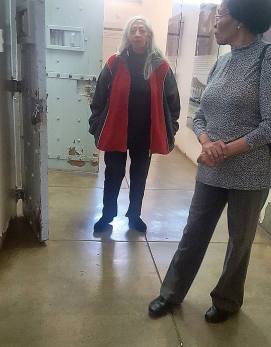
Juby Mayet and Cecilie Palmer standing in front of cells in Constitution Hill women's prison

GS: What happened to AZAPO, PAC leaders?

CP: They were just pushed out and ignored.

JM: I meet up with those guys and we talk. There was a group of students from SOWETO and they were quite surprised by the way I spoke. I make it quite clear that the ANC sucks! They irritate the hell out of me. I don’t have anything to do with them. I tell them that. I don’t vote for the ANC. Sometimes I say why don’t you guys form a coalition. Can you imagine if AZAPO and the BC people came together then the ANC would be seriously challenged, voted out in elections.

CP: They pushed out a lot of leaders, extremely well educated people, some died, like Percy Qoboza,   but none of them are anywhere in government structures. Brilliant people were pushed aside.

GS: What do you think can be done to stop the party that is about to take power in a situation like that from isolating or silencing intellectuals?

CP: They didn’t just sideline intellectuals they also preached that the older people who stayed in the country, that we were stupid and didn’t know what we were doing. Some children are extremely angry because their parents have been treated so badly.  We’ve got this inter-generational dialogue and it’s all about talking with the younger people and not at them. Some of them are extremely angry at Nelson Mandela.

GS: Why?

CP: Because he sold out. I sit there and I think, yes, it is true what you say but I cannot say that. So, I go the other way and say, ‘Look, he had to do what he did otherwise violence would have consumed the country.’  That’s true. There was Eugene Terre Blanche and Inkatha and all that but if you go further back they had been negotiating with Mandela a very long time before his release without the other prisoners being involved. They actually moved him from Robben Island and took him to Pollsmoor and Pollsmoor wasn’t private enough so they took him to Victor Verster where he was living in a house. So that is the truth of the matter and that is where a lot of the anger comes from. That is why they are saying, “We are struggling today because our parents are not living any differently than before apartheid, look at my mother living in a little pondotjie somewhere and so on. All those things are boiling. We can’t pay bills. Even when people study where are they going to get jobs.

JM: We should suggest to them that the next time they want to go on a burning spree, they should start with Luthuli House.

GS: How were the big corporations positioned during the transition from Apartheid?

JM: Big business just kept going like a steam roller.

CP: The same white bosses and even though black Joe might be the CEO, he still doesn’t really control the business. They are definitely not going to change our society for the better. I told you the story of Eldorado Park, now also in Eldorado Park we were working with UNISA against violence and that kind of thing and then they came and told us that they had been funded by the police. Imagine, funded by the police during the time of Apartheid! We said, ‘Oh oh, no thank you. Within a week, I was summoned to Luthuli House, Ralph phoned me and said, come in to see us because we want to talk to you about the UNISA program. I said, ‘No, I will not come to Luthuli House. You come to the township!’ I mean that was where the group started. He could talk to the board there were we all operated. Then they also asked us to spearhead the formation of the ANC women’s league in Eldorado Park. We said no to that too. Like I said, our belief about the women’s group was that we were all working together, no matter what party women supported. We were combining our strengths to make change happen. But from then on we were totally isolated by the ANC. We founded the Women’s Institute for Leadership, Development and Democracy (WILDD) in 1994 and we were being funded by the Swedes so what  the ANC did about the second or third year after they came into power, they ruled on bilateral funding so it then had to be government to government funding. So any foreign funding had to go through the government. That is how they destroyed a lot of the NGOs. So they were quite clever. They managed to destroy independent community organisations and thinkers. Through the WILDD, we used to help women’s groups in townships. Let’s say a group was working against gender violence, we would write a proposal that might include establishing shelters for women, things like that and that was one of the ways we increased the consciousness, the awareness and the education of women and men. We had a women’s cooperative that was a successful community enterprise. So, we would write the proposals and the women would get money. Then we would teach them to draw up progress reports and insist that they prepared and submitted regular reports to us. We needed those reports to get more funding and train more women. Very, very soon, the women began to say that the government was giving them funding because of this new government to government funding I spoke about. So the ANC was the one giving them the funding not foreign sources and the women did not need to report to us anymore. They could not be expected to bite the hand that feeds them. We as community leaders were isolated that way too. The original structures we had all built were destroyed. The government gave the groups money once, they gave twice, then they deserted the women and other civic groups.

So now we work very quietly.

GS: How do you think that kind of scenario can be prevented before it gets to that point?

CP: I don’t know. It is a very hard question to answer. But I think also what happens in people’s minds is that they saw the ANC as their liberators and they were told that they were their liberators.

JM: If the propaganda, the lie, is told often enough, people believe it.

CP: It’s like starting again right from the beginning which means starting in the house, starting in the street, in the factory, in the mines. It’s important to work within the community.

JM: I think we need a true revolution. It won’t be difficult to build up to a proper revolution because people have not settled into this so-called solution. They do not accept this life of entitlement that ANC officials and black CEOs and the like are living. The top guys are treating the country’s assets as if everything is there for the taking. That becomes the attitude. If they are doing, what is wrong with me doing it too.

CP: And the jargon is there all the time, you know, I can tell you now, let’s say I was going to a Women’s Day celebration, and the speaker gets on the stage. Before she opens her mouth, I know exactly what she is going to say. It will be the same thing that is repeated all the time, the same jargon, the propaganda repeated over and over again. Empty rhetoric. No real analysis. No encouragement of independent thinking. It’s also more difficult because before with Apartheid, the enemy was clearer. If you criticise the ANC, they say that you want to bring the white oppressor back.

JM: That’s another thing. We had Apartheid but there wasn’t the same yackety yack that there is now about racism. It’s used now for small things, almost like a diversion from the bigger picture, the economic problems, the economic system.

CP: The economic oppression is still very much there. We have a lot of black people in charge now of administration and the running of government but they treat other black people badly.

JM: You see it in the shops and the cafes and the post office. People are not there to serve. They are there to fill their pockets and stuff you Jack. I remember going to Ackermans with my late mother. She was struggling because my daddy left us and we were ten children. She somehow made friends with an Afrikaner lady working there. That woman used to assist my mother by putting extra items into the bag when she was buying school shirts or trousers for the boys. Sometimes my mother used to send me to Ackermans to buy items. I can’t remember that woman’s name now but I can see her face, a stylish woman and she would treat me in such a friendly way. She’d ask me how my mother was. Whatever I was buying, underwear or socks for the boys, she would always manage to sneak extra into the bag.

CP: Strangely, Juby, some of the Afrikaner people were very human, very genuine. An Afrikaner either liked you or hated you. It was clear cut. Where with the English you never knew. And Afrikaner children even up to today will respect an older person. They will say Tannie to me. That is how they are brought up. But if they don’t like you, they don’t like you and they make no bones about it. You knew exactly what your place was with them.

But going back to your question about what could be done differently, I don’t know but many people change. I cannot understand how they can change like that because it must be very uncomfortable.

JM: The day I landed in Number Four (Constitution Hill Prison), Debs wasn’t there at that time. Thenjiwe and Joyce and other women were. A white warden was taking me through to my cell, my new living quarters, and she was stunned when those other women prisoners broke into cheers and yelling Amandla and hey Juby what took you so long? The warden took me to my cell and she asked, ‘How do you know those women?’ I knew some of them personally, most of them knew me because I was a journalist but she couldn’t figure it out, ‘Die Coolie met dai Kaffir.’ When we were in there we had political discussions, we celebrated June 16. So then Thenji and all of them were released and I was left there with Gladys Manzi from Kwazulu and then they brought Debs from Maritzburg. She was in a bad way.

CP: Oh God.

JM: She’d been tortured. Her hair was falling out. Eventually I was released. We were all released. Some of us kept in touch. Some of us wrote to each other. Some moved on with their lives. The next time I saw one of the woman I had got close to in prison was  at some journalism awards event at one of the conference rooms at the South African Broadcasting Commission but you know, she didn’t acknowledge me. We were so close in Number Four but by then she had become ambassador or something like that. I looked directly at her and she looked directly at me. No smile. Nothing. I thought, God, what have I done? She just refused to acknowledge me. I was going  to go up to her and ask her how she was but then I thought okay I won’t. You give me a cold shoulder like that, I will ignore you. But I couldn’t believe it and I was hurt. From the person I knew in Number Four to this. She’s now up there and I am just the same old Juby.

CP: So why should she associate with you?

JM: Exactly. So, I thought, well stuff you, buddy boy!

CP: Yes, you can walk away and feel good about it. I must say, I feel free. I don’t owe anyone anything. I live on my one thousand five hundred Rand pension and I’m comfortable with it. I don’t owe anybody. I feel free but those people we are talking about have no vision. That is the sad part. They go into these positions. In 1994, nobody knew how to govern and we accept that. They employed consultants and what have you. They chased the Boer out who were in those positions. They didn’t want to learn from them. I think they should have first learnt from those people. Taken advantage of their knowledge and experience and then made them move over. They could have said, ‘Okay, we will make you consultant in this department for five years.’ They decided to chase those people out and employ consultants but up to today, they haven’t learned. About four years ago I spoke to one of the ANC women and told her what I saw happening in our communities. They don’t go to their constituents. They don’t know what’s really going on. I told her that communities are fragmenting more and more along lines of race, religion, political party and all that. We need to get these people back together. She agreed and suggested we involve other people in government and she did that. She got them in and I presented a proposal which we discussed. I emphasised that this drive to get people back together has to start by the ANC admitting their mistakes. The next thing, they were talking about fragmentation of communities and that the SACC was going to do this and that. They didn’t involve me nonetheless, I was happy it seemed to be going ahead. But it fell apart because they didn’t have the same vision. If you don’t have the vision for going forward, it is just not going to work. They stole people’s projects. A group would write a proposal to them with what they wanted. Then they would call those people in and ask for more detail. The group would give them all their ideas. Four weeks later they’d see someone from government announcing those very ideas on TV as a government initiative.

Juby, you know the saga about registering children on-line for school?

JM: Yes.

CP:  The education department has announced the idea of registering children on-line from grade one to grade eight. It’s an idea that they have stolen. Somebody presented this proposal to them around 2008. They dismissed her saying it was nonsense. Thank heaven she is taking it up with them. She’s not letting them get away with it. NGOs don’t stand a chance with the government stealing ideas like that. That lack of vision is terrible. They took over our women’s groups and now the gender violence is getting worse not better. Another peculiar thing that is happening most of our experts are whites and people who do not live in the townships. They are on TV telling us what we need.  So we are asking, why is it always about us but we are not leading. We know what is happening in the township. We know what is happening in our communities because we still live here. We don’t live in a big house in the white suburbs with high fences and security guards. But no, those experts have all the answers.

JM: The statisticians.

CP: We must sound like bitter people.

GS: You sound like people with many years of experience.

CP: When I do a tour or give talks, people sometimes ask me, ‘But don’t you hate the people who have done these things?’ No I don’t.

JM: Hatred is a waste of energy.

CP: Hatred to me is a wasted emotion, a waste of energy. I don’t hate but I also haven’t forgotten and I’m not going to forget because it did happen. Actually, I’m  not sure at this moment that I don’t hate the people who are sitting in Luthuli House. I’m not sure I don’t hate them for what they are doing to this country.

JM: My remedy is laugh it off and say stuff you lot!

CP: Like there is Kenny Motsamai who they have only just released from jail. Nearly twenty eight years in jail. Yet, they let Eugene de Kock out who tortured and murdered so many people who fought against Apartheid. There are still other PAC cadre sitting in jail.

JM: Now we have black on black Apartheid. That’s what it has come down to. Economic.

CP: They spent over a billion rand on the ANC campaign for the local government elections. Where did they get that money from?

JM: Exactly and why not use it on something more constructive? Building houses, schools, medical facilities. Prioritising the education of teachers. They did away with teacher training.

CP: They closed nursing colleges. They are trained at university with no practical experience. They come into the wards and will not take advice from the older nurses who did the proper training including the practical internships and the like. They are starting to privatise the services.

JM: Like the prisons are semi-privatised now.

CP: And the bureaucracy is getting bigger and bigger. It’s messed up. There’s no getting away from it.

JM: We need to teach that the ANC were not the only liberators of the country. Campaign to change voting patterns.

CP: I think we really need to get back to thorough and committed community activism, community responsibility and confidence. I work with the women from the inner city. They are eager to jump when the ANC Women’s League says jump, the rent a crowd kind of thing. Their responses and their problems are different to our problems in the townships. You know another thing we don’t have is an alternative media. We were lucky because we used to have the Vrye Weekblad, an Afrikaans newspaper which was really helpful, one of the best newspapers.

JM: Ja, Max du Preez.

CP:  It was run by Max du Preez. We need that kind of newspaper back. The Weekly Mail was also there. Those newspapers tried but they were never free to do what they wanted. The Post used to have ugly stories that didn’t educate anybody.

JM: Like the Sun today.

CP: Like the Daily Sun. Now that’s the only newspaper that people can afford. The Daily Sun will tell you that the rat ate the cat. Like the TV. Keep the masses uneducated and you can do whatever you want.

JM: That is why I read books. Our young people need to read more.

CP: Reading is very important. Education for our young people has to improve. Over half of our children cannot read fluently. We should be working on basic literacy and numeracy. We are condemning a huge majority of young people to unemployment and  poverty. You know, we are a depressed country at the moment. You don’t see people smiling and laughing. We used to laugh and talk and scream and sing even during the time of Apartheid. We’ve stopped. I definitely don’t think we would be  better off under Apartheid. We still need to rid ourselves of the legacy of Apartheid. We really need to sit and talk and analyse what has not worked in the struggle. The ANC has to admit its mistakes. Maybe then we will begin to smile again.
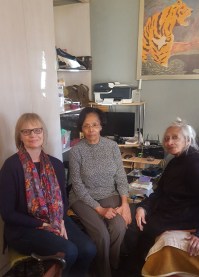
Gaele Cecilie JubyInterview conducted with Juby Mayet and Cecilie Palmer in Lenasia, 2016 – May you rest in peace and power my friends.

Links:

Black Wednesday, the day the Apartheid government banned 18 Black Consciousness Movement organisations and three newspapers (featuring Juby Mayet)

Interview with Cecilie Palmer  in the Constitution Hill Women’s Jail
Dignity is essential. It means we are viewed by the other as a human being : an interview with Alice Cherki

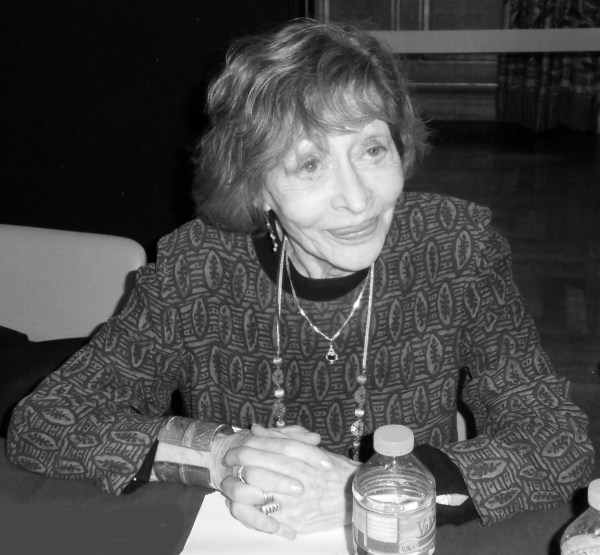
A recent black and white photograph of Alice Cherki, sitting at a table, smiling.

Alice Cherki

ALICE CHERKI is a psychiatrist, psychoanalyst and author. Born in Algiers, 1936. She knew Frantz Fanon well, working by his side in Algeria and Tunisia as a psychiatrist, and sharing his political commitment during the war of independence in Algeria.

Alice Cherki has lived in France since 1965. She is co-author of the books, Retour à Lacan (Fayard, 1981) and Les Juifs d’Algérie (Editions du Scribe, 1987), and author of La frontière invisible (Editions des Crépuscules, 2009) Frantz Fanon, portrait (Seuil, 2000) translated into English by Nadia Benabid and published as Frantz Fanon: A Portrait (Cornell University Press, 2006) and Mémoire anachronique (Editions De L’aube, 2016).

Gaele Sobott: Can you talk a little about the history of your family, your place of birth and your childhood?

Alice Cherki: I was born in a family of Jewish Algerians who were in Algeria since the Romans or before the Romans. My parents were born in the small towns of Medea and Ksar Bukhari but they met in Algiers. I was born and I lived in Algiers. I am Algerian, voilà!

Some of my family are Jewish Berbers.

GS: Were there Jewish people in Algeria before the Arabs?

AC: Yes, the majority were there well before. Some came later in 1492 from Spain through Morocco, others from Italy, and then Alsatian Jews, but at that point it was already colonial Algeria.  Many of those left again and went elsewhere. But most of the Jews of Algeria had been there for a very, very, very long. Some of them were Berbers who converted to Judaism. I belong to that history.

GS: Did you speak Arabic?

AC: Very little. I’m not very good at languages. I come from the same environment as Derrida. at school, we learnt Latin and Greek.

GS: Did you know Derrida?

AC: I knew Derrida very well. He was eight or nine years older than me and that represents a big difference but yes I knew Derrida well.

Like Hélène Cixous and Derrida, my childhood was marked by the Vichy anti-Jewish legislation which excluded Jews born in Algeria, denied us French nationality, the right to go to school, the right for Jews to work in government administration. This was hugely traumatic for me as a child.

One Christmas, I was 4 or 5 years old, my teacher said, “Tell your mother that after the break you must not come to school anymore.”

When I asked her the reason, the only answer I got was, “It’s because you’re Jewish.”

I didn’t know what that meant.  So, I gathered my courage and asked, “What’s Jewish?”

She replied, “It’s you with your big eyes, big mouth and big ears.”

Each of us, as Derrida also relates, was excluded from school, our parents could no longer work.

GS: How has this experience affected your adult life?

AC: It opened my eyes to the injustices of the world in which we live; a world marked by colonial ideology.  In Algiers in the 1950s, there was no intersection between Europeans, the Jews and Arabs –  the so-called natives. I didn’t experience it at home but we were caught up in all that. I talk about it a little in my book, Mémoire anachronique.  Everyone lived in their own sphere. Some of us would meet each other outside these spheres.

During my early years at primary school there was no mixing at all. In Grade 6, there were some girls; Rachida, Malika.  For the whole of my secondary schooling I only knew of one Algerian woman student even though my school was not the most snobbish high school in Algiers.

GS: It was the same principle as Apartheid?

AC: The same principle except that it was more camouflaged. Algerians were contained in their own neighbourhoods. Even the bourgeois had their areas. The Algerians passed like shadows in the European neighbourhoods

GS: What area of Algiers did you live in?

AC: I first lived on the border of a working-class suburb, near the boys’ school, known then as Lycée Bugeaud, now it’s called Lycée Abdel Kader. Later, at the age of 17, we moved to Central Boulevard in Hydra. Our house was on a piece of land owned by my uncle –  my father’s brother, my father’s sister, and my father. After some years, they managed to build a three-storey house there for the three families.

GS: What did your father do for a living?

AC: My father traded in cereal. He carried out transactions with farmers for the export and import of chickpeas and lentils.

GS: How did your interest in psychiatry come about?

AC: Firstly, it was a struggle for me as a woman to study. After I passed my baccalaureate, even though I was from the middle-class, it was not usual for women to continue their education. Women were expected to marry and so on. I had an older brother and a younger brother and was the only girl. Neither of my parents continued their studies. My father, a brilliant student, was pulled out of school at age 16 by his father. He was the eldest of ten children There were two or three girls before him so he had to work. I believe my mother chose to leave school to get married. When she met my father, she dropped out.

My parents were both very intelligent and relatively progressive. My father spoke Arabic, but they did not have a higher education.

I already had a certain outlook on society and I was more inclined towards literature. I wasn’t a good student and had never received any awards for excellence. I was impertinent and people always told me I would make an excellent actress. With no one to advise me, in those days, if I had decided I wanted to be an actress, it would have been worse than deciding to be a prostitute. Having said that, I did later have the luck to meet many people who became involved in theatre.

So, I found myself first in hypokhâgne and then khâgne. You know what they are?

GS: No.

AC: Preparatory literary classes for the grandes écoles. The equivalent also exists in the scientific field. I was interested in studying philosophy but decided that would mean cutting myself off from the real world. I made up my mind that I wanted to be useful so I chose to study medicine. But very soon I realized medicine didn’t meet my needs. It was all about identifying symptoms and responding with treatments. I remember a teacher saying, “But Mademoiselle, you ask too many questions.”

We never say, “Why” in medicine. Instead we talk about, “How to fix it.”

So, I was part of two cultures; one of interest for human beings and their psyche, and the other a group culture which stemmed from my medical studies.

GS: Were there other women you knew of who were studying medicine then?

AC: There were a few, but they were a definite minority.

There was a saying that summarized the situation quite well. It relates to sitting the intern examination:

If you are white, European and male, you have an 80% chance of sitting the exam. If you are female and European, you have a 60% chance. If you are Jewish and male, you have a 50% chance. If you are female and Jewish, you have a 25% chance. If you are Muslim and male, you have a 10% chance. As for being Muslim and a woman, you are not even mentioned because you just don’t get the opportunity.

Some managed to study medicine or become trainees but none got to sit the intern examination, voilà!

GS: When did you meet Fanon for the first time?

AC: I was part of a youth movement called AJASS (Association of Algerian Youth for Social Action) and Fanon was invited to give a lecture by a friend of mine, Pierre Chaulet, who died recently. It was a lecture on fear and anxiety in 1955. I must have been 19 or 20 at the time and had to leave my parents’ home where I’d been living. Most of the interns at the hospital were French-Algerian and because of my opinions I faced all kinds of problems. My car tyres were punctured, my white doctor’s coat soiled, my files stolen. So, when Fanon found out I wanted to do psychiatry, he told Pierre Chaulet I should come and intern under him at Blida psychiatric hospital.

GS: So you lived at the hospital in Blida?

AC: Yes, as an intern. That’s where I met my husband, Charles Géronimi. He shared my ideas, but having Corsican parents, teachers but Corsicans, they had trouble accepting a little Jew in their family, especially my mother-in-law.

GS: What were your first impressions of Fanon?

AC: My first impressions, at 20, I found everything he had to say very interesting and didn’t think of him as black. He analysed the subjectivity of racism which was very different from the discourse of the time. On the one hand, we had Existentialism and on the other, Marxist materialism which didn’t include questions of subjectivity. It was the first time I’d met someone who was only 10 years older than me but had immense experience, and a developed understanding of these two worlds, of the two ‘ideologies’.  He was neither on one side nor the other which met my expectations, answered my questions.

GS: He had practical ideas?

AC: Yes, he was a hands-on kind of man.

GS: That’s to say, the development of his thought was founded not only on the theoretical but also on his lived-experience?

AC: On his experience, yes. And that also pleased me. It was from his lived-experience that he elaborated his ideas. But he also had very advanced psychiatric training.

GS: What were some of the work experiences during your time with Fanon in Blida that influenced your practice of psychiatry?

AC: Everything he brought to psychiatry, especially his critique of the School of Algiers’ theory of primitivism. He also introduced social therapy, institutional psychotherapy.

GS: How do you define institutional psychotherapy?

AC: Institutional psychotherapy, as developed by Tosquelles, took off in France with the support of Oury and Bonnafé. It encourages the residents of psychiatric institutions to share things with their caregivers. Through humanising the functions of these institutions, it allows understanding not only of patient symptoms but also the roots of these symptoms. There are still two or three people in France who are struggling to create places that foster institutional psychotherapy, but it is becoming more and more difficult.

GS: Why is it becoming more difficult?

AC: Because of the prevailing ideology. Now we have DCM 3, DCM 4, DCM 5. It is a performative ideology that absolutely bypasses all subjective aspects of alienation.

GS: Did you have any significant experiences in the hospital setting as a female doctor caring for patients in that historical and social context?

AC: What do you mean by significant experiences?

GS: For example, when you worked at Joinville-Blida Hospital, were there certain events that affected you?

AC: Yes, of course.

GS: What were they?

AC: So many things. For example, I saw women hospitalised after childbirth for postpartum, transitory delirium. Some doctors didn’t understand and sometimes even people in the women’s families said, “It’s the djnoun who came to inhabit her.”

It affected me deeply because  I wanted to ascertain their experience of the delivery because it influences their relationship to the newborn baby.  It’s a complicated relationship.

GS: Did you have your own children at that time?

AC: No, I had no children at the time. I now have a son who is 40 years old. He studied political science and then he got involved in theatre.

GS: So, he is fortunate?

AC: Well there you have it.

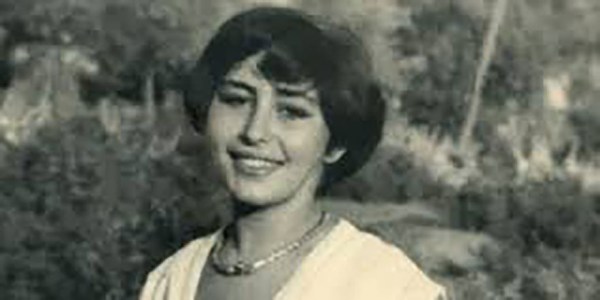
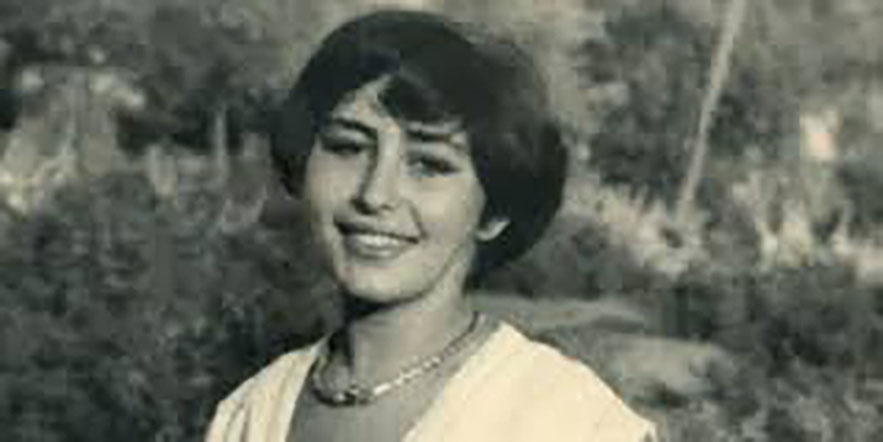
Black and white photograph of Alice Cherki as a young women. She has short, dark hair, is wearing a white, V-neck dress and a necklace, and she is smiling.

GS: As a female doctor, what were your professional relationships like with your colleagues at the hospital?

AC: Amongst us interns at the psychiatric hospital of Blida, I was considered an equal.

I married an intern from the hospital. No, I can’t say I had any problems. On the other hand, before that when I was at the Mustapha Hospital in Algiers, I was very young, I did my hair in a bun and put on big glasses to make myself look older so I’d be left in peace.

GS: Was your husband originally from Blida?

AC: No, he was also from Algiers but he was an intern with Fanon in Blida. They wrote a paper together on Algerian women and the cultural specificity of TATs (Thematic Apperception Tests).

GS: In your book, Fanon, Portrait, you mention a meeting between Fanon and Jeanson. (1)

AC: Yes.

GS: In that meeting Fanon expressed his wish to go beyond certain ideas so that readers can experience aspects of life that they could never know firsthand.  You talk about Fanon exploring the sensory dimension of language. Do you think that this approach to writing could enable us to communicate experiences around difference, to understand our differences from an egalitarian point of view – not superior or even inferior?

AC: Yes, I think this type of writing is essential. In my experience, sensory writing starts from perceptions, sensations to try to improve communication with the other, I think it is very, very necessary.

GS: Do you know any writers today who write like that?

AC: I’m not qualified to say. I don’t know today’s writers that well. But Kateb Yacine wrote like that.

GS: Do you see difference as a dialectical space that can trigger creativity and imagination?

AC: Yes, that’s what I call the relationship to the other, the recognition of the outside, the stranger. It is important. I wrote another book called La frontière invisible, in which I insist on the relationship to the other. This allows you to accept the outsider in yourself.

GS: In your book, La frontière invisible, you link psychoanalysis and politics. I understand colonial violence, violence of displacement, violence against the subject in the social context, the context of specific historical and political circumstances, for example, those of Algeria and France. But when I try to analyse this violence from a psychoanalytic point of view, I find it difficult to understand.

AC: It is complicated. But you have sought out strangers?

GS: Always, yes.

AC: Perhaps it’s not by chance.

GS: Perhaps not.

Did you know Fanon outside his work, in his family life? What kind of man was he as husband and father?

AC: Yes, of course I had the opportunity to know Fanon outside his work. I knew his wife well and I know his son very well. As a dedicated husband and father. At the same time, he was a very busy man. But he was very dedicated to his family. When his father left for Africa, Olivier didn’t see him that often only from time to time when Fanon came back from working there.  Olivier was only five when his father died.

Fanon loved life. He liked to go out to dinner, go dancing, things like that.

GS: What type of dancing did he like?

AC: All the dances of that time, le slow, the rhumba . . .

GS: Did you like to dance?

AC: It has been a long time since I really danced but yes at the time I loved it.

GS: At friends’ places?

AC: Yes.

GS: What type of music did Fanon like?

AC: He especially loved Caribbean music.

GS: And you?

AC: Back then my tastes were very eclectic. I liked the Arab-Andalusian, Jewish-Andalusian music right through to Bach, Beethoven, Mozart and then Jean Ferrat, Barbara, Montand. More and more now I love Musique Concrète.

GS: Tell me more. 

AC: When I was a psychoanalyst, I was working very hard. In the evening, when I had finished working and my head was full of words, words, words, I’d play the likes of Kurtág and Blériot. The music is largely based on the sonority of the human body. It defies the normality of melody. It’s best to listen to it alone. There are not many people who love and desire that genre of music. It scares them.

GS: What kind of a sense of humour did Fanon have? What made him laugh?

AC: He had a great sense of humour, Fanon. It was humour that made him laugh.

GS: People who are very involved in revolutionary struggle often dedicate huge amounts of time and energy to the cause, and I suppose that doesn’t allow them to be very good parents.

AC: That’s true, yes. Especially at the time because the people involved in the struggle were very young.

GS: Have you met children whose parents were not only very involved but who were tortured, wounded or killed as part of the struggle?

AC: Yes, children who became orphans.

GS: Regarding the children of revolutionaries, what observations have you made?

AC: It was very variable. For example, Fatma Oussedic, her father was a great militant and she has good memories of her relationship with him. In addition, many families did not only consist of the father and mother, there were, aunts, uncles, cousins etc. They weren’t nuclear families. If we’re talking about orphans this helps a little. But when you see your parents killed before your eyes, that’s not the same thing. As for the children of the surviving revolutionaries following independence, the notion that their fathers are heroes has weighed heavily on many of them.

GS: Would you mind giving me a brief definition of your concept of alienation and the ways it may be experienced in countries marked by colonisation.

AC: That’s a big question. Both the coloniser and countries who achieved their independence, like Algeria, deny in various ways the colonial wars that have taken place. Algeria swept a large part of the past away by claiming the national story begins at the time of Independence. Generations have been taught that they have one history, one language, one origin. This kind of discourse has done a lot of damage. There are many young people who now don’t know who they are.

GS: How does that manifest psychologically?

AC: It varies considerably and is different in Algeria and in France. Here in France these young people are excluded from participating in the inner circle, In Algeria they are divided. There is group of social conformists who represent the youth, and another group of which no one ever speaks but which gnaws away at the heart and soul of the country.  Young people are suffering a great deal, even those who are socially successful. Many young people ask, “What was Algeria like before 1962?” Many are Berbers. The heterogeneity of their roots has been hidden from them. It is as if these roots don’t exist but they are longing for what I call multiple identification … not to be cast in a single mould.

In France there are many young people who describe their lives very well and write novels. Some are very interesting, written in the language of the suburbs. For example, Sabri Louatah, Les Sauvages.

GS: What is your definition of dignity, especially the dignity of colonised people, people considered mentally ill or disabled?

AC: Dignity is essential. Dignity means we are viewed by the other as a human being.

GS: In revolutionary situations, when a group of people can no longer withstand massive pressure and extreme violence, they react violently to create a change in the power structure. This changeover is often quick, lasts for a moment, the objective is specific: to get rid of the immediate cause of the violence that oppresses them. Beyond this moment of revolutionary violence, what measures do you think people can use to get rid of the everyday violence that continues?

AC: Firstly, to speak.

GS: To whom?

AC: Speak, tell, write. . . I think there are many forms of expression, of creation. Because we must get by. We must get out of the stupor. The essential thing is to get out of it, including through collective struggle.

GS: What for you is the most urgent task required to change human relations in the future? What needs to be done to update and develop new definitions of power?

AC: We need to do work in many areas if we are going to change human relations and bring about new definitions of power. Each person should focus on their own domain, the place where they live. It’s true, like many people, I feel I am very active and committed. At the same time, I denounce all modes of liberalism and things like that.

GS: How do you define liberalism?

AC: It is being governed by financial capitalism which transforms the subject into an object.

GS: Is it enough to denounce? Sometimes I get the impression that it is useless.

AC: I know it well. Organisations are important. There are organisations, people who are militant. I am fortunate to have a son, and nephews who are politically engaged in their fields. Me, everyone knows my positions, my writings. My son works in theatre. They go to schools, to high schools. I am not against the revolution.

GS: Do you think that as individuals, we are afraid of revolutionary violence, afraid of revolutionary confrontation?

AC: It depends. There are many people who are afraid of violence. In my case, I’m not afraid. Many French people want to stay in their little cocoons. In Europe, the French are very much like that, withdrawn on their plots of land, and yet they made a revolution.

But I believe violence is . . . for example, what happened in 2005 in the housing estates, with Sarkozy insulting everyone. People called them riots but I called them revolts. Those young people were not afraid.

GS: It is temporary, a moment?

AC: Revolution is always like that. It’s a moment. But moments that produce difference. Every revolutionary moment must be seen as the introduction of change.

GS: Even if it takes a long time to get to that point.

AC: Yes, like psychoanalysis.

GS: Why did you choose to become a psychoanalyst?

AC: Because I found it was the best way to understand the psyche and help people. It’s exciting, I love it, yes, I like it very much.

GS: You must undergo psychoanalysis for several years to be a psychoanalyst?

AC: Yes, you do. It’s experience. You see, even you talk to an 80-year-old woman who is a psychoanalyst and it’s fine.

GS: Yes, it’s been good.

AC: I have lots of stories to tell. I am attentive to other human beings.

GS: Ah yes, but not all psychoanalysts are like you.

AC: That’s true.

GS: Did you have any conversations with Fanon about the ‘Jewish question’ or the events that led to the establishment of the State of Israel?

AC: Of course, Algerian Jews, like myself and Jacques Azoulay, worked with Fanon in Blida. Fanon had very close Jewish friends in Tunis. The subject of the establishment of the State of Israel was far from our concerns. Fanon was profoundly atheist. I, too, am an atheist. We were part of the struggle for Algerian independence, there was never any conversation about the existence of God for example. Those questions and discussions were not on our radar.

GS: But religious discourse was there nonetheless with Messali . . .

AC: Oh, yes. Those discussions took place within the independence movement. It was very heterogeneous. There were plenty of different poles of thought, different ideas. For example, Fanon, returning from sub-Saharan Africa, jokingly said to his colleagues, to the revolutionary friends of the mujahidin, that they should follow the example of Islamic Africans, their wives can walk topless. He said that jokingly. I mean the issue of Islam as a fundamental direction was probably underestimated, but religion was not ubiquitous in our workplace. I think, even Messali, he was for independence from France, he was married to a French woman, he wasn’t a religious Iman.

GS: When and why did you leave Algeria? Do you consider yourself a woman in exile?

AC: I did not really leave Algeria. I settled in Paris but with frequent trips to Algeria and back. I’m not in national exile and I think exile of the psyche is the hallmark of any successful human life.

Notes:

1. Alice Cherki refers to a meeting  between Fanon and Jeanson in her book, Fanon, portrait (Seuil, 2000), however the English translation, Fanon: A Portrait, (Cornell University Press, 2006) refers to a letter.

Alice Cherki was interviewed by Gaele Sobott in Paris, 26 September 2015 and by email between 18 and 20 November 2016.

Translated from French by Gaele Sobott

Creative Commons License
“Dignity is essential. Dignity means we are viewed by the other as a human being”: an interview with Alice Cherki by Gaele Sobott is licensed under a Creative Commons Attribution-NoDerivatives 4.0 International License.

La dignité est essentielle. C’est être regardé par l’autre comme un être humain : un entretien avec Alice Cherki

SAMSUNG DIGITAL CAMERAALICE CHERKI est psychiatre, psychanalyste et auteure.  Née à Alger, 1936.  Elle a bien connu Frantz Fanon, en travaillant à ses côtés, en Algérie et en Tunisie dans son service psychiatrique, et elle a partagé son engagement politique durant la guerre de l’Independence d’Algérie. Elle vit en France depuis 1965.  Elle est coauteur des livres, Retour à Lacan (Fayard, 1981) et Les juifs d’Algérie (Éditions du Scribe, 1987), et auteur de La frontière invisible, (Editions des crépuscules, 2009) Fanon, portrait (Seuil, 2011), et Mémoire anachronique (Editions De L’aube, 2016)

Gaele Sobott: Pouvez-vous m’en dire un peu sur l’histoire de votre famille, votre lieu de naissance et votre enfance ?

Alice Cherki : Je suis née dans une famille de juifs d’Algérie qui était installée là depuis les Romains ou avant les Romains. Mes parents sont nés dans les petites villes de Médéa et Ksar Boukhari. Mais ils se sont rencontres à Alger. Je suis née et j’ai vécu à Alger. Je suis Algéroise, voilà ! Une partie de cette famille est juive berbère.

GS : Y avait-il  des Juifs en Algérie  avant les Arabes ?

AC : Oui bien avant, majoritairement.  Quelques uns sont arrivés d’Espagne en 1492 par le Maroc, d’autres d’Italie, et ensuite des Juif alsaciens, mais c’était déjà l’Algérie coloniale, beaucoup d’entre eux sont repartis d’ailleurs. Mais la plupart des Juifs d’Algérie étaient là depuis très, très, très longtemps. Certains d’entre eux étaient des Berbères judaïsés. Moi j’appartiens à cette histoire-là.

GS : Est-ce que vous avez parlé l’arabe ?

AC : Très peu. Je ne suis pas très douée pour les langues. Et en plus, je suis un peu comme Derrida. On a vécu certainement dans le même milieu et puis à l’école, on apprenait le latin et le grec.

GS : Vous avez connu Derrida ?

AC : J’ai très bien connu Derrida. Il avait huit ou neuf ans de plus que moi et ce qui représente une grande différence mais oui j’ai bien connu Derrida.

Mon enfance a été marquée tout comme Hélène Cixous et  Derrida par les lois de Vichy qui excluaient les Juifs nés en Algérie, les destituaient de la nationalité française, du droit à fréquenter les écoles et à exercer dans les administrations. Vous voyez, cela a été un grand traumatisme d’enfance.

A 4 ou 5 ans, à Noël mon institutrice m’a dit,  « Tu diras à ta mère qu’à la rentrée, tu ne viens plus à l’école. » 

Lorsque je lui ai demandé la raison, j’obtiens pour seule réponse, «  C’est parce que tu es juive. » 

Moi, je ne savais même pas ce que ça voulait dire. J’ai pris mon courage à trois mains et je lui ai demandé, « Etre juive c’est quoi ? » 

Elle m’a répondu, « C’est être comme toi avec des grands yeux, une grande bouche et des grandes oreilles. »

Chacun d’entre nous, comme le raconte Derrida, a été exclu de l’école, nos parents ne pouvaient plus travailler.

GS : Comment est-ce que cela a marqué votre vie d’adulte ?

AC : Cela m’a ouvert les yeux sur l’injustice, sur le monde dans lequel on vivait, un monde marqué par l’idéologie coloniale, pas chez mes parents, mais on était pris dans ce mouvement-là. A Alger dans les années 50, il n’y avait pas d’intersection entre les différentes sphères. Il y avait les Européens, les Juifs et ceux qu’on appelait les Arabes, les indigènes. Il n’y avait pas d’interpénétration. J’en parle un peu dans mon livre, Mémoire anachronique. Chacun vivait dans sa sphère. Les rencontres se faisaient à l’extérieur.

Quand j’étais dans les petites classes où la mixité n’existait pas à l’époque, il y avait quelque filles qui s’appelaient Rachida ou Malika, mais dès que je suis rentrée en 6e, dans ma classe il n’y avait qu’une seule Algérienne pendant toute ma scolarité secondaire et pourtant j’étais dans un lycée qui n’était pas le lycée le plus snob d’Alger.

GS : C’était le même principe que l’Apartheid ?

AC : Le même principe sauf que c’était plus camouflé. Les Algériens étaient contenus dans certains quartiers. Même les bourgeois avaient leurs quartiers. Les Algériens passaient comme des ombres dans les quartiers Européens.

GS : Vous habitiez quel quartier d’Alger ?

AC : J’ai d’abord vécu près du lycée de garçons, le lycée Bugeaud, devenu maintenant le lycée Abdel Kader, à la frontière du quartier populaire. Plus tard, à l’âge de 17 ans, nous avons emménagé sur le boulevard central, à Hydra, dans une maison sur un terrain qui était une copropriété appartenant à mon oncle, le frère de mon père, la sœur de mon père, et mon père. Ce n’est qu’au bout d’un grand nombre d’années qu’ils sont parvenus à y construire une maison à trois étages pour y abriter les trois familles.

GS : Quel métier exerçait votre père ?

AC : Mon père était céréalier. Il faisait les transactions avec les agriculteurs pour l’exportation et l’importation de pois chiches et de lentilles.

GS : A quand remonte votre intérêt pour la psychiatrie ?

AC : J’ai d’abord beaucoup lutté pour faire des études. Quand J’ai passé mon bac, même si je venais de la moyenne bourgeoisie, ce n’était pas classique que les femmes continuent leurs études. Pour eux, c’était le mariage et cetera. J’étais la seule fille. J’avais un frère ainé et un frère cadet mais mes parents n’avaient pas fait d’études. Ils avaient été tous les deux retirés de l’école.

Mon père, un brillant élève, a été retiré du lycée à 16 ans par son propre père parce que c’était une famille de dix enfants et qu’il était l’aîné. Il y avait deux ou trois filles avant lui et il fallait qu’il travaille. Ma mère a choisi de quitter sa classe de première, je crois, au lycée pour se marier. Quand elle a rencontré mon père elle a abandonné ses études.

Mes parents étaient tous les deux étaient très intelligents et plutôt progressistes. Mon père parlait l’arabe, mais ils n’avaient pas fait des études supérieures comme on dit à l’époque.

J’avais déjà un regard sur la société. J’étais plutôt littéraire. Je n’ai jamais eu de prix d’excellence parce que je n’étais pas une bonne élève. J’étais plutôt impertinente. On me disait toujours que j’aurais pu être une excellente comédienne. Il n’y avait personne pour  vous conseiller. Si j’avais dit je voulais être comédienne, cela aurait été pire que prostituée à l’époque. Mais J’ai eu la chance de rencontrer beaucoup de gens qui sont devenus des gens du théâtre ensuite.

Je me suis retrouvée d’abord en hypokhâgne et khâgne. Vous savez ce que c’est ?

GS : Non.

AC : Ce sont des classes préparatoires littéraires pour intégrer les grandes écoles. Elles ont leur équivalent dans le domaine scientifique. Mais je me suis mise en tête que je voulais être utile et que si je me mettais à faire de la philosophie je me couperais de la vraie vie si vous voulez. J’ai donc obliqué vers la médecine. Mais très vite en médecine, je me suis rendue compte que ça ne répondait pas du tout à mon interrogation. C’était une médecine des symptômes auxquels on répondait par des traitements. Je me souviens d’un prof qui me disait,  « Mais Mademoiselle vous posez trop de questions. »   On ne dit jamais,  « Pourquoi  » en médecine. On dit toujours,  « Comment faire. » 

 Donc j’avais cette double culture de l’intérêt pour l’humain et son psychisme et puis une culture de groupe seulement parce que j’ai fait mes études de médecine.

GS : Est-ce qu’il y avait d’autres femmes qui faisaient des études de médecine ?

AC : Il y en avait quelques unes mais elles étaient très minoritaires.

Il y avait un dicton qui résumait assez bien la situation pour passer le concours d’internat qui était assez prestigieux :

Quand on est blanc et européen et garçon on a 80% de chance d’avoir le concours, quand on est fille et européenne on a 60% de chance, quand on est juif et garçon on a 50% de chance, quand on est fille et juive on a 25% de chance, quand on est musulman et garçon 10% de chance et quant aux filles musulmanes le dicton ne mentionnait rien parce que il n’y en avait pas.

Certaines parvenaient à devenir externes ou stagiaires mais aucune n’obtenait le concours d’internat, voilà.

GS : Quand avez-vous rencontré Frantz Fanon pour la première fois ?

AC : Je faisais partie d’un mouvement de jeunes qui s’appelait AJASS (Association de la Jeunesse Algérienne pour l’Action Sociale) et Fanon était venu faire une conférence par l’intermédiaire d’un ami à moi, Pierre Chaulet, décédé récemment. C’était une conférence sur la peur et l’angoisse en 1955. A cette période-là,  j’ai dû quitter mes parents chez qui je vivais encore à l’époque. Je devais avoir dix-neuf, vingt ans. A l’hôpital, compte tenu de mes opinions, comme la majorité des étudiants et des internes en médecine qui étaient plutôt Algérie-Française, j’y avais beaucoup d’ennuis.  On nous crevait des pneus de voiture, on me salissait mes blouses, on volait mes dossiers et quand Fanon avait su que je voulais faire de la psychiatrie, il a dit à Pierre Chaulet et bien qu’elle vienne comme interne chez moi à l’hôpital psychiatrique de Blida.

GS : Alors, vous avez habité à l’hôpital de Blida ?

AC : Oui comme interne. C’est là où j’ai rencontré d’ailleurs mon mari, Charles Géronimi. Il partageait mes idées, mais ayant des parents Corses, instituteurs mais Corses, ils ont eu du mal à accepter une petite juive dans leur famille, plus particulièrement ma belle-mère.

GS : Quelles ont été vos premières impressions de Fanon ?

AC : Mes premières impressions, à vingt ans, j’ai trouvé ses propos très intéressants et je ne me suis pas rendue compte qu’il était noir. Il analysait la subjectivité du racisme ce qui était très différent du discours de l’époque. Il y avait d’un côté l’existentialisme et de l’autre le matérialisme marxiste pour qui les questions de subjectivité n’étaient pas à l’ordre du jour.

C’était la première fois que je rencontrais quelqu’un qui avait 10 ans de plus que moi avec un immense vécu et une grande expérience de la rencontre de ces deux mondes, des deux idéologies entre guillemets. Il  n’était pas d’un côté ou de l’autre et cela a répondu à mes attentes et mon interrogation.

 GS : Il avait des idées pratiques ?

AC : Oui, c’était un homme de terrain.

GS : C’est-à-dire que le développement de sa pensée était fondé non seulement sur le théorique mais aussi sur le vécu ?

AC : Sur le vécu, oui.  Et cela aussi me plaisait. C’était à partir de l’expérience vécue qu’il a élaboré une pensée. Mais il avait une formation psychiatrique très poussée.

GS : Quels événements vécus lors de votre travail avec Fanon à Blida ont influencé votre pratique de la psychiatrie?

 AC : C’est tout ce qu’il a apporté par rapport à la psychiatrie et la théorie du primitivisme de l’école d’Alger, et il a introduit la thérapie sociale, la psychothérapie institutionnelle.

GS : Qu’est-ce que c’est la psychothérapie institutionnelle ?

AC : Voilà, dans la psychothérapie institutionnelle, que Tosquelles a développée, et qui a trouvé d’ailleurs un grand essor en France avec Oury et Bonnafé, il s’agit de permettre aux pensionnaires des institutions psychiatriques de partager des choses avec leurs soignants, d’humaniser le fonctionnement de ces établissements, et que de là puisse émerger si vous voulez non seulement une compréhension des symptômes mais aussi des racines. Il y a encore deux ou trois personnes en France qui se battent pour créer les lieux de psychothérapie institutionnelle mais c’est de plus en plus difficile.

GS : Pourquoi plus difficile ?

 AC : A cause de l’idéologie ambiante. Maintenant on en est au DCM 3, DCM 4, DCM 5. C’est l’idéologie performative qui court-circuite absolument tous les aspects subjectifs de l’aliénation.

GS : Avez-vous eu des expériences significatives dans le milieu hospitalier en tant que femme médecin soignant des patientes dans ce contexte historique et social ?

AC : Qu’est que vous entendez des expériences significatives ?

GS : Par exemple, quand vous avez travaillé à l’hôpital Joinville-Blida, est-ce que certains événements vous ont affectée ?

AC : Bien sûr que oui

GS : Lesquels ?

AC : Tellement des choses. J’ai vu par exemple, des femmes hospitalisées pour des post-partum, après l’accouchement, avec un délire transitoire. Certains médecins ne comprenaient pas et parfois même des gens de sa famille disaient,  «C’est les djnouns qui sont venus l’habiter.»

Cela m’affectait beaucoup parce que ce qui m’intéressait vraiment était tout ce qui concernait la manière dont elles avaient vécu cet accouchement, ce qui avait infiltré leur rapport à ce nouveau-né qui est toujours un rapport compliqué.

GS : Est-ce que vous aviez des enfants vous-même à cette époque ?

AC : Non, je n’avais pas d’enfant à l’époque. J’ai actuellement un fils qui a 40 ans. Il a fait des études de sciences politiques et est ensuite devenu un homme de théâtre.

GS : Alors il y a de la chance ?

AC : Bon ben . . . voilà.

alicecherki

GS : Quelles étaient vos relations professionnelles en tant que femme médecins avec vos collègues à l’hôpital ?

AC : Dans le milieu de l’internat de l’hôpital psychiatrique de Blida, j’étais considérée comme leur égale.

Je me suis mariée avec un interne de l’hôpital. Non, là je ne peux pas dire que j’avais des problèmes. En revanche dans un milieu Algérois de l’hôpital de Mustapha quand j’étais très jeune, je me faisais un chignon et mettais des grosses lunettes pour paraître plus vielle, pour qu’on me fiche la paix.

GS : Votre mari était originaire de Blida ?

AC : Non il était d’Alger aussi mais il était interne en psychiatrie à Blida avec Fanon. Ils ont écrit un article ensemble sur les femmes Algériennes et la spécificité culturelle de T.A.T.
(Thematic Apperception Tests)

GS : Dans votre livre, Fanon, Portrait, vous évoquez la rencontre de Fanon avec Jeanson.

AC: Oui

GS : Il y exprime le fait qu’il aimerait dépasser certaines idées afin que le lecteur puisse expérimenter des aspects de la vie qu’il ne pourrait pas capter dans un premier temps. Vous parlez aussi de la dimension sensorielle du langage. Pensez-vous qu’une telle conception de l’écriture peut nous permettre de communiquer des expériences autour de la différence,  de comprendre nos différences d’un point de vue égalitaire  –  non supérieur voire inférieur ?

AC : Oui je pense que ce type d’écriture est essentielle. Mon expérience avec l’écriture sensorielle qui part des perceptions, des sensations pour essayer d’améliorer la communication avec l’autre, moi je pense que c’est très, très nécessaire.

GS : Vous connaissez des écrivains d’aujourd’hui qui écrivent comme ça ?

AC : Je ne suis pas qualifiée pour en parler. Je ne connais pas aussi intimement les écrivains d’aujourd’hui mais je sais que Kateb Yacine écrivait comme ça.

GS : Envisagez-vous la différence comme un espace dialectique déclencheur de créativité et d’imagination?

AC : Oui c’est ce que j’appelle le rapport à l’autre, le fait de reconnaitre l’étranger. C’est important. J’ai écrit un autre livre qui s’appelait,  La Frontière Invisible, dans lequel j’insiste sur le rapport à l’autre et qui vous permet d’accepter l’étranger en soi.

GS : Dans ce livre La Frontière Invisible il y a un lien entre la psychanalyse et la politique.

Moi, je comprends la violence coloniale, la violence de déplacement, la violence faite au sujet dans le contexte social, le contexte des circonstances historiques et politiques précises, par exemple, ceux de l’Algérie et la France. Mais quand j’essaye d’analyser cette violence d’un point de vue psychanalytique, je trouve que c’est difficile à comprendre à mon niveau.

AC : C’est compliqué. Pourtant vous avez été cherché des étrangers ?

GS : Toujours, oui.

AC : Ce n’est peut-être pas par hasard.

GS : Peut-être pas.

Avez-vous eu l’occasion de connaître Fanon en dehors de son travail, dans sa vie familiale ?

Quel genre d’homme était-il en tant que mari et père?

AC : Oui, bien sûr j’ai eu l’occasion de connaître Fanon en dehors de son travail. J’ai bien connu sa femme et je connais très bien son fils. En tant que mari et père, il était très présent. En même temps il avait beaucoup à faire. Mais il était très présent. Bon, Olivier, quand son père est parti en Afrique, il ne l’a plus beaucoup vu à ce moment-là sauf si Fanon venait de temps en temps. Olivier n’avait que cinq ans quand son père est mort.

Il aimait bien vivre Fanon. Il aimait aller dîner, aller danser, les choses comme ça.

GS : Il aimait quelles danses ?

AC : Toutes les danses de l’époque, le slow, la rumba . . .

GS : Et vous aimiez la danse ?

AC : Ça fait longtemps que je ne danse plus vraiment mais oui à l’époque je l’aimais.

GS : C’était chez des amis ?

AC : Oui.

GS : Fanon aimait quel genre de musique?

AC : Il aimait surtout la musique antillaise.

GS : Et vous ?

AC : A l’époque j’étais très éclectique. J’aimais la musique arabo andalouse, judéo andalouse jusqu’à Bach, Beethoven, Mozart et puis Jean Ferrat, Barbara, Montand. J’aime de plus en plus la musique concrète.

GS : Dites-m’en plus.

 AC : Quand j’étais psychanalyste, je travaillais beaucoup. Le soir, lorsque j’avais fini de travailler et j’avais la tête remplie de mots, de mots, de mots, je mettais des choses comme Kurtág et Blériot, et c’est uniquement la sonorité qui vient du corps et qui s’échappe de la normalité de la mélodie. Il faut écouter seul parce qu’il y a peu de gens qui aiment et envient cela.  Cela leur fait peur.

GS : Quelle sorte d’humour avait Fanon ? Qu’est ce qui le faisait rire ?

AC : Il avait beaucoup d’humour, Fanon. C’était l’humour qui le faisait rire.

GS : Les personnes très impliquées dans la lutte y consacrent souvent beaucoup de temps et j’imagine que cela ne leur permet pas d’être de très bons parents.

AC : C’est vrai, oui. Surtout à l’époque car les personnes impliquées dans la lutte étaient très jeunes.

GS : Avez-vous rencontré des enfants ayant eu de tels parents, non seulement très impliqués mais qui ont pu aussi être torturés, blessés ou tués dans le cadre de leur combat?

AC : Mais oui les enfants qui devenaient orphelins.

GS : Concernant les enfants de révolutionnaires, quelles observations avez-vous pu faire ?

AC : C’était très variable. Pour Fatma Oussedic, son père était un grand militant et elle garde un bon souvenir de sa relation avec lui. En plus et dans beaucoup de familles il n’y avait pas que le père et la mère à l’époque, il y avait tout un environnement, les tantes, les oncles, les cousins, les cousines, etcetera, pas de famille nucléaire. Si on parle des orphelins ça aide un peu. Mais quand on voit leurs parents tués sous leurs yeux, ce n’est pas la même chose. Quant aux enfants des révolutionnaires survivants après l’indépendance, le caractère de héros de leur père a pesé lourdement chez beaucoup d’entre eux.

GS : J’aimerais que vous me donniez une brève définition de votre conception de l’aliénation sous toutes les formes où elle peut être vécue dans les pays marqués par la colonisation.

AC : C’est une grande question. Il y a eu  les dénis qui ont porté sur les guerres coloniales d’un côté et puis sur les pays nouvellement indépendants, notamment l’Algérie. On a fait table rase de ce qu’ils  avaient avant en disant que l’histoire commençait au moment de l’Independence. On a enseigné aux générations ce type d’histoire en leur disant vous avez une histoire unique, une langue unique, une origine unique. Ca a fait beaucoup de dégâts. Il y a beaucoup de jeunes qui savent plus  où ils en sont.

GS : Comment est-ce que ça se manifeste psychiquement ?

AC : C’est très variable. Ce n’est pas pareil en Algérie et en France. Ici, ils sont exclus de l’intérieur si vous voulez. En Algérie ils sont clivés.  Il y a une partie sociale conformée et puis une partie intérieure dont ils ne parlent jamais mais qui les rongent. Les jeunes vivent une grande souffrance, même ceux qui ont réussi socialement. Et puis beaucoup d’entre eux demandent, « Avant 62 c’était comment l’Algérie ? »   Beaucoup sont des berbères. Il y a tout une hétérogénéité de racines qu’on leur a cachée. On leur a dit que ça n’existait pas. Eux ils ont envie d’avoir ce que j’appelle des identification multiples… ne pas d’être assignés à un moule.

En France il y’a beaucoup de jeunes qui racontent très bien leur vie. Ils écrivent des romans, et quelques-uns sont écrits dans le langage des banlieues et sont très intéressants. Par exemple, Sabri Louatah, Les Sauvages.

GS : Quelle est votre définition de la dignité et plus particulièrement la dignité des personnes colonisées, des personnes considérées malades mentales ou handicapées ?

AC : La dignité est essentielle. C’est être regardé par l’autre comme un être humain.

GS : Dans les situations révolutionnaires, lorsqu’un groupe de personnes ne peut plus supporter la pression massive et l’extrême violence, sa réaction est violente afin de créer un changement dans la structure du pouvoir. Cela est rapide, dure un moment, l’objectif est spécifique : se débarrasser de la cause immédiate de la violence qui les opprime. Au-delà de ce moment de violence révolutionnaire, quelles mesures pensez-vous que les gens peuvent utiliser pour se débarrasser de la violence quotidienne qui continue ?

AC : D’abord parler.

 GS : A qui ?

 AC : Parler, dire, écrire . . . voilà je pense qu’il y a beaucoup de formes d’expression, de création. Parce qu’il faut s’en sortir. Il faut sortir de la sidération. L’essentiel est d’en sortir y compris par la lutte collective.

GS : Qu’est ce qui reste le plus urgent pour vous aujourd’hui à comprendre afin de changer les relations humaines dans le futur ? Que devons faire pour mettre à jour et développer de nouvelles définitions du pouvoir ?

AC : C’est dans beaucoup de domaines, changer les relations humaines dans le futur pour mettre à jour les nouvelles définitions du pouvoir, chacun dans son domaine, chacun dans le lieu où il vit. Moi, c’est vrai comme beaucoup de gens, je me sens très engagée. En même temps je dénonce tous les modes du libéralisme et les trucs comme ça.

GS : C’est quoi pour vous le libéralisme ?

AC : C’est être régi par le capitalisme financier qui transforme le sujet en objet.

GS : Est-ce qu’on se contente de dénoncer ? Quelque fois j’ai l’impression que cela ne sert à rien.

AC : Je sais bien. Les organisations sont importantes, il y a des organisations, des gens qui militent. J’ai la chance d’avoir un fils, et des neveux qui sont engagés politiquement dans leurs domaines. Moi, tout le monde connait mes positions, mes écrits, mon fils dans le domaine du théâtre, il fait  justement du théâtre vivant. Ils vont dans les écoles, dans les lycées. Moi je ne suis pas contre la révolution.

GS : Pensez-vous que nous, en tant qu’individus, avons peur de la violence révolutionnaire, peur de la confrontation révolutionnaire ?

AC : Ça dépend. Il y a beaucoup de gens qui ont peur de la violence. Ce n’est pas mon cas. Beaucoup de Français veulent rester dans leurs petits cocons. En Europe, les Français sont très comme ça, très repliés sur leurs lopins de terre et pourtant c’est eux qui ont fait une révolution.

Mais, moi, je crois que la violence elle est . . ., par exemple, ce qui s’est passe en 2005 dans les cités, avec quelqu’un comme Sarkozy qui avait été insultant et tout, les gens appellent ça les émeutes, moi, j’appelle ça des révoltes et ces jeunes-là n’avaient pas peur.

GS : C’est temporaire, un moment ?

AC : La révolution est toujours comme ça. C’est un moment. Mais les moments qui produisent les différences. Chaque moment révolutionnaire doit être vu comme l’introduction d’une différence.

GS : Même si ça prend beaucoup de temps.

AC : Oui, comme en psychanalyse.

GS : Pourquoi avez-vous choisi de devenir une psychanalyste ?

AC : Parce que j’ai trouvé que c’était la meilleure façon de comprendre le psychisme et d’aider les gens et c’est passionnant, j’adore, oui, j’aime beaucoup.

GS : On doit faire une psychanalyse de plusieurs années pour être une psychanalyste ?

AC : Oui. Il faut en faire une. C’est une expérience. Même vous, voyez, vous parlez à une femme de 80 ans qui est psychanalyste et ça va.

GS : Ça va.

AC : Je raconte beaucoup de choses. Je suis attentive aux autres d’êtres humains.

GS : Ah oui, mais tous les psychanalystes ne sont pas comme vous.

AC : Ça c’est vrai.

GS : Avez-vous eu des conversations avec Fanon au sujet de « la question juive » et des événements qui ont conduit à l’établissement de l’Etat d’Israël?

AC : Bien sur des juifs Algériens, comme moi et Jacques Azoulay, ont travaillé avec Fanon à Blida. Fanon avait des amis juifs très proches à Tunis. Le sujet de l’établissement de l’Etat d’Israël, c’était loin de nos préoccupations.  Fanon était profondément athée. Moi aussi je suis athée. Nous étions dans le combat de l’Indépendance de l’Algérie, on n’avait jamais de conversation sur l’existence de Dieu par exemple. Ce n’était pas du tout dans les champs de nos interrogations, de nos conversations.

GS : Mais le discours religieux était là quand même avec Messali . . .

AC : Ah oui. Il y avait ce discours dans le mouvement indépendantiste. C’était très hétérogène.  Il y avait plein de gens qui étaient dans des pôles différents, des idées différentes. Par exemple, Fanon, qui en revenant de l’Afrique noire, disait en plaisantant aux collègues, aux amis révolutionnaires de moudjahid, qu’ils devraient prendre l’exemple de l’Islam des Africains, leurs femmes elles peuvent se balader les seins nus. Il leur disait ça en plaisantant. Je veux dire que la question de l’Islam comme direction fondamentale était probablement sous-estimée mais la religion n’était pas omniprésente dans le milieu de travail dans lequel on se trouvait. Je crois que même Messali, était un indépendantiste, il était marié avec une française, Il n’était pas un iman religieux.

GS : Quand et pourquoi avez-vous quitté l’Algérie ? Considérez-vous comme une femme en exil ?

AC : Je n’ai pas vraiment quitté l’Algérie. Je me suis installée à Paris mais avec de fréquents allers-retours. Vous savez, je ne suis pas dans l’exil territorial et je pense que l’exil psychique est le propre de toute vie d’humain réussie.

Alice Cherki a été interviewée en direct par Gaele Sobott à Paris le 26 septembre 2015 et par courriel entre le 18 et le 20 novembre 2016.

Remerciements à Martine Cassagne et Karima Mezoughem pour leur assistance dans la transcription de cet entretien.

Creative Commons License
La dignité est essentielle. C’est être regardé par l’autre comme un être humain : un entretien avec Alice  by Gaele Sobott is licensed under a Creative Commons Attribution-NoDerivatives 4.0 International License.