An interview with Liz Sherborne

Our climate is becoming more unpredictable and we need options. We need the autonomy of knowing how to put solutions in place ourselves. Knowing how to defend ourselves. Knowing how to protect ourselves. Knowing how to take care of our families, neighbours and communities.

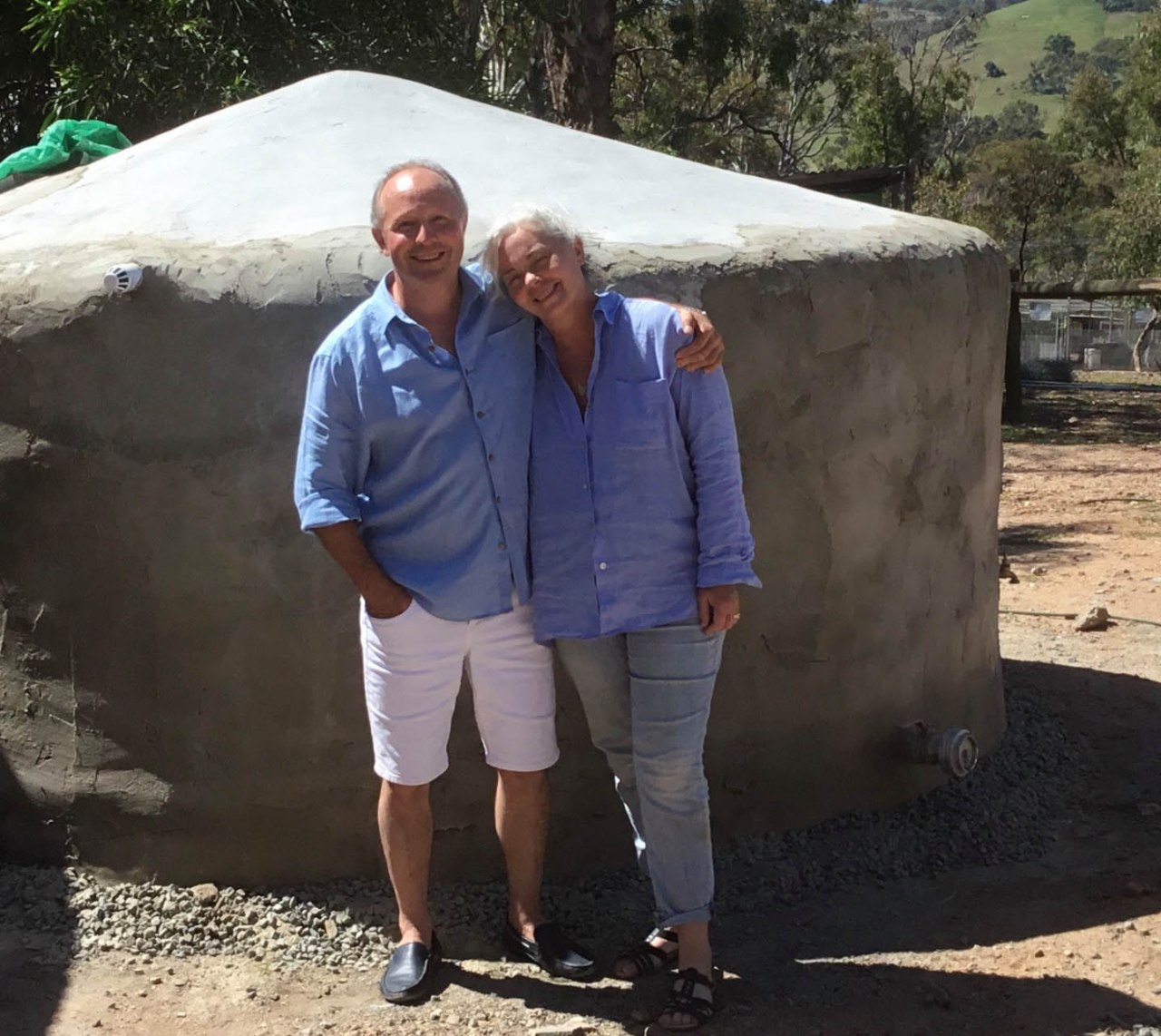
Liz Sherborne is director of NeckTek, a designer and restorer. She and her husband Alex introduced earthbag building to Vanuatu in 2013. They founded Vanuatu Earthbag Building; an eco-building group that links volunteers and schools to water-tank projects in the pacific.

This interview is the third of four interviews with volunteers involved in the building of an earthbag water tank at Lucky Stars Sanctuary, Bywong. Vanuatu Earthbag Building assisted in this project. They have provided free plans, support and the materials required to build water tanks for people in need in fire zones in NSW Australia, cyclone zones in Vanuatu and Pacifica.

Gaele Sobott: You have assisted people to build tanks in Vanuatu and have just completed two tanks in Australia. How did you reach the point where you decided to help people build earthbag water tanks?

Liz Sherborne: Well, both Alex, my husband, and I have been volunteering and giving to charity all our lives. We were doing that long before we met each other. Over the years, we became disillusioned with charities and the waste of resources on CEO wages and marketing costs. We thought that there must be a better way to fulfil our moral obligations to society, and we decided to do our own volunteer work.

GS: What does moral obligation mean for you?

LS: I believe very strongly that service to others is the rent we pay for our room here on earth. Muhammad Ali said that. Gandhi is reported to have said,” The difference between what we do and what we are capable of doing, would suffice to solve most of the world’s problems.” I think the idea is very old. We use the earth’s resources. We are part of a community. Those of us who find ourselves on the better end of that deal have an obligation to help those in need. One of the events that spurred us on was when our government cut the Australian aid budget to the Pacific. The idea that we weren’t going to help our neighbours but that we were going to pollute the air and accelerate climate change was not acceptable. We thought, well, we can’t physically go and make our politicians make the right decisions. We can’t force a politician to pay attention to climate justice or what’s happening to the poorest people in our world. But we can contribute to helping our neighbours survive. We began by researching a lot of family volunteer holidays and discovered that most of them have middlemen that take most of the money that is raised. The money doesn’t actually end up with the people who need it for projects. So, we thought, well it can’t be that difficult to go to a country that may want volunteer assistance, make friends, listen to what it is that they need and help them.

GS: How do you finance your volunteer operation?

LS: We started just using our personal savings. Over the years, friends and family have sponsored tank materials, a couple of businesses that we work with and the Corrilee foundation have paid for materials. We are not a charity and we don’t take donations but if someone wants to come along and help or pitch in on the costs on the concrete or the bagging, then we happily accept.

GS: How did you come to the decision to proceed with earthbag building?

LS: First, we travelled to Vanuatu. Once we started getting to know people and listening to their problems, it became evident that they wanted a roadside market. The women we met didn’t have a safe place where they could sell their yams and their woven mats and their local produce. So the focus became providing them with a safe place to sell their goods. We then researched different methods that would be suited to tropical climates. Port Vila is one of the most disaster-prone capital cities in the world. So any structure you build will be hit by a cyclone, volcanic eruption, earthquake or tsunami within several months of building it. So we had to look for something that would survive all of that and we discovered earthbag building.

GS: How did you develop the knowledge and skills to start building?

LS: We corresponded with people overseas who had done this type of building and we learned by doing it. We just did it. The first tank was an experiment to see if it worked and it did.

GS: What were the problems you encountered? What were the successes?

LS: The problems in Vanuatu weren’t with the building process. The problems were more about negotiating land leases, the right to use land. Negotiating the rights of women to participate in the project and the ownership of the building. Project money disappearing. The problems were more culture-based than engineering problems. One of the more surprising successes was that a tank seemed to result in more girls going to school because they didn’t have to fetch water.

GS: Would you mind explaining how the idea for the project came from the community?

LS: One question I get asked by missionaries and charities is, how do you know you are helping the right people? I always find that a funny question, who are the right people? I see charities over there providing plastic water tanks to communities. They don’t follow up with what happens afterwards. They don’t train members of the community to maintain the tank. They don’t have friends in the community. They just deliver the tank, bring in a water truck, fill up the tank then leave. Sometimes the tank ends up rolled away to someone else’s house and a lock put on it so the community can’t use it. Other tanks are built attached to churches and only the church members who pay their tithe can use it. They are not really community assets. We build a water tank with any woman who asks for one and has organised enough helpers. So far, they have all maintained them really well.

We were lucky to meet a builder from Tanna called Philemon, who was essential to the project. The design of the tank needed to be appropriate to the island. Philemon’s input was imperative for that. We also paid a woman called Rachel, who went out to all the islands and started building tanks. There was no way we could have introduced the tanks to custom islands and remote islands without Rachel. We work with the local people, teach them how to build their own tanks and leave them with enough material to build one for themselves.

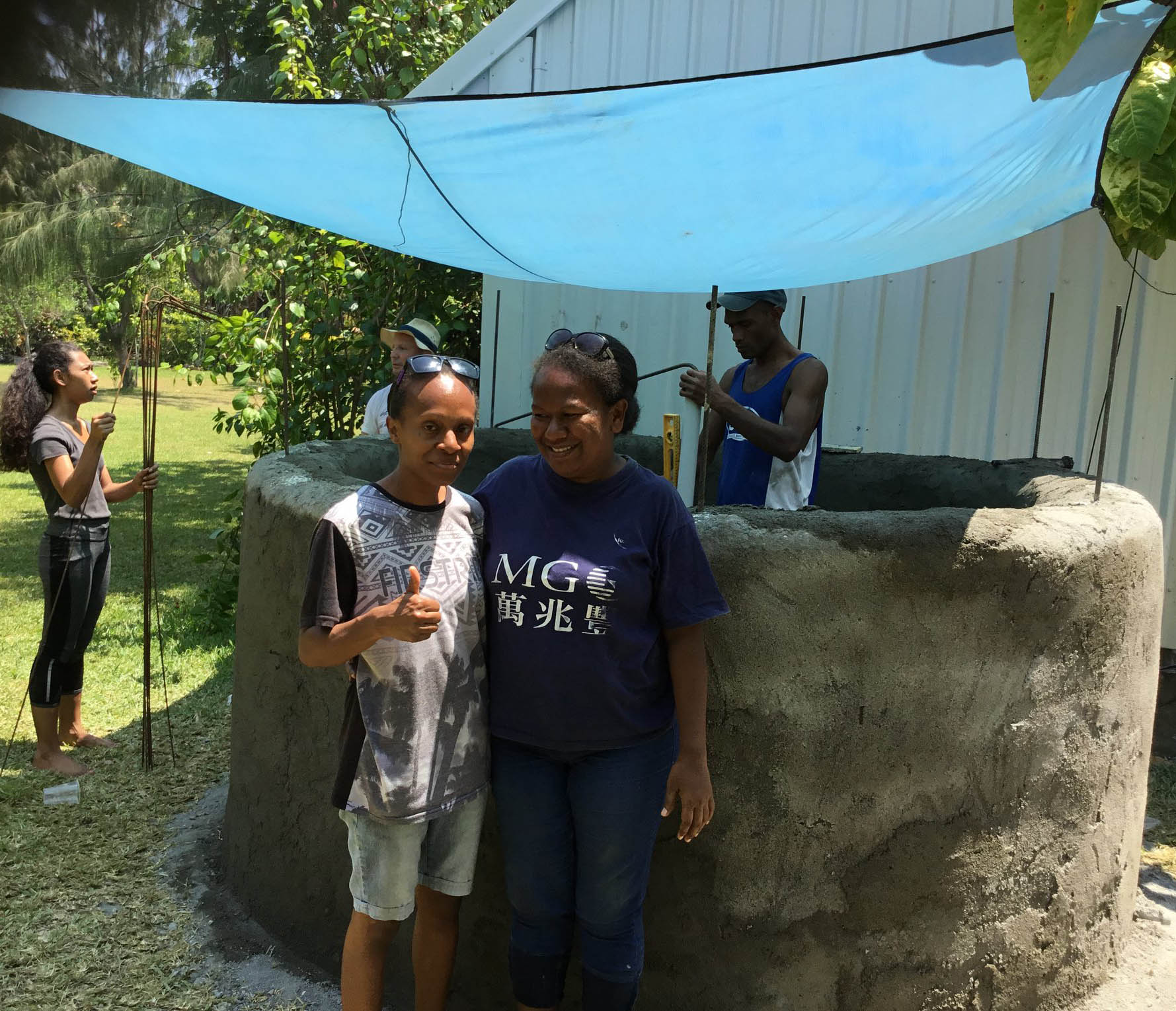
Volunteers from Pentecost Island, Vanuatu

GS: How long have you been building the tanks?

LS: We built the women’s roundhouse in March 2013. The first water tank was built in January 2014. Since then we’ve seen more than 60 water tanks built. Some by Rachel, some by the Save The Children volunteers Rachel trained, some by St Augustine’s school, some by the Laurien Novalis Steiner school. We organised building holidays for some families who built tanks and a significant number were built by our friends and us.

GS: What would you like to happen in the future with the earthbag-building initiatives?

LS: I would love for this to be adopted in developing communities, especially coastal Pacific communities. At the moment versions of our tanks are being built in 8 countries on three continents. I just send the plans to anyone who asks.

I never thought we would need to build them in Australia but I found the bushfires towards the end of 2019 and early this year completely paralysing. The very air we were breathing was people’s homes burning, their farms, our forests and wildlife, burnt koalas. It was horrifying. We were breathing that air in Sydney. Alex and I were talking about it and we realised that the one thing we had to offer was the building of fireproof water tanks. We can teach people how to build their own earthbag structures in the fire zones. Then Helen Schloss contacted us about building a tank for the Lucky Stars Sanctuary. We thought, well building a tank for an animal sanctuary is different for us. We had been more focused on building structures that would benefit women, especially mothers. But Helen had organised people to do the work and they all wanted to learn. So we said, yes. COVID delayed the project but we finally got there. We were really amazed at how well run the Sanctuary was and the fantastic group of local people, and people from all over the place, who support the work that Kerrie Carroll does. We discovered that humans are definitely on the list of mammals that get sheltered there. It was the most fun we have had building in years.

In regards to the future, what I would really like to see happen is we vote for a government that acknowledges that climate change exists and addresses the emergency. Then we wouldn’t need to use our weekends doing this work. Failing that, I think it’s like barn-raising where you work in groups and help your neighbour. Building a water tank is really hard, dirty work but it can be fun. It takes four and a half days for a group of eight to ten people to finish a large fire reserve tank. The Lucky Star Sanctuary got a wonderful group of people together. But I don’t know if this form of tank building will take off in Australia.

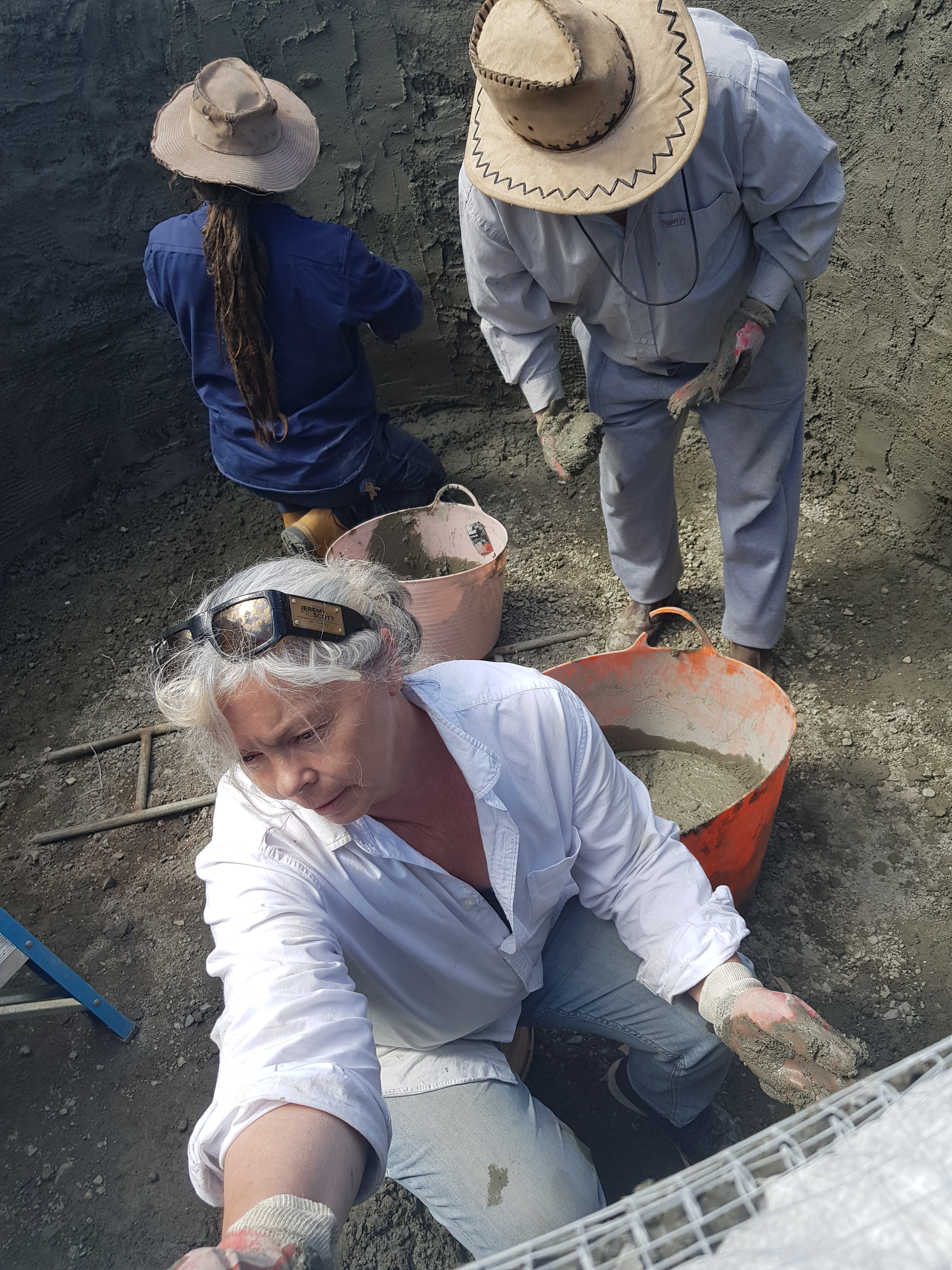
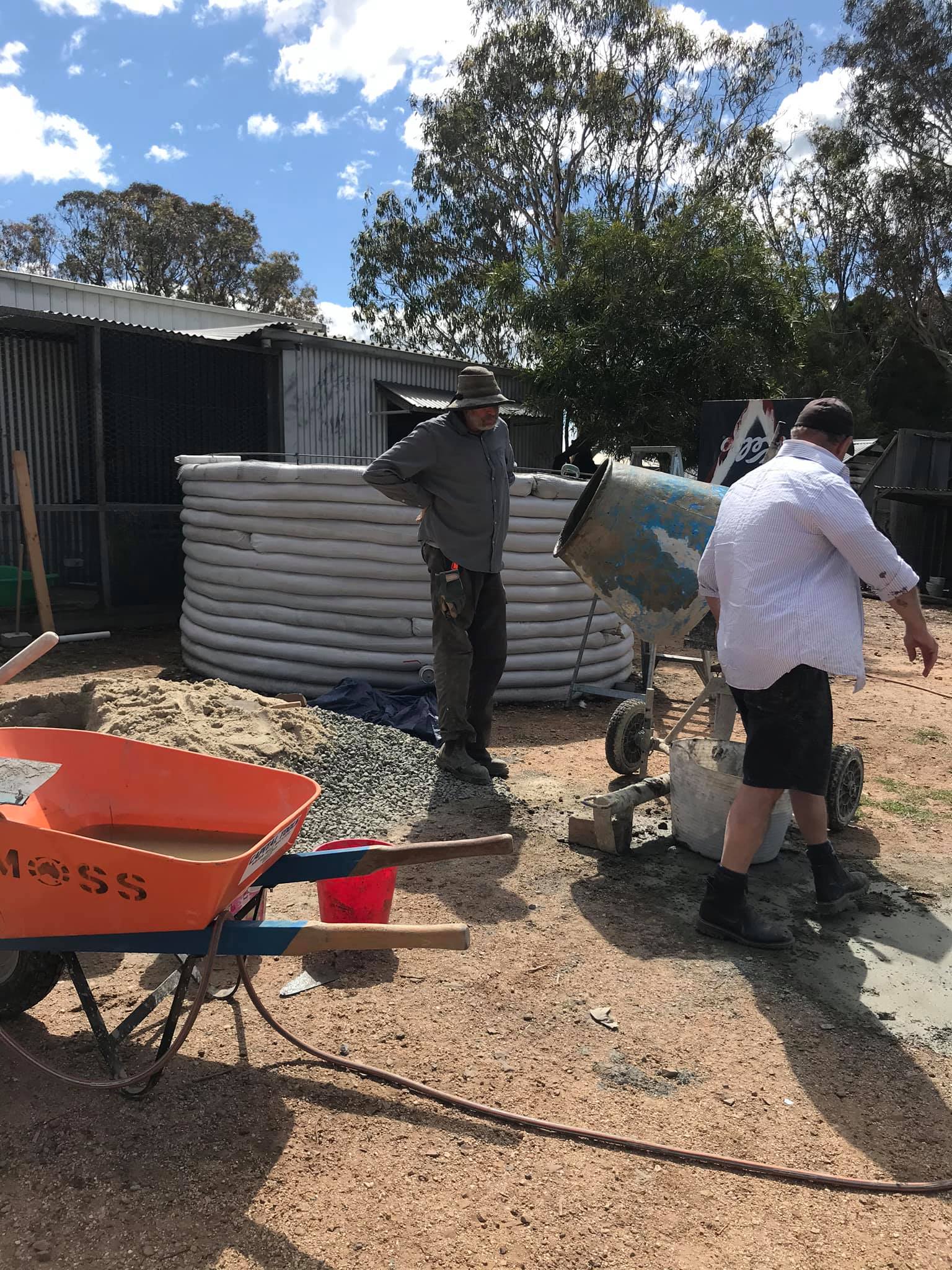
Volunteers working on the water tank

The two tanks we built in NSW posed some problems. In Vanuatu, we worked with sand which was full of salt and the fill we used for our earthbag tubing was crushed coral. You’re not meant to put salt with concrete because it creates a chemical reaction. But it works in the tropics because the crystals from the chemical reaction inside the concrete seal off the capillaries and seal the tank. In Australia, we are not working that way. We can’t rely on the passage of time to seal our tanks and we can’t afford any seepage. We need to keep them drum tight. On the tank at Lucky Stars Sanctuary, we used road base and packed it so tight that it was holding water before we put the ferrocement on. We’ve adjusted the plans quite a bit to suit firefighting. After talking to the Rural Fire Service (RFS), we now fit a STORZ valve so they can connect their fire trucks and quickly refill their water. We had to re-engineer the entire tank design to suit the new conditions. We may refine the design even further according to the different contexts and situations we find when we build.

GS: I believe you are researching more about waterproofing the Australian tanks.

LS: Yes, we just found a fantastic local company that sells a flexible cement membrane that will keep the tank from seeping. This means we don’t have to rely on crystallisation.

GS: Would you describe briefly how the tanks are built.

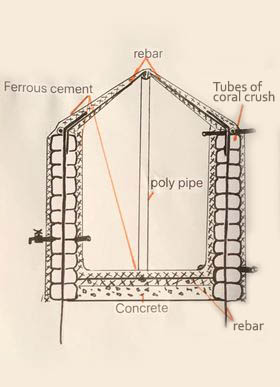
Cross-section diagram of a tank

LS: We buy polypropylene tubing from Bundaberg Bag Co. It comes in long rolls. The last lot we cut into twelve-meter lengths. We fill that tubing with either earth which we then compact or with road base. Row by row as we build up and compact the fill down. We basically end up with a lot of rings on top of each other that look like flattened sausages. The tank at Lucky Stars Sanctuary required eight tons of road base just in the formwork. The entire tank needed eleven-and-a-half tons of material. We use ferrocement as the inner lining, then we put wire and cement down. We use the UNHCR recommendation of a two to one sand-to-cement mix on the inner lining. We work the concrete to reduce the capillaries and reduce leakage. On the outside of the tank, we again use a ferrocement coating. The idea is that you then basically have two structures which are helpful if you get a weather event like Cyclone Pam. If a coconut hits the structure at 260 kilometres an hour, it might smash the outer ferrocement wall. But the internal tank remains intact and this is why they survive, earthquakes, cyclones and fire. The inner tank is protected from natural disaster.

GS: Where has it been tested in a fire situation?

LS: Well, we had no idea about fire until several of our tanks were built on Ambae Island by Rachel. Soon after that, everyone was evacuated because of volcanic eruptions. Those tanks experienced eighteen months of volcanic hot ashfall. When the residents went back to the island, they found that all the fibreglass and plastic tanks had melted. Many houses had been turned to ash and the only tanks standing were the ferrocement tanks and our tanks. The ferrocement tanks were upright but not holding water anymore. Our tanks still worked because only the external wall had been touched.

We build a cone on the top to complete the tank. The reason we create a cone rather than a flat roof is to reduce the amoeba content in the water. You don’t want your water evaporating up to the tank ceiling and sitting there getting mouldy. By building the cone-shaped roof on the tank, it means the droplets run back into the water rather than stick to the roof and breeding bugs. In the tropics we line it with cement, here we now use an extra layer of flexible cement membrane. After that, we cement render the entire outside of the tank, for added strength and so there is no UV damage to the bagging. Sometimes we raise tanks up by building them on a base. In the case of the Lucky Stars Sanctuary, the ground was hard. So we compressed road base for the tank to sit on. I don’t think we’ve ever built two tanks the same way. When we completed the last tank, we asked someone from the RFS to check it out for us.

GS: How much does it cost to build one of the tanks?

LS: If you buy at suburban retail prices and have all your materials delivered. If you use compressed road base and if you use all the fancy fittings we used on the latest tank it costs $1610.00. That’s for a W12000 litre tank. In the islands, we can build one for less than $600

GS: How much would a plastic or ferrocement tank cost?

LS: A plastic tank would cost over $2000.00 and I think a ferrocement tank delivered is between around $10000.00 to $15000.00.

GS: What would you like to say to finish up this interview?

LS: This form of building suits extreme climates with low labour costs or willing volunteers. It is very adaptable. We started this project in Australia not because we thought that this was the best water tank available but because it was the only fireproof one that could be built by an unskilled team. It was all we could offer in the face of such tragedy. You can literally use the burned land to stuff the bags and rebuild. The tank project allows people on the fire front to talk with each other about their losses and exchange information and innovative ideas. Coming together and working as a group of volunteers on building a tank can serve as a kind of therapy. It may also help people to feel more in control of their future. Some of the promised assistance has been non-existent. It is possible to organise and support each other and also support the RFS by providing water reserves. People realise they can actually build a bunker, a water tank, a safe shelter for their animals. You can start small. Build it up bit by bit. There’s no deadline. You can take all the time you need.

On the build at Lucky Stars Sanctuary, we met a guy who is using scoria as his fill, which is like pumice, to build a safe house for his bees and protect them from the next fire. You can’t really put your bees in the back of the car with your kids and your dog when you are evacuating. He has built this fantastic beehive-like structure using earthbag building techniques.

Our climate is becoming more unpredictable and we need options. We need the autonomy of knowing how to put solutions in place ourselves. Knowing how to defend ourselves. Knowing how to protect ourselves. Knowing how to take care of our families, neighbours and communities. When people come together on these tanks projects, it has the potential to provide an antidote to feeling helpless and hopeless about the overwhelming devastation we went through with the last fires.

Interview conducted with Liz Sherborne at Lucky Star Sanctuary by Gaele Sobott, 11 October 2020.

Links:

Interview 1 in the series: Kerrie Carroll

Interview 2 in the series: Helen Schloss

Interview 4 in the series: Scotty Foster

Vanuatu Earthbag Building

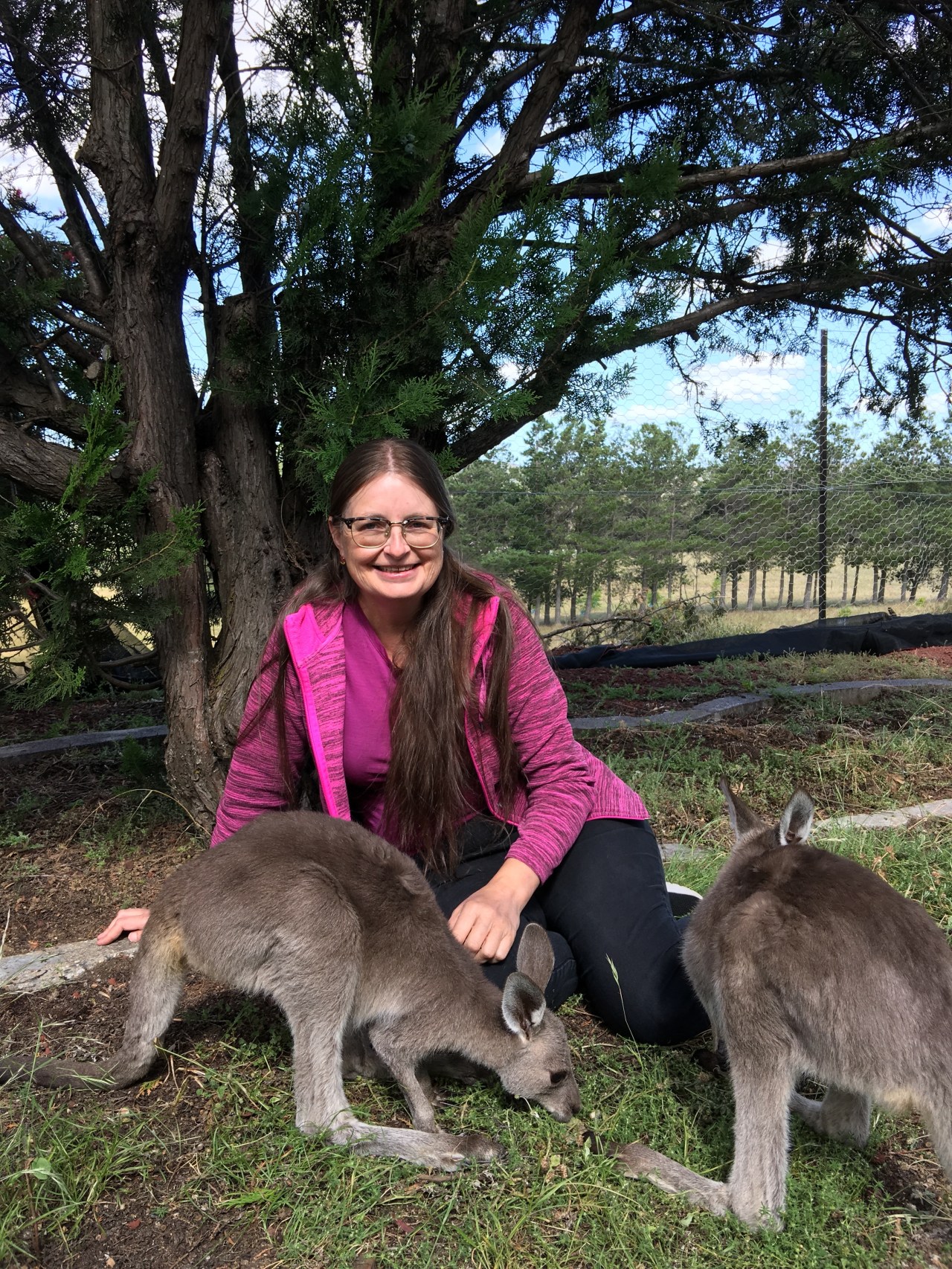
Helen Schloss sitting outside with two Eastern Grey joeys in her care. She is wearing a pink jacket and she is smiling.

An Interview with Helen Schloss

I was gobsmacked by the melted tanks I saw on telly. People lost their homes and there has been a long waiting time for them to receive assistance, especially the wait to get a roof over their heads. I was concerned by the need for water, and I thought, surely if you can build a house out of earthbags, you can make a water tank using the same methods.

Helen Schloss lives on a small property in Bywong, New South Wales, near Canberra. A primary caregiver and dedicated wildlife volunteer, Helen prides herself on her strong work ethic and animal rights principles. Some of her voluntary work includes producing ‘Tuesday Tips’ for Lucky Stars Sanctuary. Her passion drives her to help others help and protect the less fortunate.

This interview is the second of four interviews with volunteers involved in the building of an earthbag water tank at Lucky Stars Sanctuary, Bywong. Vanuatu Earthbag Building assisted in this project. They have provided free plans, support and the materials required to build water tanks for people in need in fire zones in NSW Australia, cyclone zones in Vanuatu and Pacifica.

Gaele Sobott: I believe you were the person who instigated the building of the earthbag tank. What gave you the idea, and how did you go about finding the expertise to commence this project?

Helen Schloss: I already had an understanding of the sustainability and affordability of earthbag building. I was interested in building a second home from earthbags on our property. Then we experienced the bushfires from early December 2019 and January 2020. I was gobsmacked by the melted tanks I saw on telly. People lost their homes and there has been a long waiting time for them to receive assistance, especially the wait to get a roof over their heads. I was concerned by the need for water, and I thought, surely if you can build a house out of earthbags, you can make a water tank using the same methods.  So I put a few words into Google, and one of the first things I found was the Vanuatu Earthbag Facebook page. That was early February this year. I saw a post that Liz Sherborne had written saying they had been using earthbag-building methods in Vanuatu. She noted that earthbag water tanks would be a valuable resource in fire-prone areas of Australia.  Helpful in protecting people’s properties, their lives and the lives of animals. I wrote a comment asking if they would be interested in doing a workshop down our way at some point. She instantly messaged me, and the project evolved from there. Liz said that if we could find ten people to assist with the building, they would come to Bywong. In some ways, it was serendipity.

GS: You found ten people and provided food for everybody, anything else?

HS: Yes, so I rounded up the volunteers to do the work. Initially, we were going to start building around early March, but then COVID hit, and the restrictions meant people couldn’t travel from Sydney or gather together. We had to postpone it, which meant I had to keep those volunteers interested throughout that time, sending them links and chatting with them online. 

GS: What previous organisational and networking experience do you have in gathering people together for projects like this one? Not everyone would know the importance of keeping that group of volunteers interested.

HS: I have some past experience. My family and I were in Papua New Guinea for a while, and I did fundraising events for various organisations. Maybe through the trial and error of that process, I learned that if you don’t keep your communication going, not everyone, but some people will lose interest. I’m pretty sure now, knowing this crew, if I had put them on hold and not had any contact with them, it probably wouldn’t have mattered. Most of them have got properties. Potentially they could use the earthbag building skills on their properties and help neighbours and their communities. But I believe in communication. I’m not fantastic with my friends and family. But when organising events for the animal sanctuary or for people in Papua New Guinea; the hospital there, I feel there’s a lot at stake. Last summer, it was scary because the bushfires were near Lucky Stars Sanctuary at Tallaganda forest and there were various other spot fires around the place. It was really worrying and very stressful for Kerrie and Yee, the founders of the Sanctuary. I think the contingency plan was if a bushfire reached them, they were going to stay and defend. It would be next to impossible to evacuate three hundred animals. That was one of the reasons I felt an affordable, fireproof water tank was necessary. The tank is fitted with a STORZ outlet so fire trucks can connect to it.

Some volunteers building the earthbag tank.

GS: How did you first get involved with the Sanctuary?

HS: In 2017, a year after they opened, I was looking for something to help my daughter, who has been unwell for some time now. She loves animals; in fact, she probably loves them more than most humans. I was looking around for animal sanctuaries and found Lucky Stars on the Internet. We live not too far from the Sanctuary, so I contacted Kerrie and asked her if she would mind if my daughter came over. I remember Kerrie saying, ‘You know it’s not just animals we look after, we look after humans as well.’ My daughter is thrilled working there and now Kerrie and I feel like we’ve known each other a lifetime.

GS: Many people who experienced the bushfires complain that they are still waiting for assistance that was promised by the federal government. I know finding funding for the Sanctuary has been a battle. How do you think a project like building this earthbag tank helps in this regard?

HS: It definitely helps. Earlier in the year, Liz was saying that they like to teach communities the skills involved in the building so that those people can pay it forward. Hopefully, one or two people from each tank-building project can do that. It is one way of getting through this deficit of government funding and developing ways to protect ourselves in the future, especially with sanctuaries. It’s really frustrating that animal sanctuaries don’t get government help, like drought assistance. That’s one way the tank building helps, and I think, also, it helps by promoting awareness. We now have an extra eight or ten people who are aware of Lucky Stars Sanctuary. Hopefully, not only do they know the Sanctuary is here, but they know that we need help from time to time. They also have increased awareness about animals, animal rights, and how tough it is for the animals, especially during bushfire season. Workshops like the tank building initiative serve to increase awareness through social media and word of mouth. More people might contribute to helping financially or by giving Lucky Stars a hand.

GS: Many community projects are continually battling time and funding constraints. People have little time to theorise about what they do, how they do it and where they are heading. How do you think we can solve that problem? How do we begin gathering the data needed to understand our impact and the choices we need to make in the future? 

HS: Hmmm, that’s a really good question. Time and money are always going to be an issue. There are various organisations and government departments that collect data, for example, the Australian Charities and Not-for-profit Commission and the Australian Bureau of Statistics. But whether it’s accessible to charities and communities … I don’t know. A tool that’s simple, affordable and standardised across the sector, could be the answer, like a smartphone app. The majority of people have smartphones now, although not everyone likes mobile apps, I guess they suck up valuable space on their phones. So maybe a website app that has the same functionality as smartphone apps. All the relevant data can be just a fingertip away, no painful paperwork and time saved as a result.

Lucky Stars Sanctuary could gather data such as volunteer info, animal health, fundraising, infrastructure problems or improvements, seasonal conditions. Even information, including photos of soil degradation would be useful for analysis, reporting, planning and decision making. It needs to be well designed, intuitive and easy to use, of course. All the data is there, no more hunting for it down the track. More time saved! Tick!

There’s an app called Farm Tracker, developed by the Department of Primary Industries. It helps farmers collect similar data, including geotagged photo diaries to monitor seasons and dam levels. Some of this information isn’t made public. Perhaps this could be retrofitted to suit charity or community-based work. Then you have the question, who’s going to commission and pay for it? Maybe the Australian Charities and Not-for-profit Commission is a place to start.

Interview conducted with Helen Schloss at Lucky Stars Sanctuary by Gaele Sobott, 11 October 2020.

Links:

Interview 1 in the series: Kerrie Carroll

Interview 3 in the series: Liz Sherborne

Interview 4 in the series: Scotty Foster

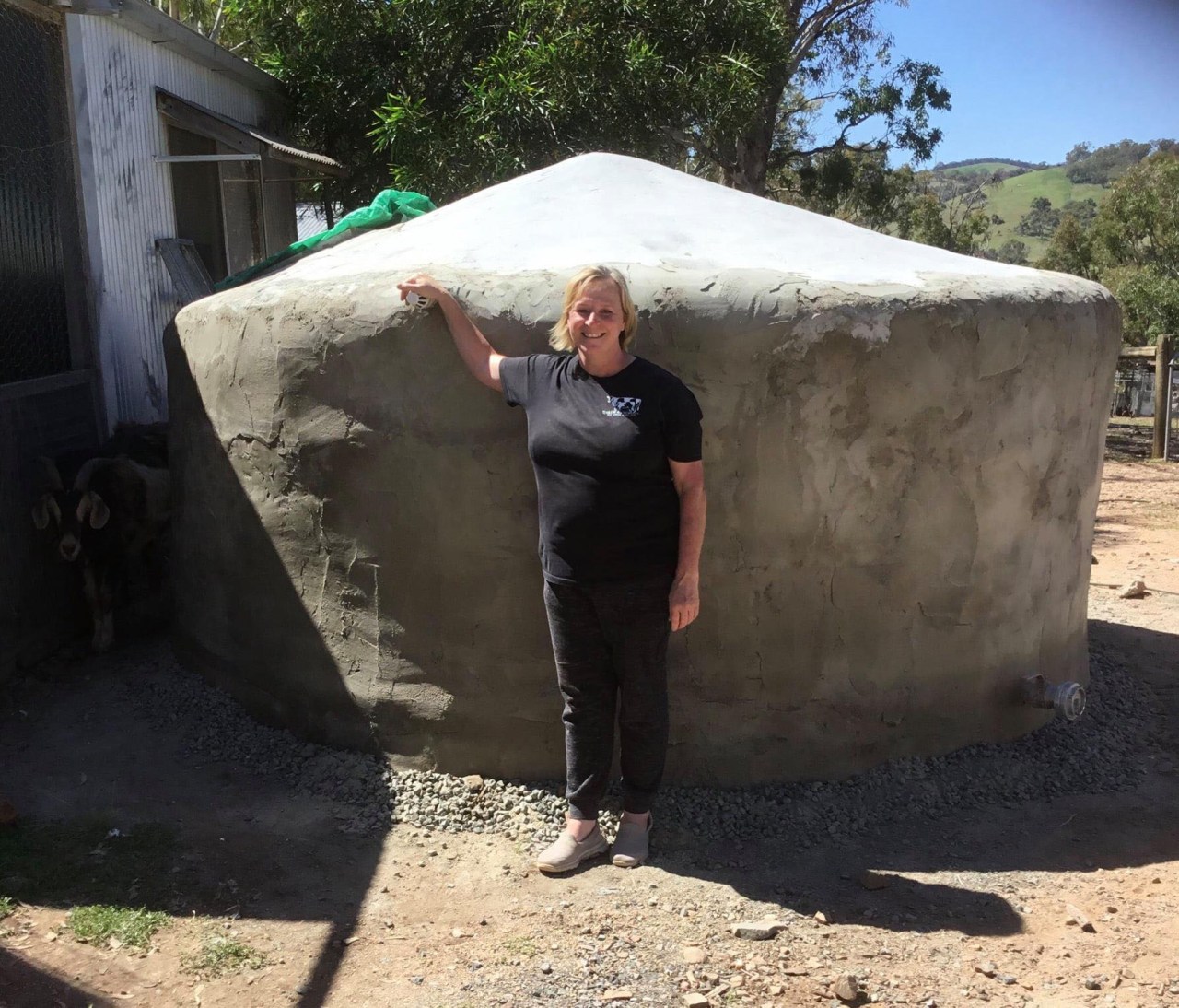
Kerrie Carroll standing in front of the completed earthbag tank

An Interview with Kerrie Carroll

“People are starting to think about their choices. They know that current systems and behaviours are not sustainable”

Kerrie Carroll is co-founder of the not-for-profit, Lucky Stars Sanctuary which is home to around three hundred animals in need. The twenty-four-acre property is in Bywong, New South Wales, 30-minutes’ drive from Canberra.

This interview is the first of four interviews with volunteers involved in the building of an earthbag water tank at Lucky Stars Sanctuary. Vanuatu Earthbag Building assisted in this project. They have provided free plans, support and the materials required to build water tanks for people in need in fire zones in NSW Australia, cyclone zones in Vanuatu and Pacifica.

Gaele Sobott: Why did you decide to build an earthbag water tank? How did you go about organising it?

Kerrie Carroll: Well, Helen Schloss had become quite concerned about drought and fires. She began to do the research. I had been into some of the fire-affected areas doing what we call black walks, where we look for injured and burnt animals. We determine whether they need to be euthanised or whether we are able to do a successful rescue. In those areas, I noticed as soon as embers fell on the plastic tanks, they burned.  People had no water at all and lost their homes.  We were on constant alert through the fires and the drought. We had six deliberately-lit fires near us and two major fires that could have easily turned this direction. It was an exhausting time. 

Helen approached me with the idea and forwarded all the information. I thought it was amazing and we definitely needed another tank here at the sanctuary. I got in touch with Liz and Alex from Vanuatu Earthbag Building and we started putting everything into motion then COVID hit so they couldn’t travel from Sydney. We commenced work here as soon as we got the all-clear. Helen kindly did a call out to a range of different groups and we got this fabulous team of volunteers. Incredibly, it’s nearly finished. I love the look of it, smooth, simple, solid. It won’t burn down, which means we will be able to protect that little bit extra.

GS: You mentioned the black walks, can you talk a little about what you found on those walks?

KC: We found some animals and birds that were desperate for food and water. We did food drops, some native vegetation that we collected from other areas. Animals were injured and burnt. Thankfully they were on properties were people loved native wildlife and they allowed us access. We provided fruits and vegetables because it was a source of water for those animals. We had echidnas, wombats, birds. We were hanging the bird feeders with seed on all the burnt-out trees and that was quite eerie because there weren’t many birds left in the area. The one’s that we did come across we made sure they were okay. 

GS: Some birds may fly away from approaching fire. I imagine some are also caught in the smoke, if not the fire.

KC: Yes, so here at the sanctuary, we were surrounded by fires. Birds were flying away from those fires and we ended up with more here. We’ve never had this many cockatoos. Butcherbirds have come in and yellow-tailed black cockatoos, even ibis. We actually had a fire-fighting group that came here from France during that period who put up all bird-nesting boxes throughout the property. That way, we were able to help the birds coming in. 

GS: How big is this property?

KC: It’s only twenty-four acres. That’s enough for us to manage at our age.

GS: There appears to be a huge amount of work in terms of day-to-day chores.

KC: There was quite a bit to do here back then. There was no fencing, no shelters for the animals and a lot of rubbish left around. We basically cleared the land of all the rubbish, erected fences and established all the shelters. During the fires, there were a few goats that came into the sanctuary. The third one passed away from smoke inhalation and stress. It was quite sad but the other two are still here and going well. We had sheep that were brought to our front gate. They had suffered burns and people brought them here in the hope they would be treated but sadly that was not the case. Their hooves were literally burned off. That would mean a lifetime of misery for them. They couldn’t be salvaged. It was a sad time because they were on people’s properties and they didn’t go and look for them. We buried them here. 

GS: Why do you bury animals that die here?

KC: Well we bury all of them but especially if they have been given the drug called Lethabarb, which is a euthanising drug. It can affect other animals so we have to make sure we bury those animals who have been euthanised. We never burn the animals that die here. Firstly it would be unsafe during bushfire season but it is about our land and also about the volunteers and friends. They get very attached to the animals and they will actually go down to the little graveyard. They have memories and emotions that need addressing.

GS: How do you deal with the emotions of finding injured and dying animals, and euthanising animals?

KC: It’s difficult. There is a part of you that gets used to the ugly side of animal rescue, unfortunately. When we lose animals or we have to do euthanasia, your mind and your heart go to another place. You know that you have to prevent or end suffering. With every single rescue, whether it’s wildlife, farm or domestic, we consider whether they are going to have a good quality of life. We have to ask, are they going to have a life of pain? You have to make those decisions around your assessment of suffering. 

GS: That must be extremely difficult.

KC: It is. We have commenced a group decision-making process. The decision shouldn’t be left to one person. We all discuss the case and come to a decision based on the facts in front of us. We have never yet felt that we have made the wrong decision. A lot of thought goes into it. 

GS: Some people ask, Why do you devote time and money to animals? You should be looking after human beings. How do you respond to them? I believe you are a nurse.

KC: Yes, I am a registered nurse and I teach but the animals and the people come together here as one. We help a lot of teenagers, especially during COVID, who became mentally unwell due to isolation. We did separate, private group tours and they were different people by the end of it. We continue to liaise with those groups. We also have older people who come here with support workers and carers. We make time for them to come out. They generally focus on one area, for example, they may have a fascination with chickens or with kangaroos so we get them involved. They take all the information on board and get involved in the care of those animals. When they leave here, they’ve been working in the fresh air, gained knowledge and applied it. They join in with the laughter and the animals are so different when they are interacting with them. Our community has really benefitted from the sanctuary, not just around Canberra but NSW because we get groups from Sydney, Wollongong. They come from Queensland and now a lot of international people come and stay. For people who live in a city, this place really opens their eyes and heart. Coming to an open space, they’re able to breathe again.

In terms of mental wellbeing, the sanctuary really helps people. It also helps with inclusivity, like the LGBTQI community. Members of that community come here because it is a safe space. We don’t charge an entrance fee at the sanctuary because we don’t want affordability to be a barrier. We believe that charging money is a discriminatory practice. People who do not have much money should not miss out on the opportunity of participating in what the sanctuary has to offer. If all they can bring is a quarter of a pumpkin to cut up and feed the animals, well that is contributing and they become a part of the sanctuary.

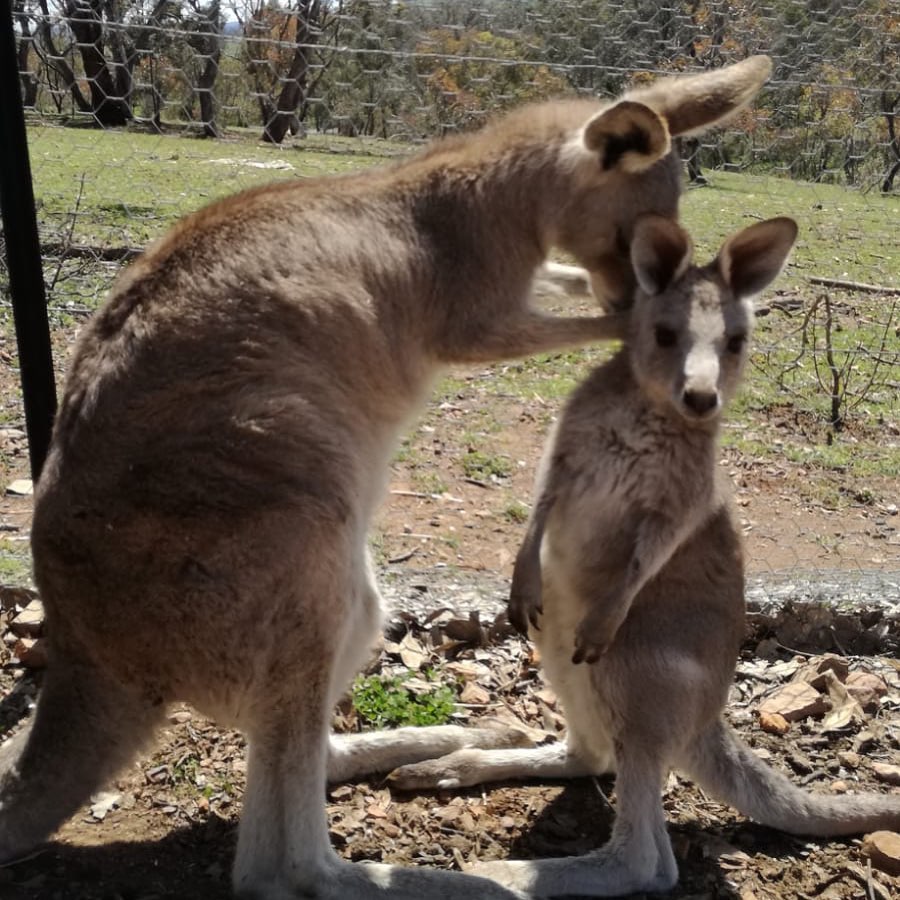
Mother kangaroo and her joey at Luck Stars Sanctuary

GS: Do some people volunteer to help with the work here?

KC: Yes, they come to see and learn about the animals, and muck in while they’re here. Today we had a gentleman and his daughter visit. They helped collect all the eggs that the chickens lay everywhere. They cleaned some bedding. They also helped fill up the duck ponds for the babies. It depends on people’s skills and capabilities. Someone may be able to do fencing or shovelling, whereas others can only do some light work. There’s plenty to do, even chopping up lettuce for the chickens and the ducks.

GS: How do you delegate and roster work? Sometimes that can be a difficult process.

KC: It can be but we talk about the roster with all our volunteers. Generally, our rostering system works well. It’s incredible how people give their time. Everyone offers based on which days and times they have available. We send the roster out every fortnight. We delegate duties according to the animals’ needs. The animals have to come first. So, food, water, their bedding and shelter are the first priorities, and if they require any medications or veterinary attention. We have a duck on antibiotics at the moment and a kangaroo that is on some medications for muscle issues. All that comes first. We have routines and systems and people go into the shed over there and look on the wall, then they know exactly what food is given to each animal etcetera. The extras come after that. It may be time to rake one area or do some fence repairs or we need to rethink how we deal with some of the animals. Goats can be very cheeky sometimes. No way they’re going to bed and that type of thing so sometimes we have to think outside the box. The volunteers love the work. Look at those two young women, they are thrilled with the work, and we’re getting more men in now of all ages. It used to be predominantly women in caring roles and women who were having trouble in the workforce. Some were treated unfairly because they were older, some couldn’t get work because of their life circumstances, and because no one would give them references. They work with us here. We’re able to help them get public service positions, housing after divorce, that kind of thing because we provide a character reference for them.

GS: I imagine they continue to help the sanctuary.

KC: Yes, they do continue to help in different ways. We have a food pickup roster. Volunteers on that roster will always pick up extra shifts if they can. It’s a whole pay-it-forward system. We get given lots of fresh food for the animals as well as the purchased food. Like the sheep love strawberries, so the supermarkets sometimes give us cases of strawberries, watermelon, seasonal stuff.

GS: You must have a good relationship with your community.

KC: We do. There is one place called Choku Bai Jo, a farmers outlet, who have supported us for years. So that they don’t have waste, it comes in bins to us. That helps them out in terms of disposal. They work towards changing culture; where people want to eat plant-based diets for the benefit of our environment, our world, our health. They’ve started stocking a lot of plant-based products now. That’s amazing. I like their chocolate. They also support a lot of local farmers where they only deal with fruit and veg and don’t deal with animal products. It’s all done very much with a community spirit. They stock environmentally-friendly bags and bowl covers and all that.

GS: Do you see a change happening at the community level concerning protecting our environment and fighting climate disaster. 

KC: I do. I didn’t think I would see such a significant change in my lifetime but it is happening. People are starting to think about their choices. They know that current systems and behaviours are not sustainable. Industrial farming, the release of methane gas, for example, is over the top. It’s going to ruin our planet if we don’t do something urgently. I also find a lot of people come here and visit, and once they find out how pigs are factory farmed for example, they have given up all pork products. Like the terrible way many chicken farms operate. At the end of the day, why would you want to consume an animal kept in such filthy conditions and filled with antibiotics? A girl is working here this weekend who has actually just chosen to become vegetarian. She is thinking about how her lifestyle affects the world and is making changes. That’s good.

GS: Why did you start the sanctuary?

KC: I have always been in animal rescue from a very young age. I’ve never stopped. I have letters from, I think it was Malcolm Fraser, our prime minister back when I was about, I don’t know, ten years old. I was mortified by the clubbing of seals so I sent letters everywhere and put up posters at school and decide then to be vegan. That was a difficult time. There weren’t many products. I ate a lot of fresh fruit and veg and I think it was a Campbell’s tin of four-bean mix. I thought if I have to eat these beans for protein, that’s fine. It was hard to be creative back then on the food front. I never thought of setting up an animal sanctuary. I always thought I would just volunteer at places that needed help, fundraise, provide supplies, that type of thing. I realised that there were many different animal rescue groups out there. Some had various ways of rescuing and caring for animals and that was okay but there were  others where conditions weren’t good. I wasn’t happy with that kind of practice. So many animals were going through those places. We realised there was a need for another shelter. We started looking for a property. It was hard to find the perfect property where we were going to be happy because you have to live your life as well among the animals. We found this one relatively close to Canberra and accessible for people to come here without having to spend a lot of money on petrol or having to pack food or stay overnight. It’s a reasonably easy three-hour run from Sydney. We’ve also got onsite accommodation so people can stay. We don’t charge massive fees or anything like that, just as long as the utilities are covered. We just appreciate all the work everyone does while they’re here. The tank building, for example. Others who stayed here this weekend helped with all the feeding and cleaning.

GS: There was an enormous amount of work done this weekend.

KC: There was. It was huge. It makes us all feel amazing, and knowing that the animals are all so healthy and clean is great. We physically inspect every animal every single day.

Shingleback lizard at Lucky Stars Sanctuary

GS: I assume your nursing experience has come in useful.

KC: My nursing experience has been invaluable, really. Syringing medications, giving needles, wound dressing, and there is a certain element of trust with our vets as well. We save a bit of money if I am supplied with the material then we can do a lot of the veterinary work ourselves on the property. If I had my time over, I possibly would have been a vet but it wasn’t to be. Fortunately, I am able to apply nursing skills to the animals quite a bit.

There is one of our volunteers who has just picked up another load of food. She has a bad back and finds it relatively light work to collect the food. That way, she gets to come out to the sanctuary and be a part of the operations. We work within everyone’s capabilities.

GS: Do you work full time as a nurse?

KC: I work full time and Yee, the other co-founder works full time. That’s why we are keen to develop our lovely volunteer base. Everyone is reliable. If the chips are down, they’ll come and help. There are some nights that we don’t get a lot of sleep but it’s for a good reason and we don’t mind.

GS: Do you get time to rest?

KC: Yes, I do get rest. Every now and then, maybe every three months, I will say to everyone, I need a night to myself. They understand because they see how much goes on. The work with the animals is a full-time job and then there’s the administration and the fundraising. We don’t get any government assistance. Not like farmers do. So we are very reliant on people’s generosity, sponsorship of the animals – a number of them are sponsored. That means all their food and medical bills are covered. COVID affected our fundraising because we had to cancel all the events. Still, we recently had a little festival in the city which went quite well. We get the message out there with our events and that means more visitors come here.

GS: How do you get the message out?

KC: Social media and our website. People print brochures but on that front, we are thinking of the environment and leaning toward just saying look us up. We have a section called Tuesday Tips where we give a lot of information on various recycling ideas. We let people know how to be water-wise, how to rescue wildlife from the side of the road or how to go about contacting the right people. We also recently wrote a piece about sanctuaries that you can stay at. That was both on electronic media with a national reach and printed as hard copy. I’m a bit old fashioned in that way because I like reading a newspaper.  Our message is also spread by word of mouth. That’s important. Someone is always talking to someone else about coming out here, volunteering and they invite people here. 

GS: How is telling stories about the animals important to the sanctuary?

KC: Well, each animal, not all of them but a lot of them, has suffered before coming to us. Shaun is one of our most beautiful sheep. He was tied to a four-meter rope for three years in an industrial area just outside the city. He was in a terrible way. He’d never had any veterinary treatment, never been sheared and he was bloated. He had a foul odour and was miserable. Thankfully, we got called in because he was getting frustrated. The owners knew they couldn’t handle him anymore. He just laid his head on my lap, he was so depressed. I suppose it’s like being stuck in a bedroom for three years. That’s what he was going through. We’ve done a lot of work with him.  He was treated, we sheared him and he now gets fresh food and water. He met other sheep which was a big deal for him because he’d been so isolated. I videoed that moment. He was ecstatic. Sheep are herd animals, not meant to be on their own. They need their own kind.

It is important to tell the animals’ stories to our visitors and online. Even factory farming, chickens are terribly abused. They are only naturally supposed to lay twelve to twenty eggs. The factory-farming industry selectively breeds hens to pump out three hundred to four hundred eggs a year. Most of them usually succumb to cancerous tumours in their reproductive systems, peritonitis and fluids. They get respiratory problems, feet issues. We have just had one little girl brought in. Her wing had been stuck in the factory farm cage. A good Samaritan handed her into us. The wing wasn’t salvageable as all the vascular supply had been ruined. We took her to our vet, who did a successful amputation. She’s only about three months old now.  She doesn’t have that drag on her side anymore. She’s spritely, has lots of energy and has an amazing personality. We called her Ella after Ella Fitzgerald, who was an amputee. Her legs were amputated due to diabetes. People can connect those stories to their food choices as well, right down to the eggs. 

GS: Do those stories also help attract sponsors?

KC:  Yes, they do.People hear about specific animals that way.We had some people here who fell in love with one of the alpacas and ended up sponsoring her.Her name was Dora and she was fascinated by them. She came from a stud that was closing down. We take in older animals too.

GS: Do you shear the alpacas?

KC: Yes, we shear the alpacas once a year. We have specialists come in to do that. We worm them and give them vitamin injections then as well. 

GS: What do you do with the wool?

KC: We let anyone take the wool who wants it for spinning, some people make dog beds out of it.  We leave some out for the birds to collect for their nests but it takes a long time to break down in the environment so we have to be careful. We shear the sheep twice a year; a full shear at the start of summer and their bottoms and tails in winter. 

GS: I notice you don’t take off their tails.

KC: Yeah, it’s a misconception that sheep will always get fly-blown around that area. Mulesing and tail-docking came about because farmers wanted a clean shear and said it was for health reasons. Any sheep we’ve had here that had flystrike got it around the ribcage area. It comes down to good husbandry where you check your sheep regularly.

Sheep express themselves through their tails the same way a dog does. If they’re frightened or unsure, their tails go down between their legs. They wag their tails when they are happy, if you massage their body or when you feed them. You can know a lot about sheep by observing their tails. If they are cut off, it’s a lot more difficult to understand what’s going on. I read a study that proved they have phantom pain from their tails being cut off.

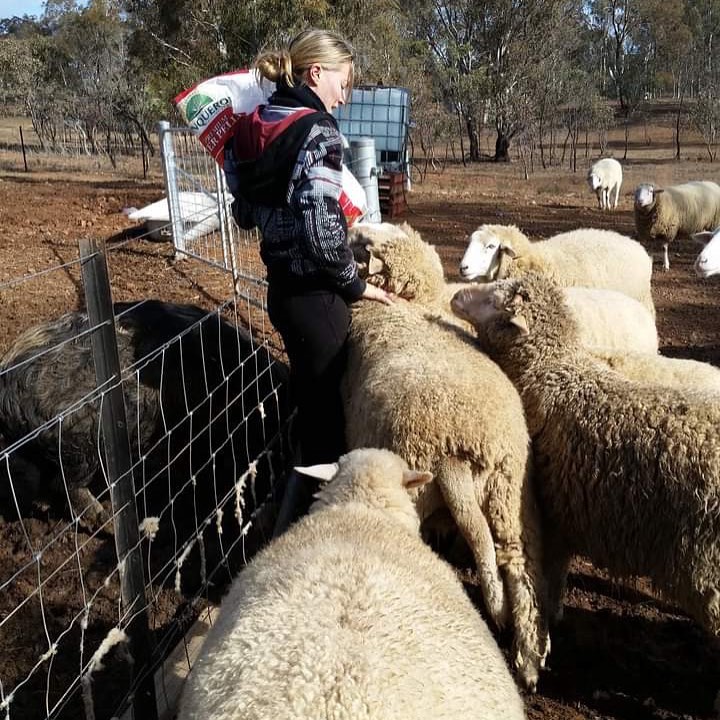
Rescue sheep at Lucky Stars Sanctuary

GS: Is there anything you would like to add?

KC: Come and visit us. Come and stay here with us. It’s accessible and I also think if people have made a donation, it would be great for them to come and see what they are supporting. Come and learn about the animals and what happens to them in our world. COVID is a big lesson for us. Bats and other wild species are in their natural environment and we have no right to mess with that. As we encroach on wildlife habitats, we can expect more spillover of animal diseases to human beings. Our use of pesticides is having devastating effects on the environment. I believe pesticides are the most likely cause of the cancer attacking our Tasmanian devils. The Tasmanian government has been lobbied many times to legislate to cease the use of chemical pesticides. So it’s crucial for us to look at the products we are buying, to find organic products. Farming practices such as introducing rabbits, foxes, then myxomatosis, cane toads, the list is long, have caused havoc on our wildlife.

GS: To finish up, how are love and respect relevant to your operation here at Lucky Stars?  

KC: Well, we respect the animals as individuals and we respect their space. If they want to come to you for affection, they come to you on their own free will and accord. We never force an animal to interact. It is important to respect them as a species. It is no different for humans. We know we must respect personal space. We have a very strong policy at the sanctuary where we all treat each other with respect. I think the animals can feel our emotions. All the volunteers develop a love for the animals and respect their space and routines. We don’t force them, like at night time, we try to put them to bed. Some are just not ready preferring to do something else. We like to know all the animals are safe at night so we try to get them used to bedtime. Some go in later than others. One night, dogs attacked. That was traumatic for one sheep who lost an ear from the attack but fortunately survived. Yeah, so we like to know they are all safe at night. Even pigeons, I think they are the most hated bird on the planet, along with the poor old ibis. We’ve got one hundred pigeons here that were rescued from a hoarding situation. They’re funny. Some will build a nest with a few twigs and lay an egg, others have got the Taj Mahal going on in there. They’ve all got their individual personalities.

We treat all our animals with the utmost respect, including our older and our disabled animals. We make sure they are happy, comfortable and have the best possible life.

Interview conducted with Kerrie Carroll at Lucky Stars Sanctuary by Gaele Sobott, 11 October 2020.

Links:

Interview 2: Helen Schloss

Interview 3: Liz Sherborne

Interview 4: Scotty Foster

Lucky Stars Sanctuary website

Lucky Stars Sanctuary Facebook

Disgust: what is not discussed in Australian politics

The sky is a dark smoke cloud tinged with orange, it’s difficult to breathe outside. I assist my mother to shower, rubbing shampoo into her hair. I hand her a facecloth to wipe the soap from her eyes. We’ve closed the windows and doors to stop ash from coming inside. It’s hot. I’m disabled, 63 years old and my parents are in their late 80s. My mother is ill and has been in bed for a few months. It is extremely difficult for her to walk to the shower. There’s no electricity due to the fires that are raging up and down the south coast of New South Wales. No TV, no internet, no phone coverage. Emergency calls only on my mobile phone. Web-based fire apps aren’t any good to us. I’ve packed the car ready to drive to the evacuation centre at Moruya showgrounds. We are relying on the static reception of the ABC and a battery-operated radio for local emergency updates. I am impressed by the local knowledge and articulate reports of people who phone in about their experiences of the fires. Their reports are invaluable to understanding the trauma and loss, the ferocity of the fires and the extent of the devastation.

The waiting is frustrating, I feel underlying and suppressed fear. Occasionally, anxiety marks my parents’ voices and actions. My father is blocking the downpipes ready to fill the guttering with water. He is determined to stay and defend the house against ember attacks and perhaps even approaching fire. His truck is packed and facing the road. He says he will go if necessary. There is no use arguing with him. I oil my mother’s finely wrinkled skin, careful not to press too hard; run my hands over her stomach, silently thanking her for bearing my sister and me. Her thighs are smooth, almost youthful, her ankles thin. I help her into pyjamas and bed and leave her to sleep.

*

Now I reflect as I wait. The ABC’s emergency reporting is serving us well, but disgust takes over at the Australian government’s not particularly subtle dismantling by stealth of this vital community and national asset. In fact, I realise disgust has been a more or less permanent emotion over the course of 2019. I’m not usually one for hyperbole but I think in this case it is warranted, not to be taken literally but illustrative of the proportions of my disgust; multi-directional, multi-dimensional, stretching to every extreme of my existence and beyond. I breathe the particulate matter of disgust into my lungs, into my veins, arteries and capillaries, my heart, my brain. It penetrates the subterranean reaches of our earth; the water tables, the aquifers, even, I suspect, the white-hot, molten-metal core. Disgust drifts to where our earth’s atmosphere bleeds into outer space.

Most of the time, disgust accompanies feelings of grief and dread. As in early 2019, when close to one million fish searched for flow, for faster cooler deeper current, desperately fighting to breathe in the lower Darling River. But they failed, suffocated; their bloated, rotting corpses floating on blue-green algae pools, piling up on the banks and dry riverbeds. The deaths of 100-year-old Murray cod, golden and silver perch, bony bream with shining spirit skins haunt me. I grieve for them as I grieve the looming death of the Murray-Darling rivers system. I fear for the lives of farmers, townspeople, wildlife, reptiles, fish, insects, plant life, wetlands and soil that depend on this river system. Geologically speaking, the Murray–Darling Basin is over 200 million years old. The river system stretches 3,200 kilometres from Queensland, down through NSW, Victoria, the Australian Capital Territory then into the Murray Mouth at Goolwa, in South Australia.

My top lip curls up on the right side, my throat constricts and I feel nauseous. Disgust oozes through my body in response to reports that in 2012 after public consultation had ended on the draft Barwon-Darling water management plan, the National Party, Primary Industry Minister, Katrina Hodgkinson changed the rules to allow irrigators to extract 32 per cent more water during low flows. Disgust that corporate farmer irrigators, many of whom are said to be major National Party donors, have been taking water illegally from the Barwon-Darling and the NSW government has turned a blind eye. Disgust at the massive level of corruption and fraud, lack of transparency and obvious disregard for the health of the Murray-Darling river system that are hallmarks of the government’s water buybacks, water-efficiency projects and capturing of water from overland flow and floodplains. For instance, the federal Minister for Agriculture and Water Resources, David Littleproud, has family links to those charged with Murray-Darling Basin fraud amounting to A$20 million, yet he is still the Minister overseeing complaints in a separate investigation of the $80 million Murray-Darling Basin scandal involving federal MPs Barnaby Joyce and Angus Taylor.

I feel disgust at the corporate farming of water-guzzling crops that are not suited to our dry climate: like the annual planting of cotton, with an average irrigation requirement of 7.8 megalitres per hectare and the planting of permanent crops like almonds that require an average of 13 megalitres of water a year per hectare. About 90 per cent of Australia’s cotton is grown in the Murray-Darling Basin. Cubbie Station, located on the Darling Riverine Plains, is the biggest water user and largest cotton farm in Australia. Its storage dams stretch for more than 28 kilometres. This water is harvested from the floodplains and cannot, therefore, flow naturally to the river. It is believed floodplain harvesting is a major contributor to the huge drop inflow in the Darling River. A significant portion of the water stored in dams is also lost to evaporation. Cubbie has water licences for 460GL or 184,000 Olympic swimming pools.

Instead of addressing how these actions contribute to the reduction of water flow, the Federal Agriculture and Water Resources Minister David Littleproud and his NSW counterpart Niall Blair blame the drought.

*

I let disgust go. I must take my mother something to drink. She is tiny in her bed, covered by red blankets, sleeping. These days, she has almost no appetite. We offer her smaller servings of food, yoghurts, milk drinks; easily digestible with nutritional powder, banana or blueberry or yoghurt mixed in. As the electricity is off, I mash a banana with a fork until it is liquid, whisk it into the milk mixture then strain out any lumps. I may try mashed avocado next time. We are on a journey of discovery, finding out the food tastes and textures that please her. She likes some soups, carrots cooked until they are soft and vegetable risotto. Yesterday, she asked for a cup of tea.

            The police knock on the door. My cousin in Perth is worried as she can’t get in touch with us. One policeman tells us that Mogo, Batemans Bay and places like Malua Bay have experienced significant damage from the fire. They say they would prefer my mother and I go to the evacuation centre today.

My father packs a change of clothes and a toothbrush in a bag. I prop Mum crookedly against some pillows on her bed; she manages to drink a small glass of banana milk. I decide to check out the centre and leave her to sleep.

It’s not far to the Moruya Showground. There are a lot of caravans and tents around the oval, horses in various enclosures and other livestock in small buildings. I can hear hens clucking and roosters crowing. People are carrying cats and walking their dogs. The evacuation centre volunteers and emergency workers are set up at tables close to the entrance of the indoor basketball court. A man offers his arm to help me walk. I’m thankful. It’s difficult to negotiate the crowd without my mobility scooter. People, strangers, seem to gain comfort from talking to each other about their experiences, their losses, their fears and their plans for the fires approaching Moruya. I talk to a couple from Canberra who can’t get back because of road closures. Another woman tells me the water is off at South Head. Two elderly men say that the leather shop in Mogo has burnt to the ground. There is a whiteboard with the latest information on the fires, road closures, power cuts and the times when food is served. I register my parents, myself and the cat with the triage team. The workers try their best to help find a suitable place for us to stay but the accommodation on offer is not accessible. They advise me to try the retirement village near the hospital which has chairs available for the night. I drive there and speak to the woman in charge. She is efficient and welcoming. The hushed pinks, greens and grey of the interior provide shelter to many elderly people and some disabled young people, all sitting quietly, staff bustling between them. The woman says we should hurry to be assured of a place as they are also expecting elderly people who are being evacuated from the retirement village in Dalmeny.

Back at home, I give my mother a small glass of apple juice. Dad puts an esky full of drinking yoghurt and apple juice, a pillow and a woollen blanket in my car. I drive to the retirement village with Mum. Two members of staff wheel her inside, I park the car and bring her bag in. She is sitting on a chair, upright, tense, ready to leave. Her eyes are bright blue, buttoned into her pale face, searching for me. I sit next to her, suddenly realising that possibly she thought I had dumped her in a retirement home under the pretext of evacuation and I wasn’t returning. She asks me numerous times why we are here and where my father is. A staff member offers her a sandwich. She refuses to eat with a slight air of indignance. She keeps repeating that she wants to go home. Her confusion and anxiety are increasing rapidly. I tell a member of staff we are leaving, take my mother to the car and we drive.

I’ve lost awareness of dates, days. It’s a weekday, mid-afternoon. No cars on the road, no people walk the streets and everything seems to glow a dirty, apocalyptic orange. We drive past the Queens Street Medical Centre. There is a sign on the door that reads ‘Closed due to fires’. Some businesses that rely heavily on the tourist season have decided to call it quits for good. ATMs don’t work and the few shops that are open require cash. The chemist in the main street and Woolworths are closed. I drive home, hoping it will be possible for Mum to stay one more night in the comfort and familiarity of her own bed.

Dad agrees with this decision. The fire glows red on the ridge north of Moruya. I’m on edge, wondering how I will know if there is an ember attack or if fire approaches during the night. I manage to sleep soundly, waking to the alarm at 6am. Dad helps Mum into the car. We find parking in front of the evacuation centre. It is not too far to walk. I keep talking to her, explaining that we will be staying here for the whole day and night. An emergency worker asks if we would like someone to bring us our meals. I appreciate her assistance. It means we don’t have to join the long queues at the building that serves as a kitchen. A charity volunteer talks to me about finding a mattress for my mother. Soon, a young man appears with an air mattress. He proceeds to blow air into it. Another volunteer brings sheets and pillows that have been donated. People are helpful. They assist me to walk and carry things. When the electricity goes off, a woman in a bed nearby tells me she is a nurse. She offers to take over from me for a while to fan my mother. Her husband has Parkinson’s and is waiting for his daily medication to take effect. Their two teenage sons are with them. Like many people in here, this family knows the fire has already been through their area but don’t know if their house is still standing. I keep Mum’s fluids up and give her mouthfuls of yoghurt from the esky. When a volunteer brings spam and salad sandwiches, surprisingly she eats most of it. The small dogs are yapping, the parrots squawking but generally, the animals in the hall are well behaved.

Time passes slowly. I keep talking to Mum, reassuring her. Someone says the fire is at North Moruya, firefighters are water bombing near the airport. A volunteer offers me two wet cloths. I put one at the back of Mum’s neck and one in the esky. She asks about Dad a few times, then asks if we can go home soon. I tell her we are staying the night. I don’t know how I am going to help her up from the mattress when she wants to go to the toilet. I speak to the emergency workers about it. The hair around my forehead is wet with sweat. People stop and talk to us. I notice various disabled people of different ages with varied impairments and health conditions. They are accompanied by family and friends. The strength of community in this hall is palpable. People seem to know intuitively how to help each other, their skills are apparent. It is clear that, even without resources, we will make the best of the distressing situation we find ourselves in.

Mum wants to go to the toilet. She tries to get up but cannot. I ask an emergency worker for assistance. She calls another woman. They try to help but hurt Mum by pulling on her arms. She doesn’t complain. An elderly woman sitting across the way gets up and walks over. Her name is Val, she was a geriatric nurse in England. She demonstrates to the women how to help a frail person up from the floor. Mum is on her feet. I guide her to sit on the walker and push her. We move slowly. I’m not physically strong. The walker helps me balance. There are four toilets and a row of metal basins on the wall. One toilet has a piece of paper taped to the door with ‘For people with upset stomachs’ written across it. Apparently, some form of gastritis is raging through the dogs and the humans in the centre. When Mum is finished, I rub her hands with sanitiser and we return to our mattress. Even though this experience is hard for her, she is quietly persevering. She lives in the immediate present or in her childhood. She talks to me now about her father, telling me that he was a gentle man.

*

I lay next to her and I think about resilience and about how we are made vulnerable by a system that has let us down. How communities that lack resources – poor communities, the disabled, the elderly, First Peoples’ communities – are particularly impacted by disasters like this one. My guts twist in anger and hurt for those in need who are disregarded or, worse, stigmatised and punished by government policies. Disgust sets in again at the repeal of Medevac, stripping away the only pathway to evacuation from offshore detention for sick refugees. Disgust at the decision to axe funding to the main body representing First Peoples women survivors of domestic abuse. Disgust at Robo-debt’s cruel assault on our welfare system causing extreme distress and, in some cases, suicide. Disgust at the refusal of government to increase the New Start support allowance which, at around $40 a day, condemns people to live well below the poverty line, barely covering rent, let alone other essentials.

Disgust that people on the cashless welfare card will not be able to buy goods during this disaster when the shops are demanding payment in cash. Disgust that the expansion of the cashless welfare card is costing between $4,000 to $10,000 per person to implement and manage. This money could be going directly to income support or work programs, education or additional resources and infrastructure in areas impacted by high unemployment. It goes instead to Indue Pty Ltd, a corporation said to donate to various Liberal and National Party branches nationally. In August 2019, Indue is reported to have received up to $21.9 million. If the card is extended to every person receiving benefits, the cost to the taxpayer for administration alone will be in the billions. Disgust also that the Indue card is the result of the sustained efforts of billionaire mining magnate, Andrew Forrest, who dictates that the solution to what he perceives as the ‘welfare dependency’ of First Peoples is income management.

*

Women bring us our evening meal; a sausage with mashed potato and fried onions. One woman asks if she can bring some water with electrolytes.

I say, ‘Yes, please.’

 ‘It’s cold and it’s electric-blue,’ she adds.

When she returns, Mum has a long drink from the flask. Then tries to get up. An emergency worker brings two young army reservists who offer their help. Val explains to them how to lift. They do a great job. I ask them how they feel about helping citizens at home. ‘It makes me feel valued,’ one says.

I help Mum to the washbasin and pour water from a bottle so she can clean her teeth. We return to our place on the floor and lay down with every intention of sleeping. It is noisy and hot.

Mum turns to face me. Her eyes seem to look right into who I am as if she has some kind of superpower.

She asks, ‘How are you? How are you really going in your life?’

I say, ‘I am good Mum. I have friends. I’m good.’

She continues to look at me.

I have not asked myself this question. Every day is a struggle. I am self-employed, work non-stop and make very little money. My work-life balance is terrible.

Children run up and down the hall, laughing and screaming. The main light in the hall is just above us, secured to the backboard of a basketball hoop.

*

I return my thoughts to Andrew Forrest and the big mining companies in Australia. Miners of fossil fuels like Adani only expect to be viable if they depend on subsidies, favourable deals and tax concessions. Over its thirty-year life, Adani’s Carmichael coal project would be given at least $4.4 billion in taxpayer subsidies. The miners bring in huge revenues but pay little or no tax at all. The latest Australian taxation figures record that massive oil and gas producers, like Exxon Mobil with $9.23 billion in Australian revenues, Chevron with $5.27 billion and Woodside with $6.28 billion, all paid no tax. Gina Rinehart’s company, Hope Downs, with $3.8 billion in revenue, does not pay tax. That both our two major political parties support coal exports when we could be developing other export industries including renewables, makes no sense. I want to see a breakdown of who exactly benefits from the US$87.7 billion income from our 2018 exports of mineral fuels. Given that the demand to decommission coal mines includes a just transition of jobs to renewables, I wonder why there is so much emphasis on jobs in the coal industry when just over 37,000 jobs are involved and many mines, including Adani, are automating. There is also little discussion on how the increase in our exchange rate caused by the resources boom negatively affects other job sectors — industries such as tourism, tertiary education, manufacturing, agriculture that employ vastly more people in widely dispersed locations. I feel disgust that we are lied to by politicians like Scott Morrison and the billionaire-owned media. We are not given the information we need to make decisions, we are discouraged from thinking critically.

I feel disgust that Gina Rinehart’s company, Hancock Prospecting, donates millions to the right-wing, climate-denying think tank, Institute of Public Affairs (IPA) which has close links to the Liberal party and to Murdoch’s media. Murdoch News Australia pays no tax, despite $2.4 billion in revenues from its papers and websites. The same media spreads clearly disproven disinformation that arsonists, not climate change, are responsible for the continuing fire disaster we are experiencing in Australia.

I am equally disgusted when, in September 2019, Donald Trump hosts a state dinner in honour of Scott Morrison accompanied by guests Gina Rinehart and Andrew Forrest, billionaire media magnates, Seven West Media chairman Kerry Stokes, News Corp’s Lachlan Murdoch and billionaire Anthony Pratt. These are the important players in Australia’s oligarchy. This is where power resides.

I assume oligarchs can helicopter out of a danger zone if they ever find themselves in one. They can afford to ‘adapt’ to climate change by building bunkers into their holiday homes. We never expect to share space with an oligarch in an evacuation centre.

*

The generator stops. The lights go out. An emergency worker fiddles with an electricity cable.

My mother asks, ‘Can we go home in the morning?’

 ‘I think so,’ I say and turn over to sleep.

The generator starts up again. I wake to the light flickering in my face. Most people in the hall appear to be asleep. Mum is trying to get out of bed. She thinks she is at home. I explain that we are in the hall, that we have evacuated. She asks where my father is. A volunteer comes to help her up. I can now see bruises on Mum’s arms, her hips and knees are sore. Val comes over and instructs the woman how to lift. Val also lifts. I wheel Mum to the toilet. It is too late. She has wet herself. I wheel her back to the bed and pack our bag. We pass by the tables near the entrance and sign out. I explain that I can’t continue to put Mum through this. A young man helps us to the car. I don’t know if we are still under threat from fire. We drive home.

Both Mum and Dad sleep through the next day. I listen to the ABC. A neighbour knocks. He tells me we must boil our drinking water because it is now being mixed with water that comes directly from the river. He says the supermarkets are empty. There is no food, no fuel. I take two cans of Irish stew from the cupboard. That will do us.

As the days roll by, we are lucky; the electricity is back on and so is the phone and Internet. Many communities are still waiting for the electricity to be restored. A truckload of supplies gets through under police escort. The food is gone from the supermarket by lunchtime.

*

My father has an appointment with an Aged Care Assessor who will assess him for Home Care Packages (HCP) level 2. She tells us that her house, north of Moruya, is under threat from the renewed fire danger forecast for the weekend. She will move into town with her in-laws. As we talk, the lack of transparency and brokenness of the aged care system become obvious. Unlike the NDIS, where disabled people at least have the option of self-management, the elderly must use providers. Some providers are said to charge elderly people up to 50% of their government subsidy for administration. Comparing provider charges is an almost impossible task as the formats are not standardised. I ask the assessor if she can explain the announcement made over Christmas by the federal government that private companies will deliver assessments from April 2021. She doesn’t know about it. More than 400,000 assessments are done every year for home-care packages and residential care, at a cost of $800 per assessment.

Disgust settles in the room once again as I realise this is another opportunity for private enterprise to pocket public funds. The assessor explains how, to date, state-employed nurses, social workers and geriatricians work through community health and public hospitals to assess the level of care required by individual elderly people. She doesn’t think private providers will have the community knowledge, expertise or concern for the individual to provide this service. She is worried that, without the involvement of state and local government structures, there will be even less transparency and little accountability. She gets up to go, saying to Dad that it will take up to two years for his package to come through once it is approved.

He says, ‘Well, I may not be here by then.’ He adds, ‘But I don’t want to shoot the messenger.’

I follow her out the door, holding onto the wall for support.

*

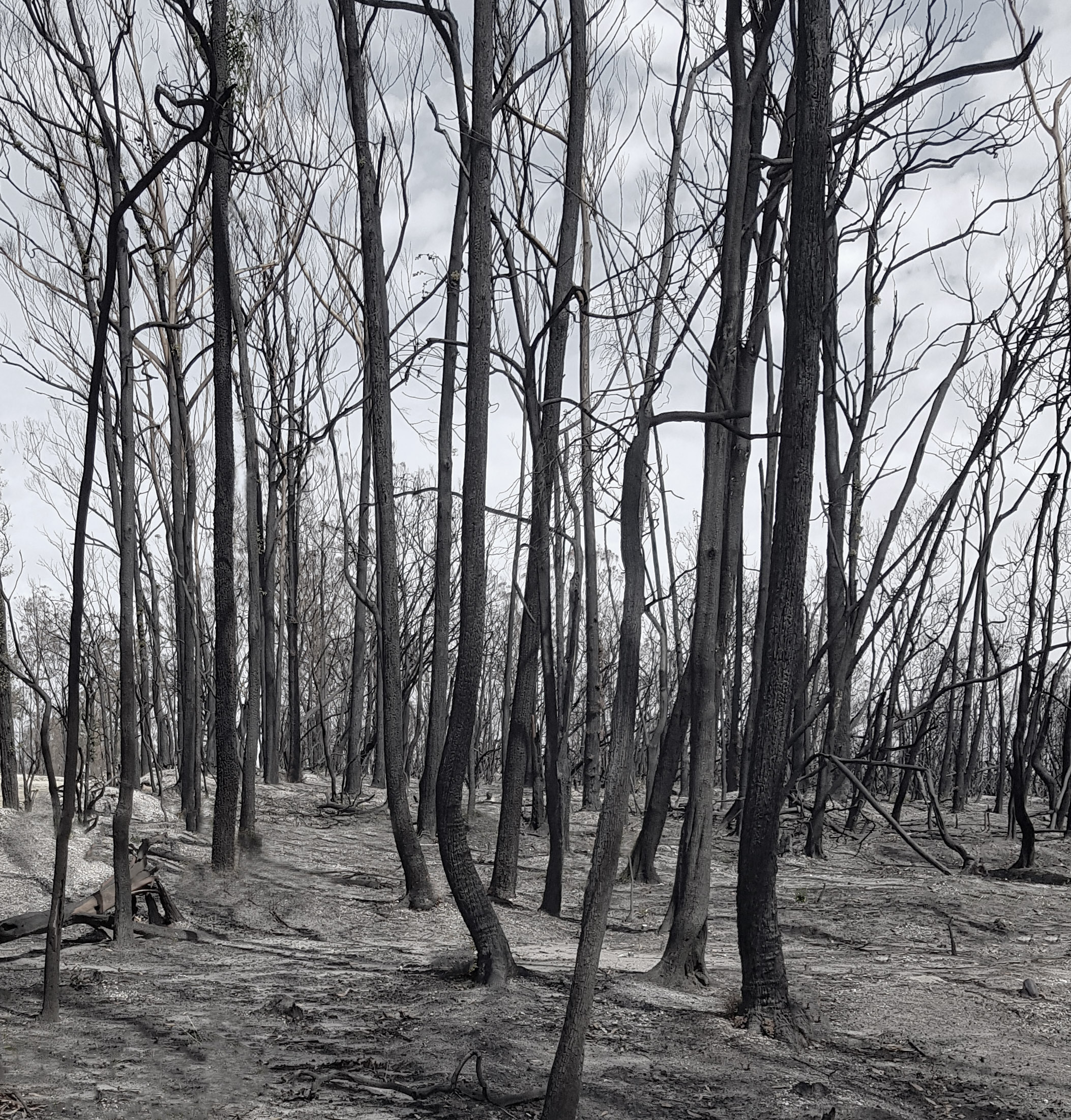
The road to Batemans Bay has just opened. I want quotes for an adjustable bed for my parents, so Mum can sit up in bed to eat. I drive through smouldering, blackened forests. Twisted sheets of roofing iron mark the spot where houses, sheds and businesses have burned to the ground. Smells of burnt wood intermingle with the acridity of charcoaled animal flesh. The agony of a young kangaroo, its body seared to a fence, is captured by a photographer, singeing the psyche of the world. One billion animals estimated killed in the fires. Unknown numbers of invertebrates, insects, frogs, bats dead. Possible catastrophic consequences to ecosystems. More than 2,000 homes and eight million hectares burned. Vast areas of bushland will not regenerate. At least twenty-four people were killed and the fires continue.

People in Sydney have been breathing toxic, smoke-filled air for months. People on the south coast are breathing smoke. On 1 January 2020, Canberra’s air quality is the worst of any major city in the world. On 8 January, the Bureau of Meteorology announces that 2019 was Australia’s hottest and driest year on record. Yet our government acts as if it is business as usual, touting that we’ve had fires since time began.

The 2008 Garnaut Climate Change Review examined the scientific evidence around the impacts on Australia of climate change and predicted that, without adequate action, the nation would face a longer and more intense fire season by 2020. Disgust almost overpowers me that this and other warnings are ignored. That Scott Morrison chooses not to meet with the twenty-three former fire and emergency leaders who ask to discuss early preparation and the equipment needed to fight the impending fire disaster. Disgust that, under the 2019-20 NSW state budget, fire and rescue capital expenditure is cut by $28.5 million or 35 per cent. The Rural Fire Service capital expenditure budget is cut by $49.9 million or 75 per cent. Disgust that the Prime Minister sees fit to go on holiday to Hawaii, the NSW Minister for Emergency Services goes on holiday to Europe, and the Federal Defence Minister goes on holiday to Bali while this land is suffering a profound disaster of apocalyptic proportions. Disgust runs out my ears, oozes from every pore and orifice at the arrogance with which the Prime Minister responds to public concerns on how to compensate and properly equip volunteer fire crews who have been battling the fires since September. Disgust at the forced handshakes and thuggish behaviour he imposes upon the traumatised community of Cobargo. I cannot possibly talk about everything that disgusts me. There is too much. This is why I choose to represent my disgust through hyperbole.

*

The bleak, ashen husks of trees that now comprise Eurobodalla Botanical Gardens are a blur as I drive back to Moruya. It dawns on me that, just like hyperbole, disgust has a purpose. Feelings of disgust are an evolutionary response to protect us from pathogens, infectious threats. Disgust helps us protect and preserve the social order from something that is offensive, poisonous or dangerous. Disgust is about survival.

My disgust calls for totally different ways of living and producing, and different ways of relating to each other and the earth. I don’t think anybody knows yet what this will look like, but I’m sure the oligarchs must not have any say in shaping it. Carbon-fuelled accumulation of capital, greed and ever-increasing profit margins are dangerous to life on earth. Our survival will involve us developing confidence in our ability to respect life, to love and help each other, confidence in our skills and our knowledge, so that we may work within our communities, upwards and outwards, joining with other communities for the common good. Our survival will depend on us learning how to recognise and actively fight corruption, fraud and lies. It will mean we find ways to make reliable information available to all, support and build progressive, independent media, develop critical thinking and make decisions based on facts, not lies.

I read that on 31 December in Victoria, Veronica Marie Nelson Walker, a 37-year-old Yorta Yorta woman is charged with shoplifting and refused bail after representing herself at Melbourne Magistrates’ Court, instead she is remanded at the Dame Phyllis Frost maximum-security women’s prison. On 2 January she is found dead in her cell. Our survival depends on urgently building solidarity with those who are discriminated against, racialised, criminalised and murdered by the laws and system that are supposed to protect us. We know the violence against First Peoples, disabled people, women, refugees, the elderly and other oppressed groups of people is linked. The brutality of this system is lethal.

*

I stand by Mum’s bed, looking at her curled warm in her blankets.

She asks, ‘Do we have to evacuate again?’

‘No,’ I say, lying next to her. She talks about her father being on the susso. She describes how, during the war, at school, they did drills, practised climbing down into trenches in the Exhibition Gardens.

‘I don’t think the world has ever been in as much danger as it is in now,’ she says, placing her hand on my hand.

Gaele Sobott

Published by Otway Journal 2021 Coming Back to Earth

Audio Version

Grandmother by Gaele Sobott

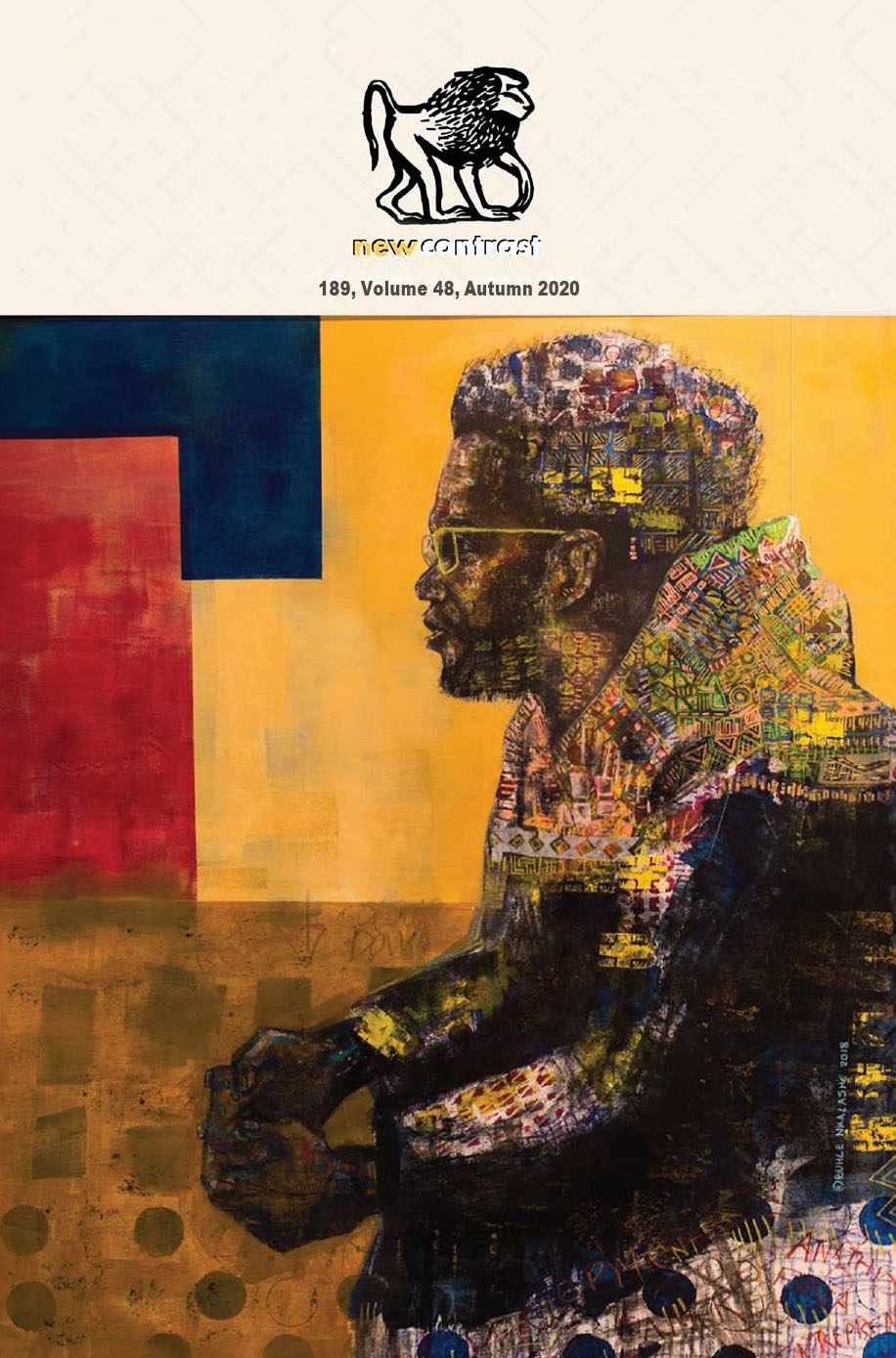
A Profile portrait of an African man, pensive, sitting with his arms resting on his lap and his hands clasped in front of him. He is wearing colourful print clothing and head gear. Blocks of yellow, navy and red make up the background wall.

Front cover art by Buhle Nkalashe

This story appears in New Contrast, one of the first South African literary journals. New Contrast is devoted to publishing the best of poetry and prose, art, reviews and interviews from both local and international authors. I am thrilled to be keeping company with such outstanding poets, prose writers, artists and photographers in this Autumn 2020 edition. Please go the New Contrast website and support this journal which relies on sales of hard-copy print editions. 

Grandmother

I smell meat cooking on the barbeque, innocuous in a typical suburban yard in Blacktown. The warmth of the winter sun penetrates my skin, the grass is cut, the deck needs oil, a scrawny rose bush winds its way too high, clinging to the asbestos wall, clambering up and over into the guttering. My granddaughter, Yasmina, throws a red ball into the blueness of the sky. The smoke twists up through my hair. I close my eyes, listening to the spitting fat.

*

Insignificant popping sounds, spitting, getting louder. A vehicle speeding so late in the winter dark pulls up, brakes screaming. Tyres graze the gravel outside. It seems my feet are walking the icy tiles before my torso leaves the bed. My hands feel for jeans, one leg in and then the other, I pull the denim up over my thighs, scrunching folds  of floral nightdress between the waistband and my skin. The zip bites down hard on the cotton fabric. Beating, clattering, chattering. Giant insects flying frantic against glass, wings flapping.

Running now down the passage into their room. I lift baby warm from her cot curled in blankets and stride skin silent on the floor across to her sister’s bed.

“Boni, Boni, I want you to lie here under the bed. Hold Moratiwa. Don’t let her go. Don’t talk. Whatever happens stay quiet.”

“Yes Mama,” she whispers.

I’m pushing the quilt and a pillow and Boni and Moratiwa under the bed.

Bre-bre-bre-bre-bre … not insects flapping wings  …  bre-bre-bre- bre … no they are not insects. Ghost men with rounded backs, bent men swarm from a white combi van. They run into our neighbours’ yard, the old colonial house is dark behind the trees, its wide veranda grimacing. The servants’ quarters, submissive and small in front of the house near the road.

Bre-bre-bra-bra, lines of yellow light burst from stumpy machine guns into the blackness, into the brick quarters where two young women live.

Peering from the side of the lounge-room window, through the crack where the curtain doesn’t quite cover the night, the grass  quivers, long and colourless under moonlight. The men throw grenades. White light flares up the lounge-room wall. The numbers on the clock flash bright. Short thuds of sound. I drop down, moving on hands and knees across the rug. The sofa and baby’s teddy in the hallway gleam iridescent razor-blade blue, every atom of my body is noise, intense loud limpet, cracking, reverberating circles, flattening my belly to the floor, shuddering walls, shattering windows, pieces of glass falling into my hair.

I crawl up the hallway, into the bedroom, crunch my hipbone cold into the white tiles, clinging to my children, not moving. They  are quiet. The dead night is quiet. There are no sirens, no dogs bark. Gaborone is acrid silence.

*

My son-in-law turns the steaks. The sausages spatter fat at his big-pony Ralph Lauren shirt and he jumps back, his body curves like a letter C. His sneakers are never-been-worn white.

I say, “I like your hair cut Walid. Really smart.”

“Thanks Lena. Got it cut this morning.”

Boni yells from across the yard, “He’s so particular about his hair! He’s been going to the same barber for fifteen years. Won’t let anyone else but Joe cut it.”

“Baby, he’s an expert blender. Not many guys know how to blend.”

“I think he’s got a bit of a bromance going with Joe,” Boni says. She’s wearing a light denim dress that criss-crosses over her back and sticks out like a tent over her pregnant belly, my second grandchild. We already know a boy is on his way.

Walid leaves the meat, comes over and bends his head down in front of me.

“Look here, he cuts with a zero, then a half, then a one, faded high like navy cut with no lines. You know what I mean?”

I nod, “Yeah, I can see.”

“The fade’s the most important part, very difficult to blend from zero to half into one without showing lines. It has to look smooth and crisp. Other hairdressers stop halfway up the back of the head because it’s too hard. Not Joe, he brings the fade right up to the top of the head, seamless. Then he scissor-cuts the top. Strictly scissors. No blade.”

Walid strolls back to the barbeque and starts putting the steaks onto a plate.

“Yeah, he thins out the top so it doesn’t look so thick and the hair sits edgy not flat. That’s the beauty of this cut. I can wear it gelled up like now or I can wear it flattened down to either side, neat like, for work.”

“It’s a smart cut,” I add.

Yasmina runs towards Walid, her arms flailing above her head like a windmill,

“I wanna help Baba,” she says grabbing hold of a steak with her plump little fingers, quickly dropping it in the dirt, looking stunned, about to cry.

“It’s hot Yasmina. Don’t touch anything. Go to Nanna.” He holds their two little white dogs back with his foot as if he’s playing soccer and guides his daughter away from the barbeque.

I call, “Come here Yasmina.”

She walks over, nonchalantly, slightly bow-legged, curly hair dancing in the breeze. Her body is solid in pink and green leggings, a green mouse dances on her tee shirt. Yasmina climbs onto my lap. I hug her, tender skin warm against mine. Boni drags a chair over to where we’re sitting. She’s puffing and as if her tiredness is contagious, I feel deep fatigue, a dark uneasiness.

“Mum, will you come to the delivery again?” “Yes, sure I’d love to.”

“Good, Walid and Moratiwa and you, just like Yasmina’s birth hey?”

“Will they do a caesarean straight away this time?” I ask.

“No, I want to try for a natural birth first. Prefer to avoid caesarean. It’s a pretty major operation.”

My granddaughter sits moist against my body, listening.

“Ok, come and help yourselves to the food,” Walid yells.

Yasmina jumps off my lap and sprints towards him. I half-expect her to fall but she doesn’t.

*

Going home, Homebush Bay Drive exit, diesel fumes slip through the vents. A mammoth truck next to me, another in front. My car, dark- green, 1998, shabby, gets me from A to B, and I fantasise, if I had money, which car would I buy? Not the Mercedes C200, maybe the black Mazda 3 in front, or the orange Toyota Camry with black mag wheels that roars when it takes off from the traffic lights. Roberts Road. Bunnings looms like a military bunker on my left, a red and yellow Maccas flag flies next to the Australian union jack and stars, my country of exile, the bright lights of a petrol station, Oporto chicken. Cruising through the green light across Juno, right up to Punchbowl Road.

I park, trying not to scrape the fence. The outside lights at Koh I Noor Court stopped working last time it rained. We want to pay to get the electrics sorted but strata fees don’t keep up with all the burst pipes and broken windows. A patchy lawn in front of the apartment block. The geraniums flower orange-pink next to the bay tree. The leaves on the dwarf mandarin curl, white with some kind of fungus. I pass my neighbour’s door, climb the stairs, to the same children’s songs I hear every day and every night… and if one green bottle should accidentally fall, there’d be five green bottles hanging on the wall…

Two and a half years since I first became a grandmother, now another grandchild is about to be, being, humans being. Strip off, shower, let the warm water flow down my arms, my legs. Curled up on the bed, comforted by the towelling of my robe, textured against moist skin. Sleep comes easily but briefly, I drift in the space behind closed eyes assailed by gruesome images, flickering faces, distorted, ugly. Unclench my hands one finger at a time, stretch out my arms, try to relax the muscles in my neck.

My  grandchildren  will  never  know  their  maternal  grandfather.  I conjure up the face of RraBoni. He rolls a joint, relaxed, laughing, listening to his favourite fusion. Tilting his head back, he blows wispy, white circles of smoke that hover, gently falling apart over the trumpet lines, the congas, the guitar snaking through Miles Davis, Bitches Brew, the bluesy keyboard on Weather Report’s Birdland. My children’s baby faces — Boni, her brown skin, freckled by the sun, a smiling dimple on her left cheek. These images relieve my nightmares. Moratiwa, more petite, darker skin, darker hair that falls in spirals over her shoulders. The one who is loved. My granddaughter, her brown, gold-tipped curls that spring in all directions, her alert eyes observing me. My yet-to-be- born grandson, another gift from the ancestors.

*

The reflection of my body moves ethereal in the sliding mirror doors of the wardrobe. My existence is enmeshed in history, some parts fluid, some parts rotting, torpid beneath my living. After almost thirty years, I feel an urgent need to tear away the scabs, dig down to the core, the agony. I begin searching, frantic, closed up in my flat. I claw at the skin of apartheid, searching for details of what happened that night. I want to know about the men who planned the killing, the men who murdered, those who justified and covered up the crimes. I trawl the Internet, South African Truth and Reconciliation Commission documents, reports, SABC  videos. There are so many submissions, so much brutality, over 20,000 statements from victims, nearly 8,000 applications for amnesty from perpetrators of crimes against humanity, a small but somehow representative taste of apartheid from the 1st March 1960 to the 10th May 1994.

Still and stiffened into a monstrously crooked position, I read like an addict craving horror, ripping open and exposing the cruel core of a desperate regime. Under the heading, ‘cross-border military operations’, I find testimonies. On 14 June 1985, twelve people were killed in Operation Plecksy … in Gaborone, Botswana. Eight of the dead were South Africans. The others were a Somali citizen, a Basotho child and two citizens of Botswana. Some of the Security Branch operatives who identified the targets and planned the raid applied for amnesty. I read their names. Their words avoid the truth. Their words are small truths, just enough to get amnesty, no more. Some are obvious lies.

A rooster crows next door, another rooster answers from the darkness across the road. I unbend my body, stand and stretch my arms in the air. I can see the tree in our neighbour’s yard. The half-moon has fallen, pale, from the sky and lies trapped in the tree’s branches. I move from one room to another without purpose, walking in the gloom.

Mrs Hilda Phahle addresses the Human Rights Violations Hearing in Alexandra. Our children fled this oppression of this country … the land of their birth, the land of their forefathers. They were tortured beyond reason and fled. The enemy followed them and brutally massacred them … the SADF arrived swearing and behaving like people well-drugged and drunk, ordering George to open the door. The door was blown open … the piano fell against Levi’s bed under which he was hiding. God spared him to tell the story. He watched from under the bed as they pumped bullets into his brother and his wife, bullets penetrating them simultaneously. They turned them over face upwards and one asked, “Is hulle dood?” (“Are they dead?”). “Morsdood” (“stone dead”) was their reply.

My eyes are scratchy in their sockets, my limbs creak like heavy machinery in need of oil. My head, an abandoned factory, echoing the vicious cruelty. Someone walks around the flat below, a door closes, a toilet flushes.

Mrs Phahle wears large, metallic pink-rimmed glasses. A woollen green and red scarf protects her neck from the winter cold. She wraps a Basotho blanket around her shoulders. Her voice has the timbre of mother love, woven loosely with threads of grief and anger. I hear her weariness. Her face is light-skinned, gentle. She says to a television camera,

As Christians we’ve got to accept what has come our way, more so that we cannot repair the damage. The only thing is for us to accept and we pray that such a thing never happens again. That’s all.

I lay on mounds of blanket twisted in sheet. Sleep rises up in the blackness and falls like a small boat on large waves. So many of the living are suffering. I’m fearful the waves will break, and the boat will smash into many pieces.

An insistent electronic pulse draws me from sleep. My fingers fumble with my phone, sliding across the small screen. Turn the alarm off. There is wind blowing outside. A branch of the bay tree scrapes against my bedroom window. I call work. My voice deliberately weak,

“Hi Maureen, I’m so sorry I won’t be coming in today. I’ve got a really bad migraine.”

*

The broken windows allow the frosty morning to creep into the lounge room, over the shattered glass, up the hallway into the bedroom. A bird dares to twitter. I hear the front door open. RraBoni has come home with two friends. They’re holding multi-pronged, metal spikes.

“Look what they threw on the roads. Eeesh, everyone has flat tyres.” My husband is a big man, wide shoulders hunched now. He puts his arm around me and I lean further into the balminess of his body, alcohol and sweat. His face is red from a night of drinking.

“Are the girls alright?”

“They’re fine. Sleeping in our bed.”

“Anyone like a coffee?” I ask.

“I’d love one thanks Lena,” the smaller man says. He is hunched over, shivering.

I turn on the kettle, go to the bedroom and lift the quilt from Boni’s bed.

“Here Motusi.” He wraps it around his shoulders, pastel green, pink, brown squares, elephant, crocodile, monkey and lion.

“Danke Mma.”

“Still no sign of the police,” says RraBoni

I’m careful not to cut myself, fingers like tweezers, picking up the bigger pieces of glass and putting them in a bucket. Sweep the kitchen floor and the hallway.

A BDF army jeep pulls up. We file outside. The grass sways yellow in winter. Everything is sepia, the trees, the gravel, the rusting wire fence. A tabby cat follows us, mewing. Confusing, smoky-meat odour clings to my skin, sweet like almonds. Pieces of the young women’s bodies grasp the fence, the grass, hang from the syringa trees. People come slowly from the flats, from the surrounding houses. Two soldiers throw a long metal box on the ground. We collect a shoe, a bloodied bra, a hand. We collect burnt chunks of flesh. No one speaks. No one cries. We gather the remains of our neighbours into the metal box.

*

It is suburban quiet. Children with shiny skin and bright white socks pass my window on their way to school. My kitchen, fake marble benches, white cupboards, is small but filled with light. I chop apple and banana into a bowl, drink green tea. I will not go to work. Bare feet, hair unbrushed, hunching over the laptop, four days and nights melt into a blistered mass of knobbled ash and grit. Friday, Saturday, Sunday, Monday, searching for detail. Gentle people murdered  in their beds, intellectuals, artists and writers, musicians and teachers. Seven of the twelve associated with the ANC. The killers shot open the front door of Tami Mnyele’s home and machine-gunned the artist as he ran across the backyard. They joked, kicked his corpse and took trophy photographs. Blasted his artwork, splintering his easels and paintbrushes, splattering paint.

Swallow painkillers, stretch my neck, bend my back, my hands dangling at my feet. I fall onto my bed again and stare at the ceiling. The Scottish woman who lives in number nine is talking to our neighbour about his fruit trees. I close my bedroom window and pull the blind.

At two o’clock Tuesday morning, I sit crunched  over  the  laptop. The men in combi vans murdered Duke Mashobane. His six-year-old nephew, Peter Mofoka, fled screaming from the bedroom, wearing flannel pyjamas. They pumped bullets into his small body, continuing at close range long after the boy was dead. Dick Mtsweni, ‘Mkhulu’, was shot and his house set alight. His body burnt to nothing. Michael Hamlyn was executed as he knelt on the floor at the end of his bed, looking up at the attackers, his red hair tousled from sleeping. He was a conscientious objector, who refused to serve in the South African Defence Force. They murdered Somali refugee and Dutch national, Ahmed Geer. His wife, Roeli, eight months pregnant, escaped with bullet wounds to her legs.

Most of those who took responsibility for planning the attack were granted amnesty from human rights abuses. The names of the 5 Recce SADF commandos and the Barnacle operatives from Special Forces are not listed. Those men who drove across the border to take the lives of twelve people didn’t apply for amnesty. I can’t find anything to say they were ever charged for their crimes. One working as a mercenary in Iraq was killed in Al Kut in 2004. His mutilated body was hung up for public display.

My phone rings. “Hi Lena.”

“Walid, what’s happening?”

“Everything is fine. We are at Westmead. Boni’s waters broke about an hour ago. Can you come?”

“I’m on my way. See you soon.”

“Great.”

Travelling through the early morning is like watching a film on the plane without headphones, everything is hushed, just the sound of my car’s engine as I drive the M4 to Westmead.

I’m at the hospital, walking into the birthing room. The lights are dull and Boni is moaning. She’s hooked up to monitors.

Walid smiles, “She’s doing well Lena.”

The nurse says, “Yes, she’s doing very well. She’s dilated to seven centimetres. The cervix has softened. I think it will be a vaginal birth this time.”

I place my hand on Boni’s forehead. Her hair sticks to her skin. She’s groaning and her lips are dry. I offer her some lip moisturiser. She digs some out of the small pot, her finger shakes. Smears it greasy over her mouth.

“Is Yasmina with your sister?” I ask Walid.

“Yes, she’s sleeping. Anisa’s at home with her.”

Boni moans and yells, “I can’t stand this pain.” She breathes out, grabs the gas and sucks on it.

“I’ll just be waiting outside.” I stroke Boni’s arm, then leave the room, walking across the shiny floor into the corridor. Sitting on a hospital chair, dread filters through my pores like grimy smog.

The passageway is empty, no sound other than the groans and she-wolf howls of women giving birth. I take a pen from my bag, bend down and scratch hard into the vinyl floor. Gladys Kelope Kesupile and Eugenia Kakale Kobole. A man pads around the corner wearing  a surgical gown. I pretend I’m picking up the pen from the ground.  He doesn’t look at me. Bending again I write, We have not forgotten. I scratch the words over and over, so they are etched deep and black into the beige vinyl. Gladys and Eugenia came to Gaborone for work, one  a typist, the other a domestic worker, not even twenty years old. That night they walked home from a prayer meeting. The killers came as they lay sleeping in their beds.

In the corridor under neon lights, I unlatch my consciousness, trying hard not to sink into pools of unarticulated fear. I sit waiting for my second grandchild, waiting for everything to be all right.

J.D. Salinger’s daughter quotes her father as saying he never really got the smell of burning flesh out of his nose entirely. No matter how long you live, that smell remains. I remember our neighbours, the two young women blown apart that indignant night. The fragrance of their lives is as fluid and volatile as the corpuscles in my blood.


In this issue of New Contrast:

Interviews:

  • An Interview with Buhle Nkalashe by David Griessel

Poetry

  • Kobus Moolman, Henry and June / The Earth is Flat / I Am Made
  • Juanita Louw, Homogeen / Love Machine
  • Rizwan Akhtar, Last Year / Now We Will Say “Happy New Year”
  • Steve Lambert, Unbecoming / Ars Poetica
  • Fiona Zerbst, Closer to Light / On the Edge of Darkness / Portrait of Three Lions
  • Bibhu Padhi, Another Need / The Address
  • Warren Jeremy Rourke, Washing Up / Double Rainbow
  • Johann Lodewyk Marais, Die stasiewa / Die eerste wens
  • Stuart Payne, The Planet
  • Justin Fox, Building Wall
  • Stephanie Williams, Mother / Let’s Talk
  • Alessio Zanelli, Hiker and Lines / Dear Old Beloved Padan Fog
  • Sarah Frost, Gold
  • Ian Salvaña, This Town We Left To Miss, You Said, Is Home / The Birthing of a Poem
  • Tom Paine, Seeds / Kamikaze Bees / That’s All

Prose

  • Gaele Sobott, Grandmother
  • Melissa Gow, One of Us Is Bleeding
  • Jonathan Tager, Guidestar
  • Rémy Ngamije, Black, Coloured And Blue (or, The Gangster’s Girlfriend)

Artworks

  • Jono Dry, In My Silence / Restrained I Unravel / Wrapped in Tradition / Separation


To purchase this issue (R120) email the business manager at business@newcontrast.net

Separation جدایی by Gaele Sobott

Colour photograph of a woman standing in a black coat in a forest. Her face is completely covered by her long black hair.

Photo by OVAN on Pexels.com

It seems my mother bore me for grief that grows of separation (from Hafez 352)


When I was a little girl in Iran I loved spinning around until my brain became fuzzy, I’d lose control and sometimes I’d fall. The roses in our garden swirled red, pink and white as I turned, and I’d smell their sweetness.

My husband has gone. There is a space where he used to be. That space loops brittle-boned into my body, across my apartment, out the window into the heavens. I water my plants on the window sill and I feed my canary, who sings yellow in his confinement. Little bird condemned to this boredom until you die. A huge bat hangs camouflaged black in the fig tree next door, across the broken concrete of the driveway. I walk fearful, careful like Mooch, my cat, soft on my toes. The moon, swollen with light, shudders as the bat takes off and I squeal. If I ran my fingers over those wings, they’d feel thin, stretched rubber or maybe silk. Shwoosh, shwoosh, stupid woman, it flies an elegant ellipse of protest high above our rows and rows of apartments to return and hang again black in the fig tree next door. My daughter weaves a life of her own in America with her husband. My grandchildren are far from me.

The evenings are cooling ever so slightly on my sadness as summer gives way to autumn. Lakemba days are shortening and people spend more time inside. Conversations in Arabic, Bengali, Mandarin drift with smoke from a wood fire, and smells of curry leaves and cumin frying. Death and rebirth, good and evil, the goldfish swims in its bowl ready for Norooz.

In Iran, I sat on my father’s lap enclosed like a Russian doll in our house, in the room with carpets, surrounded by the architecture of my father’s body, the warmth and murmured rumblings of his chest. His arms wrapped around me so I was almost in darkness. My father and his friends laughed and talked. The volume of their voices crescendoed and lulled in concentric circles. I peeked out to see my mother swinging a brass censer filled with coals. She seemed entranced by the swinging chain. The coals glowed in their cage. I broke from my father’s arms and ran to her. Pulling on the folds of her long robe, I wanted to feel the motion, the weight of the censer. I wanted to do as my mother did and make the coals breathe red. My brother followed me and my mother allowed us to swing the censer very gently before she took it to the brazier in the middle of the room. My father prepared two of his favourite vafoor. One pipe had a gold rim and paintings of blue birds with long tails on the bulb. It belonged to my grandfather who was growing smaller and smaller, sitting in the quieter shadows of the house, storm clouds under his eyes, and dark thin lips.

My uncle had returned from the edge of the desert where the air is crisp. He returned from Kerman with pistachios and the golden-brown tariaak they called senatori. The men joked about the senators smoking the highest quality opium. Now the ayatollahs have taken over from the senators. My father broke off a small piece of opium and put it in the pipe. My uncle held a burning coal in the tongs.

Grief has made its untidy nest in my apartment, in this body of mine. I try to sleep but the night is restless, the darkness is full of angst. I try to rest sitting on my couch reading but sentences scramble, scratching the paper like scuttling cockroaches. The words scream a cacophony of meaning at me and I feel their rage because I am porous. I have no boundaries.

In the morning, I leave my flat at 7am and walk to the train station. I walk tall, long feet and long fingers, wearing a dark suit. My hair long and black swings in time to my steps. Back and forth I walk every day, past discarded TVs and old mattresses. I walk past piles of clothes and curtains, and couches, broken tables and packaging that recently held a new refrigerator or television. Every day the train sways, stops and starts. People get on and people get off. Some play games on their phones. Some stare glassy-eyed into corners of their lives I cannot see. Belmore backyards flash by, we rattle through the inner west, Redfern platforms, sniffer dogs assiduous, salivating for a bust. I get off at Town Hall, moving at the same pace as everyone else, trotting up the escalator, across George Street, a fast-moving mass of people who seem to know their way, know what they want in life. Lines of square windows and grey concrete stretch to the sky but I rarely lift my head to look. I don’t stop in the city. In the city, I’m a lawyer. My work holds me tight like a corset. Keeps me going.

The lift zooms up to level thirty-two. I greet Helen, the receptionist. “How you doing today?”

She says, “My cat’s sick,”

“Sorry to hear that.” I commiserate.

“Yeah, she’s not eating. Just lies there. If she’s still like that after work, I’ll take her to the vet.”

The phone rings, she puts on head phones and her receptionist voice to answer. She winks at me and I continue to my office. Sexual harassment cases splayed across my desk, on chairs, clusters of papers, book upon book with fawn covers, gold titles on red binding. I click on my inbox. Emails like hordes of insects. I click, answer, click, answer. Read some specialist medical reports. So much reading. Reading consumes my day. Rowena’s complaint with the AHRC, the respondents denied the allegations. All attempts to bring the parties together have failed. Not the best-case scenario for Rowena. The alleged perpetrator relies on entitlement, on his positioning in the hierarchy of power. The offensive sexual jokes, suggestive and lurid remarks, sly rubbing of his cock against her body, always in tight spaces, in the kitchen, at the photocopier, fingers pinching her bottom, prodding. All that disappears with his denial and confident smirk. Rowena’s supporting evidence is weak. She’s depressed, experiencing reactive anxiety. She resigns from the job. Her marriage breaks apart. I’m not sure how she’s going to cope with the pain, the anger, shame, the humiliation of the public process. I’m a lawyer, a professional, but sometimes emotion and passion leak through my lawyer skin onto the desk, across the papers, like dark, golden sap escaping from the inside of a tree. When that happens, I am not useful to my client. When that happens, I want to cry.

On the train back home, the hurt under my breasts and the desire to cry are desperate, they rage against my false calm. The train doors whoosh shut, I climb the stairs, walk, unlock the front door, the cat rubs against my legs. Tip dry food into its bowl. Feed myself. White cheese, walnuts, dates, Persian cucumber, tomatoes, olives, nuts. I sip black tea from a glass and let lumps of sugar dissolve slowly in my mouth, longing for my mother’s sweets.

My mother put rose petals in with the tea leaves. She carried the teapot and glasses clinking on a tray. Her thick hair pinned up in a French roll. On one side of the manghal sat plates of honey crisps with almonds and the pistachios my Uncle brought us as a gift. Dates and figs, and small biscuits kept my father’s blood pressure from dropping too low. I sat on my father’s lap. My tooth ached. He inhaled, and the pipe whistled. He held his breath, his cheeks bulged, he blew smoke across the top of my head. Haalaa bekesh too. I inhaled and the woody perfume was purple or maybe turquoise, the most sensuous bitterness. I was transported away from pain.

Cat footprints mark the dust on my bookshelves like fallen blossoms, Mar Name leans neglected against a Farsi translation of Nietzsche. Deleuze and Guattari, Anti-Oedipus balances on Grammatology. In the Realm of Hungry Ghosts lies on the floor alongside classical music CDs I no longer play. I sit on the couch. My fingers habitually exploring the patch that covers a small hole burned by my cigarette into the fabric. Above me hang crooked on the wall, cheap copies from the seventies turning brown. I ran from Iran over twenty years ago, first to Pakistan, then here. I am forever a kharjee spirit, an outsider, an adventurer, maybe a heretic … at day and at night, branded by love, like Hafez, with nightingales of dawn, I cry songs, woes of separation.

Mooch stretches his tabby body across my thigh, heavy, snoring like the man of the house he is. He brings me lizards and mice and small birds. He lays them wet at my feet, sometimes moving, sometimes still.

I am still, here with my cat, and the canary asleep in its cage, and the fish.

The city on the edge of the desert, the ancient city called Kerman, where the air is crisp and very cold at night, is surrounded by fields of poppies but was once surrounded by fields of barley. I would lay on my stomach on our carpet from Kerman, rolling from one end to the other over the pastel shades, the blues and creams, back and forth until my brain was fuzzy. I imagined I was lying in fields of yellow barley ready for harvest, looking up at the sky so very blue. My father sat with his friends drinking tea, eating cakes and sweets. They laughed and they cried. They talked as if to stop talking would show weakness. They talked over the top of each other. Their conversation infinite, uninhibited…

Read more 

Published 8th November 2019 in Prometheus Dreaming


The Struggle Continues: An interview with Juby Mayet and Cecilie Palmer

Juby Mayet and Cecilie Palmer standing in front of Constitution Hill Women's Prison

Zubeida ‘Juby’ Mayet (1937 – 2019) was a journalist who dedicated her life to fighting for a free press in South Africa, gender justice and an end to the Apartheid regime. She began writing for the Golden City Post in 1957 and worked for Drum magazine. In 1977 she joined The Voice, in Lenasia, Johannesburg, where she was appointed Deputy Chief Sub-Editor, a first for black women journalists. She was a founding member of the Union of Black Journalists (UBJ), serving as its assistant secretary-treasurer, a member of the Writer’s Association of South Africa, and contributed a great deal to the Media Workers’ Association of South Africa (MWASA). Juby also wrote for UBJ Bulletin Asizothula and The Worker. She was detained in 1979 and upon her release, served with a five-year banning order under the Internal Security Act. She and her family suffered continued police harassment and surveillance

Cecilie Palmer (1944 – 2019) was a stateswoman, active in the struggle against the South African Apartheid regime and in fighting for the emancipation of women. She served in many organisations including, the United Democratic Front, the Federation of Transvaal Women, the Legal Resource Centre and Sizoya Sibuye, a platform for raise public awareness of women’s experiences of torture and jail during the struggle and counselling ex-prisoners. Before her arrest in 1976, she was active in the National Union of South African Students on the University of the Witwatersrand campus. Cecilie was also one of the founders of  the Women’s Institute for Leadership, Development and Democracy (WILDD). She and her family experienced continued police harassment and surveillance after her release from prison.

Gaele Sobott: We have just visited the Constitution Hill Women’s Prison, where you were both detained in the 70s. You’ve described the torture of women in the prison and the mental scars that have plagued you and the other women who were detained from the time of their release onward. Cecilie, you had two children and you were pregnant when you were detained and your mother, Vesta Smith, was also detained in the same prison. Juby you relied on friends to look after your children while you were detained. You were both involved in your different ways in the struggle against Apartheid and to bring about a more just society in South Africa.

In the years leading up to 1994, I am wondering how you balanced or negotiated the need for a hierarchical leadership to overthrow the old Apartheid regime and establish a new regime with the need to broaden and deepen the education of the general population?

Cecilie Palmer: I remember the time, years ago, I think it was 1982 or 1983, when the President’s Council presented its proposals for the reform of government structures, and we were having debates about whether to go into that Council under the new constitution or not to go in. I was sitting with Professor Mohammed and Firoz Cachalia and some others in the UDF office. We were debating and we were dead against going into the Council. Firoz and them were trying to push us to change. That was the kind of consultation that went on. We debated in the branches and the decisions were taken from there up. It’s true, education, that kind of education stopped, that kind of mix of people, it stopped when the exiles arrived back here and they said, ‘This is how it’s going to be done!’

GS: When was that?

Juby Mayet: They started coming back late eighties, early nineties. Sorry I have almost lost my voice. It’s a bit difficult for me to speak. I’ll whisper.

CP: Ja, they built a different structure and they said, ‘This is how you will fight.’ So then you had this structure where the country was really being ruled by six people sitting in Luthuli House.

GS: How did they gain the power to do that?

CP: I don’t know. What ever they did, it was very cleverly done. Remember, people used to trust each other. We were all comrades in the struggle. Some of us were mixed, right.

GS: What do you mean by mixed?

CP: In the sense that I didn’t really belong to the African National Congress (ANC). I didn’t belong to the Black Consciousness Movement (BCM).

JM: Yes.

CP: I didn’t belong to anybody. I went where it was necessary to fight a battle. That was how I operated. Then they came with the UDF and at that time, I remember we were asked very specifically,  because we had a very good women’s movement at that time, the Federation of Transvaal Women. Each province had their own women and we saw ourselves as women working towards common goals. Then we were told no, we had to choose whether we Charterists or whether we were BC. I remember one ANC woman asked me that question and I stood back and said, ‘None. I like to work where I’m needed most.’ But when the ANC was unbanned, people positioned themselves where they knew or thought the power was going to be …

JM: Where they thought their bread was going to be buttered.

CP: For instance, in Eldorado Park, which is a township just on the other side of Lens.

JM: Ja, we passed it. I pointed it out to you.

GS: Yes.

CP: We worked very hard there. We had established a really strong activist community where we had an advice centre, a women’s group, we had women against the abuse of women, we had a pre-school programme. The pre-school programme was designed by one of the women in Eldorado Park who was a pre-school specialist and that programme was designed on a non-sexist, non-racist basis. It was assessed by a professor from Rhodes University who said the programme should expand right through Africa. We replicated that programme from Eldorado Park throughout the Transvaal.

GS: By we, you mean the Eldorado Park women’s group?

CP: Yes. We had a strong movement going. We also had a civic association. Our belief and my belief was that civic associations belong to the people of the community that starts those associations, irrespective of what their political affiliations are.

JM: Yes, absolutely.

CP: Then we were asked by the ANC, because they had regrouped, to spearhead the formation of the South African National Civic Association (SANCO) and that was affiliated directly to the ANC. We said, ‘No, we’re not going to do that.’ Our pre-school programme had established pre-schools in the Transvaal and those pre-schools each had parent bodies. We taught the women in those parent bodies politics, not party politics but  community activism, so they knew about political, social and economic injustice and they were figuring out ways to build alternatives in their communities. This all grew from the strong community activism in Eldorado Park, so we brought those Eldorado women and the women from the pre-school parent groups into the Federation of Transvaal Women. We didn’t realise the ANC and those leaders who decided to identify with them, were positioning themselves for future power. The ANC started choosing people for their executive committees in Eldorado Park. They were lobbying.

JM: Manipulating.

CP: Ja, so, none of the activists, the youth groups, the women’s group, none of those activists were chosen for the executive committees. Anyone who wasn’t ANC was kicked out of those groups. We were very innocent then. Not skilled in that kind of politicking.

GS: Do you think the ANC saw those people, those activists on the ground who did not want to join them, as a threat and if so why?

CP: I really don’t know why they saw them as a threat but they did.  I think they were scared of people who had experience in the struggle but were refusing to join the ANC, probably because they were a stumbling block to those who were opportunists, those people who joined the ANC to climb. Those activists were wise and they expected the organisations to be run on same lines as they had been run on before. I think that’s probably what it was. I don’t know. One needs to think very deeply about this time and what happened.

JM: It was the ANC state capture. They rode roughshod over all these people and groups, like they were the only ones who fought to liberate us. The Pan African Congress (PAC), Azanian People’s Organisation (AZAPO), all the rest, were just thrown to the wayside. I’ve never been a card carrying member of any political party. I was labelled a sickly humanist. I worked for the human rights committee which had ANC members and Liberal Party members, then after I covered the  South African Student Organisation (SASO) trial in Pretoria, Sathasivan Cooper, Sivalingam Moodley, Audrey Mokoape, I became kind of involved with, not involved but enamoured of the Black Consciousness Movement and of course when I met people like Sobukwe, he was such a lovely man, and  Joe Tlholoe who was so young when he was sent to jail for so-called PAC activities, so I never really had a particular inclination towards any political party, I just felt I had to do a typical sickly humanist’s job.

GS: As an individual do you resent being dominated in a job or within a community?

JM: Not really. If I am dominated by anybody who thinks they are better than me, yes. I think I am as good as the next person.

CP: In other words, you refuse to be bullied.

GS: There is bullying and there is sometimes the need for hierarchical leadership. Do you think it is possible for South Africa to change existing social and economic conditions without hierarchical leadership?

JM: It has got to come from the younger generation.

CP: Exactly.

JM: I don’t know if they are better educated. They go to varsity and vandalise the school structures, the very place of learning. I don’t understand that mentality.

CP: I think our education system doesn’t teach people to think. It teaches them to regurgitate stuff without thinking.

JM: I went on protest marches but I never threw a stone through anybody’s window or set fire to any buildings. We marched with our banners and we sang our freedom songs without vandalising or damaging people’s cars or property. I cannot understand that mentality, especially when they go and burn down schools.

CP: Twenty eight schools burnt just a few months ago.

GS: Why? What caused that anger?

CP: Municipal demarcation. Dividing the wards up. The local government structures are divided in to wards. It affects voting. That’s why they keep changing it. They changed the boundaries and the community didn’t want it. Like Vuwani, where the community withdrew their children from school as a form of protest. Then they burnt the schools. The schools become the targets.

JM: That is why I say it is because of a lack of education. Those parents obviously did understand that this is not the right way to protest and make change. We need those schools. We are depriving our children of education.

CP: If you look at the age group of those people, it’s the age group that went to school after 1994. They are keeping their children out of school. They are the ones who are throwing stones. The ones who were born in the mid-eighties. That’s my view. Yes, we had Bantu education, Coloured education, Indian education but I swear that was one-hundred-and-ten-times better than the education we have today.

GS: During that period of change, how do you think it could have been done differently in terms of education?

JM: It would help if we had a president who was actually literate. Our education system is terrible. They keep saying how young people must be educated to become future leaders but it has become empty rhetoric, just words, no substance.

CP: It was during his time, that education started deteriorating. With every step, the education system seems to deteriorate further with every change they make. The very last change was the curriculum assessment policy called CAPS, a system that came in 2013. Plus the mentality of the new teachers is not good. We need better teacher training.

Juby Mayet and Cecilie Palmer standing in front of cells in Constitution Hill women's prison

GS: What happened to AZAPO, PAC leaders?

CP: They were just pushed out and ignored.

JM: I meet up with those guys and we talk. There was a group of students from SOWETO and they were quite surprised by the way I spoke. I make it quite clear that the ANC sucks! They irritate the hell out of me. I don’t have anything to do with them. I tell them that. I don’t vote for the ANC. Sometimes I say why don’t you guys form a coalition. Can you imagine if AZAPO and the BC people came together then the ANC would be seriously challenged, voted out in elections.

CP: They pushed out a lot of leaders, extremely well educated people, some died, like Percy Qoboza,   but none of them are anywhere in government structures. Brilliant people were pushed aside.

GS: What do you think can be done to stop the party that is about to take power in a situation like that from isolating or silencing intellectuals?

CP: They didn’t just sideline intellectuals they also preached that the older people who stayed in the country, that we were stupid and didn’t know what we were doing. Some children are extremely angry because their parents have been treated so badly.  We’ve got this inter-generational dialogue and it’s all about talking with the younger people and not at them. Some of them are extremely angry at Nelson Mandela.

GS: Why?

CP: Because he sold out. I sit there and I think, yes, it is true what you say but I cannot say that. So, I go the other way and say, ‘Look, he had to do what he did otherwise violence would have consumed the country.’  That’s true. There was Eugene Terre Blanche and Inkatha and all that but if you go further back they had been negotiating with Mandela a very long time before his release without the other prisoners being involved. They actually moved him from Robben Island and took him to Pollsmoor and Pollsmoor wasn’t private enough so they took him to Victor Verster where he was living in a house. So that is the truth of the matter and that is where a lot of the anger comes from. That is why they are saying, “We are struggling today because our parents are not living any differently than before apartheid, look at my mother living in a little pondotjie somewhere and so on. All those things are boiling. We can’t pay bills. Even when people study where are they going to get jobs.

JM: We should suggest to them that the next time they want to go on a burning spree, they should start with Luthuli House.

GS: How were the big corporations positioned during the transition from Apartheid?

JM: Big business just kept going like a steam roller.

CP: The same white bosses and even though black Joe might be the CEO, he still doesn’t really control the business. They are definitely not going to change our society for the better. I told you the story of Eldorado Park, now also in Eldorado Park we were working with UNISA against violence and that kind of thing and then they came and told us that they had been funded by the police. Imagine, funded by the police during the time of Apartheid! We said, ‘Oh oh, no thank you. Within a week, I was summoned to Luthuli House, Ralph phoned me and said, come in to see us because we want to talk to you about the UNISA program. I said, ‘No, I will not come to Luthuli House. You come to the township!’ I mean that was where the group started. He could talk to the board there were we all operated. Then they also asked us to spearhead the formation of the ANC women’s league in Eldorado Park. We said no to that too. Like I said, our belief about the women’s group was that we were all working together, no matter what party women supported. We were combining our strengths to make change happen. But from then on we were totally isolated by the ANC. We founded the Women’s Institute for Leadership, Development and Democracy (WILDD) in 1994 and we were being funded by the Swedes so what  the ANC did about the second or third year after they came into power, they ruled on bilateral funding so it then had to be government to government funding. So any foreign funding had to go through the government. That is how they destroyed a lot of the NGOs. So they were quite clever. They managed to destroy independent community organisations and thinkers. Through the WILDD, we used to help women’s groups in townships. Let’s say a group was working against gender violence, we would write a proposal that might include establishing shelters for women, things like that and that was one of the ways we increased the consciousness, the awareness and the education of women and men. We had a women’s cooperative that was a successful community enterprise. So, we would write the proposals and the women would get money. Then we would teach them to draw up progress reports and insist that they prepared and submitted regular reports to us. We needed those reports to get more funding and train more women. Very, very soon, the women began to say that the government was giving them funding because of this new government to government funding I spoke about. So the ANC was the one giving them the funding not foreign sources and the women did not need to report to us anymore. They could not be expected to bite the hand that feeds them. We as community leaders were isolated that way too. The original structures we had all built were destroyed. The government gave the groups money once, they gave twice, then they deserted the women and other civic groups.

So now we work very quietly.

GS: How do you think that kind of scenario can be prevented before it gets to that point?

CP: I don’t know. It is a very hard question to answer. But I think also what happens in people’s minds is that they saw the ANC as their liberators and they were told that they were their liberators.

JM: If the propaganda, the lie, is told often enough, people believe it.

CP: It’s like starting again right from the beginning which means starting in the house, starting in the street, in the factory, in the mines. It’s important to work within the community.

JM: I think we need a true revolution. It won’t be difficult to build up to a proper revolution because people have not settled into this so-called solution. They do not accept this life of entitlement that ANC officials and black CEOs and the like are living. The top guys are treating the country’s assets as if everything is there for the taking. That becomes the attitude. If they are doing, what is wrong with me doing it too.

CP: And the jargon is there all the time, you know, I can tell you now, let’s say I was going to a Women’s Day celebration, and the speaker gets on the stage. Before she opens her mouth, I know exactly what she is going to say. It will be the same thing that is repeated all the time, the same jargon, the propaganda repeated over and over again. Empty rhetoric. No real analysis. No encouragement of independent thinking. It’s also more difficult because before with Apartheid, the enemy was clearer. If you criticise the ANC, they say that you want to bring the white oppressor back.

JM: That’s another thing. We had Apartheid but there wasn’t the same yackety yack that there is now about racism. It’s used now for small things, almost like a diversion from the bigger picture, the economic problems, the economic system.

CP: The economic oppression is still very much there. We have a lot of black people in charge now of administration and the running of government but they treat other black people badly.

JM: You see it in the shops and the cafes and the post office. People are not there to serve. They are there to fill their pockets and stuff you Jack. I remember going to Ackermans with my late mother. She was struggling because my daddy left us and we were ten children. She somehow made friends with an Afrikaner lady working there. That woman used to assist my mother by putting extra items into the bag when she was buying school shirts or trousers for the boys. Sometimes my mother used to send me to Ackermans to buy items. I can’t remember that woman’s name now but I can see her face, a stylish woman and she would treat me in such a friendly way. She’d ask me how my mother was. Whatever I was buying, underwear or socks for the boys, she would always manage to sneak extra into the bag.

CP: Strangely, Juby, some of the Afrikaner people were very human, very genuine. An Afrikaner either liked you or hated you. It was clear cut. Where with the English you never knew. And Afrikaner children even up to today will respect an older person. They will say Tannie to me. That is how they are brought up. But if they don’t like you, they don’t like you and they make no bones about it. You knew exactly what your place was with them.

But going back to your question about what could be done differently, I don’t know but many people change. I cannot understand how they can change like that because it must be very uncomfortable.

JM: The day I landed in Number Four (Constitution Hill Prison), Debs wasn’t there at that time. Thenjiwe and Joyce and other women were. A white warden was taking me through to my cell, my new living quarters, and she was stunned when those other women prisoners broke into cheers and yelling Amandla and hey Juby what took you so long? The warden took me to my cell and she asked, ‘How do you know those women?’ I knew some of them personally, most of them knew me because I was a journalist but she couldn’t figure it out, ‘Die Coolie met dai Kaffir.’ When we were in there we had political discussions, we celebrated June 16. So then Thenji and all of them were released and I was left there with Gladys Manzi from Kwazulu and then they brought Debs from Maritzburg. She was in a bad way.

CP: Oh God.

JM: She’d been tortured. Her hair was falling out. Eventually I was released. We were all released. Some of us kept in touch. Some of us wrote to each other. Some moved on with their lives. The next time I saw one of the woman I had got close to in prison was  at some journalism awards event at one of the conference rooms at the South African Broadcasting Commission but you know, she didn’t acknowledge me. We were so close in Number Four but by then she had become ambassador or something like that. I looked directly at her and she looked directly at me. No smile. Nothing. I thought, God, what have I done? She just refused to acknowledge me. I was going  to go up to her and ask her how she was but then I thought okay I won’t. You give me a cold shoulder like that, I will ignore you. But I couldn’t believe it and I was hurt. From the person I knew in Number Four to this. She’s now up there and I am just the same old Juby.

CP: So why should she associate with you?

JM: Exactly. So, I thought, well stuff you, buddy boy!

CP: Yes, you can walk away and feel good about it. I must say, I feel free. I don’t owe anyone anything. I live on my one thousand five hundred Rand pension and I’m comfortable with it. I don’t owe anybody. I feel free but those people we are talking about have no vision. That is the sad part. They go into these positions. In 1994, nobody knew how to govern and we accept that. They employed consultants and what have you. They chased the Boer out who were in those positions. They didn’t want to learn from them. I think they should have first learnt from those people. Taken advantage of their knowledge and experience and then made them move over. They could have said, ‘Okay, we will make you consultant in this department for five years.’ They decided to chase those people out and employ consultants but up to today, they haven’t learned. About four years ago I spoke to one of the ANC women and told her what I saw happening in our communities. They don’t go to their constituents. They don’t know what’s really going on. I told her that communities are fragmenting more and more along lines of race, religion, political party and all that. We need to get these people back together. She agreed and suggested we involve other people in government and she did that. She got them in and I presented a proposal which we discussed. I emphasised that this drive to get people back together has to start by the ANC admitting their mistakes. The next thing, they were talking about fragmentation of communities and that the SACC was going to do this and that. They didn’t involve me nonetheless, I was happy it seemed to be going ahead. But it fell apart because they didn’t have the same vision. If you don’t have the vision for going forward, it is just not going to work. They stole people’s projects. A group would write a proposal to them with what they wanted. Then they would call those people in and ask for more detail. The group would give them all their ideas. Four weeks later they’d see someone from government announcing those very ideas on TV as a government initiative.

Juby, you know the saga about registering children on-line for school?

JM: Yes.

CP:  The education department has announced the idea of registering children on-line from grade one to grade eight. It’s an idea that they have stolen. Somebody presented this proposal to them around 2008. They dismissed her saying it was nonsense. Thank heaven she is taking it up with them. She’s not letting them get away with it. NGOs don’t stand a chance with the government stealing ideas like that. That lack of vision is terrible. They took over our women’s groups and now the gender violence is getting worse not better. Another peculiar thing that is happening most of our experts are whites and people who do not live in the townships. They are on TV telling us what we need.  So we are asking, why is it always about us but we are not leading. We know what is happening in the township. We know what is happening in our communities because we still live here. We don’t live in a big house in the white suburbs with high fences and security guards. But no, those experts have all the answers.

JM: The statisticians.

CP: We must sound like bitter people.

GS: You sound like people with many years of experience.

CP: When I do a tour or give talks, people sometimes ask me, ‘But don’t you hate the people who have done these things?’ No I don’t.

JM: Hatred is a waste of energy.

CP: Hatred to me is a wasted emotion, a waste of energy. I don’t hate but I also haven’t forgotten and I’m not going to forget because it did happen. Actually, I’m  not sure at this moment that I don’t hate the people who are sitting in Luthuli House. I’m not sure I don’t hate them for what they are doing to this country.

JM: My remedy is laugh it off and say stuff you lot!

CP: Like there is Kenny Motsamai who they have only just released from jail. Nearly twenty eight years in jail. Yet, they let Eugene de Kock out who tortured and murdered so many people who fought against Apartheid. There are still other PAC cadre sitting in jail.

JM: Now we have black on black Apartheid. That’s what it has come down to. Economic.

CP: They spent over a billion rand on the ANC campaign for the local government elections. Where did they get that money from?

JM: Exactly and why not use it on something more constructive? Building houses, schools, medical facilities. Prioritising the education of teachers. They did away with teacher training.

CP: They closed nursing colleges. They are trained at university with no practical experience. They come into the wards and will not take advice from the older nurses who did the proper training including the practical internships and the like. They are starting to privatise the services.

JM: Like the prisons are semi-privatised now.

CP: And the bureaucracy is getting bigger and bigger. It’s messed up. There’s no getting away from it.

JM: We need to teach that the ANC were not the only liberators of the country. Campaign to change voting patterns.

CP: I think we really need to get back to thorough and committed community activism, community responsibility and confidence. I work with the women from the inner city. They are eager to jump when the ANC Women’s League says jump, the rent a crowd kind of thing. Their responses and their problems are different to our problems in the townships. You know another thing we don’t have is an alternative media. We were lucky because we used to have the Vrye Weekblad, an Afrikaans newspaper which was really helpful, one of the best newspapers.

JM: Ja, Max du Preez.

CP:  It was run by Max du Preez. We need that kind of newspaper back. The Weekly Mail was also there. Those newspapers tried but they were never free to do what they wanted. The Post used to have ugly stories that didn’t educate anybody.

JM: Like the Sun today.

CP: Like the Daily Sun. Now that’s the only newspaper that people can afford. The Daily Sun will tell you that the rat ate the cat. Like the TV. Keep the masses uneducated and you can do whatever you want.

JM: That is why I read books. Our young people need to read more.

CP: Reading is very important. Education for our young people has to improve. Over half of our children cannot read fluently. We should be working on basic literacy and numeracy. We are condemning a huge majority of young people to unemployment and  poverty. You know, we are a depressed country at the moment. You don’t see people smiling and laughing. We used to laugh and talk and scream and sing even during the time of Apartheid. We’ve stopped. I definitely don’t think we would be  better off under Apartheid. We still need to rid ourselves of the legacy of Apartheid. We really need to sit and talk and analyse what has not worked in the struggle. The ANC has to admit its mistakes. Maybe then we will begin to smile again.

Gaele Cecilie JubyInterview conducted with Juby Mayet and Cecilie Palmer in Lenasia, 2016 – May you rest in peace and power my friends.

Links:

Black Wednesday, the day the Apartheid government banned 18 Black Consciousness Movement organisations and three newspapers (featuring Juby Mayet)

Interview with Cecilie Palmer  in the Constitution Hill Women’s Jail

Little Tree by Gaele Sobott

Colour, botanical drawing of a nutmeg tree

I have opened the door and stepped into the beginnings of my old age, into the house of my youth. Surrounded by the smell of wood, not damp, musty perhaps, and the scent of my mother. Avon Unforgettable, floral, carnations with undertones of moss. The scent that witnessed me sneaking through her snap-shut, gold-latch handbag, caught me searching in the darkness of her wardrobe, searching for private things, searching for her lipstick.

Memories of my mother’s slim ankles in stiletto shoes and her auburn-bourbon-red hair lay, hidden like Easter eggs, awaiting the joy of discovery. She is here within the carved and oiled wood of the beds, the tables, chairs and the cupboards. She is in the timber ceilings and floors, even in the weatherboard exterior of the house.

My mother’s voice still lives in the small garden at the back of the house. Her words bob and rustle in the breeze — the myths, fairy tales, the nursery rhymes….

Read more

Published December 17, 2018 Meanjin Quarterly

Black and white photograph of a mother holding a new born baby on her chest. The baby's mouth is wide open, crying.

The Cry Room by Gaele Sobott

Published by Verity La

What does it mean to be born outside of marriage to a mother who wonders if the bleats of a goat are your first cries?

Birth

I just slipped out she said. Like a slip of the tongue, slipshod, a slip stitch forever unknitted. I was born. Slippery, sibilant, small in the scheme of everyday lives. Nothing stopped. There were no celebrations. I was born and everyone got on with their work in the power station, the briquette factory, the mine, a gaping, brown open-cut.

She hung the nappies and sheets on the line, coal dust settling on the whiter than whites, on the window sills and mantle pieces, on the froth of the men’s beer, in our lungs. I was two-months old. Thin and pale, she shivered, her breasts bulging red and hot above her shoulders, a painful mountain range of igneous rock. Mastitis the doctor said. Milk fever, once a reason for admitting women to the insane asylum.

He laughed with a fat, purple face and said, ‘Keep breastfeeding! Let the baby suck’.

Not having a bar of it, my mother put me straight on the bottle.

She laid me down to sleep, seething ready to explode because my father’s English friend from the Woodcraft Folk was Morris-dancing in the bathroom day and night, until he got a desk job at Maryvale Paper Mills. Then he moved out.

Irene, our neighbour, would throw me around like a football and babysit when my parents went to Hamish Gardner’s house for Communist Party meetings. Dad was a proud member of the Trades and Labour Council, a deputy rep for the Transport Workers Union. He drove the bright-yellow Euclids carting overburden from the coal deposit.

The women went to Party meetings but my mother would rather have been at the picture theatre with its curved façade and big clock embedded into beige bricks. In summer, they turned on the air conditioning. In winter, she could take off her shoes, rest her feet on hot-water warmers and watch Vincent Price murder people in The House of Wax, 3D technicolour on a panoramic screen.

She took me with her once when I was a baby and sat at the back of the auditorium in the soundproofed, glass-fronted, cry room to watch East of Eden. I slept and she cried. My mother would sit in the cry room. Often without me.

In the theatre, she always refused to stand for the national anthem.

At home, she took a failed dish of bread and butter pudding from the oven, cried, splattered it against the kitchen wall.

What does it mean to be born in a town purposely planned and built, then purposely demolished for the coal that lays beneath it?

My birthplace is an ever-expanding, dark and greedy hole in the ground. With heat and oxygen, the coal spontaneously combusts. Lignite dust bursts into flame at the drop of a match, a spark, a welding torch, a yellow flash igniting in mid-air. Volatile, toxic. Giant, cylindrical cooling towers, chimneys, steel girders, high wire fences, power lines.

My birthplace is Brayakaulung land, Gunaikurnai, cleared, windswept, foothills.

What does it mean to be born to land where the ancestors are denied, where they are brutalised? Do they know my footsteps, my birth spirit?

My blood ancestors, Polish, Italian, Scottish, do they know my footsteps, my birth spirit?

Birth

I walk the short corridors of a small hospital, Bamalete Lutheran. I’m the heaviest I’ve ever been. Seventy-four kilos. Twenty-four years old like my mother when she had me.

First baby. My father drove to Melbourne to collect his friend from England.

First baby. My daughter’s father is out with friends.

The walls are green gloss, the floor concrete, painted dark red, polished, worn where I walk.

I walk because the nurses tell me I should. Read the birth records open on the counter in front of me. Stillbirth. Don’t think about it. Float.

The nurses give me an enema, warm and wet, not painful.

Cow bells ring hollow and deep. The land is dry, gold, studded with small trees and shrubs. I’m on my back on the bed. The midwife checks dilation.

‘Don’t hyperventilate. Breathe normally’, she says.

I read about the breathing in a book. Neon light.

The doctor is at the end of the bed. A tall German woman telling me to push. Round pain, rhythmic, I float. From deep within the back of my head I float. My hip bones separate like a spatchcock cut with kitchen scissors, pressed flat on the white sheet, I rip, a goat bleats at the window.

Release.

My baby cries.

Ten fingers. Ten toes. She is big.

A big baby.

Relief.

We wait as my uterus presses down. A balloon shrivelling in on itself, contracting against the placenta, the temporary organ I have harboured, accepted and must now expel. Every process orchestrated by this new child in the room.

The midwife wants to sew the tear that extends from my vagina to my anus.

The placenta is ragged maroon not flat-cake perfect circle. We wait for more contractions. My skin smells damp, of freshly-cut grass, metallic.

The needle in and in and in and in.

Is it curved this needle?

Is it huge, with a big eye?

Black thread pulls through my tenderness. Pulls me back together, hurting. No pain killers.

The nurse tells me to get up and walk to the room.

I lie on my bed. My baby next to me in a Perspex cot. Sleep.

She cries. I take her. Sleep.

A nurse holds her to my breast. She sucks. Sleep.

I wake. It feels like I’m giving birth again. Waves of pain.

I tell the nurse.

She smiles, ‘The uterus contracting back to its pre-birth size. It’s nothing to worry about’.

I can’t float. The nurse brings tablets. They dull the pain. Sleep.

The light bulb hangs from the ceiling, stark and still. I sit up to look at my baby, eyes closed, her chest rising and falling rapidly, small lungs, heart, kidneys learning how to work in this world, outside me.

A spider, light brown and black, with very long front legs speeds across the wall above her cot.

My feet feel the cold of the concrete floor. Trembling, I take her wrapped in pastel yellow, blue and pink softness, and hug her close to my chest.

Indecision and anxiety prickle my skin. The spider waits for my next move. I bend over, clutching my baby with one arm, grab my shoe and throw it. The spider falls. I’m not sure if it’s dead. Part of a spindly leg sticks to the wall.

At home with my baby. I am frightened to hold her in water, to rub her skin with soap. My breast swells, lumpy, the ducts blocked.

The doctor gives me antibiotics for mastitis. I keep feeding.

She cries. Every night she cries.

I pull my hair, fighting the temptation to throw her across the room.

So tired.

We drive dark streets and she sleeps. Drive and cry. I am very thin. Mosetsi.

What does it mean to be born outside of marriage to a mother who wonders if the bleats of a goat are your first cries? What does it mean to be born to land that your mother came to as an adult? That your father’s mother came to as an adult? Bamalete land, Bangwaketsi land where your father and his father and all the fathers going back in time are deeply rooted in the sand, deeper than the roots of the shepherd’s tree?

Who knows the vibrations of your feet on the earth?

Who knows your birth spirit?

Who do you become?

Read more of The Cry Room at Verity La 

© 2018 Verity La. All Rights Reserved.

My freedom is writing. My freedom is my peace of mind. My freedom is building a good relationship – An Interview with Ken Canning

Head shot of Ken Canning. He is wearing glasses, and a long necklace of small, red, gold and black beads (Aboriginal colours). He has a greying mustache and beard, and he is smiling.

Credit: Socialist Alliance

Ken Canning is a Murri activist, writer and poet. His people are from the Kunja Clan of the Bidjara Nation in south west Queensland, Australia. His Bidjara name is Burraga Gutya. Ken has lived in Sydney for over 30 years. He worked as an academic and cultural adviser at the University of Technology Sydney and is currently a support worker at the Judge Rainbow Memorial Fund, where he assists people who have experienced the criminal justice system.

Ken’s poetry has been translated into several languages. His publications include Ngali Ngalga, Breakout Press,1990 and Yimbama, Vagabond Press, 2015. His first major play, 49 Days a Week, was showcased at the Yellamundie National First Peoples Playwriting Festival 2017. He has also written a half-hour film script called Cocky on a Biscuit Tin.

Gaele Sobott: Let’s start with your birth. There’s information on the Internet stating you were born on Bribie Island, Queensland.

Ken Canning: I spent some time on Bribie Island as a kid but I wasn’t born there. I was born in Frankston, Victoria. My mother’s family come from Charleville in Queensland.  Dad was stationed in Victoria when Mum was pregnant with me.

GS: Where was your father from?

KC: He was from Toowoomba. My Dad was a whitefella. The family was Irish from County Cork. They were very rich and very powerful. My grandfather’s name was Bob Canning.

GS: Where did you parents meet?

KC: Granddad worked out at Charleville. My father was in the navy and when he got leave, he went out to see his father. That’s where he met my mother. When they decided to marry, the Canning family didn’t want anything to do with us because they were against inter-racial marriage.

My grandfather said, ‘My son can marry who he wants.’

So, the family disowned both my father and Granddad. Any wealth, any land my father and grandfather were entitled to was stripped from them. They were outcasts. Granddad was disappointed with his family. He said they were traitor Irish. They took part in some of the massacres of Aboriginal people. I researched it years later with Dr Carroll Graham at University of Technology Sydney (UTS). They didn’t come here like your average Irishman who didn’t like authority. One of granddad’s uncles even became a policeman.

The reason I was born in Frankston was a bit random because while Mum was pregnant with me, she accidentally trod on a Red-Belly Black snake and got bitten on the foot. An old fella reacted quickly, got a sharp knife, cut her foot open and sucked the poison out. She was lucky, she was only a bit crook but after that she wanted to be with my father so she went and stayed in Frankston. About six months after I was born, we headed to Narrabeen in Sydney and then we took off to Queensland.

GS: So, you may have a bit of Red-belly Black venom in you?

KC: Well I might. I was fascinated by snakes growing up. There were snakes everywhere on Bribie Island. One time I was hiding from my cousins behind a tree, waiting to scare them and a snake crawled across my foot. I froze. I knew if I kept still it would leave me alone and it did. It took off when my cousins came running up the road. I admire snakes but I don’t really want them crawling on me!

I used to stalk kangaroos as a kid. I knew I couldn’t catch them. They were too clever for me. I’d chase goannas too then one evening a goanna turned on me. Jeez, I tell you what, I reckon if it had been an Olympic trial, I would’ve won. I ran home and slammed the door. My brother and I were looking through the front window and it was sitting there waiting for me to come out. It was much bigger than what I’d initially thought. They can give you a nice bite. The funny thing about a goanna bite is that every year to the day the bite mark will come back.

GS: Can you talk a little about your mother’s family?

KC: I don’t know the traditional names but my great, great granny was called Jane Boyd by the whites who invaded the area. I read a police document on her – ‘Jane Boyd, Aboriginal woman, associate of Chinese gardeners. Likes opium, is armed and will shoot at police.’ The Chinese came to the area because they were being persecuted. They lived with our people.

My great, great grandfather walked down from Tenant Creek right into the middle of the wars, the Forty-Year war. He married Jane Boyd. He was given the name Edward Prince. There are still Princes out West but he originally came from the Northern Territory, Carpet Snake Dreaming. My mother’s side are Magpie Dreamers. My great granny looked after me. She used to tell me stories about how her mother would stand up to the police. They were very strong people. Granny got kicked in the hip by a horse out West and the doctors wouldn’t come to see her. The family mended the hip bone as best they could but she had trouble with it all her life. So, a lot of the time she was bedridden. She was addicted to morphine. She passed when I was about fifty-six.

It was confusing growing up because Mum had me when she was young and when I was little, I thought she was my sister and called her Joan. I thought my grandmother was my mother. I used to call her Mum, and I thought my great grandmother was my grandmother. That still sticks in my mind today. Often when I talk about my gran, I’m actually talking about my great grandmother.

GS: Tell me more about the Forty-Year war.

KC: The Forty-Year War was one of the longest wars in Australian history. Not the whole Bidjara people but our clan group, the Kunja clan, fought for forty years. That war went from the 1860s right up to the 1900s when they allegedly defeated our people. Men, women and children were fighting against the British. After that a lot of my great uncles went off with the bushrangers to continue fighting for another twenty years.

My great, great grandmother was carrying a gun around everywhere she went, shooting at police. We were a people who travelled on foot then. We didn’t take to horses until the cattle stations started using us as labour. Some of people rode horses but basically our guerrilla warfare was on foot. We only have oral history records of that war. My cousin, Sam Watson, found some information in the archives in Brisbane. There was a box just sitting there collecting dust and he started reading through some fascinating documents, but the archive staff told him the material wasn’t for public viewing and he should come back. When he went back the whole box was gone.

There is no official acknowledgement that the Kunja clan of the Bidjara people fought for forty years. That’s two generations and no recognition. When you look at our society today, we’re coming up to Anzac Day where people beat their chests and say, ‘My grandfather fought to save this country.’ I don’t have that right. It’s a denial of history. Like the very first boys’ home I was put into, does not exist. It’s been wiped from history.

GS: Where was the boys’ home?

KC:  It was in Scarborough, run by the Catholics behind a boarding school for white kids. The building was full of Aboriginal kids who had allegedly committed crimes. They were totally brutalised. There is no record of that place ever existing. The Catholic Church denies it ever existed. It does not exist but I was there. I know other people who were there too. I knew people who committed suicide in there. It’s as though I fabricated eighteen months of my life. Our history is denied.

GS: How old were you when you went to Scarborough?

KC: I was ten, almost eleven. It was just after my great gran died. There were a lot of kids my age there and kids up to sixteen, seventeen-years. The place was run by brothers who were mad brutal rapists. They did some terrible things. They didn’t care what damage they caused. When they tried to take me, I’d jump up on the bed and scream, bite, kick. I was too much trouble for them. But they did bed checks every day so they set me up by putting two cigarettes under my pillow. I was flogged, every single day for the two cigarettes they’d find.

I was christened a Catholic. My parents were Catholic. Then I remembered Granddad talking about a cousin of his, called Archbishop Duhig, the archbishop of Brisbane at that time. I told one of the brothers. They must have checked it out and then there was a big change in attitude towards me.

GS: Why were you put in the boys’ home?

KC: I was living on Bribie Island and there was a shop I wasn’t allowed into because I was Aboriginal. The place was all bush back then. It was beautiful. Not like now. It’s disgusting. All built up. Multi-million dollar homes.  I was waiting on the road up from the shop for my cousin. Some white boys came out of the shop. I knew them. They were older than me.

They said, ‘Do you want a bag of lollies Johnny?’

That’s my middle name. Anyway, I said, ‘Yeah, thanks.’

So, I was standing there with the bag of lollies when the shopkeeper came out and accused me of stealing them. He knew I wasn’t allowed in the shop.

I said, “I’m not allowed in the shop. How could I have stolen them?’

He took me to the policeman who put me in the cells. Twice a week a priest came to Bribie from the mainland. He was there too. The shopkeeper, the policeman and the priest made the decision without any consultation with my family, to send me to Scarborough. My family didn’t know where I was. They assumed I’d been taken to Brisbane. Everyone was looking for me in Brisbane. Some of my relatives went to the boys’ home in Scarborough but there were only records for orphans. The people in the office didn’t know who was in the home. Most of us kids were taken there illegally.

When stories started circulating about the place, and blokes in jail started talking about the treatment they’d received at the home, the Catholics closed it down. No record of anything ever happening there.

GS: You came from Frankston in Victoria, stayed for a while in Sydney and then came back to Queensland. Where did you live? Was it Bribie Island?

KC: We came from Sydney back to Charleville.

GS: What are your memories of that time?

KC: I was a funny little kid. I was fair. The old people in the family who lived inland, didn’t have any contact with white people, they’d come and visit, and every time they left, I’d follow them back out to the desert. Those men and women laughed at me and gave me the nick name, Myal. In our region that means an Aboriginal person who doesn’t want anything to do with white ways. The whites changed the meaning to a wild Blackfella. I later heard that all the family were killed by white people.

West Queensland in those days was lawless. It was brutal towards Aboriginal people but we had some good fighters in our family. We had some victories. My uncle Bill Bailey was a big, powerful man, huge. Any time we’d work for the white man, he wouldn’t pay us. It didn’t stop Blackfellas from working to try and make a living. My Uncle didn’t accept it.

He said, ‘I don’t care if I go to jail. You pay me or you’ll be in your grave.’

They paid him. We weren’t allowed to have bank accounts so he saved his money in an old Sunshine Milk tin that he buried in different places. No one ever knew where. Aboriginal people weren’t allowed in Charleville. He’d walk up the main street. Blackfellas weren’t allowed in the pub. He’d go in and demand to be served and they served him. The local police couldn’t get him into the jail. He was too powerful.

He saved enough money to buy a block of land just out of Charleville. We weren’t allowed to own land but they sold him the land. It’s still in the family. He made history. I loved Uncle Bill.

GS: When did you move to Bribie Island?

KC: We were hounded out of West Queensland. My old gran, my mother’s mum, wanted us to go. The government didn’t let blackfellas go to school and because of my complexion, I would have been taken by Welfare. We moved around South-West Queensland for a while then we stayed in Brisbane. We lived at a hotel under the Story Bridge. Unfortunately, by then, Mum had become an alcoholic. I was about five years old and I wandered off and nearly fell into the Brisbane River. The authorities put me in an orphanage. Two years later Dad came out of the navy. Because he was white, he was allowed to take me from the orphanage. He was a violent man.

One time, I was sitting on the beach with my granddad when he was dying of leukemia in the 80s and I asked him, ‘Have you got any regrets?’

The old fella said, ‘Yes, one regret, your father!

I got on well with Granddad. We lived in Redcliff for a while. I was seven or eight when Grandad got me into a Catholic school but they kicked me out because I was disruptive. I stood on the desk and hit people on the head with a ruler so they gave me a warning. Not long after that I got up on the roof of the boys’ toilets, jumped down onto a group of people and got stuck into them. I had a lot of rage by then. After that we moved to Bribie Island.

GS:  Where did that rage come from?

KC:  The rage came from a whole lot of things. There was a lot of violence in the home and alcoholism had taken my Mum. I found my grandfather on my mother’s side dead at the kitchen table. That shocked me. I was starting to understand the attitudes of white people towards my mother, towards Aboriginal people, racism. The police, and white people in general would call my mother names like whore, slut. Those things affect you as a little kid.

 GS: You’ve said you chased kangaroos and goannas, how else did you like to spend your time as a kid?

KC: Yeah, I played in the bush but I’d also take time and go and sit with my Gran. She’d tell me stories about what was happening in her day and her mother’s day. She talk about which family groups were related to other family groups and where they went to when they were hunted out. She told me a whole lot of things. She told me stories about the black servicemen from the States stationed in Charleville during the Second World War. She didn’t like them. Stories of rape and violence towards our women. She experienced it personally.

In our land before white people came we were very much matriarchal. Gran and my old Granny Boyd, they had several husbands. They were open about their views that if a man started playing up, getting silly after he’d done his job, given them kids, they’d show them the door. Our lands were matriarchal. That didn’t mean that men were demeaned or exploited.

Another thing I liked doing was listening to the wireless. I used to listen to radio plays, the news, BBC programs.

GS: So, you were taken to the boys’ home in Scarborough from Bribie Island. How long were you in that home?

KC: I was in there for about one year or so. When I got out, the authorities took me back to Bribie Island and dumped me in the middle of the road outside an abandoned house. I was twelve going on thirteen-years-old. I went around to my old boxing trainer. He told me the family had gone to Brisbane looking for me. He drove me to Brisbane and I asked him to drop me at Musgrave Park. I sat with all the Blackfellas there and people took me in. They looked around and found Mum living at Wilston.

I was only in Brisbane for a little while and the local police grabbed me and took me to Windsor police station. They were screaming at me about a heap of break and enter crimes. Mum came in and tried to set the record straight. They called her every filthy name under the sun and threatened to lock her up. She got Granddad and he demanded to see the charge sheets.

He said, “My grandson was in the boy’s home in Scarborough for most of these.’ The coppers weren’t about to argue with Granddad and they let me go.

After the boys’ home in Scarborough, I made a habit of being alone. I didn’t want any ties for a long time. I got into a lot of trouble in Brisbane and ended up in Westbrook, another boy’s home. I ran away from there and stole a car. Police cars surrounded me down near Roma street and ran me off the road. They were shooting at me, bullets flying everywhere. One went through the door straight into my leg near the knee. I jumped out of the car and collapsed.

They put straight into the men’s prison, Boggo Road, Two Division. That was illegal because I was only sixteen. When Two Division was eventually closed in 1989, the Australasian Post, described it as the most notorious division in Australia. It was a hell hole. They had a young offenders’ yard but they put me in the men’s yard. I came in on crutches. My Uncle Vic was in there. He said, ‘You’ll be right. Settle down.’

Everyone knew Vic. Because I was his nephew, they left me alone. I only did a couple of months and I was let out. I told Mum I was going bush for a while. I had a bit of money because I was working hot so I caught the train to Sydney. Then went to Melbourne, across to Adelaide and on to Perth. I got knocked over there with a mini minor full of stolen property. How stupid was I then? You’d think I would’ve got a bigger truck.

The authorities contacted the Queensland authorities about me. They told them that they’d put me in Boggo Road because the boys’ homes couldn’t handle me. So, Western Australia put me straight into Freemantle adult prison. I was alright there because all the Blackfellas knew me. Again, I wasn’t there long. When I got out, the police put me on the train handcuffed. Just before it pulled out they took the cuffs off and said, ‘If you come back to WA we’ll put a bullet in you.’

None of the passengers would talk to me on the trip across the Nullarbor. It was a very spooky little trip.

I got to Sydney and found out that a member of our family had been shot to death by the police in Melbourne. Cuz and I went mental. We were already working hot but after that we made sure we were armed with sawn-off shot guns coxnd pistols wherever we went.

GS: I’d like to talk about your play 49 Days a Week.  I saw the reading at Yellamundie 2017. The story is very powerful, moving, thought-provoking.  Could you tell me a bit about the creative development process?

KC: I started writing that play years ago when I was at uni. I wrote a piece for a prisoner radio program. It was stream of consciousness, the thoughts of a bloke walking up and down his cell and I added some sound effects. That was the genesis but I changed it for Yellamundie reading. I set it in the cages at Bogo Road jail not the cells. That was the focus of the story, what the cage does to your mind. I had a lot of bad experiences in Long Bay jail too but I couldn’t set the Yellamundie play in two environments so I just kept it to the Boggo Road cages.

I wore myself down to the ground doing the writing. I was working, arranging the Invasion Day march at the same time and sitting up every night doing re-writes. I really wore myself out and I got ill. That sort of shut everything down. I’ve had a break now and I’m ready to write again.

Yesterday I was at the bus stop and along comes Fred Copperwaite, the director. He told me they are interested in developing the play further. He liked it because his father and his uncle had been in jail.  I was scared that audiences wouldn’t like it, that they wouldn’t get it, they wouldn’t get why it had to be so intense.  But the reception it got at Yellamundie was really good. The play means a lot to me because my friend was actually executed by the police in 1984. He was thirty-five.

GS: He was of Irish origin?

KC:  Yes.

GS: Can you tell me more about him?

KC: Well, he was a professional armed robber. We met when we were kids. He had a great sense of humour. Me and Cuz were up and coming and the older robbers took to us. Our friend was one of the people from that era who got in with the old guard of armed robbers.

GS: 1970s?

KC: Yeah, the late 60s going into the 70s. I started doing stick-ups in Brisbane when I was very young and got mixed up with older fellas. When I escaped, I did jobs in Sydney, then I’d head off to Adelaide to live quietly. That was a little recipe I had. Come back and do some more. I got to know some good people. They were good at their trade. They liked me and Cuz because we were naturals. We started when we were sixteen. We got knocked when we were eighteen but in those couple of years we did some big jobs. When we escaped, people saw exactly how willing and how good we were at the work.

GS: What makes a good armed robber?

KC: I used to talk to my best mates who were armed robbers about this subject. One of them is a whitefella with a long surname. I don’t know if it’s German or what. He was the most infamous escapee we had in this country and the most proficient armed robber we’ve ever seen. The authorities described him as a modern-day Ned Kelly, only better. I liked him. So, we’d spend hours discussing these sorts of things. Once you escape, the authorities always say, ‘He’s armed and dangerous and will shoot at police. Do not approach.’

So, the public gets the idea that you’re a raving lunatic and a killer. The consensus is that we’re low in intellect but my mates were all deep thinkers.

We talked about our early lives and how those experiences influenced what we did for a living. Whatever happened to one man must have been traumatic. He had no memory of anything before he was eight. He couldn’t remember what his parents or aunties or uncles looked like. Not one memory from his childhood. Completely blank. Another came from a poor Irish family. His father refused to assimilate, refused to obey authority. From the start, my friend was targeted because he was the son of a mad Irishman who hated the authorities and liked blackfellas. When he was about seventeen, he moved in with an Aboriginal woman. They had a baby together. He told me he had thought his life was hard but once he started living with a Murri woman, the police were breaking down the door, putting a gun to his head, calling her all sorts of filthy names, even putting guns at the baby’s head. It was like a horror story.

When you have those kinds of experiences, you can go two ways. You can take the anti-social path where you are reckless or the anti-social path where you want to beat them. We were driven by the desire to beat them. We were all thorough planners. We all had a mad survival instinct and a sixth-sense for trouble. Every one of us were experts at counter surveillance. If we were under surveillance, we knew it.

When one mate escaped from Katingal, he was out for eleven years. That’s a phenomenal amount of time to be on the run. He was the smartest of us all. In all aspects of criminality, he was an absolute genius. The other commonality we had was, we didn’t think we were doing anything wrong.

To be a good armed robber you need to be able to plan. A well-thought-out escape route is the most important aspect of the planning. you’ve got to be able to think on your feet. Something might go wrong. Someone in the crowd might try to rush you. It’s best to work by yourself or as a pair. Three people gets too complicated. We were a close circle of friends. We trusted and knew each other. Fitness was another requirement. We all worked-out very hard. Even in jail. Exercise was illegal in Boggo Road but I worked out in my cell all night. Fitness for when I escaped. We didn’t like drugs and alcohol.

GS: Can you briefly describe a typical job?

KC: We re-enacted one in the play. You run through the front door. You’re wearing overalls, gloves and balaclavas. One puts everyone on the ground, the other jumps the bank counter and takes the money. That’s easy to do.

We were the first groups to hit armoured trucks in the seventies. We’d wait for then to come out with the money. Then we’d come from behind, put them on the ground, take their weapons, take the money and get out. You’ve got to do your homework. I’d watch a place for five or six weeks. During the seventies and eighties and into the nineties vans were being done over left, right and centre. The insurance premiums were going through the roof. You can’t do it now. They’ve tightened up now, invested in better security in the banks, back-up people and back-up cars for the vans. Those cassettes they put in the ATMs hold A$200,000. I know that because even after I’ve done my time and retired, I still observe these things. If I see a van pull up I look at the time and note the location. I automatically go ding, ding, ding and start figuring out how to do the job. It’s a habit. I’m not remotely interested in robbing a place but I can’t help observing.

One of the smartest robberies was done by the late Jack Wilson and Don Flanders in the mid-seventies. They ran a postal van off the road, coming from the Sunshine Coast to the Reserve Bank. It was full of old bank notes but still legal tender. They got over a quarter of a million. In those days, it was a lot of money. Jackie Wilson was as smooth as a cucumber. We used to call him Hungry Jack because he’d be sitting on a fortune but he was as tight as they come. He’d open his wallet and moths would fly out. A cunning old bugger. He wouldn’t give away a thing but Donny got knocked and the coppers verballed Jackie.

GS: What does verballed mean?

KC:  It’s when an unsigned record of interview was used to convict suspects. I got convicted on unsigned records of interview. I never got convicted on evidence, neither did Cuz, or our mates. Brett Collins was one of my old colleagues. He started up the Prisoners Action Group and they worked hard to get verbals outlawed. You’d say nothing but the coppers would just type up a confession. They’d present it in court saying this man confessed then refused to sign the confession. It was accepted as evidence.

Before I first got verballed, we were in Sydney working, I was only young, and the armed robbery squad got hold of us and told us that if we gave them twenty-five percent of our earnings, we could do what we liked. Our answer was, ‘What earnings?’

They’d say, ‘We know you’re running hot.’

We’d say, ‘The only thing we’ve got going is a hot shower.’

No way we’d work with them. There were people that did work with them and they got free range but we hated them. They also gave up other criminals. Part of the deal was dropping other crooks in. They were dogs, informers. Barking to the coppers. I had so much contempt for people like that. All of us who refused to work with the police, when we got shopped, we were in for a very long time, but at least we had our honour. We chose a certain life and we stuck by what we thought were the rules.

We used to talk about all kinds of things in the cages. When I first tried to read Foucault, I wasn’t used to the language and it didn’t make much sense but once I did get the language, I sat down in the class at UTS and said, ‘You know, this is very ordinary.’

They said, ‘What?’

I told them I was sitting in a cage for years and we used to talk about this stuff. We were uneducated men talking about prison structures. Two Division was a circular design. You could see everybody at once. At any given time, you could be observed.

We didn’t call it the Panopticon but we did talk about how the prison meant you were under constant surveillance and that you ended up surveilling yourself and everyone else. You became your own jailer. We worked that out and we were one step ahead of the system because we deliberately allowed ourselves to fuck up. It was as simple as that. I was considered a very violent inmate. But all my life I have acted intentionally. I was violent intentionally. I don’t deny that sometimes I’d blow up. I’d lose my temper but most of the time it was planned and there was purpose to it. I saw what I was doing as part of the war against the invaders. My mate saw it as the continuing war against the British. We were aware that the surveillance was happening but we were not going to let them control us.

I’ve always felt that defiance, that wilfulness. I think that goes back to my old gran. Granny was strong willed too. Well before the Black Panthers came on the scene, she gave me my first taste of Black Power. It was on Queens Street in Brisbane. She wanted to go to a shop across the road. My cousins told her she had to walk down to the lights to cross.

She said, ‘Why would I want to go all the way down there and back when the place I want to go is just opposite?’

My cousins said, ‘That’s what it’s like in the city Gran,’ and they all ran off to the lights.

I was stuck with my grandmother. So, she just crossed the road there and then with me following behind. A car beeped its horn and she smashed the walking stick straight into the bonnet of the car.

She yelled, ‘I’m walking on my land. You don’t do that!’

It was in the middle of Brisbane where black people were locked up and shot at the drop of a hat. To use a biblical analogy, it was like Moses parting the Red Sea. The traffic stopped. She walked across her walking stick in the air, yelling, ‘I’ll go where I want to go.’

She didn’t speak very good English. I was in a sort of daze. I felt like I was floating a foot off the ground. It was an amazing thing for me after seeing so much oppression, then here was this black woman standing up to a city. She was my hero. The feeling that surged through me at that point was pure strength.

When I was in Sydney’s Long Bay we had some very bad things happen to us. We had an attempted breakout. It backfired and we took over the amenities block. The screws grabbed us, stripped us naked and flogged us. It got that bad some of the screws dropped their batons and went to get the senior to stop the others belting us. We were taken to the cells and dumped naked. The ones who stopped the beating insisted the prison doctor should come. He said we were alright. We weren’t alright. The sweepers could hear our groans. Other prisons knew we were not alright. They threatened to burn the jail down unless an independent doctor came in. There was an inquiry and that independent doctor gave evidence saying the four men he examined nine days after the beatings resembled four lumps of raw meat in a butcher shop. Heaven knows how we survived.

I was in and out of consciousness.  I couldn’t move and the only way I could breathe was taking lots of short breaths through my mouth. Later the pain of taking a drink of water was unbearable. One guy was found dead in his cell months later. We got sent back to Queensland and put in the cages. Cuz was put in the intractable section in Parramatta. They had him in a cage for five years. It was a horrific period of time but it taught me a lot.

GS: What did it teach you?
Colour photograph, interior, mid shot of Ken Canning standing in his apartment. Right hand clasped around the back of his head. He wears a striped grey, white and black T-shirt and two necklaces in the colours of the Aboriginal flag.

Credit: John Janson-Moore

KC: I know more about the world by being in there than I probably would if I was out. I know how peoples’ minds work. When you’re in there you’re seeing the most brutal aspects of mankind and you must work out how to survive. How to come out with your sanity intact? I developed some mental health issues but I learnt how to survive. When you get out, it’s worse. We didn’t do medium security or minimum security, it was all maximum. When you get out, you’re a lunatic. How do you survive that? The first few years I was completely off my head. Mad!

GS: When did you get out?

KC: In 1979. My parole was transferred to NSW. I was hallucinating, seeing things, screaming. By 1982 I was starting to calm down.

GS: Did the hallucinating start after you got out?

KC: No, I started hallucinating in jail. When I came out of the cages, I was in the mess hall getting my food, walking with my plate looking at one of the other prisoners and he turned into a creature. That was alarming.

GS: Can you describe the cages?

KC: They built six cages onto the walls in one corner of the yard where it narrowed into a point. Metal bars in front, to the sides and across the top. Small barred, rectangles joining each other.  A rough concrete floor and a seat built out of the same iron bars.  We’d get escorted down from the cells. We were in the cells at night. In the morning at about seven-thirty, the screws would drop the flap on the cell door, we’d put our hands out to get handcuffed. The screws would not enter the cell unless we were handcuffed and facing the back wall. Four small paces square. Because we were classified as intractables, they had to have a minimum of four prison officers to take one of us out.

GS: What are intractables?

KC: We didn’t accept the prison discipline and kept on escaping.  I was classified as an intractable not long after I first went to prison. That classification doesn’t exist anymore. Once your papers were stamped, intractable, they could isolate and brutalise you, put you in the cages for as long as they wanted.

GS: You were saying a minimum of four prison officers were required to take you out of the cell.

KC: Yes, the first thing they did when they entered was smash our head so our face would hit the wall. That was how every day started. Then they’d turn the cell upside down, go away and leave you to clean up the mess. They’d come back in ten minutes and escort the prisoner out of the wing, down a passage way and through the yard. The blokes in the yard were not allowed to talk to us.

Some refused to obey and would say, ‘How you goin’ Bra?’

We’d be carrying our toilet tub. When we got to the cages yard, there were three security doors to go through. The detail would grab the toilet tub and it’d be back outside the cell when we returned. Once in the cages, we’d put our hands out a little square in the door and they take the cuffs off. That was our outside time. They’d take us back about three o’clock. There was a cold shower at the front of the cages but for a while they wouldn’t let me shower. That’s why I’m fanatical about showering now.

GS: What was the worst thing about being in the cells?

KC: No space. As much as we got on together, sometimes we really got on each other nerves, wanting to kill each other. Most blokes were put in the cages for a couple of months, we were in there for years. For extra punishment, we’d be taken to the underground cells.

GS: You kept escaping?

KC: Yes, I liked to escape.

GS: Why did you like it?

KC:  It was like doing stick-ups, there was an adrenaline rush and it was defiance. There were cruel, despicable, white people in control in the jail. A hardened, inhuman bunch of people. I was not going to accept their authority over me.  I was always in maximum security. Escaping from maximum meant I only got three months on top of my sentence. Medium was twelve months and minimum was eighteen months. Every minute of every day, I’d be planning my escape. I was obsessed.

I talked to a criminologist, Dr Tony Vincent, about this. He believed that my obsession with getting out, stopped me becoming institutionalised mentally. If you go along with the daily routine and the surveillance, your mind becomes part of the system. Bodily I was pretending to go along with it most of the time but not in my mind. It was continual defiance on my part.

My initial sentence was thirty-two years. I’d just turned nineteen and I was given thirty-two years for four armed robberies. That’s unheard of. Every morning I’d come out of my cell and look at my cell card, my name, crime and sentence – thirty-two years. I was going to get out when I was fifty-one. When you’re nineteen, that’s like a death sentence. I appealed and got one of the sentences reduced to eight years so I ended up doing seventeen years, but when I was on appeal, I escaped from the courthouse. I’ve got a photo of me when I was on the run. It’s in a nightclub. I look like an office worker.

The next time I escaped, I faked a broken ankle, dropped my crutches and ran from the hospital. The time after that I turned a big garden sprinkler into a grappling hook, plaited sheets for a rope, jumped out of the yard and over the wall at Boggo Road. I escaped from maximum security three times.

Before that I escaped from police cells, and police cars, and I escaped from boys’ homes. There were a couple of attempted escapes too. One from Long Bay and one in Brisbane. I was working in the bake house in Boggo Road and watching their security when they send the bread out to the hospitals. They were slack. I got the blokes to pack me in the back of the truck with the loafs of bread. But the screws  did a random check in between gates and found me. I was laughing. If you’re busted, you’re busted.

Another time, it cost me a couple of grand but I got a little, diamond-tipped, flexible hacksaw smuggled in. I’d almost sawed through the top hinge of my door and was half way through the bottom hinge. I had no idea what I would do once I got out of my cell. Maybe I’d get out of the wing but then what? Hide somewhere until I figured out how to get out of the prison. But the guards came to do their usual check and one of them dragged his baton across the door. I was lying in bed and the door started wobbling. All hell broke loose. This was about two or three in the morning. They left me in the cell and cleared the rest of the wing out, tear-gassed it. Everyone was in the yards and it was cold. Then they came in armed, wearing their gas masks, the whole rigmarole.

I was put in the underground cells for that. They can only keep you underground for four days at a time because it’s brutally inhumane. They unscrew a big metal flap and lift it up then walk you down the stairs. There’s no light and hardly any air. Every day they give you a piece of bread and a jug of water but mix up the time so you are disoriented. Men go mad in those cells after two days and just start talking gibberish. They never came back from that. I knew some of those men. It broke them, I was afraid I might be next.

There was no bed in there just a toilet tub. I didn’t want to lay down because they don’t clean those places. People don’t always get the tub when they go to the toilet. I’d sleep sitting on top of the tub with my head against the wall. It stank and it was pitch black. If they wanted to keep me in longer than the four days, they’d wait until the middle of the day, run down, drag me up into the bright sunlight and order me to stand to attention and salute the Australian flag. I couldn’t. It was impossible. I was so disoriented and couldn’t handle the glare. So, then they picked me up, ran me over to the superintendent’s office, charge me with disobedience and took me for another four days down the hole. One time I was down there for almost twenty days.

GS: You’ve spoken about mental illness. How did you cope?

KC: I say to people, I went mad one hundred times but I came back ninety-nine times.

GS: One bit of madness is still hanging in there. When did you learn to read and write?

KC: Before I was in the cages, a whitefella, called Keith, who was in for fraud, taught me. He was a white-collar criminal but he gave the superintendent lip. One of the blokes who worked in the office told us. So, the super chucked him in our yard, Two Division, where all the ratbags were. The first day he walked in he had his hands behind his back. His hair was slicked down and he had an upper-class accent and he appeared arrogant. Normally, a bloke like that would get slaughtered. It didn’t happen. There was something about the guy and people just left him alone.

One day he sat down and asked, ‘Anybody have trouble reading or writing?

A couple of blackfellas said, ’Yeah.’

He asked, ‘You want to learn?’

It ended up he was a good teacher. He taught Aboriginal prisoners because only white prisoners could go to the education courses. We were in the middle of a campaign to change that.  So, this old bloke put the word out that we need equipment. The whitefellas who were going to the courses started knocking stuff off. Bringing back stencils and rulers and pencils. But in max the prisoners are not the only ones with instincts. The screws have instincts too. When something is going on, they know it. They were running around checking the cells then they did a big bust on Keith Edwards’ cell. It was the biggest bust they’d done for a long time. They were upending everything looking for contraband. We laughed because all they found was educational material. He went to solitary for seven days because of that.

It took a lot of years before Aboriginal prisoners were allowed education in prison. I was writing poetry by then and short stories.

The screws came to my cell and said, “Poetry’s considered a hobby and to do a hobby you’ve got to have permission. You don’t have a permission slip. This is an illegal hobby.’

They gathered up all my writing, handcuffed me, took me down to the incinerator and burnt all my work. That hurt far more than the floggings they gave me. I retaliated that night. Some of the poems were in my memory. I had a spoon in the cell and the concrete walls were old and a bit damp and soft, so I engraved a poem on the wall.

GS: Sometime after you were released, you went to UTS. What did you study?

KC: Yes, I went to UTS and studied Communications and then Oral History. Oral history became a battle in the politics of history. I was fighting to do my master’s thesis orally. I wanted to carry on the traditions of oral history in my work. They didn’t recognise oral history as history unless whatever was said, was proven to be true by someone else. After that Social Sciences developed a new master’s degree that allowed students to incorporate their cultural and socio-economic experiences.

GS: You were one of the founding members of Jumbunna Indigenous House of Learning at UTS. Tell me about that.

KC: Franny Peters-Little, Uncle Norm Newlin and I were the founders. It was called the Aboriginal Education Centre then. We did a lot of other things at UTS. The appointment of Debbie Stoddard as the first overseas students’ officer was because of a campaign we initiated. She became human rights coordinator for the ALTSEAN, the regional human rights group. We campaigned hard for more people from Non-English Speaking Backgrounds to study at UTS as well as Aboriginal students. We were responsible for the first anti-racism policy at UTS. The first policy aimed at hiring Aboriginal staff was drawn up by me and a non-Aboriginal man called Michael Refshauge.

GS: Were you one of the first Aboriginal students to enroll at UTS?

KC: There were other Aboriginal students before us but they didn’t sit it out. I finished in 1987 and I was the first Aboriginal student to graduate. Francis Peters-Little was the second. She was the first Aboriginal woman to graduate.  I graduated in 1988 and I pulled out the Aboriginal flag, wrapped myself in it, ran up and gave the black power salute. There was shock horror. Everyone was disgusted in what I did. At the reception. It was like I had spiders all over me. People just kept away. Twenty years later the University has used footage they have of that graduation to celebrate diversity at UTS. I didn’t realise they had filmed it.

GS: You published your first collection of poems in 1990, Ngali Ngalga: Let’s Talk.

KC: Yes, it was published by Breakout Press. The first poem I ever wrote is in that book. I eventually got permission to write and I wrote down the poems I remembered, the ones the screws destroyed, and I wrote other poems. A lot of those poems were rubbish some were so romantic, they were sick but writing was important to me. It was my survival. One bloke told me I had to have rhythm and rhyming schemes and all that and I was doing it but driving myself a bit mad. Then I thought oh bugger this. I was looking for words at the expense of feeling and emotion so I decided to just write what I think. I started writing my own patterns. Long lines then bang, one word. I liked that style. Sometimes it’s a bit disjointed. I like that too. Visually my poems are not square or rectangular.

GS: What is your favourite poem in Ngali Ngalga?

KC: ‘Black Baby’ is my favourite in that collection.  ‘Small soft baby, thrust from the womb . . . ‘

GS: Your second collection, Yimbanna, was published by Vagabond Press in 2015.

KC: Yes, Yimbanna means to understand. So, we’ve already talked in the first collection and now it’s time to understand. One of my favourite poems in the collection is ‘We Said.’ It’s about listening and understanding, about relationships. It’s a simple poem but deeper than what I originally thought when I wrote it. If everyone lived by this poem, we’d have world peace. You’ve got to listen to each other.

. . . LISTEN – To what
You said, I said, you said.
We both said instead,
I did, you did, I did – you.
Neither of us did,
Understand –
A word.
A sentence.
A thought.
A feeling.
A rejection.
A misperception
Of
each other.
YimbamaIt’s not about blaming anyone. There’s a degree of fault all around. It’s about solving disagreements. You’ve got to sit back and look at each other, listen to each other. All parties need to engage. I’ve learnt to develop that skill of listening and talking with Cheryl, my wife. We have definite commonalities but we don’t always think alike. At times we are opposites. Our politics can be different but we have learnt how to co-exist. We have respect for each other.

I learnt about valuing other people’s opinions from my gran. She was really against putting people down because of their beliefs. She made that very clear to me. Once my cousin, Peter, called someone, I still can’t say the word, a W.O.G, she flogged him.

She said, ‘You don’t like people calling us bad names, you don’t call anybody bad names!’

GS: How would you describe the focus of your writing?

KC: I write about a diverse range of topics. I’m an Aboriginal man in my 60s who has seen a lot of oppression, my personal experiences and the experiences of my people. I write about the horror of these experiences, our strength and our survival, about the love of our culture and I write about our respect for mother earth.

GS: There are poems in Yimbama about mental distress. One is called ‘Psychotic Serenade.’ Why did you write that poem? What was going on in your life?

KC: I was living in Merrylands when I realised I had a serious mental health issue going on. It wasn’t just episodes where I was a bit off. The doctors had diagnosed PTSD, I wasn’t sleeping and I was a bit of a nervous wreck but I hadn’t been diagnosed with anything else. I was sitting on the veranda and I went straight inside and wrote that poem to describe what I was feeling.

Sing – high sing loud
the songs of the silent
musical mayhem,
suicidal symphonies.
Sprinkle sprinkle cyanide star
now I know how disturbed you are.

That’s the last stanza.

Realising I was experiencing some kind of mental distress was one thing but getting something done about it was another thing. I was picked up a lot in the Parramatta area. The police would take me in, give me the knuckle then let me go. It escalated and I got really disorientated.

One time the police took me in and where giving me a hiding in the cells. One copper came in and told them to stop. He realised I need help not a flogging. He had joined the police force in his thirties and worked as a plumber before that so he had a different perspective to the kid who came straight out of Goulburn Police Academy.

I was in hospital for a long time and I went in and out a few times after that. One of those times I was picked up by the police again and sitting in the back of the paddy van, handcuffed and one copper said, ‘You’ll have to wait a while, these other nut-jobs are getting booked in.”

I didn’t like that. That same copper who used to be a plumber heard him and saw my reaction. He intervened and told off the other copper.

The fact that someone who I saw as the enemy was understanding was a big part of my healing. Sometimes it just takes that one person.

I was diagnosed with Schizo-affective Disorder.  But if I allow the mental health diagnosis to define who I am, I’m allowing my life experiences of oppression and brutality to define me. I have always had very strong self-awareness. The psychiatrist who treated me was a wonderful woman. She said one of the saving graces was my awareness of my illness and where it came from. She believed I wouldn’t need to be on medication for the rest of my life.

At first the doctors at Rozelle told me I’d never be able to work again. When they let me out, I agreed to come back as an outpatient but made it clear that I fully intended going back into the workforce. I got my job back at UTS. I’m not saying it was easy but I got through it.

GS: You just said, ‘Sometimes it just takes that one person.’ Can you talk a bit more about that?

KC: Every other policeman was giving it to me, but that one policeman understood. In my journey since day one, there have been a lot of strange, undesirable people but I’ve also been fortunate enough to meet some of the most amazing people you’d ever want to know. Like the late Uncle Jimmy Little.  In his life time, he was called a Living National Treasure. He was Mr Smooth in his nice suits up on the stage but at home he’d be dressed in old ragged shorts and an old singlet, eating damper and because he couldn’t find a cup big enough to drink his tea. He was a big influence on me. Jimmy wasn’t as calm as everyone thought. He was radical in his way of thinking.

He said to me, ‘If you’re going to take a hard line, don’t take a backward step. Keep to that line. It’s your path.

GS: Do you see yourself as unflinching once you take a stand?

KC: Yes, and at the same time, I’m good at identifying the enemy. The enemy is not the woman next door, not the bloke who lives up the road, the enemy is bad government. The enemy is oppressive government and people who buy into racism like the United Patriots Front and groups like that. I don’t want to focus on the bloke who’s doing his job to earn a wage. I focus on the leadership, the heads of power. Even individual coppers, I’m not going to hate them. I don’t like coppers but I focus on the system that creates and uses them. There are some coppers out there saving people, running into house fires, things like that. I forged my political beliefs and direction in prison. I learnt a hard edge but a rational edge. I also developed a softness for people victimised by the system. In prison, we witnessed people being beaten to death. In my play, Mick hears Ray being beaten to death. I heard a very close friend of mine being beaten to death in the cell next to me. That experience has never left me. In those days when a prisoner was beaten to death, it didn’t require a coronial inquiry. All that was required was a doctor’s signature on the death certificate. Like I said before, the prison doctors were alcoholics who did whatever the jail wanted. The screws told the doctor the prisoner had a heart attack and that’s what the doctor signed. So, I was hardened by those experiences but sometimes I’d sit and cry. The authorities never succeeded in crushing my humanity. But jail does snuff out the humanity of some inmates. That’s sad too.

My saving grace was writing. I was so confused when I got out. Writing saved me.

GS: How do you define freedom?

KC: When they turn that key to let you out of prison, that’s not freedom. Cuz and I found the key to freedom. After we were brutalised and kept in institutions, from a young age, where within those mechanisms you had to be violent to survive, we didn’t continue to be violent. We didn’t go out of our way to hurt anyone. The very fact that I am not a violent person means I am free.

The authorities, the state, the society failed to turn me into a monster. I am a human being. That is freedom. If they turn me into a monster, I belong to them.

When Cuz and I got out, we talked about it a lot.

He said, ‘Now we’re out, we can’t afford to inflict our anger on those around us. I know there are times you feel like just giving it to everyone in the street.’

I said, ‘Yeah, I do.’

He said, ‘Well, we can’t cross that line. If we do, the authorities, the screws, own our minds, our hearts and our souls.’

There are good white people. There are also a lot of white people who have a history of despicable behaviour against our people. For me, freedom is not allowing that to cloud my thinking, not to be pre-judgmental towards all white people. If I say to myself, every problem we have as Aboriginal people in this country has come at the hands of white invasion, so therefore every white person is the enemy, then I’m still in prison. Racism wants us to think that way. But once we think that way, we cannot have conversations. Once we cannot converse, we can’t learn what happened, how it happened, how it continues.

Freedom for me is my old gran telling me, ‘Think what you want.’

My freedom is writing. My freedom is my peace of mind. My freedom is building a good relationship.

Ken Canning was interviewed by Gaele Sobott in Glebe, Sydney, 22 April, 2017

Creative Commons License
My freedom is writing. My freedom is my peace of mind. My freedom is building a good relationship – An Interview with Ken Canning by Gaele Sobott is licensed under a Creative Commons Attribution-NoDerivatives 4.0 International License.