In Memory of Lauretta Ngcobo 1931-2015

Front cover of book. Close up photo of woman's eye, nose and mouth in orange tones. Title - And They Didn't Die Autor - Lauretta Ngcobo


Lauretta Gladys Nozizwe Duyu Ngcobo (née Gwina)  was born in the southern-most part of KwaZulu Natal in 1931. She was the first girl in a family of four. Her mother, Rosa Fisekile Cele, had a difficult time with the birth. Lauretta wrote,

On the night of the second day, my grandfather, who knew the white doctor personally, had managed to persuade him to venture into the black reserve, by night, to save the life of his elder daughter and her unborn child. And so he did.1

Lauretta was born into a family of storytellers, growing up in a rural setting where she valued her exposure to oral literary traditions. Commenting on how poetry informed all occasions she said,

It was performed to honour kings, to welcome newly born babies, and to rock them to their sleep. It is sung at weddings, at funerals and at war. It even heralds peace.2

She recalled her mother relenting in family arguments and reciting poetry at the doorway of the ‘great house’, ‘the maternal family line first, followed by the paternal line’ until the grandmother nodded her head and the argument was over.3

Lauretta’s mother would tell her African folk stories. Her great-grandmother narrated episodes of Zulu history. She composed poetry about her painful life as the least-loved wife of her husband’s four wives. She also created poetry for each child in the family including Lauretta who used to cry as a baby. ‘Apparently I had a very sharp voice . . . My poetry imitates the honey bird which is very insistent.’ 4

When Lauretta was seven years old her father, Simon Shukwana Gwina, died. Both he and Lauretta’s mother were teachers. Lauretta’s mother became the sole breadwinner in the family. Despite the difficulties, she was determined that all her children would be educated regardless of their gender.

The public openly condemned us, girls, who ‘demanded’ the same privileges as boys. In a family where mother had never made us aware of the preferences, the remarks were not only hurtful, but created a throbbing consciousness of one’s burdensome value.5

Lauretta went to primary school in Webbstown and Nokweja. In 1944 she was at a boarding school run by American missionaries in Dumisa and then in 1946 she went to Inanda Seminary. At home, she had gained a knowledge and interest in English literature and history from her mother.

My mother got me interested in her favourite writer, Montgomery, Anne of Green Gables. Her stories became my favourites too. From her I learned about Henry the Eighth. I was very fond of Thomas Hardy and his stories of rural England and I liked Charles Dickens.6

She enjoyed school but began to sense a ‘silent disapproval of the barefoot life-style and art that was part of my whole way of life’. The ‘borrowed culture of city girls’ was the dominant ethos and she found herself caught in a ‘tug of warring cultures’. She described how she felt a ‘disfigurement of outlook, a mutilation within’, a conflict that ‘persisted even against the most arduous efforts to strike a balance’.7

In 1950 Lauretta attended the University of Fort Hare and obtained a BA in Psychology, and Zulu Language and Literature. She also studied for a postgraduate University Education Diploma. Fort Hare had a ‘ratio of thirty-five women students to five hundred men in those days. In some classes the preference given to male students was disarming.’ 8

Her first job as a teacher was in Pietermaritzburg in 1954. One year later, she took up a position as a scientific research assistant for the CSIR. In 1957 she married Abednego Ngcobo and in 1960 went back to teaching in Durban. Lauretta always enjoyed writing. She wrote a number of articles and books which she discarded or burned mainly due to her assumption that nobody would be interested in reading anything she had to say, ‘not the men’ and not the ‘white people’.  She stated,

I don’t think I know why I write, I just know I must. I scribble a lot that I know will never be read by anyone, for since I was a little girl by conditioning, I never expected anyone to read anything that I wrote, outside my classroom assignments. I feel the need to communicate with myself. It is a duty to myself. Yet, by its very nature, writing is an outgoing channel of communication, no matter how private.9

She saw the Bantu Education Act of 1953 as the greatest limitation on Black writing in South Africa. 

Cut off from the mainstream of world literature which could otherwise act as a model and an inspiration. I have shared these limitations with all Black South Africans whether male or female.’10

Lauretta’s husband was imprisoned in 1960 for his political activities in the PAC and the Sharpeville uprising. In 1963 she was forced to leave South Africa.

I learned that there was a plan to have me arrested. It was the month of May. I had to escape and leave my two children with my mother. I decided to leave at once: the next day, at five in the morning, the police burst into my house to get me. I made it by the skin of my teeth.11

She spent the first six years of her exile in Swaziland and Zambia where she worked as a teacher. Her children were later able to join her in Swaziland. The family moved to England in 1969 and Lauretta began teaching in London at Tufnell Park Primary School. She then taught at Lark Hall Infant School where she became Deputy and then acting Head. She also began to write, spending ‘hours pinning my episodes together at the seams. I cannot think of a more time-consuming way to write . . . I had no time limit to my expression and no deadlines to meet.’ 12

In 1987, her novel, Cross of Gold, was published and time became very important her. She was invited to talk and write essays on a wide range of subjects,

I had to read a lot more widely. This factual diet does little for my creativity – especially considering how limited time is between my teaching job, my ‘factual’ reading and speechifying and creativity. What I need as a writer, more than anything, is time.13

Cross of Gold is told from the perspective of a young, male activist, Mandla. The women characters are silent and isolated. The only active, strong woman, Sindisiwe, dies in the first chapter of the book. She is shot by the South African border police while trying to flee apartheid South Africa into Botswana. Reflecting on the many questions that came from women readers, Lauretta realised that although she was actively occupied with gender issues in her life, ‘it hadn’t occurred to me that the book was not about me, was not about Sindisiwe, it was about a man!’14 She felt that this was a product of her socialisation and began to think of her construction as a rural, black South African woman growing up with the migrant labour system and the absence of men. ‘I was brought up by women. They were strong, independent and silent . . . it was inescapable that I should turn out very much like them: fertile and rich from within but silent or barren from without.’15

Lauretta edited a collection of essays, stories and poems, Let It Be Told: Black Women Writers in Britain, published in 1987.  The book aims to ’embody a largeness and a continuity’ extending beyond conventional race and gender stereotypes.16 She included a detailed introduction, an essay on her life and writing and an extract from Cross of Gold. In 1990, she published her second novel, And They Didn’t Die. Lauretta said,

I hadn’t written about women successfully, but at the same time I knew all about women. As I had shared so much of their pain, it could be that that was one of the reasons why I could write a different story in And They Didn’t Die.17

She presents active women characters and portrays the solidarity and strength that binds rural Black South African women. It is through the life of Jezile, a young rural woman, that we are made aware of women’s experiences under apartheid and the migrant labour system. Traditional Zulu power structures, especially that of the mother-in-law, and patriarchy are also problematised in what is a tragic yet tender tale of deep love, human strength and resilience. Her children’s story, Fiki Learns to Like Other People, published in 1993, is based in Southern Africa and aimed primarily at children learning English as a second language.

Lauretta taught Black Women’s Literature on a part-time basis in the Department of Extra-Mural Studies at the University of London. She lectured in Britain, the United States, Italy, Holland, Sweden, South Africa, Botswana and in Zimbabwe where she spoke on the problems of women in publishing at the International Book Fair. She published various essays under the name of Nomzamo. Her article, ‘Four Women Writers in Africa’, was published in South African Outlook in 1984. ‘Black African Women Writers’ was published in Cambridge Journal of Education in the same year. She wrote,

In our modern world, when women assert their right to self-determination and self-definition, it has become urgent for the African woman to write, to reverse the long-established opinions and beliefs that are prevalent today. It has become imperative for our schools to approach African women with enlightened curiosity. It is in the classrooms of our changing world that people must learn about the African women from the authentic voices of the African women themselves.18

In 1985 Kunapipi published ‘The African Woman Writer’, a speech given by Lauretta at the African Writers’ Conference in London in 1984, and an essay entitled ‘My Life and Writing’. ‘The Plight of Exiles’ appeared in African Concord and in 1990 ‘Black, Female, British and Free’ was published in For a Change. For many years Lauretta was president of ATCAL, the Association for the Teaching of Caribbean, African and Associated Asian Literatures.  She said, ‘We sought to persuade the Department of Education and Science through the inspectorate, to introduce into the various syllabi some text books from these rich literature sources.’19 She was also a founding member of the African women’s organisation, Akina Mama Wa Afrika which produced the journal, African Woman.

Lauretta felt strongly that ‘African writing should draw more from the African traditions of oral culture. I have not done much myself in this way but I feel it ought to be the way my writing goes’.20  She would like to write fictional works based on the lives of some of Southern Africa’s women leaders and spiritualists. After thirty years in exile, she returned to South Africa. She worked in education, and served on the KwaZulu-Natal provincial legislature until 2008.  It was in this year that she was awarded the Order of Ikhamanga by the South African government in recognition of her literary achievements. She edited an anthology of exiled South African women writers, Prodigal Daughters published in 2012. Lauretta Ngcobo died in Johannesburg on the 3rd November 2015. She is one of South Africa’s literary pioneers. A writer who fought tirelessly to give voice to her people, to Africans, to people of the African diaspora, to Black women. She specifically represented the experiences, resistance and power of Black, South African women. 

Hamba Kahle Mme Lauretta Ngcobo

Notes

1 ‘My Life and My Writing’. Kunapipi, Special Double Issue Colonial and Post-Colonial Women’s Writing, 7, 2 &3, 1985, p.83 Lauretta Ngcobo has published two articles entitled ‘My Life and My Writing’. One published in Kunapipi and republished in A Double Colonization: Colonial and Post-Colonial Women’s Writing, eds. K. Petersen and A. Rutherford. Oxford: Dangaroo Press. 1986 and another published in Let It Be Told, ed. Lauretta Ngcobo, London: Virago. 1988. The two articles are different.
2 ibid p.84
3 ibid
4 Interview with Lauretta Ngcobo’ by Anissa Talahite, Journal of Gender Studies, 1,3 1992, p.317
5 ‘My Life and My Writing’, Kunapipi, p.85
6 Letter from Lauretta Ngcobo to Gaele Sobott, June, 1993
7 ‘My Life and Writing’, Kunapipi, p.85
8 ibid
9 ‘My Life and Writing’. Let It Be Told. ed. Lauretta Ngcobo. London:Virago, 1988, p.134
10 ibidp.135
11 Interview with Lauretta Ngcobo by ltala Vivan, August, 1980, Between The Lines II. eds. Eva Hunter and Craig Mackenzie, Grahamstown: NELM, 1993, p.99
12 ‘My Life and Writing’, Let It Be Told, p.139
13 ibid
14 ‘Interview with Lauretta Ngcobo’ by Anissa Talahite, p.317
15 ibid. p.317
16 lntroduction to Let It Be Told, p.l
17 ‘Interview with Lauretta Ngcobo’ by Anissa Talahite, p.318
18 ‘Black African Women Writers’, Cambridge Journal of Education, 14, 3, 1984, p.17
19 Letter, June 1993
20 ibid

Bibliography

Books

Cross of Gold, London: Longman, 1981

Let it Be Told: Black Women Writers in Britain, ed. Lauretta Ngcobo, London: Pluto, 1987

And They Didn’t Die, London:Virago, 1990; Johannesburg: Skotaville, 1991; New York:

George Braziller Publishers, 1991

Fiki Learns to Like Other People, London: Macmillan, 1993

Prodigal Daughters, University of KwaZulu-Natal Press,  2012

Essays/Articles

‘Four Women Writers in Africa’, South African Outlook, May, 1984, p.16

‘Black African Women Writers’, Cambridge Journal of Education, 14,3 1984, p.17

‘The Plight of Exiles’, African Concord, May, 1987, p.32

‘The African Woman Writer’ and ‘My Life and Writing’, Kunapipi, Special Double Issue

Colonial and Post-Colonial Women’s Writing, 7, 2 & 3 1985 pp.83-86; A Double Colonization: Colonial and Post-Colonial Women’s Writing, eds. Petersen & Rutherford, Oxford: Dangaroo, 1986

‘Impressions and Thoughts on the Options of South African Women’, Kunapipi, Double Issue New Art and Literature From South Africa, 13, 1&2 1991, pp.165-169

Introduction to Like A House On Fire: Contemporary Women’s Writing, Art and Photography, Johannesburg: COSAW, 1994


This is an edited version of an entry written in 1994 for Wozanazo : A Bio-bibliographical Survey of Twentieth-Century Black South African Women Writers (University of Hull)

Creative Commons License
In Memory of Lauretta Ngcobo by Gaele Sobott is licensed under a Creative Commons Attribution-NoDerivatives 4.0 International License.


THE COURAGE TO COME FORWARD – An Interview with Colin Hambrook

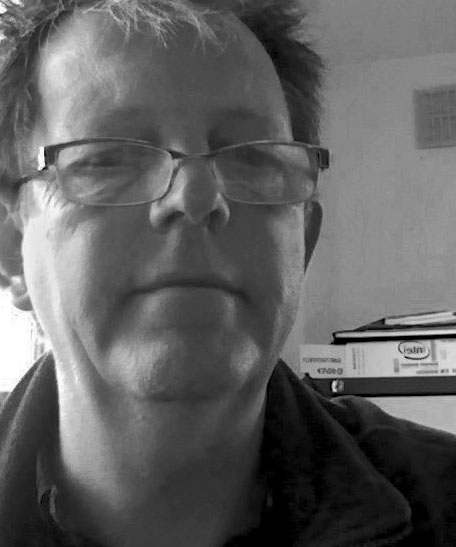
Black and White headshot of Colin Hambrook, a middle-aged, white man wearing glassesColin Hambrook was educated at Dartington College of Arts in South West England. Knitting Time, his exhibition of paintings, drawings and poetry about the experience of psychosis is on show at The Hub, East London until 15 November. The work was previously shown at Pallant House, Chichester and the Impact Arts Fair 2013. Colin’s first collection of poetry, 100 Houses was published by DaDaSouth in 2011, followed by Knitting Time (Waterloo Press ISBN 978-1-906742-65-2). He is the founding editor of Disability Arts Online

The interview was conducted by Gaele Sobott on 28th September 2015 at the Barbican Centre in London just before Colin attended the Creative Future Literary Awards at the Free Word Centre in Holborn.

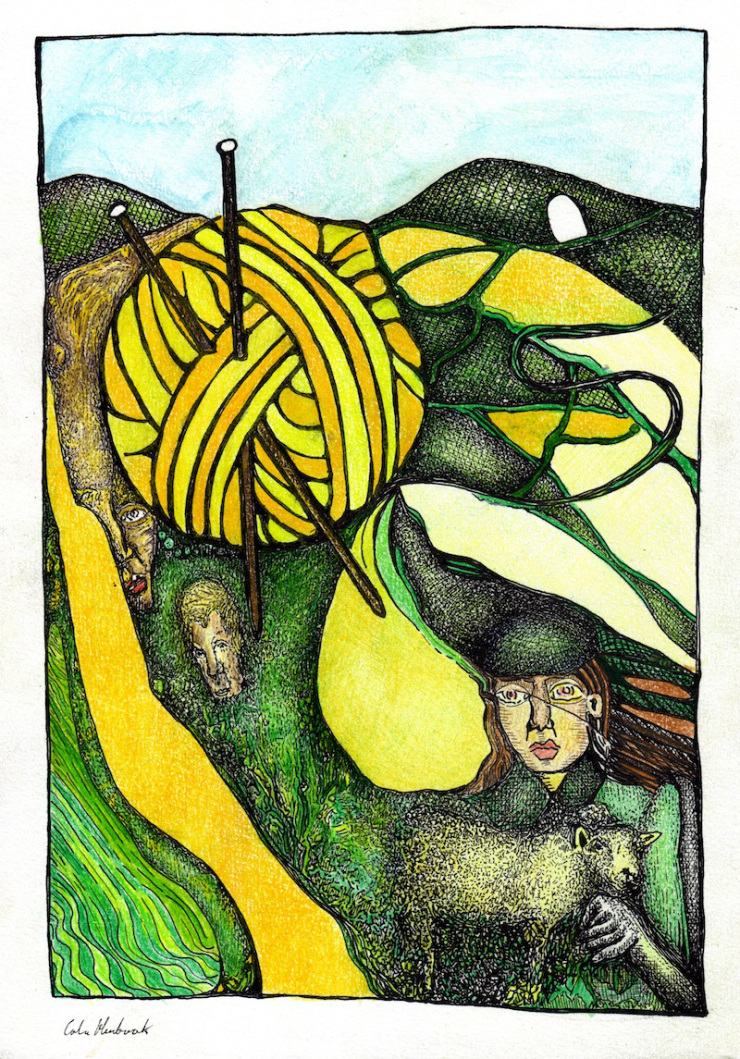
Drawing by Colin Hambrook. Blue sky with clouds above green hills, a large ball of yellow wool sits just below the hills. Brown knitting needles are stuck in the ball of wool. A thick yellow line runs down the left side of the picture like a river, and green and yellow squiggly lines run parallel to this yellow band. To the right of the picture there is another thick band of yellow intersected by thin meandering green curves that creates what looks like an aerial view of plots of land or small farms. There a two faces, one squashed between the ball of wool and the yellow band on the left and one just below the ball of wool. In the bottom right-hand corner there is a woman wearing a green beret type hat and green coat. She is holding a sheep.

Call of the Ancient by Colin Hambrook

Gaele Sobott: In Australia the visual arts and now dance appear to be surging ahead in terms of developing platforms and exposure for disabled artists. Literature is quite a way behind. In the UK disabled writers and literature seem to be better placed. What are the Creative Future Literature Awards and how is Disability Arts Online involved?
Colin Hambrook: Creative Future is a Brighton-based organisation looking to promote careers of ‘marginalised’ writers and artists. Amongst those they support with their annual Literary Award are a certain number of disabled writers. Disability Arts Online is a partner. We have signed up to help them promote the program, get information out, reach people. In terms of literature in the UK, Survivors’ literature has led the way.
GS: Please explain what Survivors’ Literature is.
CH: The key organisation is called Survivors’ Poetry, founded in 1990 by four poets with direct experience of the mental health system in the UK. In a really short space of time it mushroomed into a huge phenomenon. It was a UK network of groups that all became affiliated, some of them became registered charities or not-for-profit companies in their own right and I would say between ’94 to ‘96 it exploded and was reported on in the media and really picked up on. It was important that the people who ran the organisation and wrote for Survivors’ poetry come from a mental health background. They had experienced mental distress, been through or had an intimate knowledge of the mental health system.
GS: What kind of work were they producing?
CH: In the 90s there was a kind of performance poetry format, going into day centres, resource centres, organisations working with people who had come through the mental health system, and producing workshops and giving people the opportunity to perform. So typically the first half of an event would be open mic encouraging people to get up and perform their writing and the second half would be more experienced performance poets. The organisation still exists with a core force of people in London but it has become less prominent elsewhere in the UK over the last ten years.
GS: Why do you think that has happened?
CH: Survivors’ Poetry’s strength was in its Community Arts ethos, but it has become harder to find funding for grassroots work. It’s hard to keep integrity, supporting individual artists creativity at a grassroots level whilst maintaining support for ‘professional’ artists. Survivors’ Poetry turned to producing a literary output, which has been fairly successful. As part of the Unlimited showcase at London’s Southbank Centre last year, Disability Arts Online and Survivors’ Poetry celebrated the achievement of the organisation with a reading by some of the Survivors’ founding poets in the Saison Poetry Library in the Royal Festival Hall. The library contains twenty-seven titles under the Survivors’ Press imprint.
GS: Has Disability Arts Online managed to keep its integrity?
CH: Disability Arts Online in the last ten or twelve years has kind of managed. It’s a bit like a dance, you want to keep your core constituency on board and to nurture that talent, but also you’ve got to watch out, keep an eye on the priorities linked to where financial support can be found to ensure funders’ demands are satisfied.
For instance we have a modest contract with Unlimited to report on all of the artists and all of the projects that come out of Unlimited. It’s a fantastic opportunity to spread the word about this important initiative. Much of Unlimited’s aims and values concur with those of Disability Arts Online, working to support the development of art by disabled artists within the UK cultural sector. Disability Art Online’s brief is to interview the artists, review the shows, comment on the work as it progresses, and where possible, to commission copy for other online magazines and press in order to facilitate the reach of Unlimited to new audiences. Unlimited had a fairly substantial presence at the Edinburgh Fringe Festival this year, with several pieces of work in the British Council Edinburgh Showcase. Unlimited is spearheaded by two organisations: Shape and ArtsAdmin and they’ve received support from the British Council in facilitating the artists taking their work outside the UK. In many ways it is a bright, shiny success story.
We have to work hard to ensure our integrity isn’t compromised, which means creating projects that support and create opportunities for our core constituency and looking to remain disabled-led as much as possible, whilst also working with the high-profile initiatives. Without the support of Unlimited many of the artists we work with would never have got the profile they’ve achieved. For example Jess Thom was unknown as a performer before her company Touretteshero received an Unlimited research and development commission for Backstage in Biscuitland. After a year or so of touring she has been commissioned by Channel 4 with a version of the show made for television, Broadcast in Biscuitland.
GS: So does your core constituency consist of disabled artists at grassroots level?
CH: Yes, disabled artists, writers, who are what the Arts Council term as emerging artists. They are people who create because they’ve got to create, not because they’re making a living out of being artists, necessarily.
GS: Is it possible some of these artists could find themselves forever classified as emerging because of the nature of the market and the value system used to categorise their art?
CH: Yes but that’s just the label that the Arts Council puts on it. People are creative because they need to be creative and creativity isn’t a commodity. We have this schism in our society that divides creativity up into commodity and art. It’s nonsense really.
GS: You mentioned that much of the art by disabled performers at this year’s Edinburgh Fringe Festival focused on the body. Can you please talk more about that?
CH: Yes that’s not necessarily a bad thing. Culturally it’s very different from disability arts of possibly ten, certainly fifteen years ago where the focus on impairment was frowned on.
GS: Was that in defence of the Social Model of Disability?
CH: Defending the Social Model but also it was much more then about community and about people raging against the machine, standing up against discrimination, being a collective force. What’s happened is that as the focus for disability arts has moved away and broken up into impairment-focused issues, which I think are important . . .
GS: Why do you think these issues are important?
CH: Because the key problem with what I would call the first wave of disability arts from the mid 80s to the end of the 90s was that it was very much inward-looking and there was a very powerful community of disabled people who were very clear in their aims and making strong art for and by disabled people. Indeed we got the DDA (Disability Discrimination Act 1995). Not the DDA we wanted but we got the DDA. What happened then was that the very clear, concise stand against discrimination got diluted and the Social Model as a source of inspiration and power for people to find a voice kind of hit a brick wall because impairment within the Social Model wasn’t really addressed in a very strong way. So all the slogans like, Nothing About us Without us, the focus on things being disability-led, kind of fell apart when certain disabled leaders, say for example a wheelchair user, didn’t understand all the politics around Deaf issues or blind issues. Having disabled leaders is important but having that broad understanding of access and the issues faced by people with different impairments is more important.
GS: Isn’t it possible to have disabled leaders with a more complex understanding of disability, Deaf experiences, impairment?
CH: Yes that is the ideal, yes.
GS: Why hasn’t that developed or has it?
CH: There’s a choice that happens in either developing the politics or developing the arts. They can go hand in hand and work with each other and they can also work against each other. The emphasis from the funders has been that if you want the money you have got to develop the aesthetic, you’ve got to develop the art. The politics have been sacrificed to a large extent. A big part of that politics is the importance and value of work being disability-led, because at the end of the day, it’s the experience of being disabled by society that motivates us.
GS: With this huge austerity drive and all these cuts do you think there is more of a need now to develop disability political leadership and action?
CH: Yes there is more of a need now than ever. Absolutely.
GS: How do you see that developing given what you have just said?
CH: It needs people with courage to come forward and start demonstrating on the streets again.
GS: Do you see the march to Downing Street on Saturday protesting the changes being made to Access to Work as an example of this?
CH: I’m really angry that the government are cutting Access to Work. In this case the government said they will cap what any one BSL interpreter can earn at $40 000 a year. But who the hell in the arts is earning forty grand a year? Very few I would say. So the demonstrators were protesting the cuts in Access to Work with this cap on how much an individual can earn. There are thousands of disabled people dying because of cuts. The government is playing a game of divide and rule. On the one hand they are saying they want to get all disabled people into work, but on the other they’re denying means to make working an option. There needs to be a clearer focus in standing up to these issues.
GS: So are you saying that political leadership and analysis are lacking?
CH: Yes
GS: When you say there is a need for people with courage to come forward, the courage to do what?
CH: What the hell do we do in this political climate? I got very involved in supporting the 10 000 Cuts and Counting protest. At the end of 2013 we were working with Michael Meacher MP and the Dean of St Paul’s Cathedral. We met Michael Meacher in his office in Downing Street. He had a mass of files of printouts, of emails and letters of people who had written to him of their plight, their family’s plight, what was happening as a result of austerity, what was happening as a result of cuts in disability benefits. The main focus was that over ten thousand people had died within six weeks of being declared fit for work because their benefits had been cut and they’d been left with no money. Those individuals didn’t necessarily pass away because of the cut in their benefits, but equally, many did. Can you imagine the indignity of being on your deathbed and getting an official letter from the Department of Work and Pensions telling you that you are fit for work? And this has happened to many thousands of individuals and their families. There has been a very dangerous shift in attitude that as an individual living in this society you have to prove that you are financially contributing to it for your existence to be valid. We’ve gone back to the Victorian age within a few short years with the ruling class and their bastard politics. They’ve got every evil connivance of screwing the tax payer and they’ve got the media sewn up so they can infest everyone’s brains that it’s disabled people who have brought austerity upon us, that have brought down the economy. It’s evil!
GS: So do you think it is the responsibility of disabled artists to identify as part of the community and bring the politics into their art in some way?
CH: I personally think it is but then who am I to demand that of an individual? I encourage individuals to get involved in Disability Arts Online who have that ethos. I would say though that generally this time around people are finding it much harder to stand up for their rights.
GS: Why do you think that is?
CH: Well I would include myself in this criticism and say after the DDA was established, the disability movement never really went out of its way to include younger people. So we’ve still got the same old codgers now trying to make a stand like they did twenty or thirty years ago. People are older and frailer.
GS: The older people may no longer have the physical strength but they have knowledge. Do you think younger people are separated from that history, that knowledge of what has gone before them? Are they expected to reinvent the wheel?
CH: Yes and the tendency of Neoliberalism is to encourage people into their own little camps, individualism, losing sight of the larger collective.
GS: Do we need to theorise how to change that and if so how?
CH: It has to happen. I think going back to what we were saying earlier there is a value and an importance in the work that has become the key focus for disability arts – the relaying of stories about the body, stories of people’s experiences of individual impairment, of discrimination.
GS: How does art play a role in changing public perceptions?
CH: Art has a key role to play. You might not call an ITV soap opera, art, but in terms of popular culture, it’s much more wide-reaching than most art.  And so for example, Liam Bairstow who trained with Mind the Gap has recently got a lead role in ITV’s Coronation Street. I think that a young actor with learning difficulties being seen on TV is definitely going to change attitudes, make a lot of people think and those changes are really important.
GS: It seems you are saying that change needs to take place on many levels.
CH: That’s where disability arts is at now I think, certainly within the performing arts, and within the visual arts. In the visual arts there is possibly a bit more politics.
GS: Going back to individual courage – someone may have the courage needed to come forward but if others don’t join with that person it could be very demoralising. What is your experience in this regard?
CH: Well yes, for me, we went to all that effort with 10 000 Cuts and Counting and none of the media turned up and it was all forgotten very quickly. No one took any notice. Nobody seems to care that many thousands of disabled people died because of cuts. Nobody thinks that could be me, or that could be a member of my family.
GS: You said the media didn’t pick up on the story. Disability Arts Online plays an important role in providing an alternative media source.
CH: Yes we do provide an alternative media and we keep plugging away.
GS: You started Disability Arts Online in 2002, and in 2004 you set it up as a not-for-profit company limited by guarantee. So it’s been running for over eleven years. How do you fund the organisation?
CH: We’re constantly working on funding applications for projects. We have a broad vision for how we operate in terms of raising debate about disability arts practice and supporting the work of individuals and organisations across art forms.
We’ve recently received funding from Arts Council’s Grants for the Arts scheme for Viewfinder over the next eighteen months. Viewfinder will see us working in partnership with Wikimedia UK, Sick! Festival, SPILL Festival, Carousel, the New Wolsey Theatre and Goldsmiths Disability Research Centre. It’s very exciting. Wikimedia UK are keen for us to populate Wikipedia with pages dedicated to disabled artists and a history of the movement. The Disability Research Centre at Goldsmiths University is supporting us in running a series of workshops.
We’re producing a video platform and commissioning disabled artists/filmmakers to curate a selection of disability work from the archives of Sick! Festival in Brighton, SPILL Festival in Ipswich/London and Carousel’s Oska Bright Festival. We will produce videos commenting on the importance of the selection in advancing the practice of disabled artists. So, for example Matthew Hellett, who is a learning disabled filmmaker on the Oska Bright committee will be making a film about what makes for good representation; how the committee judge the best films for Oska Bright. We’ve also got another year of core funding from the Esmée Fairbairn Foundation, which is renowned for funding organisations with a community remit.
GS: Have you come up with ideas for sustaining Disability Arts Online on a more long-term, financial basis? Have you tried financing the group by any means other than government funding or philanthropy?
CH: We’ve tried a few experiments. We recently worked with Stopgap Dance Company. They produced the Independent Fringe platform in Edinburgh. Disability Arts Online produced a crowd-funding platform for one of the younger artists, Rowan James. That was successful. We raised £1500 towards getting him to the Edinburgh Fringe Festival. We want to do more of that.
GS: You have described how outside funding can determine the path you take. So if you want to be independent of those demands and priorities in terms of changing the political situation how do you achieve financial independence and sustainability?
CH: Well yes sometimes you feel that the odds are stacked against you. It is a constant struggle. We need time and energy and imagination to come up with strategies. We have a shared knowledge and experience that can be incredibly useful to many industries, so we are also working to find ways to be more sustainable through consultancy and media partnerships.
GS: You have shared your childhood and some challenging personal experiences through your poetry in a way that must be quite confronting but hugely important in terms of supporting people within the Survivors Movement and people who may feel isolated. Would you like to comment on how art can provide a form of community solidarity and empowerment, especially in reference to your latest collection of poetry, Knitting Time?

A drawing of a small boat knitted from yellow wool, sailing on a blue sea with stylised waves against a bright blue sky

Knitting Time by Colin Hambrook

CH: I’d like to think that Knitting Time had value in giving a voice to issues around mental distress. Mostly, psychiatry condemns individuals to the judgement of a medical imperative, which locates mental health problems in the head divorced from the individual’s life experience and circumstances or indeed from any emotional impact located in the body. It treats the individual as having a separate, disconnected body and mind and introduces powerful and potentially harmful drugs to suppress experience deemed as mental health problems. Often, those experiences can be exhilarating and creative even if they can make it harder to function in the ‘real world’. Often mental health ‘issues’ are a matter of an individual having the confidence to be comfortable with who they are.
So in sharing some of my own journey I would hope to break some of the isolation people feel. There is empowerment in hearing others’ stories, others’ expression. There are poets like John Clare and William Blake whose names come up frequently in terms of writers whose core work continues to inspire empowerment within a survivors’ community. There was a poem by Ellen Link that I go back to again and again that inspires my sense of the value of connection; and connection with nature as a healing force in contradistinction to this narrow framework we are meant to fit in with when it comes to being seen as valid, mentally healthy members of society: “In the woods they blast/ your courage to tell you/ you are not a tree, that the wild wind /and the grey skies are not your cousins/ though their atoms be like yours. . .”

For further reading:

Colin Hambrook’s Art and Poetry Blog

Celebrating the Survivors’ Movement

Jess Thom’s Tourettes Hero

10 000 Cuts and Counting 1

10 000 Cuts and Counting 2

10 000 Cuts and Counting 3

Creative Commons License
The Courage to Come Forward – an Interview with Colin Hambrook by Gaele Sobott is licensed under a Creative Commons Attribution-NoDerivatives 4.0 International License.

Support and promote community-led healing to end Indigenous suicide

BE PART OF THE HEALING

EldersReport4 Almost non-existent 30 years ago, the rate of youth suicide and self-harm in Indigenous communities across Australia is now the highest in the world. Urgent action is desperately needed to address this crisis.

Current mainstream efforts by Government policy makers and health and social services are not working, nor are they empowering communities to implement their own solutions.

Indigenous community leaders and Elders are calling for your support to help them heal their young people, by reconnecting them to their culture, and strengthening their sense of identity.

They are asking that long-term funding be directed to grassroots, community-based programs that are working on the frontline with at-risk youth, providing vital support, cultural education and on-country healing.