“I Think of Dance as My Most Honest and Purest Form of Expression . . .” An interview with Christelle Dreyer

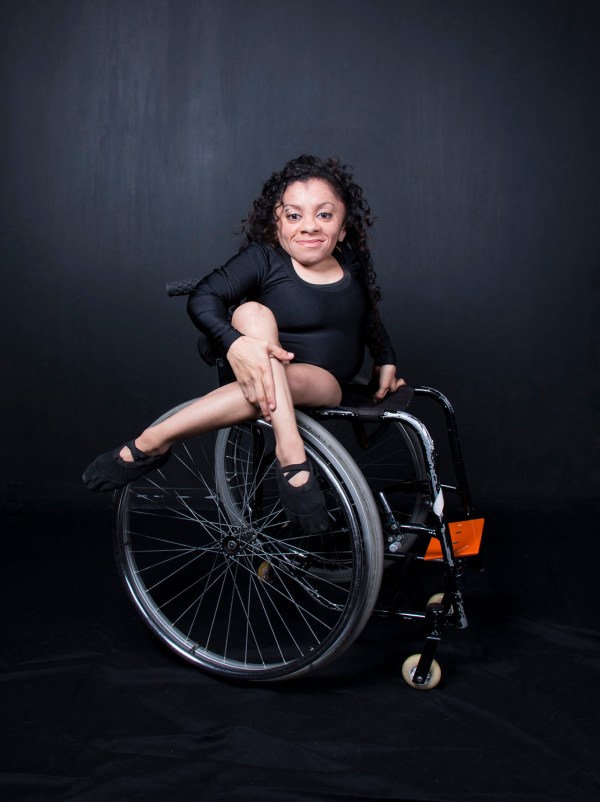
Christelle Dreyer1

Credit: Marike Van Wyk

Christelle Dreyer is a freelance graphic designer and dancer who lives in Brackenfell, Cape Town.  She took up competitive ballroom and Latin dancing in 2004, then moved onto contemporary dance in 2010, performing in Dance Joint produced by Jazzart Dance Theatre and choreographed by Jackie Manyaapelo,  Infecting the City, choreographed by Tebogo Munyai, and Unmute Project, choreographed by Andile Vellum. She has worked on projects with various dance companies, including Jazzart Dance Theatre, Remix and Unmute. She recently performed in No Fun ction alL anguage, at South Africa’s National Arts Festival 2016 in Grahamstown.

Gaele Sobott: How did your passion for ballroom and Latin dancing initially develop?

Christelle Dreyer: As a child I loved listening to all kinds of music and watching people dance. I can`t really recall exact dates, but Jazzart Dance Theatre came to my school and I was lucky enough to be chosen as one of the kids to be part of a performance. It opened me up to realising that I actually could move and not just be on the side admiring people as they danced. After that I started Ballroom and Latin dancing.

GS: What then led you to contemporary dance?

CD: I started taking open dance classes as a way to keep fit and do something different. I enjoyed it so much I never stopped.

GS: How did you become involved in No Fun ction al Language?

CD: I received a phone call from Danieyella Rodin who works at The Chaeli Campaign, the organisation that produced No Fun ction al Language. She asked me if I’d like to audition for the show and then emailed me all the relevant information. I contacted Jayne Batzofin, the director, who was conducting the auditioning process over a two week period. So I auditioned and got a part in the show.

GS: Who are the other performers in the show?

CD: Andile Vellem Daniel Mpilo Richards, and Iman Isaacs are the other dancers. Dave Knowles is the musician.

GS: Tell me about your experience of working on the show.

CD: No Fun ction alL anguage has been an exceptional experience and an amazing opportunity. From the start of the creation process to the final production and the moments in between it’s been an incredible process of growth and discovery.

Jayne Batzofin and the cast, everyone involved, have been so open-hearted and open-minded. Some of them, before meeting me, hadn’t had any interaction with a disabled person but the way they approached the idea of disability is no less than amazing. I would like to think that we have become a little No Fun ction alL anguage family. I feel blessed to be part of the team. Together we created a work that has stimulated discussion around what happens if we don’t have the right words or any words to share our thoughts, discussion about our desperate search for meaning and about inclusivity for all members of our society. Each chapter of No Fun ction alL anguage encouraged different thought processes and emotional dialog within me. It was great being in a position to explore these things through performance. The response from audiences has been more than overwhelming.

GS: How did you contribute to the choreography of the piece?

CD:  When Jayne choreographs she uses a theme then allows us to improvise our body movements in relation to the theme. So we generated new movements and material. These were then incorporated into duets or into the larger choreography.  In chapter five of No Fun ction alL anguage, for example, that entire solo was created by me, and Jayne refined and detailed some moments.

GS: Please describe what Chapter Five is about.

CD: Chapter Five was about deception. How you experience deception, what it means to us. I looked at the emotions we feel when we are deceived and when we deceive and worked on translating that into movement. So Daniel explored the act of deceiving someone. His character was saying, “I love you” but not meaning it. Andile and Iman looked at how you can deceive yourself, and I worked on how sometimes you want to believe the deception. You know you are being deceived but you want to go ahead, for example, you believe that person loves you. So the choreography I developed was communicating that process of trying to hold on to what you know is not true but what somehow is pleasurable. Well it would be pleasurable if it was true. You try to hold onto that pleasurable non-reality for as long as you can. So my choreography was very quiet.

GS: How did you translate quiet into movement?

CD: Slow and controlled, under the radar.

GS: I think it was Silence, the chapter where you were on your back and moved your leg up very, very slowly.  That was a powerful moment.

CD: Yes that took extreme concentration, and the right breathing.

GS: Do you have control over your safety during the creative process?

CD: Complete control. If my body doesn’t want to do something, I don’t. But I try new moves. If that doesn’t suit me, I say so. I know what my body is capable of. Anyone who works with a disabled dancer knows that there are certain traditional ways of dancing that may be impossible. It’s a fine line between a director knowing when to push and when not to push you. At the same time you don’t want a director to be patronising and not get you to push boundaries.
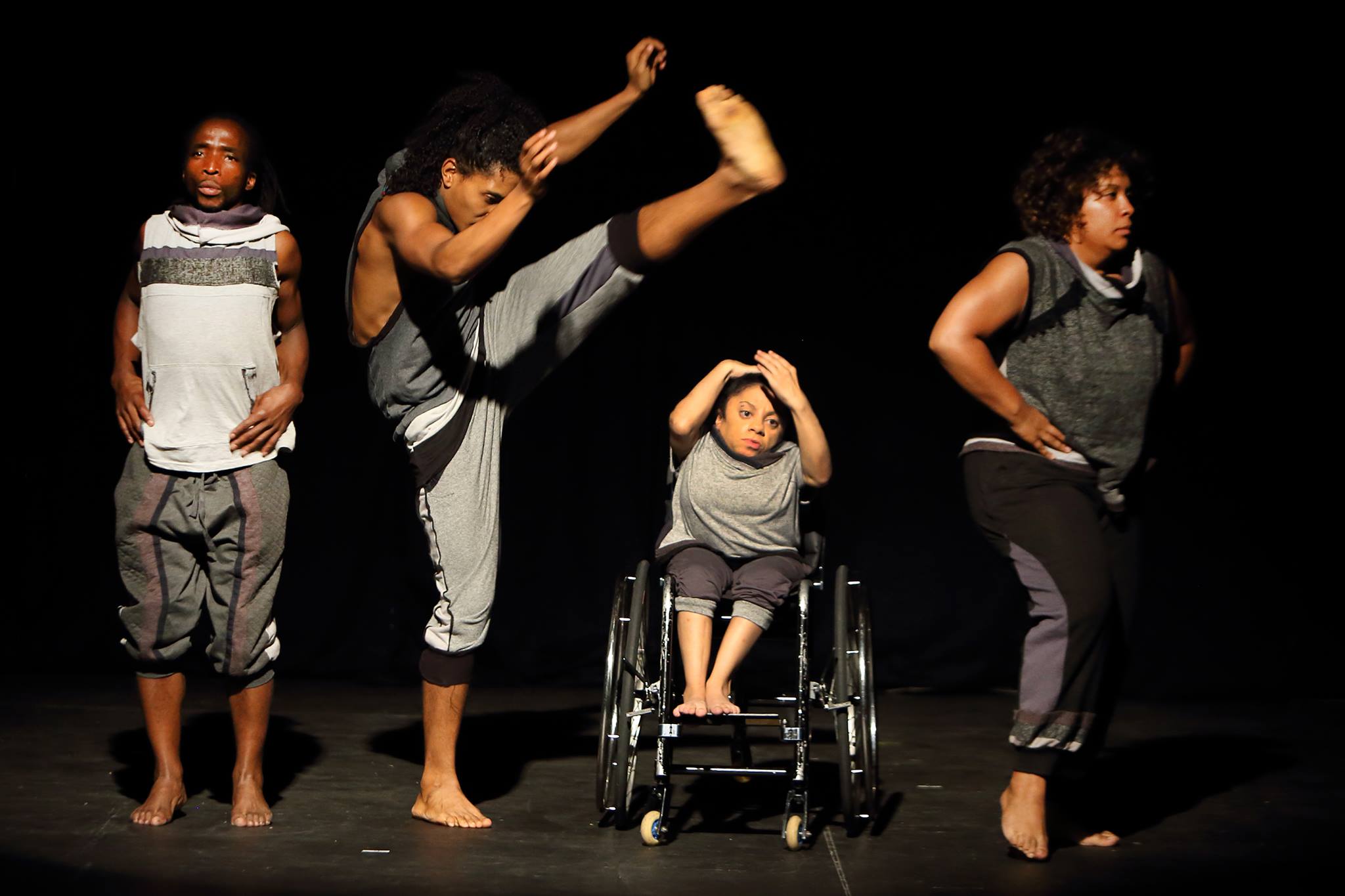
From left to right, two male dancers, one standing facing audience, the second lifting his arms and one leg high over the third dancer who is seated in a wheelchair. She leans away from him and holds her hands on her head. The last dancer, a woman, stands facing the away from the other dancers. They are all dressed in casual pants and tee shirts in various shades of grey.


GS: How do the themes of language and communication addressed in No Fun ction al Language relate to you personally?

CD: For me communication takes on many different forms. I think of dance as my most honest and purest form of expression and communication. In those moments of dance, the movement and the spaces between movement, I find what I really want to say to the world. I also communicate as a graphic designer. My work tends to be minimalist, which I feel expresses my easy-going personality.

I think the way I communicate with others is largely determined by the circumstances I’m presented with. For example, the way I communicate with Andile Vellem, who is Deaf, is different to how I communicate with the rest of the cast. My sign language is very bad, but somehow it’s often easier to convey information to him than to someone who can hear, other times we have big gaps in communication. I really need to work on my SASL (South African Sign Language). As far as spoken language goes I am fluent in English and Afrikaans. Not really sure about fluent as my vocabulary is not that large, in my mind at least. I find it difficult to learn new languages. But also I realise the value of discovering new forms of communication and maybe just maybe, I will be putting pen to paper more often.

GS: Afrikaans and English. How do these languages figure in your life? Do you consider either of these languages as your first language or mother tongue?

CD: Both languages are equally as strong as each other in my life. My parents raised me speaking English and I went to an English-speaking school but my family, my parents, aunts and uncles, also speak Afrikaans, and my community.

 GS: Afrikaans has historical significance in the context of the ant-Apartheid struggles and the 1976 student uprisings against the Afrikaans Medium Decree. Do you think the language still represents an oppressive force for some people? Tell me more about what the language means to you.

CD: I was a bit too young to fully understand what it was like during Apartheid. I don’t really have the experience. My parents are the ones who know about what happened then. But from what I observe now Afrikaans is becoming a more general language in Cape Town. There are a lot of Coloured people who speak Afrikaans but it’s a bit different to the way White people speak the language, not pure like in the text books.  Coloured people have their own slang, and it’s more musical. Also the humour in the way Coloureds speak the language is different. I enjoy that humour.

GS: What are the elements of your identity that have remained steadfast over the years, what has changed?

CD: Well my identity is not something I really think about in great depth. Apart from the more obvious things like the fact that I am a Coloured disabled artist. I think I have always been open to experiencing different things. Perseverance and persistence is something I’ve always had and I have a feeling that will not change anytime soon.

I never understood myself as unique. That was partly to do with me being a twin. I am a twin but actually my sister and I are completely different.  My immersion in creative processes demanded that I explore my sense of self. So that definitely helped me realise and embrace my uniqueness.

GS: I was recently at an event where the writer and journalist, Sylvia Vollenhoven was talking about her book, The Keeper of the Kumm. She said, you can be Zulu or Xhosa and it defines to some extent your history but Coloured is a more general term. She feels that people who identify as Coloured are largely excluded from the narratives of nationhood that South Africa is now constructing. What does this part of your identity mean to you?

CD: There are lots of divisions and classes in the Coloured community. The way you live as a Coloured person, where you live, the way you identify, the way you’re brought up. Generally yes, a Black person has a very strong sense of identity. The backstory of being Black or the backstory of being White is usually solid where they know their granny’s granny’s granny.  Many Coloured people haven’t answered the questions, Who am I? What is my history? Where do I belong? Like what exactly is a Coloured person? Yeah, it’s complex. I don’t think Coloureds really know how to define themselves. They don’t have resources to draw on. Like me, I don’t know the history of my grandparents or beyond them.

GS: Why do you think that is? The reasons why you don’t know?

CD: Maybe because the past has been painful and people haven’t wanted to talk about it. But I’m lucky at least I knew all my grandparents. I only have my grandfather left. He has dementia now so I can’t really ask him about our family history. My father’s parents died many years ago. My mother’s mother, Ma Yvonne Lopes, played a big role in encouraging me to be confident and proud of who I am. She was an amazing grandmother. My mother too, she instilled certain values in me and I don’t give her enough credit for all my successes. I am content with who I am and where I am in my life. My friends and family keep me grounded.

GS: Elaborate a little on your identity as a disabled artist?

CD: I was diagnosed with OI (Osteogenesis Imperfecta) when I was a baby. My sister also has OI, I mention this because I always get asked since we’re twins. Because of my OI I spent many of my childhood years with broken bones or in hospital. My mother has lost count of the number of operations I’ve had, at least twenty.  The amount of times I’ve broken my bones seems endless. My tolerance to pain has become so high that most of the time I don’t realise I have a broken bone and in some cases more than one.  I was born and grew up in Cape Town with my parents. I’ve always been surrounded by family and friends so apart from OI issues I’ve had a very normal childhood.  OI is one of the many layers that shapes who I am. I Matriculated in 2004 and started studying Graphic Design at Cape Peninsula University of Technology in 2006. I graduated with a Baccalaureus Technologie in 2011. During my years as a university student I never stopped working on my dance goals and dreams.

GS: Can you describe any barriers you have encountered as an artist with OI?

CD: The strangest thing to me is that artists are generally more open to individuality and people expressing their uniqueness. But somehow when people see disabled artists they have this preset idea that disabled people cannot produce the same high quality as them. I am not saying it is all arts practitioners and audiences but that bias is there. Yet in many cases the standard of work produced is of equal quality or even better.

I have experiences where I would go for graphic designer interview and I’d be told they could not hire me because I was not what they expected but I have a very good CV and portfolio. I don’t put the fact that I am disabled in my CV as that should not be the measure as to whether I get the job or not. Of course they know they can`t say to my face it is because I am disabled that they will not hire me, so they come up with polite and creative ways to tell me. It really is not fair.

It’s very satisfying when I get to prove people wrong and exceed their expectations of me as an artist. Like after performances of No Fun ction al Language when audiences are left not only in awe but with different perspectives of disability.

GS:  How did you find disability access at Grahamstown National Arts Festival 2016? What changes would you like to see?

CD: I feel that disability access was not taken into consideration at the Festival. This is really disappointing as there where disabled artists on the festival program. There is so much said in South Africa about human rights and treating people as equals, yet the basic needs of people using wheelchairs, deaf people, blind people are not being considered. I’m blessed to be able to walk for short periods of time, but what about disabled people who can`t walk at all and need their wheelchairs to get around? Access is not just needed for artists but also people attending the festival, audience members. It’s a national festival, disabled artists and audiences should be welcomed, not excluded.

I think disabled people are standing up for themselves more than in the past and that they are being integrated as part of their communities so much better. There is still however a long way to go.

Grahamstown National Arts Festival 2016 – No Fun ction alL anguage Trailer

This interview was conducted 21st July 2016

Creative Commons License
“I Think of Dance as My Most Honest and Purest Form of Expression . . .” An interview with Christelle Dreyer by Gaele Sobott is licensed under a Creative Commons Attribution-NoDerivatives 4.0 International License.
People love stories: An interview with Amit Sharma

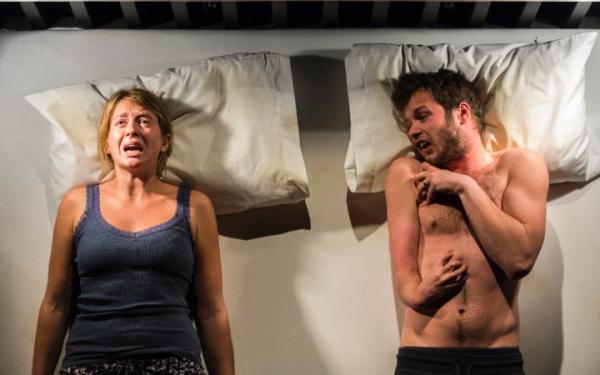
A young woman wearing a blue singlet lying on a bed with an anxious expression on her face. Next to her is a young man also lying on his back. He is only wearing black shorts.

GENEVIEVE BARR AND ARTHUR HUGHES AS ALICE AND PHIL IN THE SOLID LIFE OF SUGAR WATER BY JACK THORNE CREDIT: PATRICK BALDWIN


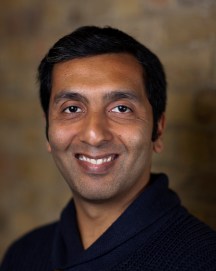
Amit Sharma 2Credit-Matt Cetti-RobertsAmit Sharma has been the Associate Director of Graeae Theatre Company, London, since 2011. He recently directed The Solid Life of Sugar Water, a Graeae Theatre Company and Theatre Royal Plymouth production, gaining unanimous acclaim at the 2015 Edinburgh Festival Fringe, leading to a 2016 UK tour including a run at the National Theatre.
Amit is a graduate from Graeae’s Missing Piece actor training course. In 2012, he co-directed the outdoor spectacle Prometheus Awakes (with La Fura dels Baus/co-commissioned by GDIF and SIRF), marking the first large-scale outdoor production to be artistically led by Deaf and disabled people in the UK. Also for Graeae, he directed Ted Hughes’ The Iron Man, which toured both nationally and internationally and co-directed Graeae’s Rhinestone Rollers in Sequins and Snowballs with Jenny Sealey at the Southbank Centre. As Assistant Director, he has worked on Graeae’s productions of The Threepenny Opera, The Changeling and on The Four Fridas for Greenwich and Docklands International Festival 2015. Amit currently leads on Write to Play, Graeae’s flagship new-writing programme in partnership with venues across the UK.


GaeleSobott: Can we start by talking about the set design in The Solid Life of Sugar Water. The bed is central, upstage, vertical with the actors standing against it. From the audience perspective it is as if they are looking down on the characters lying on the bed.

Amit Sharma: The thing about Sugar Water and the aspect that I was really interested in was the relationship between the two characters, Alice and Phil, how much they were or weren’t communicating. The style, as it was written by Jack Thorne, consists of two monologues essentially inter-dispersed with both the characters’ dialogue. Well it is much more intricate and clever than how I’ve just described it to you, but the nature of them not talking to each other and addressing the audience set up something which is immediately striking, irrespective of the subject matter. There is some form of subtext that is going on between the two characters, which is very exciting. When we did our original set design it was very abstract, very sparse actually. Then we did a reading of it and the designer said to me, ‘I think we’ve got this wrong. I think the audience needs to be placed in the bedroom. The bed is missing.’

She was absolutely right. The bed was like the third element of the relationship within the text. So then we needed to decide how to be artistic about it. We didn’t want the bed to be literal. The piece isn’t naturalistic. We jump from the past to the present and then back again. So we developed the idea of looking down into the couple’s bedroom.

GS: What is that perspective? What does it give to the play?

AS: I really wanted the audience to feel that they couldn’t get away from being privy to and a part of the couple’s life. I don’t know about you, but when I visit a friend’s house the bedroom is always the last place I look. It would be a bit weird to go and look in their bedroom. That’s because it’s private and you’d feel as if you were prying into someone’s very personal space, even if they’re not in the room. I wanted the audience to feel like they were able to be in that space.

GS: How does this position the audience? Are they voyeurs or perhaps fly on the wall?

AS: I think more fly on the wall. I think voyeurism has an element of choice about it. Maybe fly on the wall does too. I just wanted the audience to really feel the pressure cooker of the couple’s relationship and be a part of that. Not able to separate themselves from it. That’s what the play does. You fall into it and by the end you’re feeling all kinds of emotions because of the performances but also because of Jack’s writing. The writing and the set. That’s why I wanted the audience to be together in the bedroom with the couple. I wanted them to be with them in their private moments without feeling they were intruding. At the end I wanted the audience to feel they have been through so much with this couple. It’s actually about healing both for the couple and also for the audience.

GS: The audience are looking down on the bed but they are also being spoken to directly by the characters. It is not possible for the audience to position themselves as just observers. They have to participate. What are your thoughts on this?

AS: That’s the good thing about theatre. You can set up a convention and then just totally break it. So whenever the characters were on the floor, that was like the wall of their bedroom but it became less about the bedroom, it was the post office, the bridge, even though the bed was always present. As a creative team we wanted it to be subtle, so yes the bed was always in the background because there was always that big question of them trying to have sex.

GS: There are many disabled artists and directors who feel there is a need to explore sex and disability, for various reasons including societal attitudes, the infantilisation of disabled people. What is the importance of sex in disabled art? What is the relation of this play to the exploration of sex and disability?

AS: The most interesting thing coming out of Sugar Water is that question has not been asked. It has not been unpacked. What the play does is almost normalise that very question of sex and disability. It is such a huge topic for so many different reasons. Perhaps it is because of the performers, one performer is Deaf and one performer has a physical impairment, but not to the extent where it impacts on their sex lives. What I mean by that is that if, say, one of the characters was a wheelchair user who had 24 hour personal care then that dynamic shifts. I was reading an article today about the Independent Living Fund and this guy saying how it can be difficult to live independently for example to go out and chat up girls because you’ve got someone else there all the time. So you have to negotiate that relationship. This play doesn’t go there. People have picked up on the element of communication between the couple, but the sex element not so. I also think it is because of how Jack as a writer was playing with the idea of sex. There’s a lot of comedy with some really graphic descriptions.

GS: Well yes there is comedy and there are very serious moments, a fine line.

AS: Yes, Jack Thorne gets that fine line absolutely right. In rehearsals we spoke about how graphic we should get or if we should get graphic at all. If we were brave enough to show our naked bodies and those kinds of discussions. It quickly became apparent that it wasn’t about that. It would have become alienating, as opposed to the audiences going: ‘Come on, we’re theatre audiences. We’re pretty smart. We can go whichever way you want us to go. We don’t have to see nudity to get what you’re talking about.’

It felt like we could just tell the story. The most interesting thing is the intricacy of communication between the audience and the performers. The couple think they are talking to each other and they’re not really, and they do the direct address where there is a conceit between each character and the audience. There are many different levels of communication.

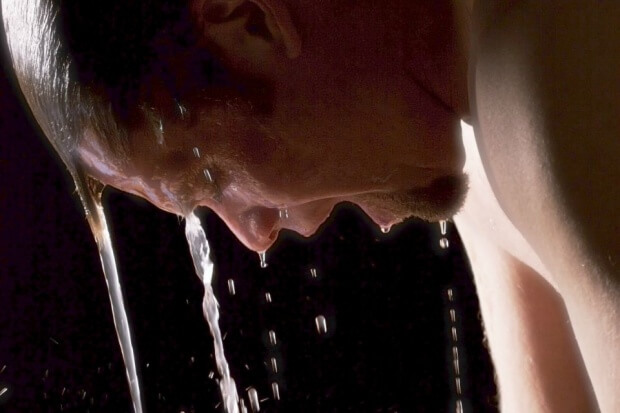
A close up of a man's head, profile looking down with streams of water flowing over his head and face.

GS: Can you talk a little about the quality of the reviews the play has received?

AS: Well I think the journey of journalism and the way this show, and other shows at the Edinburgh Fringe by Deaf and disabled artists, have been reviewed has really shifted. It’s really come a long way. The art is now being reviewed as opposed to the performers and their physical shapes and sizes and what have you. It is really refreshing to see the work being reviewed in this way.

Talking about Sugar Water the reviews spoke about the subject matter as happening to two human beings not to two disabled people. In relation to Genevieve, being a Deaf performer, the discourse was quite intelligent as opposed to talking about a Deaf person blah blah blah, it was more sophisticated in both the reviewing and the conversation around it. That hasn’t always been the case.

GS: What comments did reviewers make in relation to Genevieve being a Deaf performer and character?

AS: The discussions were linked to the idea of communication. Naturally if your partner doesn’t sign then you have to rely on lip reading and you may not catch all the communication. Phil can’t sign so he is not able to get what he feels across all the time. The scene when he’s on the bridge and he tries to sign and gets it completely wrong really resonated and got the biggest laugh every time. By that point the audience realises Alice and Phil are not communicating on a number of levels. It was about them as individuals and what they felt for each other, what they wanted and needed from each other. Phil had never had a huge number of relationships before hand. Alice had just come out of a very difficult relationship. So that makes two very vulnerable people in a position where they are wondering if the relationship can work, can they get along. Can they get married and try to have a baby. Is their relationship driven by their love and passion for each other or by their insecurities? Sometimes the best art doesn’t answer the questions it poses. It poses the questions for the audience to consider.

GS: Do you think Alice and Phil’s relationship is resolved in the end?

AS: I don’t want to say. Some people are unsure whether they continue or they don’t and I intended for that to happen. In my head they do, yeah. But I didn’t want to answer that. I spoke to Jack about it. He really wanted a happy ending and I really didn’t want a happy ending. I said, “Ok if we’re going to have a happy ending we have to hint and suggest the possibility.”

GS: I do think the play ends with them understanding and respecting each other.

AS: It’s only at the end that they actually say, ‘I love you’ to each other. Having been through the trauma of losing a baby. Jack’s a smart dude!

GS: There seems to be some relationship and similarities between The Solid Life of Sugar Water and Lungs, which also played at 2015 Edinburgh Fringe. Can you explain this?

AS: We had read the script about three or four years ago. When we got the script we were really interested. Duncan Macmillan is a great writer. We were thinking of doing a double bill but then Paines Plough went ahead with the commission so we didn’t.

GS: I found the story quite similar.

AS: Yes that’s why we had the idea that the two plays could work together.

GS: Where are you taking the play next?

AS: We’re putting a tour together. We’re going to be at the National Theatre for three weeks, which is superb. It’s the first time Graeae has been there and we’re incredibly proud. We hope the momentum builds from there.

It’s one of those plays. I remember reading it for the first time, here as a company, and the kind of silence at the end of the reading, everyone taking deep breaths. We knew it was a huge impact type of play. Audience reactions to the play have been emotional and deep. One woman stopped watching half way through. She sat there with her head down and just wouldn’t watch. There was obviously something that really connected with her. She started watching again a bit later. She was with a group of her friends and I saw her at the end. She was just in complete floods of tears. I don’t really feel bad about too many things but I did then.

GS: Why did you feel bad?

AS: I felt for her because I didn’t know her story and didn’t know what it was that she was relating to. I went over and asked her and her friends if they were alright and did as much as I could, offered her a gin and tonic. Theatre is such a powerful thing. I think people sometimes forget the impact theatre can have.

GS: Why do you think theatre powerful as opposed to other mediums of storytelling?

AS: It’s so immediate. You’re there. You can connect, relate to the work. You are immersed in the play for the length of the piece. People love stories.

GS: You can watch a series on TV and experience stories. What is it specifically about theatre?

AS: The craft of theatre is important, the putting together of the story although you can also do that with film and TV. There is something unique about theatre in showing that passage of time. I think the immediacy of you as a member of the audience and your relationship with the performers is so unique to you in an environment where there are other people as well. That is very special. You can watch television or a film in a cinema however the screen allows you to be one step removed from it. You can’t really do that with theatre. It is more interactive. It’s more immediate.

The question in theatre is – Why now? What’s important about telling the story now? With TV and film you can go back to it again and those performances won’t change but with theatre they will. You can go one night and the next night there will be subtle differences, something may have shifted – become more superficial, something may have become deeper. There’s an unknown quality. There’s that thing also where if something ‘goes wrong’ the performers just have to pick up the baton and carry on and audiences love those moments when it doesn’t all go to plan. Film and TV are created where it all goes to plan so with theatre there’s a different type of freedom and an improvisational quality.

It’s about creating the story. The performers grab the audience very quickly, in a vital and stark way, asking them to empathise with them.

GS: Did the actors contribute to Jack Thorne’s script during rehearsal. Were changes made for any reason?

AS: Well the actors didn’t really suggest changes but we did shift the script around them. We didn’t have any idea who we wanted to work with so in the beginning in Jack’s script the character, Alice, wasn’t Deaf. When we cast Genevieve as the actor for that part, Jenny Sealey, the Artistic Director of Graeae, and I had a conversation and we gave notes to Jack saying there are elements relating to Genevieve that should have some representation in the script. But in contrast, the Post Office scene about Phil not being very strong wasn’t adapted for him because of Arthur’s arm or anything. That was the original script.

GS: I didn’t take that scene as being about his arm.

AS: Well some people do you see. They think that was where his impairment was being referenced because he had this big box that he couldn’t quite carry. That was always there. But Phil signing on the bridge wasn’t there before we cast the actors. Jack did a couple of rewrites based on Jenny’s and my notes.

The stuff that happens behind the scenes may change according to the actor you cast. At the beginning we had created a soundscape and every now and then there’d be a heartbeat noise as a cue for the actors to shift position. There was also a sound cue for the actors to know the audience was seated and we’d got clearance from front of house. It was a dog bark. Genevieve has hearing aids so she could feel the vibrations of the heartbeats, the shift and the change, because there was a speaker close to her. What became slightly tricky was her trying to listen to the dog barking because of the frequency and because there were so many people in the room all making noise. So we discussed a better way of cueing and her feeling comfortable within the cueing system.

Also because there is so much direct address, I said, ‘You have permission to look at Arthur whenever you want. We’re not asking you to play hearing.’ But Genevieve got around that by learning Arthur’s script as well and picked up on his rhythms, picked up on how he delivered the text. That was her process. She wanted the same access and freedom as him and decided on her own cues. That didn’t mean Arthur had to do it exactly the same way each time. So there was that kind of negotiation going on during rehearsal.

GS: How do you cast at Graeae? How did you cast the actors for this play?

AS: For this play I got a casting director in. We work with some amazing performers and some amazing actors. I just felt this time round it would be really healthy for the Company to audition new people and add to our expanding pool of performers.

GS: Do you specifically cast disabled actors?

AS: For this play I decided the casting breakdown. Irrespective of impairment this is what I’m looking for. Just by the nature of the play we needed people who would be good at delivering text. I don’t mean in the classical sense, I mean it’s such a wordy play. There is a demand that Jack’s writing presents itself. That doesn’t mean being quick or slow or whatever. That’s what Graeae does – we say this is the play and this is what we are looking for. Let’s see who we can get through the door.

GS: I believe Graeae practises some form of affirmative action in casting performers and actors who identify as Deaf and disabled. How does this work?

AS: Yeah in our plays we’ve got at least fifty percent actors who identify as Deaf or disabled. For the two-hander I thought we had to have two performers who identify. We couldn’t have one. It just didn’t feel right. It was such a small company. But when we did the Threepenny Opera there were something like twenty performers so ten were disabled and ten were non-disabled. As it transpired, we got to the end of rehearsals and three of the people who previously didn’t identify said, Oh yeah, I’m deaf in this ear or I’ve got this impairment. So the Deaf and disabled were staring to outnumber the non-disabled. It was interesting. One of the reasons is that if people declare their impairment jobs shut down.

GS: But not here at Graeae?

AS: Yeah exactly, absolutely not at Graeae. For Sugar Water we were conscious we wanted new blood and we found it. The other thing is that we will use some of the people who auditioned but didn’t get involved in Sugar Water for other projects. So we did pull in a new pool of actors. We are good at that.

GS: What’s the next project?

AS: At the moment we’ve got the Write to Play initiative, nurturing new writing talent. We’re also developing a new adaptation of The Hunchback of Notre Dame for production in 2017. There is also a verbatim play around the Incapacity Benefit, the Employment and Support Allowance, that’s under commission.

GS: Whose voices are represented? Those who apply for or receive the benefit, or those in the bureaucracy who assess people, hand out the benefit.

AS: A bit of both but mostly people on the receiving end of decisions. We’ve got a doctor. We’ve got a legal aid person, a variety. We’re doing a taster session at the moment in aerial training building up to a project with war veterans in 2018 – an outdoor piece I think. It’s linked into the recent 1914-1918 reflections on the First World War. There’s a big artistic element to it all. We are very fortunate to be working in this profession on great projects with wonderful people. It’s a really odd time because for a lot of Deaf and disabled people at the moment they don’t know whether they’re coming or going.

GS: Are you referring to government austerity measures?

AS: Yeah but the profile of Graeae is really accelerating. The Company is being recognised for the work that we’re doing. We’ve got Ensemble starting next week. It’s an eight-month, work-based, professional-development programme for six young artists. They’re nineteen to twenty-five year olds and we’re training them as theatre makers. Jodi Alissa Bickerton is our Creative Learning Director. She’s running that programme. It’s in response to barriers faced by many Deaf and disabled artists, as well as a lack of diversity within the current theatre climate.

GS: How do you choose the participants?

AS: We get the information out there. There’s an application process. We audition, then we interview them and go from there.It’s difficult at the moment because the austerity drive is seriously impacting disabled people on a number of levels, work, living, health.

GS: Do you think disabled artists have a responsibility to reflect this in their art?

AS: I think disabled artists have a responsibility to their art. It’s a tricky one. I think it’s about choice. Some artists are deciding to reflect in their work what’s happening socially, economically in our society. Other artists feel that the art itself, no matter what it’s about, will create the shift, create the change. It’s a difficult choice but I don’t begrudge anyone for whatever the choice is that they make. I really resist the idea of hierarchical disability. Disability includes such a wide range of circumstances. It can mean so many different things to people. The wider the experience and the subject matter of our art, the better it is for changing perspectives. Graeae does a lot of advocacy work but it can be really relentless. The cuts are creating a lot of insecurity.

GS: How important do you feel disability-led writing and directing is to changing public perceptions around disability?

AS: I think everything needs to be driven by the story that the writer or the director is trying to convey. Sometimes that feeling of importance can be restricting and uncreative. Audiences are smart, open and intelligent. If you take them on a journey then they’ll go with it. If everything about a play or a show becomes agenda driven then it can fail in changing those perceptions. The story is the thing.

Further Information:

Interview with Genevieve Barr & Arthur Hughes

Information on Graeae and the tour of The Solid Life of Sugar Water  or

The interview was conducted by Gaele Sobott on 28th September 2015 at Graeae Theatre Company in London

Creative Commons License
People Love Stories – an Interview with Amit Sharma by Gaele Sobott is licensed under a Creative Commons Attribution-NoDerivatives 4.0 International License.

CROSSING CHASMS OF MISCONCEPTION: Contemporary short stories from Gaza and Sydney

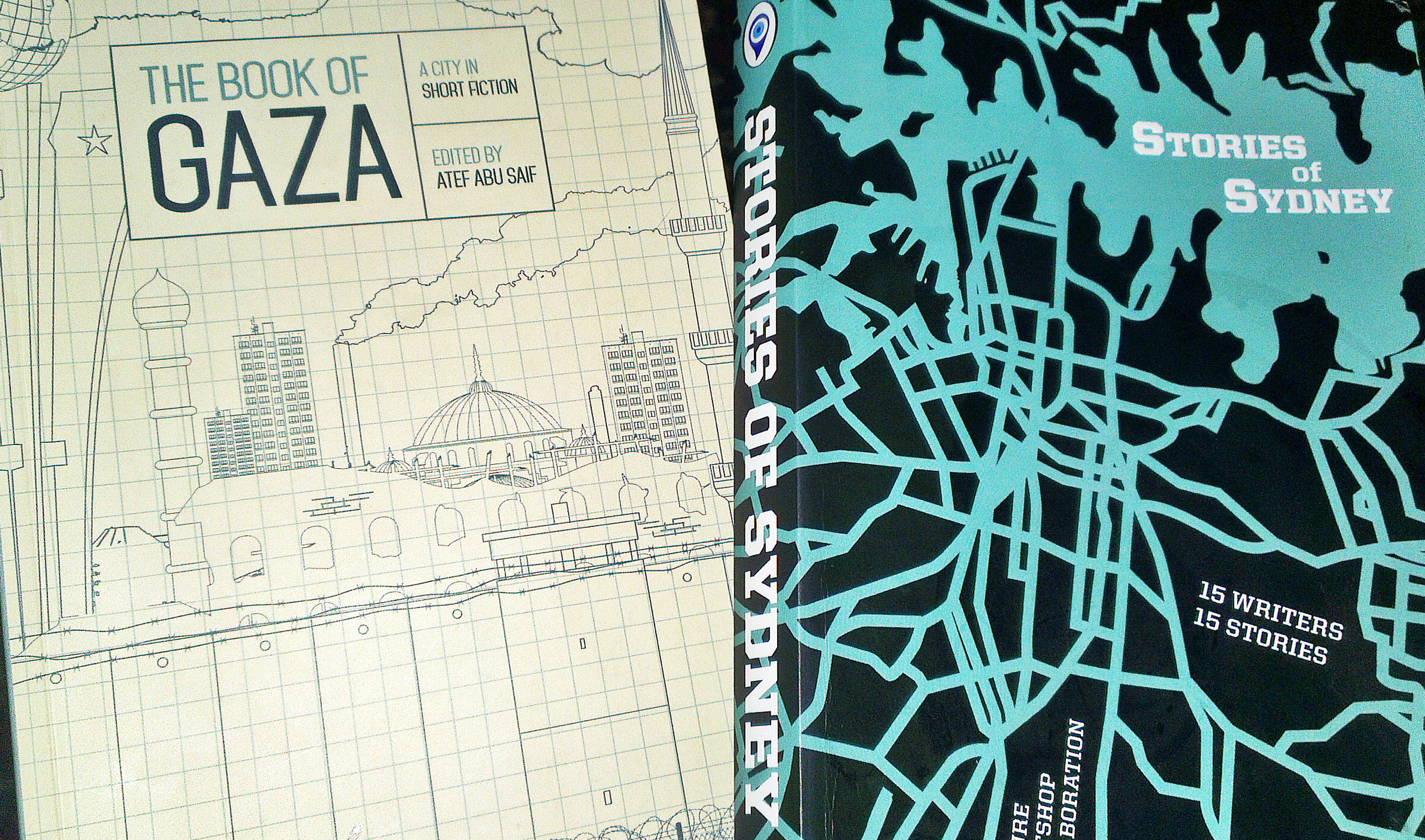
Image Description: Two books.The Book Of Gaza - Front cover is a drawing of Israeli Separation Wall in the foreground and the city of Gaza beyond the wall. Stories of Sydney - Front cover is Sydney harbour and streets in turquoise on black background.
The Book of Gaza
Edited by Atef Abu Saif
Published by Comma Press 2014
128 pages
ISBN 978-1-905583-64-5
£8.75 plus postage from Comma Press

Stories of Sydney
Edited by Michael Mohammed Ahmad, Alice Grundy and David Henley
Published by Seizure and Sweatshop 2014
249 pages
ISBN 978-1-921134-26-5
$19.95 AU Seizure

“Gaza has always had a central place in the literary life of Palestine,” says editor and writer, Atef Abu Saif in his introduction to The Book of Gaza. Important Palestinian literary figures from Gaza extend back to the eighth-century poet, philologist and one of the founders of Islamic jurisprudence, Imam al-Shafii. They include poets like Mu’in Bseiso and Harun Hashim Rasheed both born in the late 1920s, and the novelist and poet, Abdul Karim Sabawi born in 1942. In 1948 the city of Gaza and the surrounding Gaza strip, which has a total area of 360 km², suddenly became home to a large number of Palestinian refugees forced from their houses, villages, towns and cities by an-Nakba. As well as being one of the oldest cities in the world Gaza became one of the most densely populated cities. With Israel’s occupation of the Gaza strip in 1967, most writers left and took refuge in countries like Lebanon, Egypt and Iraq. Abdul Karim Sabawi eventually migrated to Australia. Atef Abu Saif describes how:

Despite restrictions on freedom of expression, the art of the short story attained great popularity during the 1960s, 1970s and 1980s . . . Through the brevity and symbolism of the short story, Gazan writers found a way to overcome printing and publishing restrictions imposed by Israeli occupation forces.

In the 1980s and 90s Gaza gained a reputation as “the exporter of oranges and short stories.”

The Book of Gaza brings together 10 short stories by ten of Palestine’s modern writers. Abdallah Tayeh, Zaki al ‘Ela and Ghareeb Asqalani represent the pioneers of the short story. They describe the long queues of exhausted Palestinian workers waiting to cross into Israel. They write of curfews, prisoners’ suffering, and heroes like Zaki al ‘Ela’s Abu Jaber, who actively resists Israeli oppression. They also write about the determination and solidarity that exists between Palestinian people. Asqalani’s story in this Anthology, “A White Flower for David”, is complex and dense. It is hard work figuring out the characters and their relationships to each other. The narrators change, perspectives shift. A fraught friendship develops between a Palestinian family, which includes three generations, and Esther who is married to David, a Jewish man. Sahimah, The Palestinian mother and grandmother, finds Esther’s name strange. Esther sits cross-legged on the bed. We see her through Mahmoud’s eyes as he addresses David, ” exposing half of her flesh, nearly making my brother, Abdallah pass out. My mother threw her coat over Esther’s nakedness . . . It was Arab shame and fear, something she hadn’t expected, but you were typically Hebrew in kidding me about it.” Esther leaves the family at the end of the day wearing a madjalawi robe, a gift from Sahimah, and a knitted shawl wrapped around her head.

Cultural differences are part of the tension that underscores the relationship between the two families but far more ominous is the fact that despite the human desire to be kind, understanding, to be friends, they are positioned socially, economically, and in the everyday reality of Gaza, as enemies. The story begins with Mahmoud standing “face to face with death” forced to choose between “two deaths: to kill or see your son killed.” He decides to hurl the rock he is clasping in his hand.

Israeli soldiers are ever-present. As Mahmoud walks late at night he sees soldiers ahead of him chasing some young men. “Kicks, blows and batons rained down; aching bones and suppressed moans. The soldiers hammered them, marked every inch of their bodies, ripped out their very identities . . .”  One handsome young man cracks a joke and bursts out laughing until the pain in his jaw becomes too much for him. Mahmoud touches the man’s moist face and curses as the life drains from him. Later, Abdallah is beaten by soldiers as his nephew looks on. He lies on the ground, “a bleeding, crumpled heap . . . his vision clouding over as the sand of the street soaked up his gushing blood. It pooled in a great red patch as the UN truck loomed into view. The soldiers dragged the wounded man into the armoured car and set off . . .”  The men sell their souls seeking a day’s work, trying to scrape a living together, martyrs fall, nerves dangle on a thread. The force of anger churns in the breasts of the young men.

Mahmoud, his wife, Haifa, and son, Husam visit Esther and David’s house. Once inside, Mahmoud watches his son looking out the balcony window. His heart pounds as Husam observes a group of soldiers at a bus stop, saying “If only I had a catapult with me . . .”

The writing is tight and nuanced. The atmosphere is claustrophobic. Somehow a very delicate shard of humanity survives amongst the rubble.

The younger generation of writers in the anthology are more introspective. They write about feelings and desire. They engage with and critique their society. Their stories are less hopeful, sometimes despondent. The space surrounding the characters seems even more restricted. Atef Abu Saif’s story, “A Journey in the Opposite Direction” is about two young men and two young women who were friends in their younger days but haven’t seen each other for ten or more years. They meet by chance in the border city of Rafah. The description is rich. Thin shafts of evening sunlight play across the road. Bananas and dates hang “like lost opportunities” in front of the fruit shop at the corner of the square. Travellers are returning from work or from visiting friends and family in Gaza city. Honda and Mercedes taxis line up. People sit on plastic chairs sipping hot anise tea at a small wooden hut that serves as a café. There is just enough room for the owner to squeeze inside to make the hot drinks on a gas stove beside the fridge, or prepare the nargilah pipe. The journey to Rafah from Gaza city is about 40 kilometres. It is the longest stretch of coast and the lengthiest trip any resident of Gaza can make. Ramzi is in Rafah to meet his brother who has been living overseas for twenty years. But it takes a miracle to get in or out of Gaza.

The four young characters chase after the moon, driving from Rafah back towards Gaza in Ramzi’s small blue car. As they approach the bridge over Wadi Gaza the road gets busier until the traffic grinds to a halt. “The water from the valley had spilled over onto the road and the bridge was impassable.” The four of them stand by the car looking at the scene in disbelief like “scarecrows or ships’ masts” sunk in the harbour.

Gaza is not known for its women writers. Palestine does however have a history of women writers and poets. Although she has been largely left out of literary studies, Samira Azzam, born in Akka in 1926 is considered a pioneer in the development of the Arab and Palestinian short story. In 1948 she fled with her family to Lebanon. By the time of her death in 1967 she had published four collections of short stories including Tiny Matters (1954) and The Great Shadow (1956). Sahar Khalifeh is Palestinian writer, born 1942 in Nablus, who has published many novels depicting the life of Palestinian women.[1]

Five of the ten writers in The Book of Gaza, are women – Mona Abu Sharekh, Najlaa Ataallah, Asmaa al Ghul and Nayrouz Qarmout. Their stories are bold, sensuous, and defiant. All explore gender restrictions in their society. Nayrouz Qarmout’s “The Sea Cloak” is about a family’s trip to the beach. Gaza’s coastline is not clean. Everything is scattered about in disarray. The sand is littered with rubbish and tents dot the beach. “This is just the way Gaza is: a young girl yet to learn the art of elegance. A young girl who has not yet developed her own scent and is still, willingly or not, perfumed by all around her.” The protagonist remembers the point where her family no longer considered her a girl. Her father slapped her across the cheek. Her mother dragged her from the room, yelling, “That’s the last time you’re going out on the streets . . . You’re grown-up now, not a little girl. Go and look at yourself in the mirror. Take your sister’s scarf and wrap your hair in it.”

On the beach she is wearing a long black robe and a headscarf. She walks past a group of young men playing cards, children dying their lips with Slush Puppies, a donkey splashing about in the sea, and a stall selling lupin beans. The scent of cardamom-infused coffee wafts from hot coals, an old man recounts tales of Palestine’s history. She walks, surrounded by her memories, into the ocean. She swims further out, feeling “an excited tingle that was almost too much to bear. Arousal grew inside her . . .”

The Book of Gaza is successful in doing what it sets out to do. That is to present us with “glimpses of life in the Strip that go beyond the global media headlines.” There are stories of anxiety, oppression, violence and self-reflection, of resilience, despair and hope. By translating these stories into English and creating this anthology, Comma Press offers English-speaking readers the opportunity to read Palestinian literature and understand the everyday experiences of the people of Gaza as they struggle to live with dignity in what many have called the largest prison in the world.

Stories of Sydney is an anthology featuring five writers from Inner Sydney and ten writers from Western Sydney. In the Editor Notes at the back of the book, Michael Mohammed Ahmad explains the editors agreed that since Western Sydney’s population outweighs Inner Sydney’s population, the ratio should be reflected in the publication. Ahmad despairs that Western Sydney is misrepresented. “When you watch a movie or read a book on Western Sydney, it’s usually about ethnic crime – our guns, gangs, drugs and sexual assaults.” The anthology claims to celebrate the diversity that exists in Sydney. If diversity means an assortment or a miscellany of stories then there is definitely a mix of identifiable cultural experiences, storytelling traditions, and other language influences on the English language and writing styles within this anthology. Some stories are stronger than others. While the content of the stories vary, it is by and large situated within the context of the humdrum of everyday life.

The protagonist in Peter Polites’ story “More Handsome than a Monkey” furtively tracks his lover, “a wheat-fed kid” with “overdose green eyes and speckled guns.” He follows him on a train trip, catching the:

6.30 am, XPT Central – Orange…The shiny city turned into the inner west. The inner west became suburbia with a middle class name. Suburbia became the outer west. The outer west. The outer west became large streets, backyards with children’s toys and BBQ patios. It slowly became rural.

Polites’ writing style is almost Neo-noir with terse dialogue and a snappy first-person narrative. The observations are realist and generally gritty. A sexual relationship drives the plot. The milieu is low-level drug dealing involving “getters” and “freshies”. The main character works in a sports club where the carpet is “a multi-colour galaxy. Yellow stars, red crescents and green comets on a cyan background.” He is flawed but not deeply. He’s looking for love. His behaviour is borderline self-destructive. When things go wrong for him he finds a “fat Leb” in a matching tracksuit. Does a blowie in the toilets and is given some crystals. He moves back into the family home. It seems he always has a room there.

“The 25th Paragon of Filial Piety” by Amanda Yeo is a collection of finely wrought, slightly tongue-in-cheek snippets of the family, work and social life of a young woman. The Yuan Dynasty scholar, Guo Jujing wrote exemplars of filial piety towards parents, nearly all about the piety of sons. These were assembled into a book called The Twenty-four Paragons of Filial Devotion. Amanda Yeo tells her stories of a daughter’s exemplary conduct, helping her mother prepare kai lan, pouring hot water into an aunty’s mug while the women interrogate her sister about her ang moh boyfriend. In the story “The Curtain Between” Maryam Azam explores the tender beginnings of a relationship between two Muslim students. Tamar Chnorhokian writes about an Armenian-Australian woman who reminisces about her late aunt in “Let Me Look at Your Face”. In “Five Arrivals” Luke Carman’s character is torn away from a conversation with an artist at a party in Concord by a phone call from his cousin growling, “Where the seven fucks have you been dick-nigger?” He gets into his Camry, with its bald tyres and speeds down the highway towards Western Sydney. The road outside his cousin’s house is “streaked with tyre marks from doughies and burnouts leading to stretches of muddied lawn.” PM Newton’s story “Aqua” is superb in its rendering of emotion. The geographical setting encompasses Sydney from Chatswood to Marrickville but focuses on the North Sydney Olympic Swimming Pool with Sydney Harbour Bridge to one side and the leering grin of the Luna park entrance on the other side. It is a story told through the eyes of a daughter, now a mother, of her family’s painful experiences of the war in Vietnam, and the pool’s significance in her life.

In the Editor notes, Alice Grundy and David Henley write:

. . . there remains a divide between ‘inner’ and ‘outer’ Sydney, between the new-formed establishment and writers who live in Western Sydney, or who speak English as a second language, or whose families are migrants, or from an Indigenous background; or a combination of the above.

So what of the pressing question of diversity? It seems that here, diversity is about cultural minorities or “lives you don’t often get to see, from authors as varied as the city itself” becoming more visible, being heard, accessing the centre. In an article she wrote for The Guardian about racism in Australian theatre, Nakkiah Lui interrogates the use of the word ‘diversity’, claiming that “diversity doesn’t challenge whiteness, it bolsters it, because we are never questioning what is at the centre.” Rather than asking, why is there not enough diversity in the arts, she argues people in positions of power should be asking questions like “Why am I in the position I am in? Why do I think I deserve to be here?” She says:

We need to remember that diversity is the means to an end. Diversity isn’t complexity, and ultimately, what we want is not a diverse country but a complex one.  By accepting diversity as an end we are just fooling ourselves into thinking that the playing field is equal.[2]

Rather than critique Stories of Sydney for not including for example, more First Nation writers or writers from African communities or of African heritage, I would ask that publishers and editors look at the processes. When applying for funding for a writing/publishing project, they should think about working to  include leaders and decision makers from diverse communities. It is not a matter of ticking boxes, or token last minute inclusions to make a collection of stories diverse. It is an organic and lengthy process of searching for and inviting existing writing groups from different communities to participate, of acting in solidarity to assist the development of new groups, new writers. It is a process of opening up to varied story telling and literary traditions, different uses of language, of seemingly unusual or irregular and sometimes uncomfortable realities. It is also a process of invigorating Australian short fiction through the reinvention of writing aesthetics and reading values. The publishers of Stories of Sydney Seizure and Sweatshop Western Sydney Literacy Movement, are at least on the right path. The launch of the First Nations Australia Writers’ Network in February, and the Accessible Arts NSW Scribbler Literature Forum held in June this year are also positive moves to achieving this kind of complexity.

The Book of Gaza and Stories of Sydney present us with tales from two very different cities. While generally recognising established short story traditions, both books offer writing that contests dictates of form and style. The stories, especially those from Gaza and Western Sydney, give voice to perspectives that challenge mainstream victim, terrorist, criminal, and superhero stereotypes. Instead of flattening people into one-dimensional images these stories offer the reader a chance to feel and experience the day-to-day life of individuals, brothers, sisters, mothers, fathers, children, lovers, workers, living in Gaza and in Sydney. Much of the writing in these two anthologies is an act of resistance. The writers in Gaza have responded to the latest Israeli onslaught by continuing to write. [3] According to an email from Ra Page, director of Comma Press, “all of the Book of Gaza contributors are writing away like crazy, whilst they have power.” [4]

The writers in both anthologies provide bridges for readers to cross over chasms of misconception, and meet the inhabitants of different communities, neighbourhoods, suburbs, cities and surrounds. This is one way of looking at people we don’t know, to look and actually see, at least partially, the depth and complexity of their humanity.

In reading these stories we also begin to understand our own identities, our privileges and our oppression. We begin to understand our responsibilities as human beings. With Israel’s relentless aerial bombardments, shelling and ground attacks in Gaza over the past two weeks, I believe this understanding is urgent.

1. Sahar Khalifeh’s books include We Are Not Your Slave Girls (1974), Thorns(1975) translated into English by Al-Saqi Books in 1985, Sunflower(1980), Memoirs of an Unrealistic Woman (1986), The Door of the Courtyard (1990) and The Inheritance (1997).

2. Nakkiah Lui, “Is Australian Theatre Racist? The Guardian 12 June, 2014

3. Follow Najlaa Ataallah’s blog

4. Sarah Irving, “Gaza’s writers keep writing under the bombs”, Electronic Intifada, 20 July, 2014 (Eighty percent of households in Gaza currently have only up to four hours power per day)