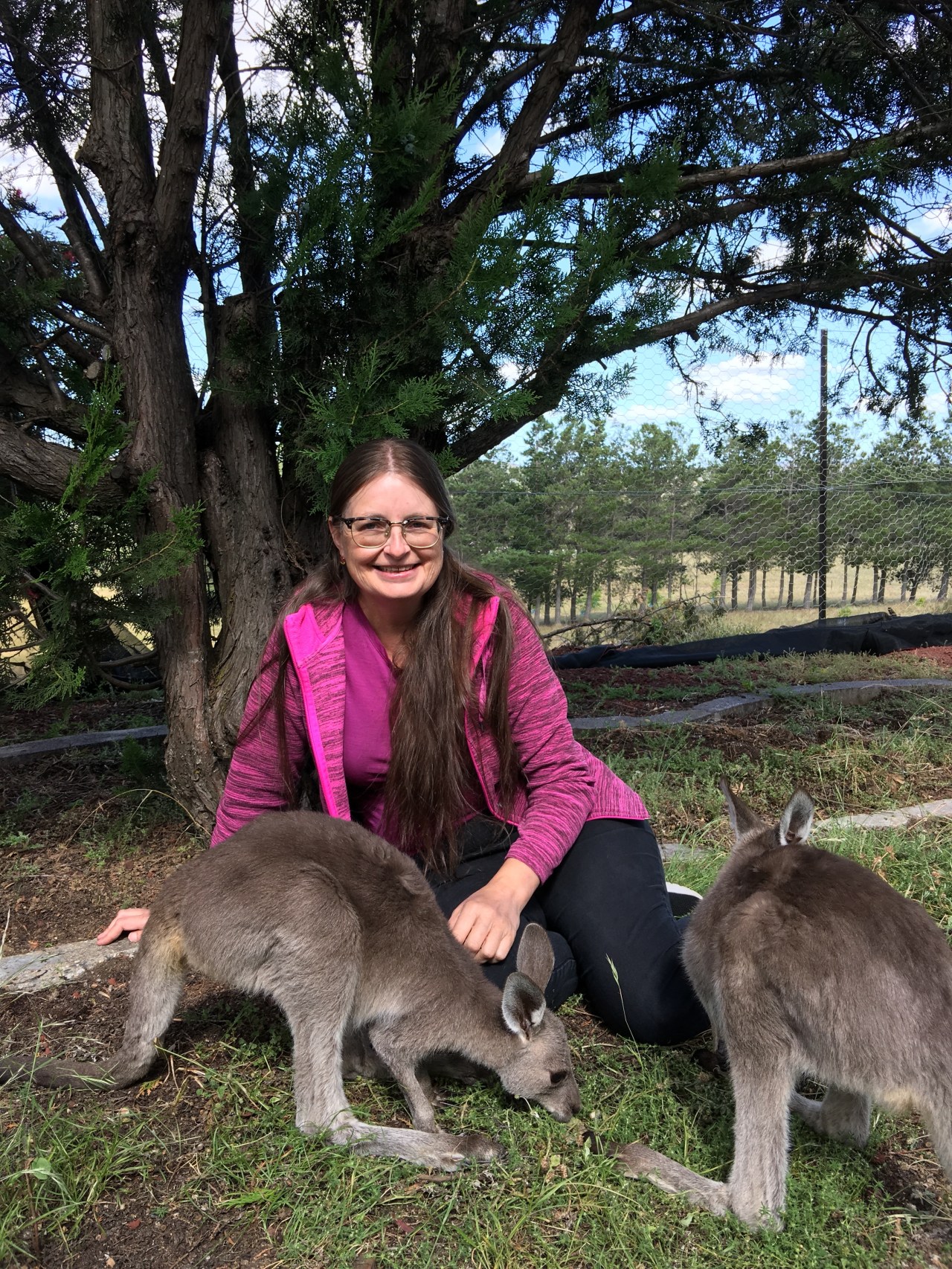
Helen Schloss sitting outside with two Eastern Grey joeys in her care. She is wearing a pink jacket and she is smiling.

An Interview with Helen Schloss

I was gobsmacked by the melted tanks I saw on telly. People lost their homes and there has been a long waiting time for them to receive assistance, especially the wait to get a roof over their heads. I was concerned by the need for water, and I thought, surely if you can build a house out of earthbags, you can make a water tank using the same methods.

Helen Schloss lives on a small property in Bywong, New South Wales, near Canberra. A primary caregiver and dedicated wildlife volunteer, Helen prides herself on her strong work ethic and animal rights principles. Some of her voluntary work includes producing ‘Tuesday Tips’ for Lucky Stars Sanctuary. Her passion drives her to help others help and protect the less fortunate.

This interview is the second of four interviews with volunteers involved in the building of an earthbag water tank at Lucky Stars Sanctuary, Bywong. Vanuatu Earthbag Building assisted in this project. They have provided free plans, support and the materials required to build water tanks for people in need in fire zones in NSW Australia, cyclone zones in Vanuatu and Pacifica.

Gaele Sobott: I believe you were the person who instigated the building of the earthbag tank. What gave you the idea, and how did you go about finding the expertise to commence this project?

Helen Schloss: I already had an understanding of the sustainability and affordability of earthbag building. I was interested in building a second home from earthbags on our property. Then we experienced the bushfires from early December 2019 and January 2020. I was gobsmacked by the melted tanks I saw on telly. People lost their homes and there has been a long waiting time for them to receive assistance, especially the wait to get a roof over their heads. I was concerned by the need for water, and I thought, surely if you can build a house out of earthbags, you can make a water tank using the same methods.  So I put a few words into Google, and one of the first things I found was the Vanuatu Earthbag Facebook page. That was early February this year. I saw a post that Liz Sherborne had written saying they had been using earthbag-building methods in Vanuatu. She noted that earthbag water tanks would be a valuable resource in fire-prone areas of Australia.  Helpful in protecting people’s properties, their lives and the lives of animals. I wrote a comment asking if they would be interested in doing a workshop down our way at some point. She instantly messaged me, and the project evolved from there. Liz said that if we could find ten people to assist with the building, they would come to Bywong. In some ways, it was serendipity.

GS: You found ten people and provided food for everybody, anything else?

HS: Yes, so I rounded up the volunteers to do the work. Initially, we were going to start building around early March, but then COVID hit, and the restrictions meant people couldn’t travel from Sydney or gather together. We had to postpone it, which meant I had to keep those volunteers interested throughout that time, sending them links and chatting with them online. 

GS: What previous organisational and networking experience do you have in gathering people together for projects like this one? Not everyone would know the importance of keeping that group of volunteers interested.

HS: I have some past experience. My family and I were in Papua New Guinea for a while, and I did fundraising events for various organisations. Maybe through the trial and error of that process, I learned that if you don’t keep your communication going, not everyone, but some people will lose interest. I’m pretty sure now, knowing this crew, if I had put them on hold and not had any contact with them, it probably wouldn’t have mattered. Most of them have got properties. Potentially they could use the earthbag building skills on their properties and help neighbours and their communities. But I believe in communication. I’m not fantastic with my friends and family. But when organising events for the animal sanctuary or for people in Papua New Guinea; the hospital there, I feel there’s a lot at stake. Last summer, it was scary because the bushfires were near Lucky Stars Sanctuary at Tallaganda forest and there were various other spot fires around the place. It was really worrying and very stressful for Kerrie and Yee, the founders of the Sanctuary. I think the contingency plan was if a bushfire reached them, they were going to stay and defend. It would be next to impossible to evacuate three hundred animals. That was one of the reasons I felt an affordable, fireproof water tank was necessary. The tank is fitted with a STORZ outlet so fire trucks can connect to it.
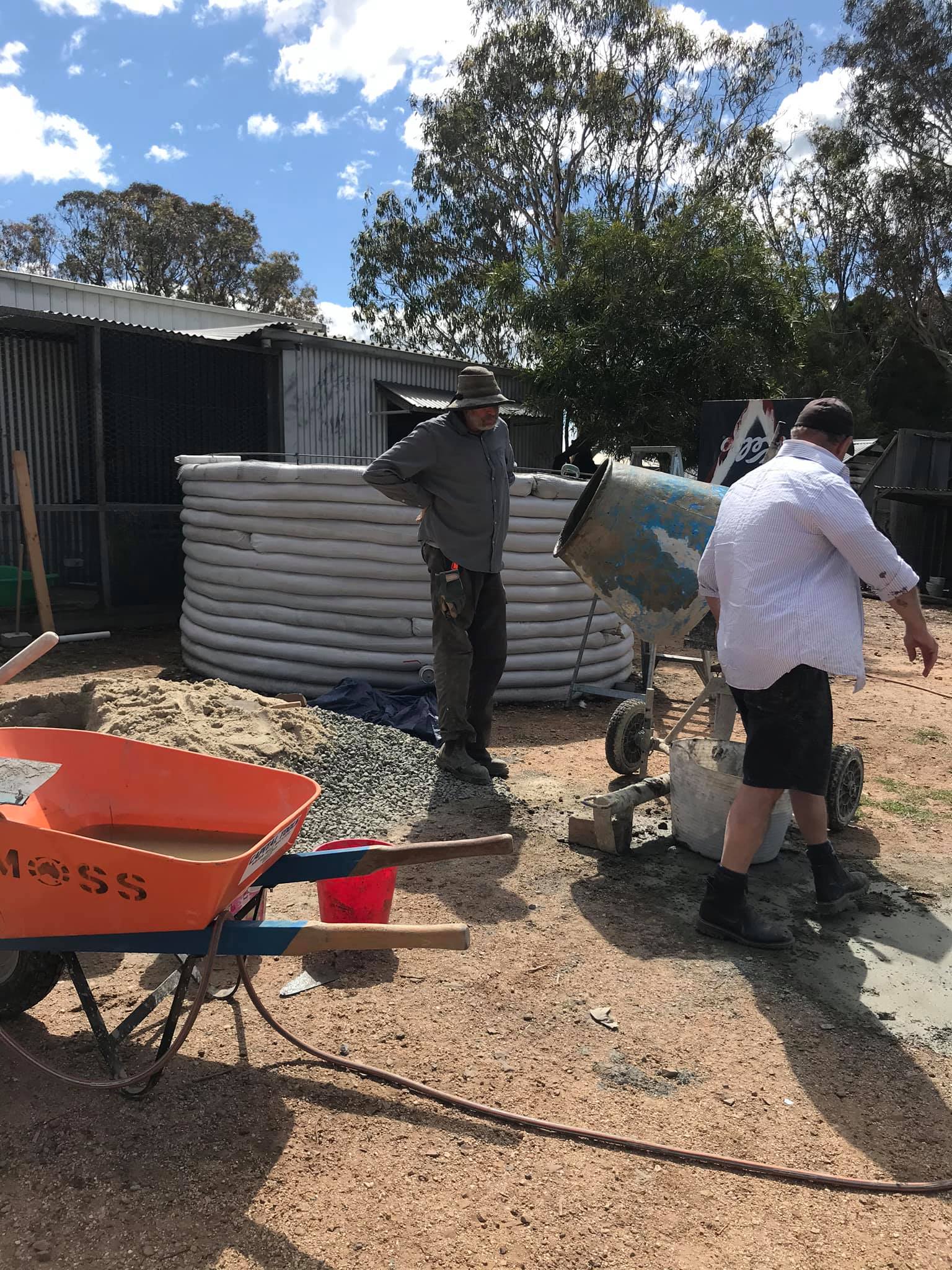
Some volunteers building the earthbag tank.

GS: How did you first get involved with the Sanctuary?

HS: In 2017, a year after they opened, I was looking for something to help my daughter, who has been unwell for some time now. She loves animals; in fact, she probably loves them more than most humans. I was looking around for animal sanctuaries and found Lucky Stars on the Internet. We live not too far from the Sanctuary, so I contacted Kerrie and asked her if she would mind if my daughter came over. I remember Kerrie saying, ‘You know it’s not just animals we look after, we look after humans as well.’ My daughter is thrilled working there and now Kerrie and I feel like we’ve known each other a lifetime.

GS: Many people who experienced the bushfires complain that they are still waiting for assistance that was promised by the federal government. I know finding funding for the Sanctuary has been a battle. How do you think a project like building this earthbag tank helps in this regard?

HS: It definitely helps. Earlier in the year, Liz was saying that they like to teach communities the skills involved in the building so that those people can pay it forward. Hopefully, one or two people from each tank-building project can do that. It is one way of getting through this deficit of government funding and developing ways to protect ourselves in the future, especially with sanctuaries. It’s really frustrating that animal sanctuaries don’t get government help, like drought assistance. That’s one way the tank building helps, and I think, also, it helps by promoting awareness. We now have an extra eight or ten people who are aware of Lucky Stars Sanctuary. Hopefully, not only do they know the Sanctuary is here, but they know that we need help from time to time. They also have increased awareness about animals, animal rights, and how tough it is for the animals, especially during bushfire season. Workshops like the tank building initiative serve to increase awareness through social media and word of mouth. More people might contribute to helping financially or by giving Lucky Stars a hand.

GS: Many community projects are continually battling time and funding constraints. People have little time to theorise about what they do, how they do it and where they are heading. How do you think we can solve that problem? How do we begin gathering the data needed to understand our impact and the choices we need to make in the future? 

HS: Hmmm, that’s a really good question. Time and money are always going to be an issue. There are various organisations and government departments that collect data, for example, the Australian Charities and Not-for-profit Commission and the Australian Bureau of Statistics. But whether it’s accessible to charities and communities … I don’t know. A tool that’s simple, affordable and standardised across the sector, could be the answer, like a smartphone app. The majority of people have smartphones now, although not everyone likes mobile apps, I guess they suck up valuable space on their phones. So maybe a website app that has the same functionality as smartphone apps. All the relevant data can be just a fingertip away, no painful paperwork and time saved as a result.

Lucky Stars Sanctuary could gather data such as volunteer info, animal health, fundraising, infrastructure problems or improvements, seasonal conditions. Even information, including photos of soil degradation would be useful for analysis, reporting, planning and decision making. It needs to be well designed, intuitive and easy to use, of course. All the data is there, no more hunting for it down the track. More time saved! Tick!

There’s an app called Farm Tracker, developed by the Department of Primary Industries. It helps farmers collect similar data, including geotagged photo diaries to monitor seasons and dam levels. Some of this information isn’t made public. Perhaps this could be retrofitted to suit charity or community-based work. Then you have the question, who’s going to commission and pay for it? Maybe the Australian Charities and Not-for-profit Commission is a place to start.

Interview conducted with Helen Schloss at Lucky Stars Sanctuary by Gaele Sobott, 11 October 2020.

Links:

Interview 1 in the series: Kerrie Carroll
Interview 3 in the series: Liz Sherborne

Interview 4 in the series: Scotty Foster

ENLIGHTENING THE GATEKEEPERS… some thoughts on the Scribbler Literature Forum

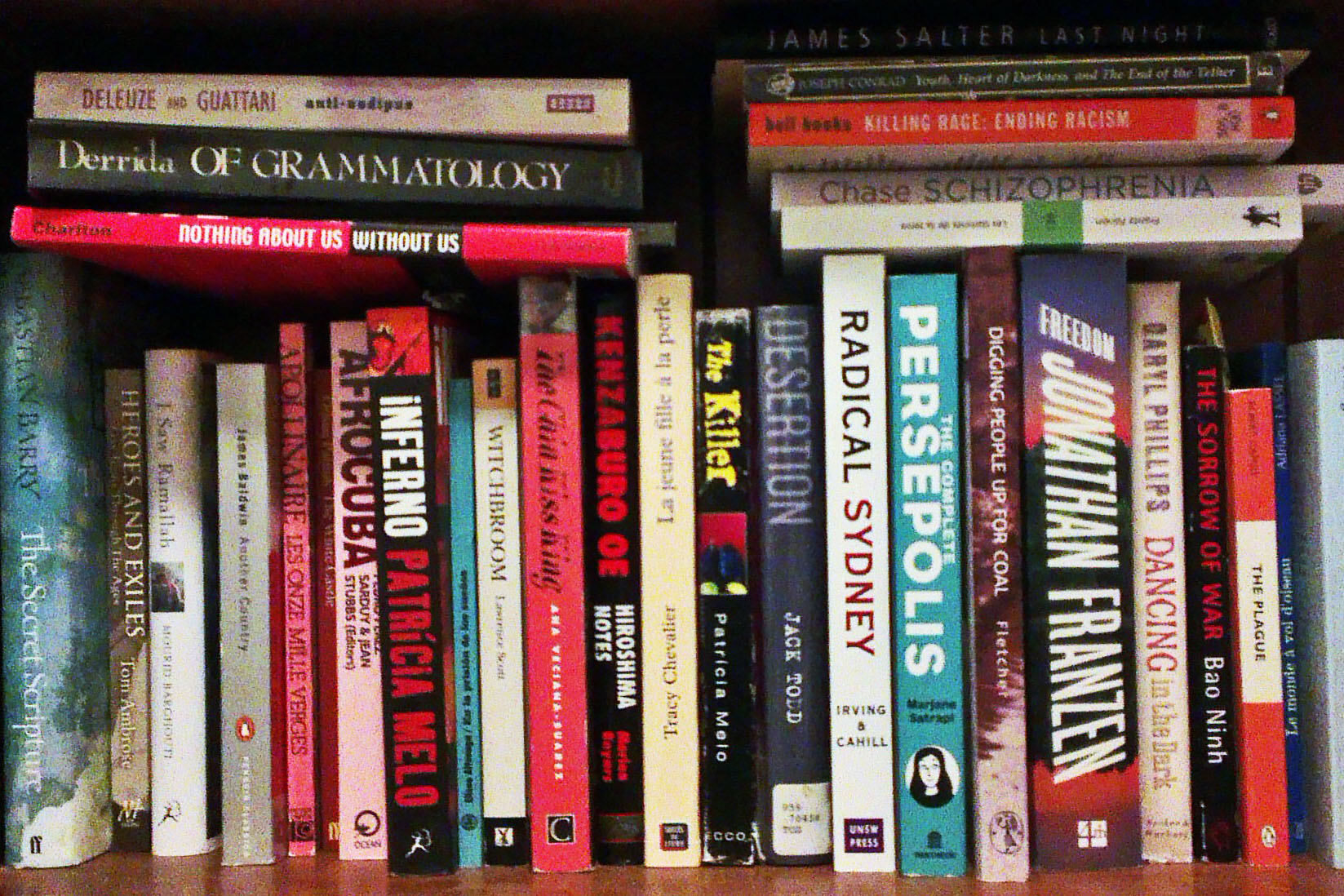
Image Description: Books on a bookshelf. Titles include Persepolis, Of Grammatology, Radical Sydney, AfroCuba


One of the more well-known slogans of the disability rights movement is “Nothing About Us Without Us” – the recent closure of ABC’s “Ramp Up” accentuates the fact that there are very few of “US” in the Australian media, literature and writing sector.

For many years, South Australia was the only state to run a program, through the SA Writers’ Centre, for writers with disability. In 2012 Arts Access Victoria and Writers Victoria took up the baton by launching the Write-ability project, supporting Victorian writers with disability to develop their skills and writing careers. At the 2014 Emerging Writers Festival in Melbourne, Write-ability proudly showcased six of its emerging writers.

Accessible Arts NSW began the process of addressing the barriers faced by writers with disability in NSW by organising the SCRIBBLER – Literature Forum at the NSW State Library, on 24th June this year. I was pleased to be invited to convene this event. Writers with disability gathered together with industry professionals to hold critical conversations around what we see as key concerns. Examples of these concerns are leadership opportunities in the sector, inclusion in festivals and on writing platforms, and changing the culture surrounding disability in the arts.

The keynote speaker at the Forum, Writer and Editor, Gayle Kennedy described in detail some of the access barriers she has faced as an award-winning writer who uses a wheelchair. One example she quoted was organisers refusing to pay her carer’s airfare, which meant Gayle was prevented from attending major events:

[As a] David Unaipon Award winner ‑ I did not get to go to any other  writers’ festivals. Year in and out every award winner is invited to the  festivals. But I didn’t. I didn’t get to go to Melbourne. I didn’t get to  go to Adelaide. I didn’t get to go to Perth.

The presenters on the “Writing the Boundaries” panel gave specific examples of the discrimination that effectively nullifies or hinders equal opportunity within their chosen occupation of writing. The experiences are complex and varied. Georgia Cranko, a writer and performing artist talked about privilege and oppression in her life, “…I am often marginalised in situations, but I have been fortunate to be equipped with tools that allow me to push through that oppression and neither be crippled by it nor defined by it. My intellect has always been doubted by strangers.” She feels lucky that she can prove her capability through her academic work and writing, not only to others but also to herself. She related how the physical manifestation of her impairment sometimes offers her privilege in comparison to people whose impairment is invisible but “It also underscores the social issues that I deal with. If employers were willing to hire someone like me, I wouldn’t need to rely on the government for the pension or be terrified that it will be cut…”

Amanda Yeo, a writer from Sweatshop Western Sydney Literacy Movement, refuses to be defined by her impairment, and does not accept the limiting inspirational, tragic or superpower tropes that are used to characterise people with disability in the media and literature. She has found writing to be an excellent way to explore her identity and learn to be comfortable in her own skin. She said,

I’m not saying we should write about people who find their disability a constant factor or concern, and I’m not saying we should only write about people with disability…I’m not saying we have to write about people with disability all the time; I’m just saying write about people.

In describing our embodied experiences of trying to work within a disabling world, the writers rejected posturing on disability by writers without disability. Historically people with disability have been the objects of research, not the researchers. We have not been seen as writers but have been written about and acted upon. The obvious way to change this is for writers with disability to write about disability themselves.

Gayle Kennedy called for affirmative action in relation to creating disability leadership opportunities, and dedicated disability access and arts funding. Affirmative action is a concept that is shied away from when discussing solutions to disabling experiences of discrimination in the arts. It is possibly the idea of quotas and succession plans that scare organisations. I think there should be a focus in Australia at this time on meaningful employment targets for artists, arts managers, arts organisers and arts workers with disability. I think we should also be focusing on effective leadership succession plans for people with disability in arts organisations, especially arts and disability organisations. But I would also emphasise that affirmative actions include training programs, outreach efforts, and many other positive steps. Jane McCredie, Executive Director of the NSW Writers’ Centre suggested that writing and literature organisations should include an access component in their budgets. I would love to see the creation of a national literary prize for writers with disability. Some publishers are beginning to actively seek out manuscripts by writers with disability. Every small step is a welcome contribution to shifting attitudes, and to creating a critical mass of people with disability in key positions in literature organisations, performing on literature festival platforms, and publishing their work.

To bring about change to the disabling aspects of our industry, I think we also need to develop a more precise understanding of how gatekeepers determine who becomes literate, who learns to write, who gets funded, what the funding criteria are, who publishes, who gets publicised, promoted, invited to read. The gatekeepers are in the media, in schools, community centres and arts organisations. They are publishers, festival directors, book reviewers and event organisers. Gatekeepers may also include parents, carers and community capacity officers. They are the people who decide. They are the people who assist in forming understandings of disability, the value and often the content of our work. They form the dominant norms of the system we live in. Gatekeeping can be subtle or blatant. We hear story after story of young people with disability being told by a parent or a teacher that they can never be a writer. Many publishers are known to prefer promoting an author who fits snugly into the narrow physical realm of normalised beauty. Festival organisers prefer a writer who can travel freely without extra accessibility costs rather than a wheelchair user. By understanding how gatekeeping works we are in a better position to design affirmative actions. In terms of creating leadership that will bring about change it is already clear that writers and arts workers with disability need to access positions of power. These include positions such as publishing editor, publicist, festival director and policy maker. We need to be on the employment interview and funding assessment panel, and the board of arts organisations.

Although I’m not sure how literature as an art form fares, the Australia Council for the Arts is leading the field at the moment in providing dedicated funding for artists with disability and a focus on leadership and disability. The Council sponsored the UK based artist and disability activist, Jo Verrant’s recent talks on the transformational potential of employing disabled people in leadership roles within the cultural sector – not just for those individuals themselves, but for the invigoration of cultural strategy, and for the benefit of all. By including writers with disability we are opening up literature to diverse perspectives, writing that stretches beyond the boundaries of traditional literary form, writing that defies genre, and the way we receive and understand normalised bodies and language. Joanna Agius, a writer and Deaf Arts Officer at AARTS NSW argued the case for writing in AUSLAN and creating AUSLAN books, which brings a whole new dimension to the category of “literature”.

I recognise that discrimination is not always intentional. It can come about through fear and ignorance. In this respect writers with disability are crucial to shifting the culture that surrounds disability in the arts and in society in general. The power of literature lies in its ability to gradually shift perception, consciousness and then reality. To paraphrase the Belgian-Egyptian writer, Khaled Diab, the culture of power can at least be rattled by the power of culture.

There is a lot to be done. Many possibilities emerged from the Forum, including more genre specific discussions, regional forums, writer-with disability-led initiatives, the creation of writing resources for writers with disability, exploration and replication of the S.A. and Victorian mentoring programs, advocate/agents who approach publishers on behalf of writers with complex communication requirements, the development of diversity action plans. Many writers at the Forum commented on Executive Director of the Australian Society of Authors, Angelo Loukakis’, reference to the Women’s Liberation Movement of the 60s and 70s when “sisters were doing it for themselves”. There is a move amongst writers with disability to create their own writing groups, their own networks and their own performance and publication platforms. While writers with disability would like to find ways of sustaining these initiatives themselves, there is also a desire to agitate for taxpayers’ money to be distributed more justly across the arts.

It is essential for writers with disability, our allies in the sector, Accessible Arts NSW and industry professionals to follow up on the ideas and the momentum created by the Scribbler forum.

Sam Twyford-Moore, the director of the Emerging Writers Festival finished his presentation at the Scribbler Forum with a quote, “Festival directors are gatekeepers, but most enlightened gatekeepers take on the role because they relish opening the gates, not because they like slamming them shut. Most responsible festival directors are acutely aware of accessibility and diversity issues, and are driven by a desire to transcend those limitations, not to cement them.”

For the benefit of literature, the arts and society in general, let us now enlighten the gatekeepers. More importantly let “US” too become enlightened gatekeepers, attuned to the specific manner disability discrimination operates in the industry, and also to the form, content and location of discrimination against writers and arts workers who belong to other sections of society.

Links to organisations mentioned in this blog:

Accessible Arts NSW

Arts Access Victoria

Australia Council for the Arts

Australian Society of Authors

Emerging Writers’ Festival

NSW Writers’ Centre

SA Writers’ Centre

Sweatshop Western Sydney Literacy Movement

Writers Victoria