An interview with Liz Sherborne

Our climate is becoming more unpredictable and we need options. We need the autonomy of knowing how to put solutions in place ourselves. Knowing how to defend ourselves. Knowing how to protect ourselves. Knowing how to take care of our families, neighbours and communities.

Liz Sherborne is director of NeckTek, a designer and restorer. She and her husband Alex introduced earthbag building to Vanuatu in 2013. They founded Vanuatu Earthbag Building; an eco-building group that links volunteers and schools to water-tank projects in the pacific.

This interview is the third of four interviews with volunteers involved in the building of an earthbag water tank at Lucky Stars Sanctuary, Bywong. Vanuatu Earthbag Building assisted in this project. They have provided free plans, support and the materials required to build water tanks for people in need in fire zones in NSW Australia, cyclone zones in Vanuatu and Pacifica.

Gaele Sobott: You have assisted people to build tanks in Vanuatu and have just completed two tanks in Australia. How did you reach the point where you decided to help people build earthbag water tanks?

Liz Sherborne: Well, both Alex, my husband, and I have been volunteering and giving to charity all our lives. We were doing that long before we met each other. Over the years, we became disillusioned with charities and the waste of resources on CEO wages and marketing costs. We thought that there must be a better way to fulfil our moral obligations to society, and we decided to do our own volunteer work.

GS: What does moral obligation mean for you?

LS: I believe very strongly that service to others is the rent we pay for our room here on earth. Muhammad Ali said that. Gandhi is reported to have said,” The difference between what we do and what we are capable of doing, would suffice to solve most of the world’s problems.” I think the idea is very old. We use the earth’s resources. We are part of a community. Those of us who find ourselves on the better end of that deal have an obligation to help those in need. One of the events that spurred us on was when our government cut the Australian aid budget to the Pacific. The idea that we weren’t going to help our neighbours but that we were going to pollute the air and accelerate climate change was not acceptable. We thought, well, we can’t physically go and make our politicians make the right decisions. We can’t force a politician to pay attention to climate justice or what’s happening to the poorest people in our world. But we can contribute to helping our neighbours survive. We began by researching a lot of family volunteer holidays and discovered that most of them have middlemen that take most of the money that is raised. The money doesn’t actually end up with the people who need it for projects. So, we thought, well it can’t be that difficult to go to a country that may want volunteer assistance, make friends, listen to what it is that they need and help them.

GS: How do you finance your volunteer operation?

LS: We started just using our personal savings. Over the years, friends and family have sponsored tank materials, a couple of businesses that we work with and the Corrilee foundation have paid for materials. We are not a charity and we don’t take donations but if someone wants to come along and help or pitch in on the costs on the concrete or the bagging, then we happily accept.

GS: How did you come to the decision to proceed with earthbag building?

LS: First, we travelled to Vanuatu. Once we started getting to know people and listening to their problems, it became evident that they wanted a roadside market. The women we met didn’t have a safe place where they could sell their yams and their woven mats and their local produce. So the focus became providing them with a safe place to sell their goods. We then researched different methods that would be suited to tropical climates. Port Vila is one of the most disaster-prone capital cities in the world. So any structure you build will be hit by a cyclone, volcanic eruption, earthquake or tsunami within several months of building it. So we had to look for something that would survive all of that and we discovered earthbag building.

GS: How did you develop the knowledge and skills to start building?

LS: We corresponded with people overseas who had done this type of building and we learned by doing it. We just did it. The first tank was an experiment to see if it worked and it did.

GS: What were the problems you encountered? What were the successes?

LS: The problems in Vanuatu weren’t with the building process. The problems were more about negotiating land leases, the right to use land. Negotiating the rights of women to participate in the project and the ownership of the building. Project money disappearing. The problems were more culture-based than engineering problems. One of the more surprising successes was that a tank seemed to result in more girls going to school because they didn’t have to fetch water.

GS: Would you mind explaining how the idea for the project came from the community?

LS: One question I get asked by missionaries and charities is, how do you know you are helping the right people? I always find that a funny question, who are the right people? I see charities over there providing plastic water tanks to communities. They don’t follow up with what happens afterwards. They don’t train members of the community to maintain the tank. They don’t have friends in the community. They just deliver the tank, bring in a water truck, fill up the tank then leave. Sometimes the tank ends up rolled away to someone else’s house and a lock put on it so the community can’t use it. Other tanks are built attached to churches and only the church members who pay their tithe can use it. They are not really community assets. We build a water tank with any woman who asks for one and has organised enough helpers. So far, they have all maintained them really well.

We were lucky to meet a builder from Tanna called Philemon, who was essential to the project. The design of the tank needed to be appropriate to the island. Philemon’s input was imperative for that. We also paid a woman called Rachel, who went out to all the islands and started building tanks. There was no way we could have introduced the tanks to custom islands and remote islands without Rachel. We work with the local people, teach them how to build their own tanks and leave them with enough material to build one for themselves.
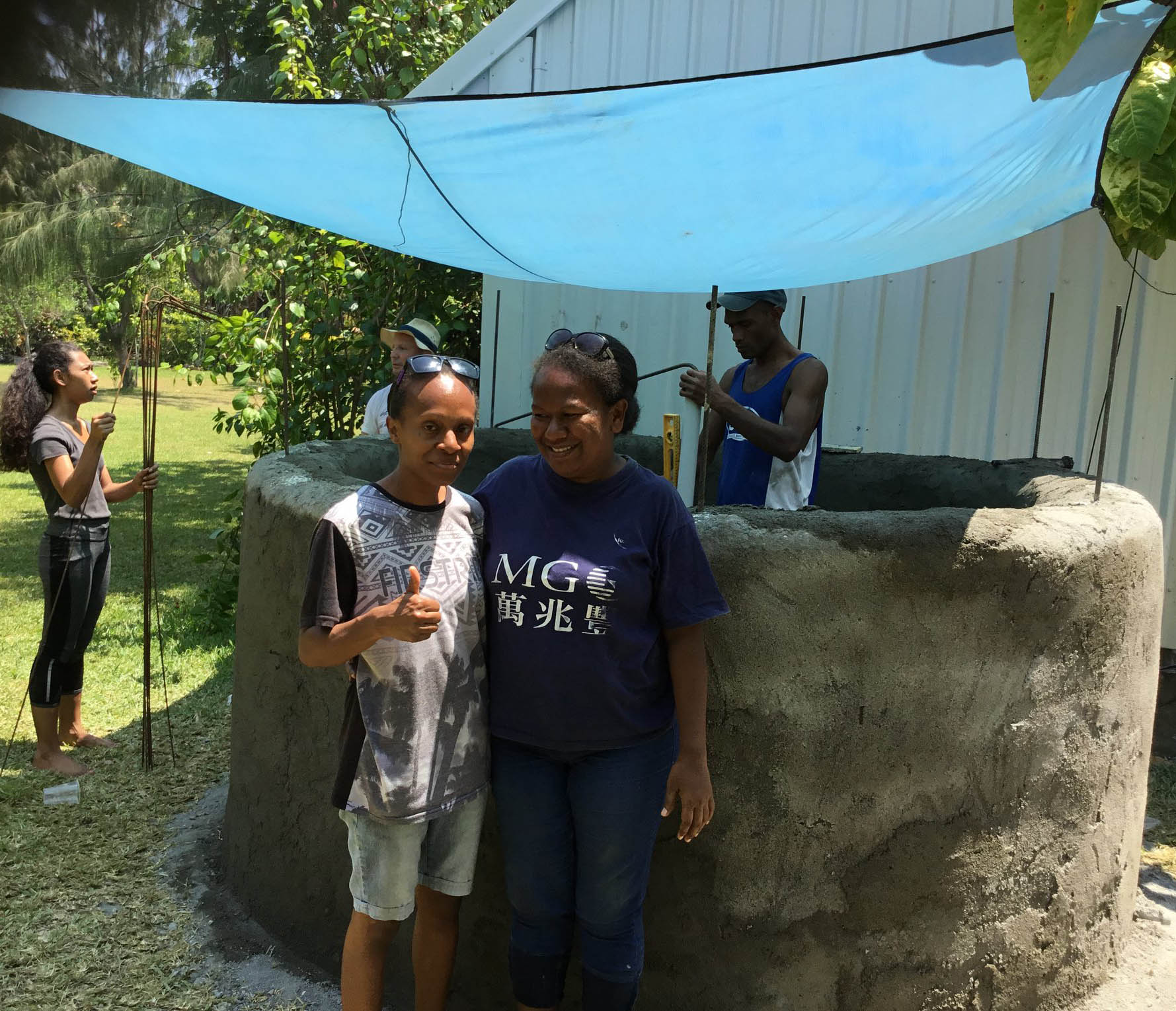
Volunteers from Pentecost Island, Vanuatu

GS: How long have you been building the tanks?

LS: We built the women’s roundhouse in March 2013. The first water tank was built in January 2014. Since then we’ve seen more than 60 water tanks built. Some by Rachel, some by the Save The Children volunteers Rachel trained, some by St Augustine’s school, some by the Laurien Novalis Steiner school. We organised building holidays for some families who built tanks and a significant number were built by our friends and us.

GS: What would you like to happen in the future with the earthbag-building initiatives?

LS: I would love for this to be adopted in developing communities, especially coastal Pacific communities. At the moment versions of our tanks are being built in 8 countries on three continents. I just send the plans to anyone who asks.

I never thought we would need to build them in Australia but I found the bushfires towards the end of 2019 and early this year completely paralysing. The very air we were breathing was people’s homes burning, their farms, our forests and wildlife, burnt koalas. It was horrifying. We were breathing that air in Sydney. Alex and I were talking about it and we realised that the one thing we had to offer was the building of fireproof water tanks. We can teach people how to build their own earthbag structures in the fire zones. Then Helen Schloss contacted us about building a tank for the Lucky Stars Sanctuary. We thought, well building a tank for an animal sanctuary is different for us. We had been more focused on building structures that would benefit women, especially mothers. But Helen had organised people to do the work and they all wanted to learn. So we said, yes. COVID delayed the project but we finally got there. We were really amazed at how well run the Sanctuary was and the fantastic group of local people, and people from all over the place, who support the work that Kerrie Carroll does. We discovered that humans are definitely on the list of mammals that get sheltered there. It was the most fun we have had building in years.

In regards to the future, what I would really like to see happen is we vote for a government that acknowledges that climate change exists and addresses the emergency. Then we wouldn’t need to use our weekends doing this work. Failing that, I think it’s like barn-raising where you work in groups and help your neighbour. Building a water tank is really hard, dirty work but it can be fun. It takes four and a half days for a group of eight to ten people to finish a large fire reserve tank. The Lucky Star Sanctuary got a wonderful group of people together. But I don’t know if this form of tank building will take off in Australia.
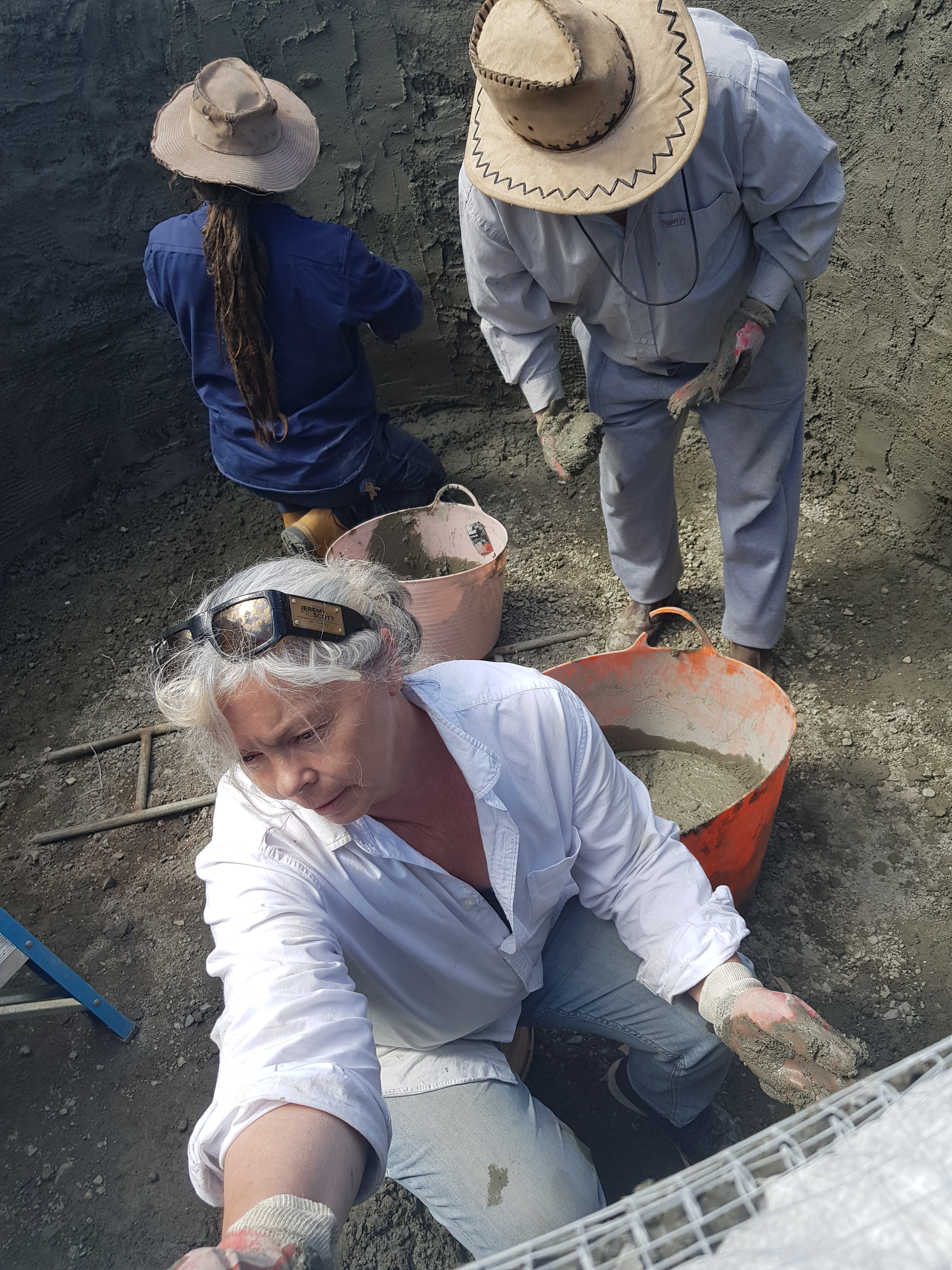
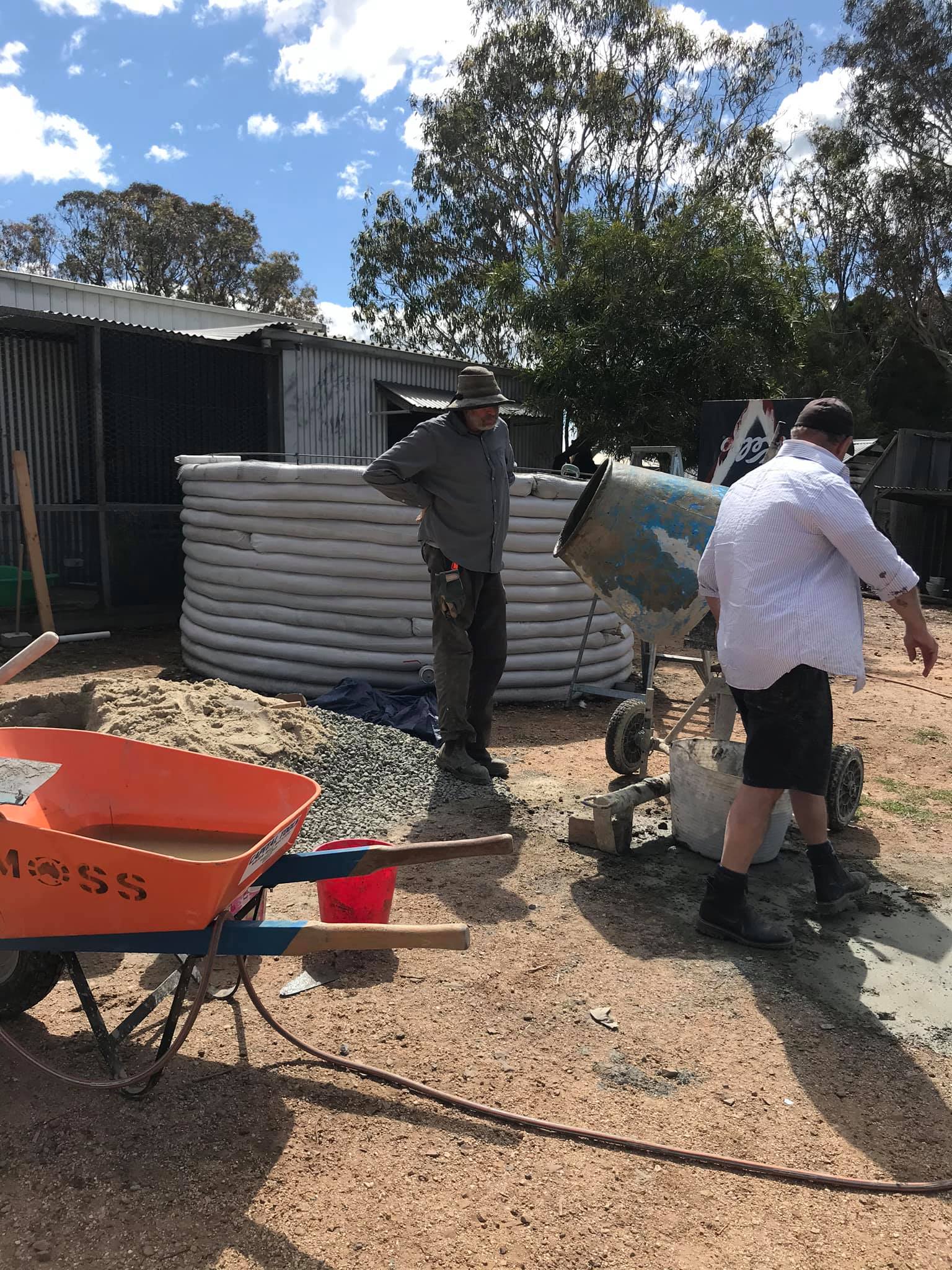
Volunteers working on the water tank

The two tanks we built in NSW posed some problems. In Vanuatu, we worked with sand which was full of salt and the fill we used for our earthbag tubing was crushed coral. You’re not meant to put salt with concrete because it creates a chemical reaction. But it works in the tropics because the crystals from the chemical reaction inside the concrete seal off the capillaries and seal the tank. In Australia, we are not working that way. We can’t rely on the passage of time to seal our tanks and we can’t afford any seepage. We need to keep them drum tight. On the tank at Lucky Stars Sanctuary, we used road base and packed it so tight that it was holding water before we put the ferrocement on. We’ve adjusted the plans quite a bit to suit firefighting. After talking to the Rural Fire Service (RFS), we now fit a STORZ valve so they can connect their fire trucks and quickly refill their water. We had to re-engineer the entire tank design to suit the new conditions. We may refine the design even further according to the different contexts and situations we find when we build.

GS: I believe you are researching more about waterproofing the Australian tanks.

LS: Yes, we just found a fantastic local company that sells a flexible cement membrane that will keep the tank from seeping. This means we don’t have to rely on crystallisation.

GS: Would you describe briefly how the tanks are built.
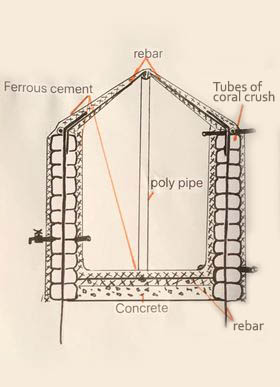
Cross-section diagram of a tank

LS: We buy polypropylene tubing from Bundaberg Bag Co. It comes in long rolls. The last lot we cut into twelve-meter lengths. We fill that tubing with either earth which we then compact or with road base. Row by row as we build up and compact the fill down. We basically end up with a lot of rings on top of each other that look like flattened sausages. The tank at Lucky Stars Sanctuary required eight tons of road base just in the formwork. The entire tank needed eleven-and-a-half tons of material. We use ferrocement as the inner lining, then we put wire and cement down. We use the UNHCR recommendation of a two to one sand-to-cement mix on the inner lining. We work the concrete to reduce the capillaries and reduce leakage. On the outside of the tank, we again use a ferrocement coating. The idea is that you then basically have two structures which are helpful if you get a weather event like Cyclone Pam. If a coconut hits the structure at 260 kilometres an hour, it might smash the outer ferrocement wall. But the internal tank remains intact and this is why they survive, earthquakes, cyclones and fire. The inner tank is protected from natural disaster.

GS: Where has it been tested in a fire situation?

LS: Well, we had no idea about fire until several of our tanks were built on Ambae Island by Rachel. Soon after that, everyone was evacuated because of volcanic eruptions. Those tanks experienced eighteen months of volcanic hot ashfall. When the residents went back to the island, they found that all the fibreglass and plastic tanks had melted. Many houses had been turned to ash and the only tanks standing were the ferrocement tanks and our tanks. The ferrocement tanks were upright but not holding water anymore. Our tanks still worked because only the external wall had been touched.

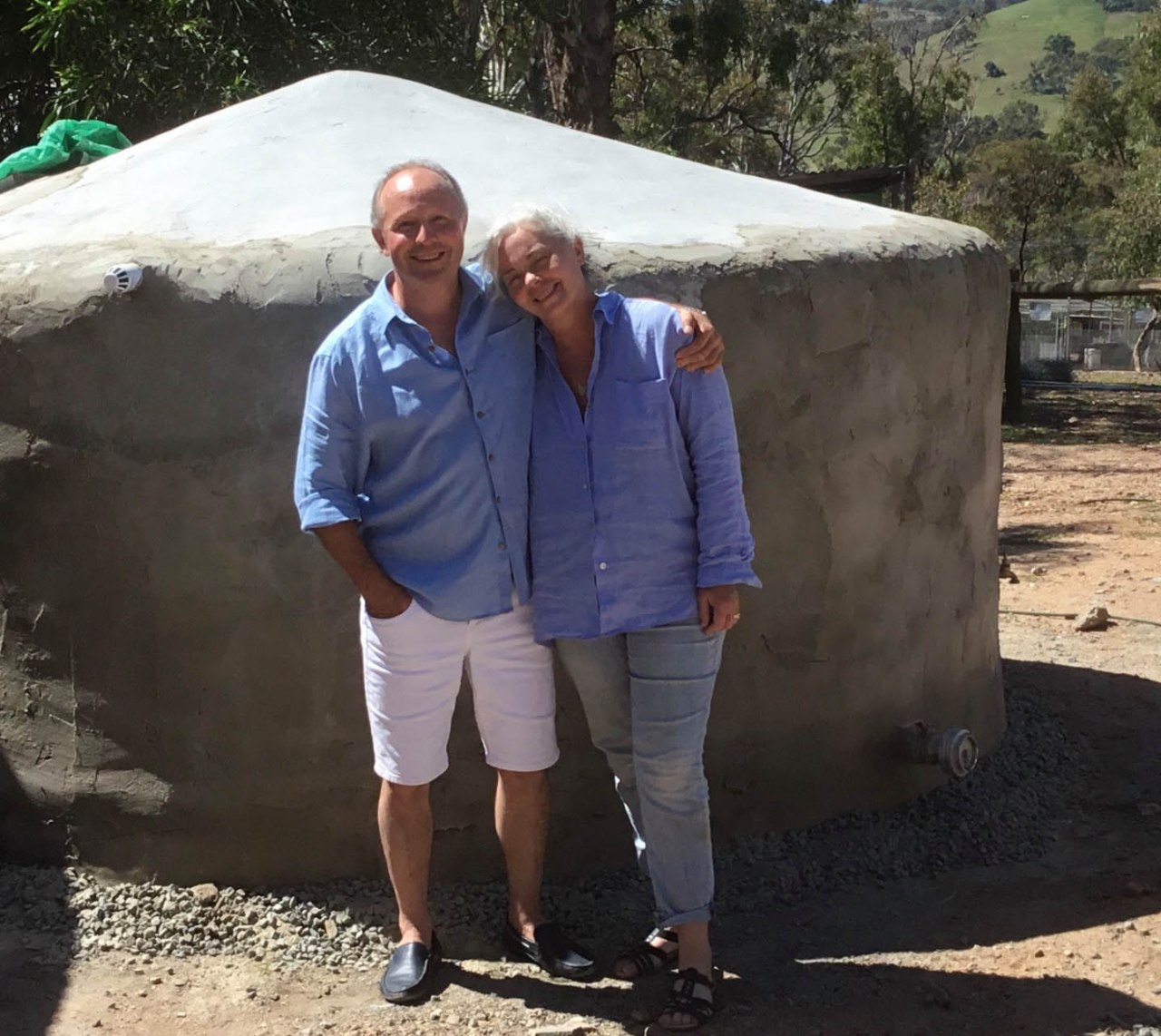
We build a cone on the top to complete the tank. The reason we create a cone rather than a flat roof is to reduce the amoeba content in the water. You don’t want your water evaporating up to the tank ceiling and sitting there getting mouldy. By building the cone-shaped roof on the tank, it means the droplets run back into the water rather than stick to the roof and breeding bugs. In the tropics we line it with cement, here we now use an extra layer of flexible cement membrane. After that, we cement render the entire outside of the tank, for added strength and so there is no UV damage to the bagging. Sometimes we raise tanks up by building them on a base. In the case of the Lucky Stars Sanctuary, the ground was hard. So we compressed road base for the tank to sit on. I don’t think we’ve ever built two tanks the same way. When we completed the last tank, we asked someone from the RFS to check it out for us.

GS: How much does it cost to build one of the tanks?

LS: If you buy at suburban retail prices and have all your materials delivered. If you use compressed road base and if you use all the fancy fittings we used on the latest tank it costs $1610.00. That’s for a W12000 litre tank. In the islands, we can build one for less than $600

GS: How much would a plastic or ferrocement tank cost?

LS: A plastic tank would cost over $2000.00 and I think a ferrocement tank delivered is between around $10000.00 to $15000.00.

GS: What would you like to say to finish up this interview?

LS: This form of building suits extreme climates with low labour costs or willing volunteers. It is very adaptable. We started this project in Australia not because we thought that this was the best water tank available but because it was the only fireproof one that could be built by an unskilled team. It was all we could offer in the face of such tragedy. You can literally use the burned land to stuff the bags and rebuild. The tank project allows people on the fire front to talk with each other about their losses and exchange information and innovative ideas. Coming together and working as a group of volunteers on building a tank can serve as a kind of therapy. It may also help people to feel more in control of their future. Some of the promised assistance has been non-existent. It is possible to organise and support each other and also support the RFS by providing water reserves. People realise they can actually build a bunker, a water tank, a safe shelter for their animals. You can start small. Build it up bit by bit. There’s no deadline. You can take all the time you need.

On the build at Lucky Stars Sanctuary, we met a guy who is using scoria as his fill, which is like pumice, to build a safe house for his bees and protect them from the next fire. You can’t really put your bees in the back of the car with your kids and your dog when you are evacuating. He has built this fantastic beehive-like structure using earthbag building techniques.

Our climate is becoming more unpredictable and we need options. We need the autonomy of knowing how to put solutions in place ourselves. Knowing how to defend ourselves. Knowing how to protect ourselves. Knowing how to take care of our families, neighbours and communities. When people come together on these tanks projects, it has the potential to provide an antidote to feeling helpless and hopeless about the overwhelming devastation we went through with the last fires.

Interview conducted with Liz Sherborne at Lucky Star Sanctuary by Gaele Sobott, 11 October 2020.

Links:

Interview 1 in the series: Kerrie Carroll

Interview 2 in the series: Helen Schloss
Interview 4 in the series: Scotty Foster

Vanuatu Earthbag Building

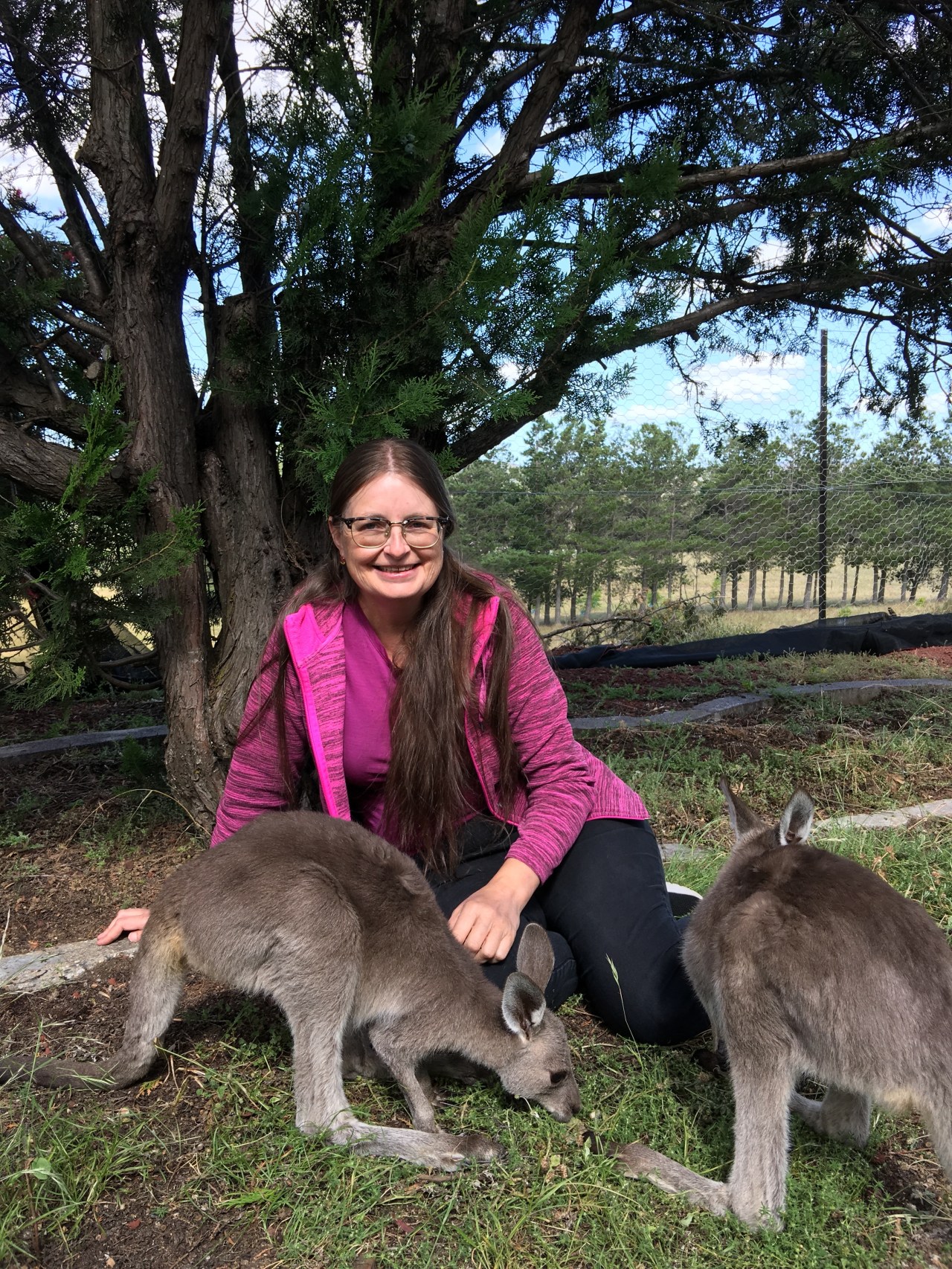
Helen Schloss sitting outside with two Eastern Grey joeys in her care. She is wearing a pink jacket and she is smiling.

An Interview with Helen Schloss

I was gobsmacked by the melted tanks I saw on telly. People lost their homes and there has been a long waiting time for them to receive assistance, especially the wait to get a roof over their heads. I was concerned by the need for water, and I thought, surely if you can build a house out of earthbags, you can make a water tank using the same methods.

Helen Schloss lives on a small property in Bywong, New South Wales, near Canberra. A primary caregiver and dedicated wildlife volunteer, Helen prides herself on her strong work ethic and animal rights principles. Some of her voluntary work includes producing ‘Tuesday Tips’ for Lucky Stars Sanctuary. Her passion drives her to help others help and protect the less fortunate.

This interview is the second of four interviews with volunteers involved in the building of an earthbag water tank at Lucky Stars Sanctuary, Bywong. Vanuatu Earthbag Building assisted in this project. They have provided free plans, support and the materials required to build water tanks for people in need in fire zones in NSW Australia, cyclone zones in Vanuatu and Pacifica.

Gaele Sobott: I believe you were the person who instigated the building of the earthbag tank. What gave you the idea, and how did you go about finding the expertise to commence this project?

Helen Schloss: I already had an understanding of the sustainability and affordability of earthbag building. I was interested in building a second home from earthbags on our property. Then we experienced the bushfires from early December 2019 and January 2020. I was gobsmacked by the melted tanks I saw on telly. People lost their homes and there has been a long waiting time for them to receive assistance, especially the wait to get a roof over their heads. I was concerned by the need for water, and I thought, surely if you can build a house out of earthbags, you can make a water tank using the same methods.  So I put a few words into Google, and one of the first things I found was the Vanuatu Earthbag Facebook page. That was early February this year. I saw a post that Liz Sherborne had written saying they had been using earthbag-building methods in Vanuatu. She noted that earthbag water tanks would be a valuable resource in fire-prone areas of Australia.  Helpful in protecting people’s properties, their lives and the lives of animals. I wrote a comment asking if they would be interested in doing a workshop down our way at some point. She instantly messaged me, and the project evolved from there. Liz said that if we could find ten people to assist with the building, they would come to Bywong. In some ways, it was serendipity.

GS: You found ten people and provided food for everybody, anything else?

HS: Yes, so I rounded up the volunteers to do the work. Initially, we were going to start building around early March, but then COVID hit, and the restrictions meant people couldn’t travel from Sydney or gather together. We had to postpone it, which meant I had to keep those volunteers interested throughout that time, sending them links and chatting with them online. 

GS: What previous organisational and networking experience do you have in gathering people together for projects like this one? Not everyone would know the importance of keeping that group of volunteers interested.

HS: I have some past experience. My family and I were in Papua New Guinea for a while, and I did fundraising events for various organisations. Maybe through the trial and error of that process, I learned that if you don’t keep your communication going, not everyone, but some people will lose interest. I’m pretty sure now, knowing this crew, if I had put them on hold and not had any contact with them, it probably wouldn’t have mattered. Most of them have got properties. Potentially they could use the earthbag building skills on their properties and help neighbours and their communities. But I believe in communication. I’m not fantastic with my friends and family. But when organising events for the animal sanctuary or for people in Papua New Guinea; the hospital there, I feel there’s a lot at stake. Last summer, it was scary because the bushfires were near Lucky Stars Sanctuary at Tallaganda forest and there were various other spot fires around the place. It was really worrying and very stressful for Kerrie and Yee, the founders of the Sanctuary. I think the contingency plan was if a bushfire reached them, they were going to stay and defend. It would be next to impossible to evacuate three hundred animals. That was one of the reasons I felt an affordable, fireproof water tank was necessary. The tank is fitted with a STORZ outlet so fire trucks can connect to it.

Some volunteers building the earthbag tank.

GS: How did you first get involved with the Sanctuary?

HS: In 2017, a year after they opened, I was looking for something to help my daughter, who has been unwell for some time now. She loves animals; in fact, she probably loves them more than most humans. I was looking around for animal sanctuaries and found Lucky Stars on the Internet. We live not too far from the Sanctuary, so I contacted Kerrie and asked her if she would mind if my daughter came over. I remember Kerrie saying, ‘You know it’s not just animals we look after, we look after humans as well.’ My daughter is thrilled working there and now Kerrie and I feel like we’ve known each other a lifetime.

GS: Many people who experienced the bushfires complain that they are still waiting for assistance that was promised by the federal government. I know finding funding for the Sanctuary has been a battle. How do you think a project like building this earthbag tank helps in this regard?

HS: It definitely helps. Earlier in the year, Liz was saying that they like to teach communities the skills involved in the building so that those people can pay it forward. Hopefully, one or two people from each tank-building project can do that. It is one way of getting through this deficit of government funding and developing ways to protect ourselves in the future, especially with sanctuaries. It’s really frustrating that animal sanctuaries don’t get government help, like drought assistance. That’s one way the tank building helps, and I think, also, it helps by promoting awareness. We now have an extra eight or ten people who are aware of Lucky Stars Sanctuary. Hopefully, not only do they know the Sanctuary is here, but they know that we need help from time to time. They also have increased awareness about animals, animal rights, and how tough it is for the animals, especially during bushfire season. Workshops like the tank building initiative serve to increase awareness through social media and word of mouth. More people might contribute to helping financially or by giving Lucky Stars a hand.

GS: Many community projects are continually battling time and funding constraints. People have little time to theorise about what they do, how they do it and where they are heading. How do you think we can solve that problem? How do we begin gathering the data needed to understand our impact and the choices we need to make in the future? 

HS: Hmmm, that’s a really good question. Time and money are always going to be an issue. There are various organisations and government departments that collect data, for example, the Australian Charities and Not-for-profit Commission and the Australian Bureau of Statistics. But whether it’s accessible to charities and communities … I don’t know. A tool that’s simple, affordable and standardised across the sector, could be the answer, like a smartphone app. The majority of people have smartphones now, although not everyone likes mobile apps, I guess they suck up valuable space on their phones. So maybe a website app that has the same functionality as smartphone apps. All the relevant data can be just a fingertip away, no painful paperwork and time saved as a result.

Lucky Stars Sanctuary could gather data such as volunteer info, animal health, fundraising, infrastructure problems or improvements, seasonal conditions. Even information, including photos of soil degradation would be useful for analysis, reporting, planning and decision making. It needs to be well designed, intuitive and easy to use, of course. All the data is there, no more hunting for it down the track. More time saved! Tick!

There’s an app called Farm Tracker, developed by the Department of Primary Industries. It helps farmers collect similar data, including geotagged photo diaries to monitor seasons and dam levels. Some of this information isn’t made public. Perhaps this could be retrofitted to suit charity or community-based work. Then you have the question, who’s going to commission and pay for it? Maybe the Australian Charities and Not-for-profit Commission is a place to start.

Interview conducted with Helen Schloss at Lucky Stars Sanctuary by Gaele Sobott, 11 October 2020.

Links:

Interview 1 in the series: Kerrie Carroll

Interview 3 in the series: Liz Sherborne

Interview 4 in the series: Scotty Foster

Disgust: what is not discussed in Australian politics

The sky is a dark smoke cloud tinged with orange, it’s difficult to breathe outside. I assist my mother to shower, rubbing shampoo into her hair. I hand her a facecloth to wipe the soap from her eyes. We’ve closed the windows and doors to stop ash from coming inside. It’s hot. I’m disabled, 63 years old and my parents are in their late 80s. My mother is ill and has been in bed for a few months. It is extremely difficult for her to walk to the shower. There’s no electricity due to the fires that are raging up and down the south coast of New South Wales. No TV, no internet, no phone coverage. Emergency calls only on my mobile phone. Web-based fire apps aren’t any good to us. I’ve packed the car ready to drive to the evacuation centre at Moruya showgrounds. We are relying on the static reception of the ABC and a battery-operated radio for local emergency updates. I am impressed by the local knowledge and articulate reports of people who phone in about their experiences of the fires. Their reports are invaluable to understanding the trauma and loss, the ferocity of the fires and the extent of the devastation.

The waiting is frustrating, I feel underlying and suppressed fear. Occasionally, anxiety marks my parents’ voices and actions. My father is blocking the downpipes ready to fill the guttering with water. He is determined to stay and defend the house against ember attacks and perhaps even approaching fire. His truck is packed and facing the road. He says he will go if necessary. There is no use arguing with him. I oil my mother’s finely wrinkled skin, careful not to press too hard; run my hands over her stomach, silently thanking her for bearing my sister and me. Her thighs are smooth, almost youthful, her ankles thin. I help her into pyjamas and bed and leave her to sleep.

*

Now I reflect as I wait. The ABC’s emergency reporting is serving us well, but disgust takes over at the Australian government’s not particularly subtle dismantling by stealth of this vital community and national asset. In fact, I realise disgust has been a more or less permanent emotion over the course of 2019. I’m not usually one for hyperbole but I think in this case it is warranted, not to be taken literally but illustrative of the proportions of my disgust; multi-directional, multi-dimensional, stretching to every extreme of my existence and beyond. I breathe the particulate matter of disgust into my lungs, into my veins, arteries and capillaries, my heart, my brain. It penetrates the subterranean reaches of our earth; the water tables, the aquifers, even, I suspect, the white-hot, molten-metal core. Disgust drifts to where our earth’s atmosphere bleeds into outer space.

Most of the time, disgust accompanies feelings of grief and dread. As in early 2019, when close to one million fish searched for flow, for faster cooler deeper current, desperately fighting to breathe in the lower Darling River. But they failed, suffocated; their bloated, rotting corpses floating on blue-green algae pools, piling up on the banks and dry riverbeds. The deaths of 100-year-old Murray cod, golden and silver perch, bony bream with shining spirit skins haunt me. I grieve for them as I grieve the looming death of the Murray-Darling rivers system. I fear for the lives of farmers, townspeople, wildlife, reptiles, fish, insects, plant life, wetlands and soil that depend on this river system. Geologically speaking, the Murray–Darling Basin is over 200 million years old. The river system stretches 3,200 kilometres from Queensland, down through NSW, Victoria, the Australian Capital Territory then into the Murray Mouth at Goolwa, in South Australia.

My top lip curls up on the right side, my throat constricts and I feel nauseous. Disgust oozes through my body in response to reports that in 2012 after public consultation had ended on the draft Barwon-Darling water management plan, the National Party, Primary Industry Minister, Katrina Hodgkinson changed the rules to allow irrigators to extract 32 per cent more water during low flows. Disgust that corporate farmer irrigators, many of whom are said to be major National Party donors, have been taking water illegally from the Barwon-Darling and the NSW government has turned a blind eye. Disgust at the massive level of corruption and fraud, lack of transparency and obvious disregard for the health of the Murray-Darling river system that are hallmarks of the government’s water buybacks, water-efficiency projects and capturing of water from overland flow and floodplains. For instance, the federal Minister for Agriculture and Water Resources, David Littleproud, has family links to those charged with Murray-Darling Basin fraud amounting to A$20 million, yet he is still the Minister overseeing complaints in a separate investigation of the $80 million Murray-Darling Basin scandal involving federal MPs Barnaby Joyce and Angus Taylor.

I feel disgust at the corporate farming of water-guzzling crops that are not suited to our dry climate: like the annual planting of cotton, with an average irrigation requirement of 7.8 megalitres per hectare and the planting of permanent crops like almonds that require an average of 13 megalitres of water a year per hectare. About 90 per cent of Australia’s cotton is grown in the Murray-Darling Basin. Cubbie Station, located on the Darling Riverine Plains, is the biggest water user and largest cotton farm in Australia. Its storage dams stretch for more than 28 kilometres. This water is harvested from the floodplains and cannot, therefore, flow naturally to the river. It is believed floodplain harvesting is a major contributor to the huge drop inflow in the Darling River. A significant portion of the water stored in dams is also lost to evaporation. Cubbie has water licences for 460GL or 184,000 Olympic swimming pools.

Instead of addressing how these actions contribute to the reduction of water flow, the Federal Agriculture and Water Resources Minister David Littleproud and his NSW counterpart Niall Blair blame the drought.

*

I let disgust go. I must take my mother something to drink. She is tiny in her bed, covered by red blankets, sleeping. These days, she has almost no appetite. We offer her smaller servings of food, yoghurts, milk drinks; easily digestible with nutritional powder, banana or blueberry or yoghurt mixed in. As the electricity is off, I mash a banana with a fork until it is liquid, whisk it into the milk mixture then strain out any lumps. I may try mashed avocado next time. We are on a journey of discovery, finding out the food tastes and textures that please her. She likes some soups, carrots cooked until they are soft and vegetable risotto. Yesterday, she asked for a cup of tea.

            The police knock on the door. My cousin in Perth is worried as she can’t get in touch with us. One policeman tells us that Mogo, Batemans Bay and places like Malua Bay have experienced significant damage from the fire. They say they would prefer my mother and I go to the evacuation centre today.

My father packs a change of clothes and a toothbrush in a bag. I prop Mum crookedly against some pillows on her bed; she manages to drink a small glass of banana milk. I decide to check out the centre and leave her to sleep.

It’s not far to the Moruya Showground. There are a lot of caravans and tents around the oval, horses in various enclosures and other livestock in small buildings. I can hear hens clucking and roosters crowing. People are carrying cats and walking their dogs. The evacuation centre volunteers and emergency workers are set up at tables close to the entrance of the indoor basketball court. A man offers his arm to help me walk. I’m thankful. It’s difficult to negotiate the crowd without my mobility scooter. People, strangers, seem to gain comfort from talking to each other about their experiences, their losses, their fears and their plans for the fires approaching Moruya. I talk to a couple from Canberra who can’t get back because of road closures. Another woman tells me the water is off at South Head. Two elderly men say that the leather shop in Mogo has burnt to the ground. There is a whiteboard with the latest information on the fires, road closures, power cuts and the times when food is served. I register my parents, myself and the cat with the triage team. The workers try their best to help find a suitable place for us to stay but the accommodation on offer is not accessible. They advise me to try the retirement village near the hospital which has chairs available for the night. I drive there and speak to the woman in charge. She is efficient and welcoming. The hushed pinks, greens and grey of the interior provide shelter to many elderly people and some disabled young people, all sitting quietly, staff bustling between them. The woman says we should hurry to be assured of a place as they are also expecting elderly people who are being evacuated from the retirement village in Dalmeny.

Back at home, I give my mother a small glass of apple juice. Dad puts an esky full of drinking yoghurt and apple juice, a pillow and a woollen blanket in my car. I drive to the retirement village with Mum. Two members of staff wheel her inside, I park the car and bring her bag in. She is sitting on a chair, upright, tense, ready to leave. Her eyes are bright blue, buttoned into her pale face, searching for me. I sit next to her, suddenly realising that possibly she thought I had dumped her in a retirement home under the pretext of evacuation and I wasn’t returning. She asks me numerous times why we are here and where my father is. A staff member offers her a sandwich. She refuses to eat with a slight air of indignance. She keeps repeating that she wants to go home. Her confusion and anxiety are increasing rapidly. I tell a member of staff we are leaving, take my mother to the car and we drive.

I’ve lost awareness of dates, days. It’s a weekday, mid-afternoon. No cars on the road, no people walk the streets and everything seems to glow a dirty, apocalyptic orange. We drive past the Queens Street Medical Centre. There is a sign on the door that reads ‘Closed due to fires’. Some businesses that rely heavily on the tourist season have decided to call it quits for good. ATMs don’t work and the few shops that are open require cash. The chemist in the main street and Woolworths are closed. I drive home, hoping it will be possible for Mum to stay one more night in the comfort and familiarity of her own bed.

Dad agrees with this decision. The fire glows red on the ridge north of Moruya. I’m on edge, wondering how I will know if there is an ember attack or if fire approaches during the night. I manage to sleep soundly, waking to the alarm at 6am. Dad helps Mum into the car. We find parking in front of the evacuation centre. It is not too far to walk. I keep talking to her, explaining that we will be staying here for the whole day and night. An emergency worker asks if we would like someone to bring us our meals. I appreciate her assistance. It means we don’t have to join the long queues at the building that serves as a kitchen. A charity volunteer talks to me about finding a mattress for my mother. Soon, a young man appears with an air mattress. He proceeds to blow air into it. Another volunteer brings sheets and pillows that have been donated. People are helpful. They assist me to walk and carry things. When the electricity goes off, a woman in a bed nearby tells me she is a nurse. She offers to take over from me for a while to fan my mother. Her husband has Parkinson’s and is waiting for his daily medication to take effect. Their two teenage sons are with them. Like many people in here, this family knows the fire has already been through their area but don’t know if their house is still standing. I keep Mum’s fluids up and give her mouthfuls of yoghurt from the esky. When a volunteer brings spam and salad sandwiches, surprisingly she eats most of it. The small dogs are yapping, the parrots squawking but generally, the animals in the hall are well behaved.

Time passes slowly. I keep talking to Mum, reassuring her. Someone says the fire is at North Moruya, firefighters are water bombing near the airport. A volunteer offers me two wet cloths. I put one at the back of Mum’s neck and one in the esky. She asks about Dad a few times, then asks if we can go home soon. I tell her we are staying the night. I don’t know how I am going to help her up from the mattress when she wants to go to the toilet. I speak to the emergency workers about it. The hair around my forehead is wet with sweat. People stop and talk to us. I notice various disabled people of different ages with varied impairments and health conditions. They are accompanied by family and friends. The strength of community in this hall is palpable. People seem to know intuitively how to help each other, their skills are apparent. It is clear that, even without resources, we will make the best of the distressing situation we find ourselves in.

Mum wants to go to the toilet. She tries to get up but cannot. I ask an emergency worker for assistance. She calls another woman. They try to help but hurt Mum by pulling on her arms. She doesn’t complain. An elderly woman sitting across the way gets up and walks over. Her name is Val, she was a geriatric nurse in England. She demonstrates to the women how to help a frail person up from the floor. Mum is on her feet. I guide her to sit on the walker and push her. We move slowly. I’m not physically strong. The walker helps me balance. There are four toilets and a row of metal basins on the wall. One toilet has a piece of paper taped to the door with ‘For people with upset stomachs’ written across it. Apparently, some form of gastritis is raging through the dogs and the humans in the centre. When Mum is finished, I rub her hands with sanitiser and we return to our mattress. Even though this experience is hard for her, she is quietly persevering. She lives in the immediate present or in her childhood. She talks to me now about her father, telling me that he was a gentle man.

*

I lay next to her and I think about resilience and about how we are made vulnerable by a system that has let us down. How communities that lack resources – poor communities, the disabled, the elderly, First Peoples’ communities – are particularly impacted by disasters like this one. My guts twist in anger and hurt for those in need who are disregarded or, worse, stigmatised and punished by government policies. Disgust sets in again at the repeal of Medevac, stripping away the only pathway to evacuation from offshore detention for sick refugees. Disgust at the decision to axe funding to the main body representing First Peoples women survivors of domestic abuse. Disgust at Robo-debt’s cruel assault on our welfare system causing extreme distress and, in some cases, suicide. Disgust at the refusal of government to increase the New Start support allowance which, at around $40 a day, condemns people to live well below the poverty line, barely covering rent, let alone other essentials.

Disgust that people on the cashless welfare card will not be able to buy goods during this disaster when the shops are demanding payment in cash. Disgust that the expansion of the cashless welfare card is costing between $4,000 to $10,000 per person to implement and manage. This money could be going directly to income support or work programs, education or additional resources and infrastructure in areas impacted by high unemployment. It goes instead to Indue Pty Ltd, a corporation said to donate to various Liberal and National Party branches nationally. In August 2019, Indue is reported to have received up to $21.9 million. If the card is extended to every person receiving benefits, the cost to the taxpayer for administration alone will be in the billions. Disgust also that the Indue card is the result of the sustained efforts of billionaire mining magnate, Andrew Forrest, who dictates that the solution to what he perceives as the ‘welfare dependency’ of First Peoples is income management.

*

Women bring us our evening meal; a sausage with mashed potato and fried onions. One woman asks if she can bring some water with electrolytes.

I say, ‘Yes, please.’

 ‘It’s cold and it’s electric-blue,’ she adds.

When she returns, Mum has a long drink from the flask. Then tries to get up. An emergency worker brings two young army reservists who offer their help. Val explains to them how to lift. They do a great job. I ask them how they feel about helping citizens at home. ‘It makes me feel valued,’ one says.

I help Mum to the washbasin and pour water from a bottle so she can clean her teeth. We return to our place on the floor and lay down with every intention of sleeping. It is noisy and hot.

Mum turns to face me. Her eyes seem to look right into who I am as if she has some kind of superpower.

She asks, ‘How are you? How are you really going in your life?’

I say, ‘I am good Mum. I have friends. I’m good.’

She continues to look at me.

I have not asked myself this question. Every day is a struggle. I am self-employed, work non-stop and make very little money. My work-life balance is terrible.

Children run up and down the hall, laughing and screaming. The main light in the hall is just above us, secured to the backboard of a basketball hoop.

*

I return my thoughts to Andrew Forrest and the big mining companies in Australia. Miners of fossil fuels like Adani only expect to be viable if they depend on subsidies, favourable deals and tax concessions. Over its thirty-year life, Adani’s Carmichael coal project would be given at least $4.4 billion in taxpayer subsidies. The miners bring in huge revenues but pay little or no tax at all. The latest Australian taxation figures record that massive oil and gas producers, like Exxon Mobil with $9.23 billion in Australian revenues, Chevron with $5.27 billion and Woodside with $6.28 billion, all paid no tax. Gina Rinehart’s company, Hope Downs, with $3.8 billion in revenue, does not pay tax. That both our two major political parties support coal exports when we could be developing other export industries including renewables, makes no sense. I want to see a breakdown of who exactly benefits from the US$87.7 billion income from our 2018 exports of mineral fuels. Given that the demand to decommission coal mines includes a just transition of jobs to renewables, I wonder why there is so much emphasis on jobs in the coal industry when just over 37,000 jobs are involved and many mines, including Adani, are automating. There is also little discussion on how the increase in our exchange rate caused by the resources boom negatively affects other job sectors — industries such as tourism, tertiary education, manufacturing, agriculture that employ vastly more people in widely dispersed locations. I feel disgust that we are lied to by politicians like Scott Morrison and the billionaire-owned media. We are not given the information we need to make decisions, we are discouraged from thinking critically.

I feel disgust that Gina Rinehart’s company, Hancock Prospecting, donates millions to the right-wing, climate-denying think tank, Institute of Public Affairs (IPA) which has close links to the Liberal party and to Murdoch’s media. Murdoch News Australia pays no tax, despite $2.4 billion in revenues from its papers and websites. The same media spreads clearly disproven disinformation that arsonists, not climate change, are responsible for the continuing fire disaster we are experiencing in Australia.

I am equally disgusted when, in September 2019, Donald Trump hosts a state dinner in honour of Scott Morrison accompanied by guests Gina Rinehart and Andrew Forrest, billionaire media magnates, Seven West Media chairman Kerry Stokes, News Corp’s Lachlan Murdoch and billionaire Anthony Pratt. These are the important players in Australia’s oligarchy. This is where power resides.

I assume oligarchs can helicopter out of a danger zone if they ever find themselves in one. They can afford to ‘adapt’ to climate change by building bunkers into their holiday homes. We never expect to share space with an oligarch in an evacuation centre.

*

The generator stops. The lights go out. An emergency worker fiddles with an electricity cable.

My mother asks, ‘Can we go home in the morning?’

 ‘I think so,’ I say and turn over to sleep.

The generator starts up again. I wake to the light flickering in my face. Most people in the hall appear to be asleep. Mum is trying to get out of bed. She thinks she is at home. I explain that we are in the hall, that we have evacuated. She asks where my father is. A volunteer comes to help her up. I can now see bruises on Mum’s arms, her hips and knees are sore. Val comes over and instructs the woman how to lift. Val also lifts. I wheel Mum to the toilet. It is too late. She has wet herself. I wheel her back to the bed and pack our bag. We pass by the tables near the entrance and sign out. I explain that I can’t continue to put Mum through this. A young man helps us to the car. I don’t know if we are still under threat from fire. We drive home.

Both Mum and Dad sleep through the next day. I listen to the ABC. A neighbour knocks. He tells me we must boil our drinking water because it is now being mixed with water that comes directly from the river. He says the supermarkets are empty. There is no food, no fuel. I take two cans of Irish stew from the cupboard. That will do us.

As the days roll by, we are lucky; the electricity is back on and so is the phone and Internet. Many communities are still waiting for the electricity to be restored. A truckload of supplies gets through under police escort. The food is gone from the supermarket by lunchtime.

*

My father has an appointment with an Aged Care Assessor who will assess him for Home Care Packages (HCP) level 2. She tells us that her house, north of Moruya, is under threat from the renewed fire danger forecast for the weekend. She will move into town with her in-laws. As we talk, the lack of transparency and brokenness of the aged care system become obvious. Unlike the NDIS, where disabled people at least have the option of self-management, the elderly must use providers. Some providers are said to charge elderly people up to 50% of their government subsidy for administration. Comparing provider charges is an almost impossible task as the formats are not standardised. I ask the assessor if she can explain the announcement made over Christmas by the federal government that private companies will deliver assessments from April 2021. She doesn’t know about it. More than 400,000 assessments are done every year for home-care packages and residential care, at a cost of $800 per assessment.

Disgust settles in the room once again as I realise this is another opportunity for private enterprise to pocket public funds. The assessor explains how, to date, state-employed nurses, social workers and geriatricians work through community health and public hospitals to assess the level of care required by individual elderly people. She doesn’t think private providers will have the community knowledge, expertise or concern for the individual to provide this service. She is worried that, without the involvement of state and local government structures, there will be even less transparency and little accountability. She gets up to go, saying to Dad that it will take up to two years for his package to come through once it is approved.

He says, ‘Well, I may not be here by then.’ He adds, ‘But I don’t want to shoot the messenger.’

I follow her out the door, holding onto the wall for support.

*

The road to Batemans Bay has just opened. I want quotes for an adjustable bed for my parents, so Mum can sit up in bed to eat. I drive through smouldering, blackened forests. Twisted sheets of roofing iron mark the spot where houses, sheds and businesses have burned to the ground. Smells of burnt wood intermingle with the acridity of charcoaled animal flesh. The agony of a young kangaroo, its body seared to a fence, is captured by a photographer, singeing the psyche of the world. One billion animals estimated killed in the fires. Unknown numbers of invertebrates, insects, frogs, bats dead. Possible catastrophic consequences to ecosystems. More than 2,000 homes and eight million hectares burned. Vast areas of bushland will not regenerate. At least twenty-four people were killed and the fires continue.

People in Sydney have been breathing toxic, smoke-filled air for months. People on the south coast are breathing smoke. On 1 January 2020, Canberra’s air quality is the worst of any major city in the world. On 8 January, the Bureau of Meteorology announces that 2019 was Australia’s hottest and driest year on record. Yet our government acts as if it is business as usual, touting that we’ve had fires since time began.

The 2008 Garnaut Climate Change Review examined the scientific evidence around the impacts on Australia of climate change and predicted that, without adequate action, the nation would face a longer and more intense fire season by 2020. Disgust almost overpowers me that this and other warnings are ignored. That Scott Morrison chooses not to meet with the twenty-three former fire and emergency leaders who ask to discuss early preparation and the equipment needed to fight the impending fire disaster. Disgust that, under the 2019-20 NSW state budget, fire and rescue capital expenditure is cut by $28.5 million or 35 per cent. The Rural Fire Service capital expenditure budget is cut by $49.9 million or 75 per cent. Disgust that the Prime Minister sees fit to go on holiday to Hawaii, the NSW Minister for Emergency Services goes on holiday to Europe, and the Federal Defence Minister goes on holiday to Bali while this land is suffering a profound disaster of apocalyptic proportions. Disgust runs out my ears, oozes from every pore and orifice at the arrogance with which the Prime Minister responds to public concerns on how to compensate and properly equip volunteer fire crews who have been battling the fires since September. Disgust at the forced handshakes and thuggish behaviour he imposes upon the traumatised community of Cobargo. I cannot possibly talk about everything that disgusts me. There is too much. This is why I choose to represent my disgust through hyperbole.

*

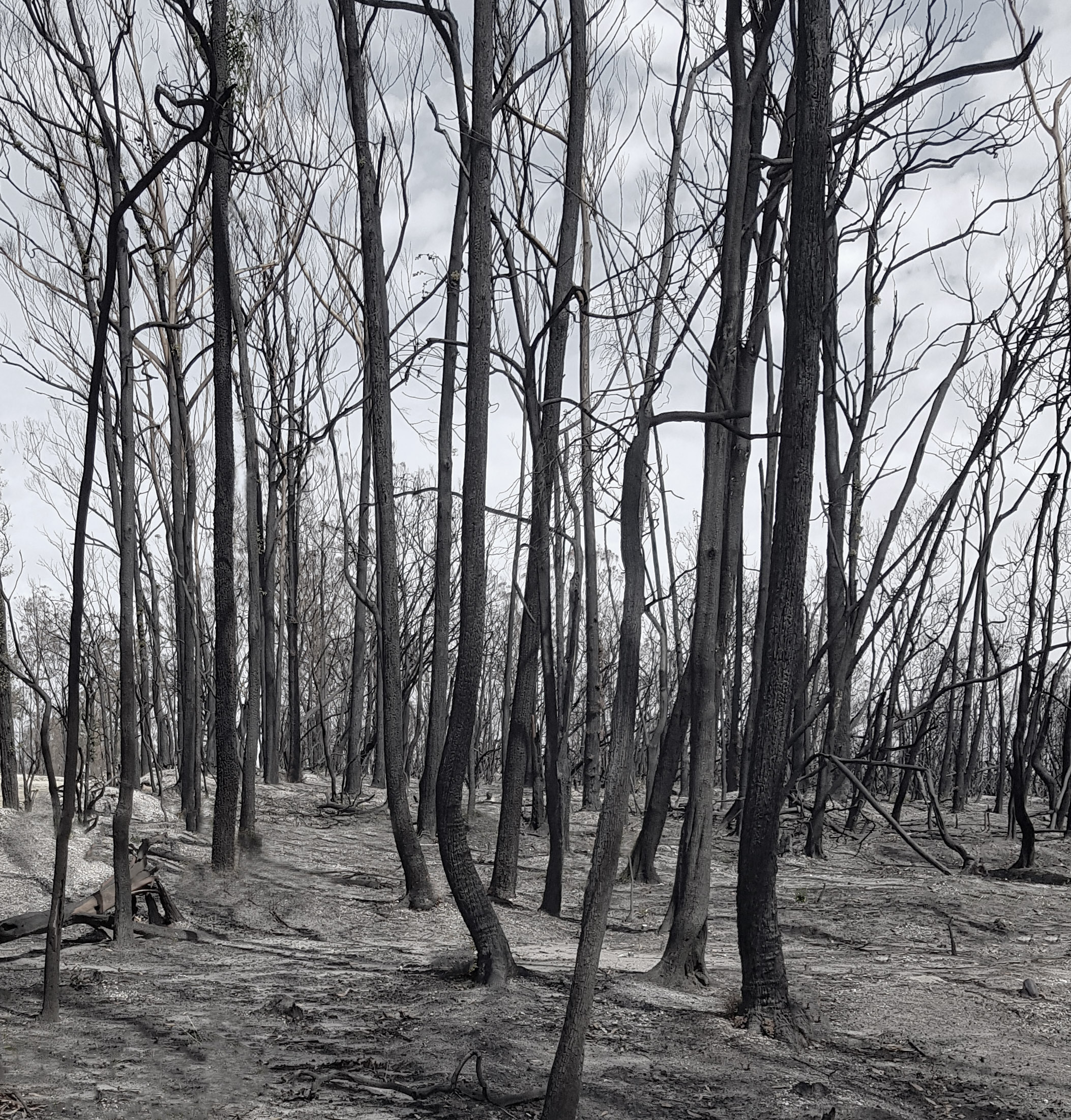
The bleak, ashen husks of trees that now comprise Eurobodalla Botanical Gardens are a blur as I drive back to Moruya. It dawns on me that, just like hyperbole, disgust has a purpose. Feelings of disgust are an evolutionary response to protect us from pathogens, infectious threats. Disgust helps us protect and preserve the social order from something that is offensive, poisonous or dangerous. Disgust is about survival.

My disgust calls for totally different ways of living and producing, and different ways of relating to each other and the earth. I don’t think anybody knows yet what this will look like, but I’m sure the oligarchs must not have any say in shaping it. Carbon-fuelled accumulation of capital, greed and ever-increasing profit margins are dangerous to life on earth. Our survival will involve us developing confidence in our ability to respect life, to love and help each other, confidence in our skills and our knowledge, so that we may work within our communities, upwards and outwards, joining with other communities for the common good. Our survival will depend on us learning how to recognise and actively fight corruption, fraud and lies. It will mean we find ways to make reliable information available to all, support and build progressive, independent media, develop critical thinking and make decisions based on facts, not lies.

I read that on 31 December in Victoria, Veronica Marie Nelson Walker, a 37-year-old Yorta Yorta woman is charged with shoplifting and refused bail after representing herself at Melbourne Magistrates’ Court, instead she is remanded at the Dame Phyllis Frost maximum-security women’s prison. On 2 January she is found dead in her cell. Our survival depends on urgently building solidarity with those who are discriminated against, racialised, criminalised and murdered by the laws and system that are supposed to protect us. We know the violence against First Peoples, disabled people, women, refugees, the elderly and other oppressed groups of people is linked. The brutality of this system is lethal.

*

I stand by Mum’s bed, looking at her curled warm in her blankets.

She asks, ‘Do we have to evacuate again?’

‘No,’ I say, lying next to her. She talks about her father being on the susso. She describes how, during the war, at school, they did drills, practised climbing down into trenches in the Exhibition Gardens.

‘I don’t think the world has ever been in as much danger as it is in now,’ she says, placing her hand on my hand.

Gaele Sobott

Published by Otway Journal 2021 Coming Back to Earth

Audio Version