Separation جدایی by Gaele Sobott

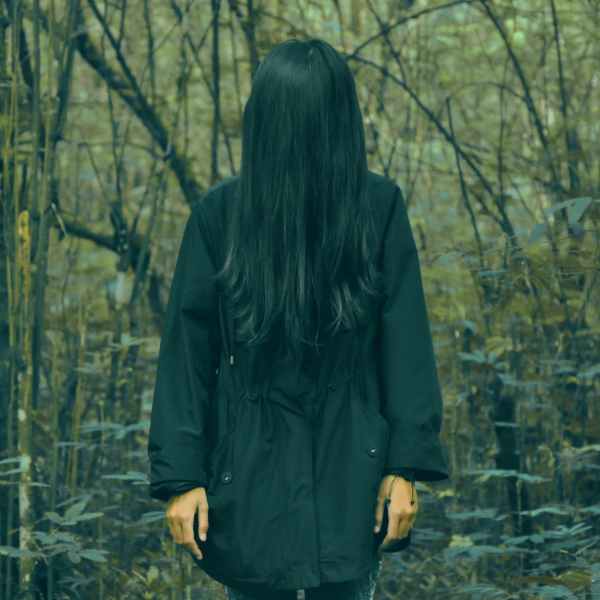
Colour photograph of a woman standing in a black coat in a forest. Her face is completely covered by her long black hair.

Photo by OVAN on Pexels.com

It seems my mother bore me for grief that grows of separation (from Hafez 352)


When I was a little girl in Iran I loved spinning around until my brain became fuzzy, I’d lose control and sometimes I’d fall. The roses in our garden swirled red, pink and white as I turned, and I’d smell their sweetness.

My husband has gone. There is a space where he used to be. That space loops brittle-boned into my body, across my apartment, out the window into the heavens. I water my plants on the window sill and I feed my canary, who sings yellow in his confinement. Little bird condemned to this boredom until you die. A huge bat hangs camouflaged black in the fig tree next door, across the broken concrete of the driveway. I walk fearful, careful like Mooch, my cat, soft on my toes. The moon, swollen with light, shudders as the bat takes off and I squeal. If I ran my fingers over those wings, they’d feel thin, stretched rubber or maybe silk. Shwoosh, shwoosh, stupid woman, it flies an elegant ellipse of protest high above our rows and rows of apartments to return and hang again black in the fig tree next door. My daughter weaves a life of her own in America with her husband. My grandchildren are far from me.

The evenings are cooling ever so slightly on my sadness as summer gives way to autumn. Lakemba days are shortening and people spend more time inside. Conversations in Arabic, Bengali, Mandarin drift with smoke from a wood fire, and smells of curry leaves and cumin frying. Death and rebirth, good and evil, the goldfish swims in its bowl ready for Norooz.

In Iran, I sat on my father’s lap enclosed like a Russian doll in our house, in the room with carpets, surrounded by the architecture of my father’s body, the warmth and murmured rumblings of his chest. His arms wrapped around me so I was almost in darkness. My father and his friends laughed and talked. The volume of their voices crescendoed and lulled in concentric circles. I peeked out to see my mother swinging a brass censer filled with coals. She seemed entranced by the swinging chain. The coals glowed in their cage. I broke from my father’s arms and ran to her. Pulling on the folds of her long robe, I wanted to feel the motion, the weight of the censer. I wanted to do as my mother did and make the coals breathe red. My brother followed me and my mother allowed us to swing the censer very gently before she took it to the brazier in the middle of the room. My father prepared two of his favourite vafoor. One pipe had a gold rim and paintings of blue birds with long tails on the bulb. It belonged to my grandfather who was growing smaller and smaller, sitting in the quieter shadows of the house, storm clouds under his eyes, and dark thin lips.

My uncle had returned from the edge of the desert where the air is crisp. He returned from Kerman with pistachios and the golden-brown tariaak they called senatori. The men joked about the senators smoking the highest quality opium. Now the ayatollahs have taken over from the senators. My father broke off a small piece of opium and put it in the pipe. My uncle held a burning coal in the tongs.

Grief has made its untidy nest in my apartment, in this body of mine. I try to sleep but the night is restless, the darkness is full of angst. I try to rest sitting on my couch reading but sentences scramble, scratching the paper like scuttling cockroaches. The words scream a cacophony of meaning at me and I feel their rage because I am porous. I have no boundaries.

In the morning, I leave my flat at 7am and walk to the train station. I walk tall, long feet and long fingers, wearing a dark suit. My hair long and black swings in time to my steps. Back and forth I walk every day, past discarded TVs and old mattresses. I walk past piles of clothes and curtains, and couches, broken tables and packaging that recently held a new refrigerator or television. Every day the train sways, stops and starts. People get on and people get off. Some play games on their phones. Some stare glassy-eyed into corners of their lives I cannot see. Belmore backyards flash by, we rattle through the inner west, Redfern platforms, sniffer dogs assiduous, salivating for a bust. I get off at Town Hall, moving at the same pace as everyone else, trotting up the escalator, across George Street, a fast-moving mass of people who seem to know their way, know what they want in life. Lines of square windows and grey concrete stretch to the sky but I rarely lift my head to look. I don’t stop in the city. In the city, I’m a lawyer. My work holds me tight like a corset. Keeps me going.

The lift zooms up to level thirty-two. I greet Helen, the receptionist. “How you doing today?”

She says, “My cat’s sick,”

“Sorry to hear that.” I commiserate.

“Yeah, she’s not eating. Just lies there. If she’s still like that after work, I’ll take her to the vet.”

The phone rings, she puts on head phones and her receptionist voice to answer. She winks at me and I continue to my office. Sexual harassment cases splayed across my desk, on chairs, clusters of papers, book upon book with fawn covers, gold titles on red binding. I click on my inbox. Emails like hordes of insects. I click, answer, click, answer. Read some specialist medical reports. So much reading. Reading consumes my day. Rowena’s complaint with the AHRC, the respondents denied the allegations. All attempts to bring the parties together have failed. Not the best-case scenario for Rowena. The alleged perpetrator relies on entitlement, on his positioning in the hierarchy of power. The offensive sexual jokes, suggestive and lurid remarks, sly rubbing of his cock against her body, always in tight spaces, in the kitchen, at the photocopier, fingers pinching her bottom, prodding. All that disappears with his denial and confident smirk. Rowena’s supporting evidence is weak. She’s depressed, experiencing reactive anxiety. She resigns from the job. Her marriage breaks apart. I’m not sure how she’s going to cope with the pain, the anger, shame, the humiliation of the public process. I’m a lawyer, a professional, but sometimes emotion and passion leak through my lawyer skin onto the desk, across the papers, like dark, golden sap escaping from the inside of a tree. When that happens, I am not useful to my client. When that happens, I want to cry.

On the train back home, the hurt under my breasts and the desire to cry are desperate, they rage against my false calm. The train doors whoosh shut, I climb the stairs, walk, unlock the front door, the cat rubs against my legs. Tip dry food into its bowl. Feed myself. White cheese, walnuts, dates, Persian cucumber, tomatoes, olives, nuts. I sip black tea from a glass and let lumps of sugar dissolve slowly in my mouth, longing for my mother’s sweets.

My mother put rose petals in with the tea leaves. She carried the teapot and glasses clinking on a tray. Her thick hair pinned up in a French roll. On one side of the manghal sat plates of honey crisps with almonds and the pistachios my Uncle brought us as a gift. Dates and figs, and small biscuits kept my father’s blood pressure from dropping too low. I sat on my father’s lap. My tooth ached. He inhaled, and the pipe whistled. He held his breath, his cheeks bulged, he blew smoke across the top of my head. Haalaa bekesh too. I inhaled and the woody perfume was purple or maybe turquoise, the most sensuous bitterness. I was transported away from pain.

Cat footprints mark the dust on my bookshelves like fallen blossoms, Mar Name leans neglected against a Farsi translation of Nietzsche. Deleuze and Guattari, Anti-Oedipus balances on Grammatology. In the Realm of Hungry Ghosts lies on the floor alongside classical music CDs I no longer play. I sit on the couch. My fingers habitually exploring the patch that covers a small hole burned by my cigarette into the fabric. Above me hang crooked on the wall, cheap copies from the seventies turning brown. I ran from Iran over twenty years ago, first to Pakistan, then here. I am forever a kharjee spirit, an outsider, an adventurer, maybe a heretic … at day and at night, branded by love, like Hafez, with nightingales of dawn, I cry songs, woes of separation.

Mooch stretches his tabby body across my thigh, heavy, snoring like the man of the house he is. He brings me lizards and mice and small birds. He lays them wet at my feet, sometimes moving, sometimes still.

I am still, here with my cat, and the canary asleep in its cage, and the fish.

The city on the edge of the desert, the ancient city called Kerman, where the air is crisp and very cold at night, is surrounded by fields of poppies but was once surrounded by fields of barley. I would lay on my stomach on our carpet from Kerman, rolling from one end to the other over the pastel shades, the blues and creams, back and forth until my brain was fuzzy. I imagined I was lying in fields of yellow barley ready for harvest, looking up at the sky so very blue. My father sat with his friends drinking tea, eating cakes and sweets. They laughed and they cried. They talked as if to stop talking would show weakness. They talked over the top of each other. Their conversation infinite, uninhibited…

Read more 

Published 8th November 2019 in Prometheus Dreaming
 

CROSSING CHASMS OF MISCONCEPTION: Contemporary short stories from Gaza and Sydney

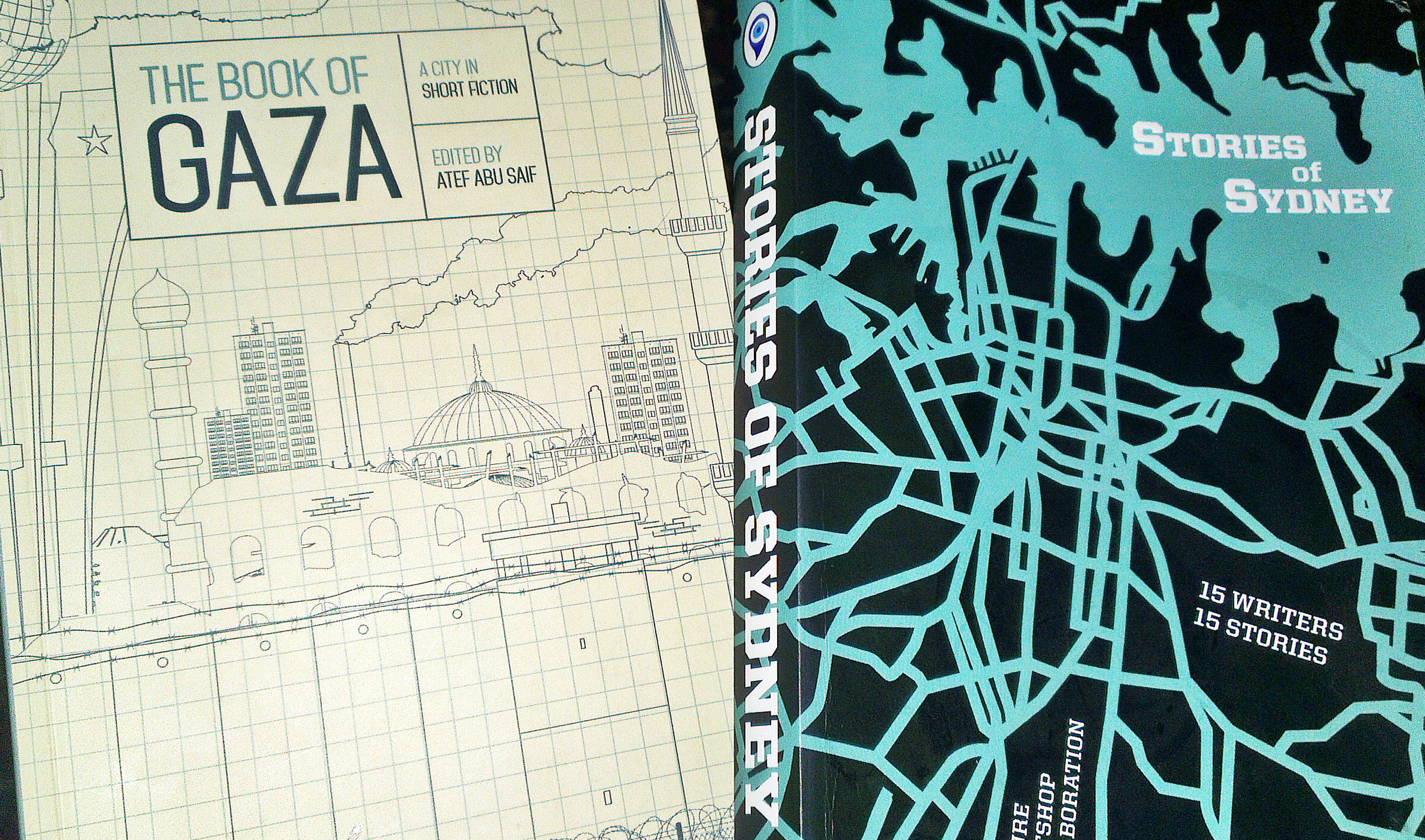
Image Description: Two books.The Book Of Gaza - Front cover is a drawing of Israeli Separation Wall in the foreground and the city of Gaza beyond the wall. Stories of Sydney - Front cover is Sydney harbour and streets in turquoise on black background.
The Book of Gaza
Edited by Atef Abu Saif
Published by Comma Press 2014
128 pages
ISBN 978-1-905583-64-5
£8.75 plus postage from Comma Press

Stories of Sydney
Edited by Michael Mohammed Ahmad, Alice Grundy and David Henley
Published by Seizure and Sweatshop 2014
249 pages
ISBN 978-1-921134-26-5
$19.95 AU Seizure

“Gaza has always had a central place in the literary life of Palestine,” says editor and writer, Atef Abu Saif in his introduction to The Book of Gaza. Important Palestinian literary figures from Gaza extend back to the eighth-century poet, philologist and one of the founders of Islamic jurisprudence, Imam al-Shafii. They include poets like Mu’in Bseiso and Harun Hashim Rasheed both born in the late 1920s, and the novelist and poet, Abdul Karim Sabawi born in 1942. In 1948 the city of Gaza and the surrounding Gaza strip, which has a total area of 360 km², suddenly became home to a large number of Palestinian refugees forced from their houses, villages, towns and cities by an-Nakba. As well as being one of the oldest cities in the world Gaza became one of the most densely populated cities. With Israel’s occupation of the Gaza strip in 1967, most writers left and took refuge in countries like Lebanon, Egypt and Iraq. Abdul Karim Sabawi eventually migrated to Australia. Atef Abu Saif describes how:

Despite restrictions on freedom of expression, the art of the short story attained great popularity during the 1960s, 1970s and 1980s . . . Through the brevity and symbolism of the short story, Gazan writers found a way to overcome printing and publishing restrictions imposed by Israeli occupation forces.

In the 1980s and 90s Gaza gained a reputation as “the exporter of oranges and short stories.”

The Book of Gaza brings together 10 short stories by ten of Palestine’s modern writers. Abdallah Tayeh, Zaki al ‘Ela and Ghareeb Asqalani represent the pioneers of the short story. They describe the long queues of exhausted Palestinian workers waiting to cross into Israel. They write of curfews, prisoners’ suffering, and heroes like Zaki al ‘Ela’s Abu Jaber, who actively resists Israeli oppression. They also write about the determination and solidarity that exists between Palestinian people. Asqalani’s story in this Anthology, “A White Flower for David”, is complex and dense. It is hard work figuring out the characters and their relationships to each other. The narrators change, perspectives shift. A fraught friendship develops between a Palestinian family, which includes three generations, and Esther who is married to David, a Jewish man. Sahimah, The Palestinian mother and grandmother, finds Esther’s name strange. Esther sits cross-legged on the bed. We see her through Mahmoud’s eyes as he addresses David, ” exposing half of her flesh, nearly making my brother, Abdallah pass out. My mother threw her coat over Esther’s nakedness . . . It was Arab shame and fear, something she hadn’t expected, but you were typically Hebrew in kidding me about it.” Esther leaves the family at the end of the day wearing a madjalawi robe, a gift from Sahimah, and a knitted shawl wrapped around her head.

Cultural differences are part of the tension that underscores the relationship between the two families but far more ominous is the fact that despite the human desire to be kind, understanding, to be friends, they are positioned socially, economically, and in the everyday reality of Gaza, as enemies. The story begins with Mahmoud standing “face to face with death” forced to choose between “two deaths: to kill or see your son killed.” He decides to hurl the rock he is clasping in his hand.

Israeli soldiers are ever-present. As Mahmoud walks late at night he sees soldiers ahead of him chasing some young men. “Kicks, blows and batons rained down; aching bones and suppressed moans. The soldiers hammered them, marked every inch of their bodies, ripped out their very identities . . .”  One handsome young man cracks a joke and bursts out laughing until the pain in his jaw becomes too much for him. Mahmoud touches the man’s moist face and curses as the life drains from him. Later, Abdallah is beaten by soldiers as his nephew looks on. He lies on the ground, “a bleeding, crumpled heap . . . his vision clouding over as the sand of the street soaked up his gushing blood. It pooled in a great red patch as the UN truck loomed into view. The soldiers dragged the wounded man into the armoured car and set off . . .”  The men sell their souls seeking a day’s work, trying to scrape a living together, martyrs fall, nerves dangle on a thread. The force of anger churns in the breasts of the young men.

Mahmoud, his wife, Haifa, and son, Husam visit Esther and David’s house. Once inside, Mahmoud watches his son looking out the balcony window. His heart pounds as Husam observes a group of soldiers at a bus stop, saying “If only I had a catapult with me . . .”

The writing is tight and nuanced. The atmosphere is claustrophobic. Somehow a very delicate shard of humanity survives amongst the rubble.

The younger generation of writers in the anthology are more introspective. They write about feelings and desire. They engage with and critique their society. Their stories are less hopeful, sometimes despondent. The space surrounding the characters seems even more restricted. Atef Abu Saif’s story, “A Journey in the Opposite Direction” is about two young men and two young women who were friends in their younger days but haven’t seen each other for ten or more years. They meet by chance in the border city of Rafah. The description is rich. Thin shafts of evening sunlight play across the road. Bananas and dates hang “like lost opportunities” in front of the fruit shop at the corner of the square. Travellers are returning from work or from visiting friends and family in Gaza city. Honda and Mercedes taxis line up. People sit on plastic chairs sipping hot anise tea at a small wooden hut that serves as a café. There is just enough room for the owner to squeeze inside to make the hot drinks on a gas stove beside the fridge, or prepare the nargilah pipe. The journey to Rafah from Gaza city is about 40 kilometres. It is the longest stretch of coast and the lengthiest trip any resident of Gaza can make. Ramzi is in Rafah to meet his brother who has been living overseas for twenty years. But it takes a miracle to get in or out of Gaza.

The four young characters chase after the moon, driving from Rafah back towards Gaza in Ramzi’s small blue car. As they approach the bridge over Wadi Gaza the road gets busier until the traffic grinds to a halt. “The water from the valley had spilled over onto the road and the bridge was impassable.” The four of them stand by the car looking at the scene in disbelief like “scarecrows or ships’ masts” sunk in the harbour.

Gaza is not known for its women writers. Palestine does however have a history of women writers and poets. Although she has been largely left out of literary studies, Samira Azzam, born in Akka in 1926 is considered a pioneer in the development of the Arab and Palestinian short story. In 1948 she fled with her family to Lebanon. By the time of her death in 1967 she had published four collections of short stories including Tiny Matters (1954) and The Great Shadow (1956). Sahar Khalifeh is Palestinian writer, born 1942 in Nablus, who has published many novels depicting the life of Palestinian women.[1]

Five of the ten writers in The Book of Gaza, are women – Mona Abu Sharekh, Najlaa Ataallah, Asmaa al Ghul and Nayrouz Qarmout. Their stories are bold, sensuous, and defiant. All explore gender restrictions in their society. Nayrouz Qarmout’s “The Sea Cloak” is about a family’s trip to the beach. Gaza’s coastline is not clean. Everything is scattered about in disarray. The sand is littered with rubbish and tents dot the beach. “This is just the way Gaza is: a young girl yet to learn the art of elegance. A young girl who has not yet developed her own scent and is still, willingly or not, perfumed by all around her.” The protagonist remembers the point where her family no longer considered her a girl. Her father slapped her across the cheek. Her mother dragged her from the room, yelling, “That’s the last time you’re going out on the streets . . . You’re grown-up now, not a little girl. Go and look at yourself in the mirror. Take your sister’s scarf and wrap your hair in it.”

On the beach she is wearing a long black robe and a headscarf. She walks past a group of young men playing cards, children dying their lips with Slush Puppies, a donkey splashing about in the sea, and a stall selling lupin beans. The scent of cardamom-infused coffee wafts from hot coals, an old man recounts tales of Palestine’s history. She walks, surrounded by her memories, into the ocean. She swims further out, feeling “an excited tingle that was almost too much to bear. Arousal grew inside her . . .”

The Book of Gaza is successful in doing what it sets out to do. That is to present us with “glimpses of life in the Strip that go beyond the global media headlines.” There are stories of anxiety, oppression, violence and self-reflection, of resilience, despair and hope. By translating these stories into English and creating this anthology, Comma Press offers English-speaking readers the opportunity to read Palestinian literature and understand the everyday experiences of the people of Gaza as they struggle to live with dignity in what many have called the largest prison in the world.

Stories of Sydney is an anthology featuring five writers from Inner Sydney and ten writers from Western Sydney. In the Editor Notes at the back of the book, Michael Mohammed Ahmad explains the editors agreed that since Western Sydney’s population outweighs Inner Sydney’s population, the ratio should be reflected in the publication. Ahmad despairs that Western Sydney is misrepresented. “When you watch a movie or read a book on Western Sydney, it’s usually about ethnic crime – our guns, gangs, drugs and sexual assaults.” The anthology claims to celebrate the diversity that exists in Sydney. If diversity means an assortment or a miscellany of stories then there is definitely a mix of identifiable cultural experiences, storytelling traditions, and other language influences on the English language and writing styles within this anthology. Some stories are stronger than others. While the content of the stories vary, it is by and large situated within the context of the humdrum of everyday life.

The protagonist in Peter Polites’ story “More Handsome than a Monkey” furtively tracks his lover, “a wheat-fed kid” with “overdose green eyes and speckled guns.” He follows him on a train trip, catching the:

6.30 am, XPT Central – Orange…The shiny city turned into the inner west. The inner west became suburbia with a middle class name. Suburbia became the outer west. The outer west. The outer west became large streets, backyards with children’s toys and BBQ patios. It slowly became rural.

Polites’ writing style is almost Neo-noir with terse dialogue and a snappy first-person narrative. The observations are realist and generally gritty. A sexual relationship drives the plot. The milieu is low-level drug dealing involving “getters” and “freshies”. The main character works in a sports club where the carpet is “a multi-colour galaxy. Yellow stars, red crescents and green comets on a cyan background.” He is flawed but not deeply. He’s looking for love. His behaviour is borderline self-destructive. When things go wrong for him he finds a “fat Leb” in a matching tracksuit. Does a blowie in the toilets and is given some crystals. He moves back into the family home. It seems he always has a room there.

“The 25th Paragon of Filial Piety” by Amanda Yeo is a collection of finely wrought, slightly tongue-in-cheek snippets of the family, work and social life of a young woman. The Yuan Dynasty scholar, Guo Jujing wrote exemplars of filial piety towards parents, nearly all about the piety of sons. These were assembled into a book called The Twenty-four Paragons of Filial Devotion. Amanda Yeo tells her stories of a daughter’s exemplary conduct, helping her mother prepare kai lan, pouring hot water into an aunty’s mug while the women interrogate her sister about her ang moh boyfriend. In the story “The Curtain Between” Maryam Azam explores the tender beginnings of a relationship between two Muslim students. Tamar Chnorhokian writes about an Armenian-Australian woman who reminisces about her late aunt in “Let Me Look at Your Face”. In “Five Arrivals” Luke Carman’s character is torn away from a conversation with an artist at a party in Concord by a phone call from his cousin growling, “Where the seven fucks have you been dick-nigger?” He gets into his Camry, with its bald tyres and speeds down the highway towards Western Sydney. The road outside his cousin’s house is “streaked with tyre marks from doughies and burnouts leading to stretches of muddied lawn.” PM Newton’s story “Aqua” is superb in its rendering of emotion. The geographical setting encompasses Sydney from Chatswood to Marrickville but focuses on the North Sydney Olympic Swimming Pool with Sydney Harbour Bridge to one side and the leering grin of the Luna park entrance on the other side. It is a story told through the eyes of a daughter, now a mother, of her family’s painful experiences of the war in Vietnam, and the pool’s significance in her life.

In the Editor notes, Alice Grundy and David Henley write:

. . . there remains a divide between ‘inner’ and ‘outer’ Sydney, between the new-formed establishment and writers who live in Western Sydney, or who speak English as a second language, or whose families are migrants, or from an Indigenous background; or a combination of the above.

So what of the pressing question of diversity? It seems that here, diversity is about cultural minorities or “lives you don’t often get to see, from authors as varied as the city itself” becoming more visible, being heard, accessing the centre. In an article she wrote for The Guardian about racism in Australian theatre, Nakkiah Lui interrogates the use of the word ‘diversity’, claiming that “diversity doesn’t challenge whiteness, it bolsters it, because we are never questioning what is at the centre.” Rather than asking, why is there not enough diversity in the arts, she argues people in positions of power should be asking questions like “Why am I in the position I am in? Why do I think I deserve to be here?” She says:

We need to remember that diversity is the means to an end. Diversity isn’t complexity, and ultimately, what we want is not a diverse country but a complex one.  By accepting diversity as an end we are just fooling ourselves into thinking that the playing field is equal.[2]

Rather than critique Stories of Sydney for not including for example, more First Nation writers or writers from African communities or of African heritage, I would ask that publishers and editors look at the processes. When applying for funding for a writing/publishing project, they should think about working to  include leaders and decision makers from diverse communities. It is not a matter of ticking boxes, or token last minute inclusions to make a collection of stories diverse. It is an organic and lengthy process of searching for and inviting existing writing groups from different communities to participate, of acting in solidarity to assist the development of new groups, new writers. It is a process of opening up to varied story telling and literary traditions, different uses of language, of seemingly unusual or irregular and sometimes uncomfortable realities. It is also a process of invigorating Australian short fiction through the reinvention of writing aesthetics and reading values. The publishers of Stories of Sydney Seizure and Sweatshop Western Sydney Literacy Movement, are at least on the right path. The launch of the First Nations Australia Writers’ Network in February, and the Accessible Arts NSW Scribbler Literature Forum held in June this year are also positive moves to achieving this kind of complexity.

The Book of Gaza and Stories of Sydney present us with tales from two very different cities. While generally recognising established short story traditions, both books offer writing that contests dictates of form and style. The stories, especially those from Gaza and Western Sydney, give voice to perspectives that challenge mainstream victim, terrorist, criminal, and superhero stereotypes. Instead of flattening people into one-dimensional images these stories offer the reader a chance to feel and experience the day-to-day life of individuals, brothers, sisters, mothers, fathers, children, lovers, workers, living in Gaza and in Sydney. Much of the writing in these two anthologies is an act of resistance. The writers in Gaza have responded to the latest Israeli onslaught by continuing to write. [3] According to an email from Ra Page, director of Comma Press, “all of the Book of Gaza contributors are writing away like crazy, whilst they have power.” [4]

The writers in both anthologies provide bridges for readers to cross over chasms of misconception, and meet the inhabitants of different communities, neighbourhoods, suburbs, cities and surrounds. This is one way of looking at people we don’t know, to look and actually see, at least partially, the depth and complexity of their humanity.

In reading these stories we also begin to understand our own identities, our privileges and our oppression. We begin to understand our responsibilities as human beings. With Israel’s relentless aerial bombardments, shelling and ground attacks in Gaza over the past two weeks, I believe this understanding is urgent.

1. Sahar Khalifeh’s books include We Are Not Your Slave Girls (1974), Thorns(1975) translated into English by Al-Saqi Books in 1985, Sunflower(1980), Memoirs of an Unrealistic Woman (1986), The Door of the Courtyard (1990) and The Inheritance (1997).

2. Nakkiah Lui, “Is Australian Theatre Racist? The Guardian 12 June, 2014

3. Follow Najlaa Ataallah’s blog

4. Sarah Irving, “Gaza’s writers keep writing under the bombs”, Electronic Intifada, 20 July, 2014 (Eighty percent of households in Gaza currently have only up to four hours power per day)