Grandmother by Gaele Sobott

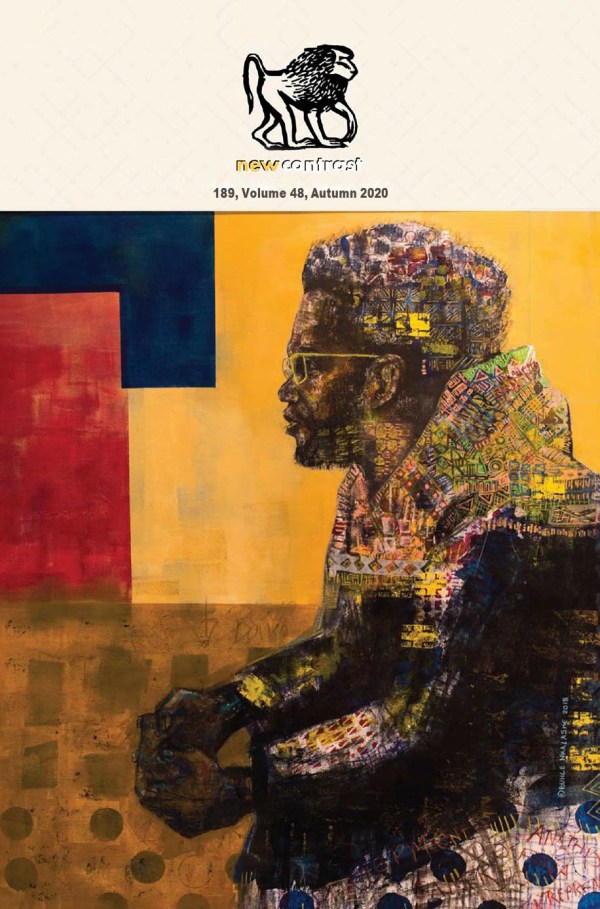
A Profile portrait of an African man, pensive, sitting with his arms resting on his lap and his hands clasped in front of him. He is wearing colourful print clothing and head gear. Blocks of yellow, navy and red make up the background wall.

Front cover art by Buhle Nkalashe

This story appears in New Contrast, one of the first South African literary journals. New Contrast is devoted to publishing the best of poetry and prose, art, reviews and interviews from both local and international authors. I am thrilled to be keeping company with such outstanding poets, prose writers, artists and photographers in this Autumn 2020 edition. Please go the New Contrast website and support this journal which relies on sales of hard-copy print editions. 

Grandmother

I smell meat cooking on the barbeque, innocuous in a typical suburban yard in Blacktown. The warmth of the winter sun penetrates my skin, the grass is cut, the deck needs oil, a scrawny rose bush winds its way too high, clinging to the asbestos wall, clambering up and over into the guttering. My granddaughter, Yasmina, throws a red ball into the blueness of the sky. The smoke twists up through my hair. I close my eyes, listening to the spitting fat.

*

Insignificant popping sounds, spitting, getting louder. A vehicle speeding so late in the winter dark pulls up, brakes screaming. Tyres graze the gravel outside. It seems my feet are walking the icy tiles before my torso leaves the bed. My hands feel for jeans, one leg in and then the other, I pull the denim up over my thighs, scrunching folds  of floral nightdress between the waistband and my skin. The zip bites down hard on the cotton fabric. Beating, clattering, chattering. Giant insects flying frantic against glass, wings flapping.

Running now down the passage into their room. I lift baby warm from her cot curled in blankets and stride skin silent on the floor across to her sister’s bed.

“Boni, Boni, I want you to lie here under the bed. Hold Moratiwa. Don’t let her go. Don’t talk. Whatever happens stay quiet.”

“Yes Mama,” she whispers.

I’m pushing the quilt and a pillow and Boni and Moratiwa under the bed.

Bre-bre-bre-bre-bre … not insects flapping wings  …  bre-bre-bre- bre … no they are not insects. Ghost men with rounded backs, bent men swarm from a white combi van. They run into our neighbours’ yard, the old colonial house is dark behind the trees, its wide veranda grimacing. The servants’ quarters, submissive and small in front of the house near the road.

Bre-bre-bra-bra, lines of yellow light burst from stumpy machine guns into the blackness, into the brick quarters where two young women live.

Peering from the side of the lounge-room window, through the crack where the curtain doesn’t quite cover the night, the grass  quivers, long and colourless under moonlight. The men throw grenades. White light flares up the lounge-room wall. The numbers on the clock flash bright. Short thuds of sound. I drop down, moving on hands and knees across the rug. The sofa and baby’s teddy in the hallway gleam iridescent razor-blade blue, every atom of my body is noise, intense loud limpet, cracking, reverberating circles, flattening my belly to the floor, shuddering walls, shattering windows, pieces of glass falling into my hair.

I crawl up the hallway, into the bedroom, crunch my hipbone cold into the white tiles, clinging to my children, not moving. They  are quiet. The dead night is quiet. There are no sirens, no dogs bark. Gaborone is acrid silence.

*

My son-in-law turns the steaks. The sausages spatter fat at his big-pony Ralph Lauren shirt and he jumps back, his body curves like a letter C. His sneakers are never-been-worn white.

I say, “I like your hair cut Walid. Really smart.”

“Thanks Lena. Got it cut this morning.”

Boni yells from across the yard, “He’s so particular about his hair! He’s been going to the same barber for fifteen years. Won’t let anyone else but Joe cut it.”

“Baby, he’s an expert blender. Not many guys know how to blend.”

“I think he’s got a bit of a bromance going with Joe,” Boni says. She’s wearing a light denim dress that criss-crosses over her back and sticks out like a tent over her pregnant belly, my second grandchild. We already know a boy is on his way.

Walid leaves the meat, comes over and bends his head down in front of me.

“Look here, he cuts with a zero, then a half, then a one, faded high like navy cut with no lines. You know what I mean?”

I nod, “Yeah, I can see.”

“The fade’s the most important part, very difficult to blend from zero to half into one without showing lines. It has to look smooth and crisp. Other hairdressers stop halfway up the back of the head because it’s too hard. Not Joe, he brings the fade right up to the top of the head, seamless. Then he scissor-cuts the top. Strictly scissors. No blade.”

Walid strolls back to the barbeque and starts putting the steaks onto a plate.

“Yeah, he thins out the top so it doesn’t look so thick and the hair sits edgy not flat. That’s the beauty of this cut. I can wear it gelled up like now or I can wear it flattened down to either side, neat like, for work.”

“It’s a smart cut,” I add.

Yasmina runs towards Walid, her arms flailing above her head like a windmill,

“I wanna help Baba,” she says grabbing hold of a steak with her plump little fingers, quickly dropping it in the dirt, looking stunned, about to cry.

“It’s hot Yasmina. Don’t touch anything. Go to Nanna.” He holds their two little white dogs back with his foot as if he’s playing soccer and guides his daughter away from the barbeque.

I call, “Come here Yasmina.”

She walks over, nonchalantly, slightly bow-legged, curly hair dancing in the breeze. Her body is solid in pink and green leggings, a green mouse dances on her tee shirt. Yasmina climbs onto my lap. I hug her, tender skin warm against mine. Boni drags a chair over to where we’re sitting. She’s puffing and as if her tiredness is contagious, I feel deep fatigue, a dark uneasiness.

“Mum, will you come to the delivery again?” “Yes, sure I’d love to.”

“Good, Walid and Moratiwa and you, just like Yasmina’s birth hey?”

“Will they do a caesarean straight away this time?” I ask.

“No, I want to try for a natural birth first. Prefer to avoid caesarean. It’s a pretty major operation.”

My granddaughter sits moist against my body, listening.

“Ok, come and help yourselves to the food,” Walid yells.

Yasmina jumps off my lap and sprints towards him. I half-expect her to fall but she doesn’t.

*

Going home, Homebush Bay Drive exit, diesel fumes slip through the vents. A mammoth truck next to me, another in front. My car, dark- green, 1998, shabby, gets me from A to B, and I fantasise, if I had money, which car would I buy? Not the Mercedes C200, maybe the black Mazda 3 in front, or the orange Toyota Camry with black mag wheels that roars when it takes off from the traffic lights. Roberts Road. Bunnings looms like a military bunker on my left, a red and yellow Maccas flag flies next to the Australian union jack and stars, my country of exile, the bright lights of a petrol station, Oporto chicken. Cruising through the green light across Juno, right up to Punchbowl Road.

I park, trying not to scrape the fence. The outside lights at Koh I Noor Court stopped working last time it rained. We want to pay to get the electrics sorted but strata fees don’t keep up with all the burst pipes and broken windows. A patchy lawn in front of the apartment block. The geraniums flower orange-pink next to the bay tree. The leaves on the dwarf mandarin curl, white with some kind of fungus. I pass my neighbour’s door, climb the stairs, to the same children’s songs I hear every day and every night… and if one green bottle should accidentally fall, there’d be five green bottles hanging on the wall…

Two and a half years since I first became a grandmother, now another grandchild is about to be, being, humans being. Strip off, shower, let the warm water flow down my arms, my legs. Curled up on the bed, comforted by the towelling of my robe, textured against moist skin. Sleep comes easily but briefly, I drift in the space behind closed eyes assailed by gruesome images, flickering faces, distorted, ugly. Unclench my hands one finger at a time, stretch out my arms, try to relax the muscles in my neck.

My  grandchildren  will  never  know  their  maternal  grandfather.  I conjure up the face of RraBoni. He rolls a joint, relaxed, laughing, listening to his favourite fusion. Tilting his head back, he blows wispy, white circles of smoke that hover, gently falling apart over the trumpet lines, the congas, the guitar snaking through Miles Davis, Bitches Brew, the bluesy keyboard on Weather Report’s Birdland. My children’s baby faces — Boni, her brown skin, freckled by the sun, a smiling dimple on her left cheek. These images relieve my nightmares. Moratiwa, more petite, darker skin, darker hair that falls in spirals over her shoulders. The one who is loved. My granddaughter, her brown, gold-tipped curls that spring in all directions, her alert eyes observing me. My yet-to-be- born grandson, another gift from the ancestors.

*

The reflection of my body moves ethereal in the sliding mirror doors of the wardrobe. My existence is enmeshed in history, some parts fluid, some parts rotting, torpid beneath my living. After almost thirty years, I feel an urgent need to tear away the scabs, dig down to the core, the agony. I begin searching, frantic, closed up in my flat. I claw at the skin of apartheid, searching for details of what happened that night. I want to know about the men who planned the killing, the men who murdered, those who justified and covered up the crimes. I trawl the Internet, South African Truth and Reconciliation Commission documents, reports, SABC  videos. There are so many submissions, so much brutality, over 20,000 statements from victims, nearly 8,000 applications for amnesty from perpetrators of crimes against humanity, a small but somehow representative taste of apartheid from the 1st March 1960 to the 10th May 1994.

Still and stiffened into a monstrously crooked position, I read like an addict craving horror, ripping open and exposing the cruel core of a desperate regime. Under the heading, ‘cross-border military operations’, I find testimonies. On 14 June 1985, twelve people were killed in Operation Plecksy … in Gaborone, Botswana. Eight of the dead were South Africans. The others were a Somali citizen, a Basotho child and two citizens of Botswana. Some of the Security Branch operatives who identified the targets and planned the raid applied for amnesty. I read their names. Their words avoid the truth. Their words are small truths, just enough to get amnesty, no more. Some are obvious lies.

A rooster crows next door, another rooster answers from the darkness across the road. I unbend my body, stand and stretch my arms in the air. I can see the tree in our neighbour’s yard. The half-moon has fallen, pale, from the sky and lies trapped in the tree’s branches. I move from one room to another without purpose, walking in the gloom.

Mrs Hilda Phahle addresses the Human Rights Violations Hearing in Alexandra. Our children fled this oppression of this country … the land of their birth, the land of their forefathers. They were tortured beyond reason and fled. The enemy followed them and brutally massacred them … the SADF arrived swearing and behaving like people well-drugged and drunk, ordering George to open the door. The door was blown open … the piano fell against Levi’s bed under which he was hiding. God spared him to tell the story. He watched from under the bed as they pumped bullets into his brother and his wife, bullets penetrating them simultaneously. They turned them over face upwards and one asked, “Is hulle dood?” (“Are they dead?”). “Morsdood” (“stone dead”) was their reply.

My eyes are scratchy in their sockets, my limbs creak like heavy machinery in need of oil. My head, an abandoned factory, echoing the vicious cruelty. Someone walks around the flat below, a door closes, a toilet flushes.

Mrs Phahle wears large, metallic pink-rimmed glasses. A woollen green and red scarf protects her neck from the winter cold. She wraps a Basotho blanket around her shoulders. Her voice has the timbre of mother love, woven loosely with threads of grief and anger. I hear her weariness. Her face is light-skinned, gentle. She says to a television camera,

As Christians we’ve got to accept what has come our way, more so that we cannot repair the damage. The only thing is for us to accept and we pray that such a thing never happens again. That’s all.

I lay on mounds of blanket twisted in sheet. Sleep rises up in the blackness and falls like a small boat on large waves. So many of the living are suffering. I’m fearful the waves will break, and the boat will smash into many pieces.

An insistent electronic pulse draws me from sleep. My fingers fumble with my phone, sliding across the small screen. Turn the alarm off. There is wind blowing outside. A branch of the bay tree scrapes against my bedroom window. I call work. My voice deliberately weak,

“Hi Maureen, I’m so sorry I won’t be coming in today. I’ve got a really bad migraine.”

*

The broken windows allow the frosty morning to creep into the lounge room, over the shattered glass, up the hallway into the bedroom. A bird dares to twitter. I hear the front door open. RraBoni has come home with two friends. They’re holding multi-pronged, metal spikes.

“Look what they threw on the roads. Eeesh, everyone has flat tyres.” My husband is a big man, wide shoulders hunched now. He puts his arm around me and I lean further into the balminess of his body, alcohol and sweat. His face is red from a night of drinking.

“Are the girls alright?”

“They’re fine. Sleeping in our bed.”

“Anyone like a coffee?” I ask.

“I’d love one thanks Lena,” the smaller man says. He is hunched over, shivering.

I turn on the kettle, go to the bedroom and lift the quilt from Boni’s bed.

“Here Motusi.” He wraps it around his shoulders, pastel green, pink, brown squares, elephant, crocodile, monkey and lion.

“Danke Mma.”

“Still no sign of the police,” says RraBoni

I’m careful not to cut myself, fingers like tweezers, picking up the bigger pieces of glass and putting them in a bucket. Sweep the kitchen floor and the hallway.

A BDF army jeep pulls up. We file outside. The grass sways yellow in winter. Everything is sepia, the trees, the gravel, the rusting wire fence. A tabby cat follows us, mewing. Confusing, smoky-meat odour clings to my skin, sweet like almonds. Pieces of the young women’s bodies grasp the fence, the grass, hang from the syringa trees. People come slowly from the flats, from the surrounding houses. Two soldiers throw a long metal box on the ground. We collect a shoe, a bloodied bra, a hand. We collect burnt chunks of flesh. No one speaks. No one cries. We gather the remains of our neighbours into the metal box.

*

It is suburban quiet. Children with shiny skin and bright white socks pass my window on their way to school. My kitchen, fake marble benches, white cupboards, is small but filled with light. I chop apple and banana into a bowl, drink green tea. I will not go to work. Bare feet, hair unbrushed, hunching over the laptop, four days and nights melt into a blistered mass of knobbled ash and grit. Friday, Saturday, Sunday, Monday, searching for detail. Gentle people murdered  in their beds, intellectuals, artists and writers, musicians and teachers. Seven of the twelve associated with the ANC. The killers shot open the front door of Tami Mnyele’s home and machine-gunned the artist as he ran across the backyard. They joked, kicked his corpse and took trophy photographs. Blasted his artwork, splintering his easels and paintbrushes, splattering paint.

Swallow painkillers, stretch my neck, bend my back, my hands dangling at my feet. I fall onto my bed again and stare at the ceiling. The Scottish woman who lives in number nine is talking to our neighbour about his fruit trees. I close my bedroom window and pull the blind.

At two o’clock Tuesday morning, I sit crunched  over  the  laptop. The men in combi vans murdered Duke Mashobane. His six-year-old nephew, Peter Mofoka, fled screaming from the bedroom, wearing flannel pyjamas. They pumped bullets into his small body, continuing at close range long after the boy was dead. Dick Mtsweni, ‘Mkhulu’, was shot and his house set alight. His body burnt to nothing. Michael Hamlyn was executed as he knelt on the floor at the end of his bed, looking up at the attackers, his red hair tousled from sleeping. He was a conscientious objector, who refused to serve in the South African Defence Force. They murdered Somali refugee and Dutch national, Ahmed Geer. His wife, Roeli, eight months pregnant, escaped with bullet wounds to her legs.

Most of those who took responsibility for planning the attack were granted amnesty from human rights abuses. The names of the 5 Recce SADF commandos and the Barnacle operatives from Special Forces are not listed. Those men who drove across the border to take the lives of twelve people didn’t apply for amnesty. I can’t find anything to say they were ever charged for their crimes. One working as a mercenary in Iraq was killed in Al Kut in 2004. His mutilated body was hung up for public display.

My phone rings. “Hi Lena.”

“Walid, what’s happening?”

“Everything is fine. We are at Westmead. Boni’s waters broke about an hour ago. Can you come?”

“I’m on my way. See you soon.”

“Great.”

Travelling through the early morning is like watching a film on the plane without headphones, everything is hushed, just the sound of my car’s engine as I drive the M4 to Westmead.

I’m at the hospital, walking into the birthing room. The lights are dull and Boni is moaning. She’s hooked up to monitors.

Walid smiles, “She’s doing well Lena.”

The nurse says, “Yes, she’s doing very well. She’s dilated to seven centimetres. The cervix has softened. I think it will be a vaginal birth this time.”

I place my hand on Boni’s forehead. Her hair sticks to her skin. She’s groaning and her lips are dry. I offer her some lip moisturiser. She digs some out of the small pot, her finger shakes. Smears it greasy over her mouth.

“Is Yasmina with your sister?” I ask Walid.

“Yes, she’s sleeping. Anisa’s at home with her.”

Boni moans and yells, “I can’t stand this pain.” She breathes out, grabs the gas and sucks on it.

“I’ll just be waiting outside.” I stroke Boni’s arm, then leave the room, walking across the shiny floor into the corridor. Sitting on a hospital chair, dread filters through my pores like grimy smog.

The passageway is empty, no sound other than the groans and she-wolf howls of women giving birth. I take a pen from my bag, bend down and scratch hard into the vinyl floor. Gladys Kelope Kesupile and Eugenia Kakale Kobole. A man pads around the corner wearing  a surgical gown. I pretend I’m picking up the pen from the ground.  He doesn’t look at me. Bending again I write, We have not forgotten. I scratch the words over and over, so they are etched deep and black into the beige vinyl. Gladys and Eugenia came to Gaborone for work, one  a typist, the other a domestic worker, not even twenty years old. That night they walked home from a prayer meeting. The killers came as they lay sleeping in their beds.

In the corridor under neon lights, I unlatch my consciousness, trying hard not to sink into pools of unarticulated fear. I sit waiting for my second grandchild, waiting for everything to be all right.

J.D. Salinger’s daughter quotes her father as saying he never really got the smell of burning flesh out of his nose entirely. No matter how long you live, that smell remains. I remember our neighbours, the two young women blown apart that indignant night. The fragrance of their lives is as fluid and volatile as the corpuscles in my blood.


In this issue of New Contrast:

Interviews:

  • An Interview with Buhle Nkalashe by David Griessel

Poetry

  • Kobus Moolman, Henry and June / The Earth is Flat / I Am Made
  • Juanita Louw, Homogeen / Love Machine
  • Rizwan Akhtar, Last Year / Now We Will Say “Happy New Year”
  • Steve Lambert, Unbecoming / Ars Poetica
  • Fiona Zerbst, Closer to Light / On the Edge of Darkness / Portrait of Three Lions
  • Bibhu Padhi, Another Need / The Address
  • Warren Jeremy Rourke, Washing Up / Double Rainbow
  • Johann Lodewyk Marais, Die stasiewa / Die eerste wens
  • Stuart Payne, The Planet
  • Justin Fox, Building Wall
  • Stephanie Williams, Mother / Let’s Talk
  • Alessio Zanelli, Hiker and Lines / Dear Old Beloved Padan Fog
  • Sarah Frost, Gold
  • Ian Salvaña, This Town We Left To Miss, You Said, Is Home / The Birthing of a Poem
  • Tom Paine, Seeds / Kamikaze Bees / That’s All

Prose

  • Gaele Sobott, Grandmother
  • Melissa Gow, One of Us Is Bleeding
  • Jonathan Tager, Guidestar
  • Rémy Ngamije, Black, Coloured And Blue (or, The Gangster’s Girlfriend)

Artworks

  • Jono Dry, In My Silence / Restrained I Unravel / Wrapped in Tradition / Separation


To purchase this issue (R120) email the business manager at business@newcontrast.net
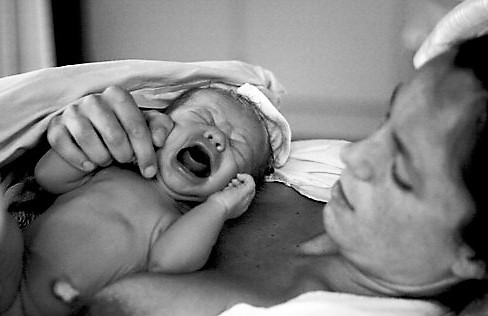
Black and white photograph of a mother holding a new born baby on her chest. The baby's mouth is wide open, crying.

The Cry Room by Gaele Sobott

Published by Verity La

What does it mean to be born outside of marriage to a mother who wonders if the bleats of a goat are your first cries?

Birth

I just slipped out she said. Like a slip of the tongue, slipshod, a slip stitch forever unknitted. I was born. Slippery, sibilant, small in the scheme of everyday lives. Nothing stopped. There were no celebrations. I was born and everyone got on with their work in the power station, the briquette factory, the mine, a gaping, brown open-cut.

She hung the nappies and sheets on the line, coal dust settling on the whiter than whites, on the window sills and mantle pieces, on the froth of the men’s beer, in our lungs. I was two-months old. Thin and pale, she shivered, her breasts bulging red and hot above her shoulders, a painful mountain range of igneous rock. Mastitis the doctor said. Milk fever, once a reason for admitting women to the insane asylum.

He laughed with a fat, purple face and said, ‘Keep breastfeeding! Let the baby suck’.

Not having a bar of it, my mother put me straight on the bottle.

She laid me down to sleep, seething ready to explode because my father’s English friend from the Woodcraft Folk was Morris-dancing in the bathroom day and night, until he got a desk job at Maryvale Paper Mills. Then he moved out.

Irene, our neighbour, would throw me around like a football and babysit when my parents went to Hamish Gardner’s house for Communist Party meetings. Dad was a proud member of the Trades and Labour Council, a deputy rep for the Transport Workers Union. He drove the bright-yellow Euclids carting overburden from the coal deposit.

The women went to Party meetings but my mother would rather have been at the picture theatre with its curved façade and big clock embedded into beige bricks. In summer, they turned on the air conditioning. In winter, she could take off her shoes, rest her feet on hot-water warmers and watch Vincent Price murder people in The House of Wax, 3D technicolour on a panoramic screen.

She took me with her once when I was a baby and sat at the back of the auditorium in the soundproofed, glass-fronted, cry room to watch East of Eden. I slept and she cried. My mother would sit in the cry room. Often without me.

In the theatre, she always refused to stand for the national anthem.

At home, she took a failed dish of bread and butter pudding from the oven, cried, splattered it against the kitchen wall.

What does it mean to be born in a town purposely planned and built, then purposely demolished for the coal that lays beneath it?

My birthplace is an ever-expanding, dark and greedy hole in the ground. With heat and oxygen, the coal spontaneously combusts. Lignite dust bursts into flame at the drop of a match, a spark, a welding torch, a yellow flash igniting in mid-air. Volatile, toxic. Giant, cylindrical cooling towers, chimneys, steel girders, high wire fences, power lines.

My birthplace is Brayakaulung land, Gunaikurnai, cleared, windswept, foothills.

What does it mean to be born to land where the ancestors are denied, where they are brutalised? Do they know my footsteps, my birth spirit?

My blood ancestors, Polish, Italian, Scottish, do they know my footsteps, my birth spirit?

Birth

I walk the short corridors of a small hospital, Bamalete Lutheran. I’m the heaviest I’ve ever been. Seventy-four kilos. Twenty-four years old like my mother when she had me.

First baby. My father drove to Melbourne to collect his friend from England.

First baby. My daughter’s father is out with friends.

The walls are green gloss, the floor concrete, painted dark red, polished, worn where I walk.

I walk because the nurses tell me I should. Read the birth records open on the counter in front of me. Stillbirth. Don’t think about it. Float.

The nurses give me an enema, warm and wet, not painful.

Cow bells ring hollow and deep. The land is dry, gold, studded with small trees and shrubs. I’m on my back on the bed. The midwife checks dilation.

‘Don’t hyperventilate. Breathe normally’, she says.

I read about the breathing in a book. Neon light.

The doctor is at the end of the bed. A tall German woman telling me to push. Round pain, rhythmic, I float. From deep within the back of my head I float. My hip bones separate like a spatchcock cut with kitchen scissors, pressed flat on the white sheet, I rip, a goat bleats at the window.

Release.

My baby cries.

Ten fingers. Ten toes. She is big.

A big baby.

Relief.

We wait as my uterus presses down. A balloon shrivelling in on itself, contracting against the placenta, the temporary organ I have harboured, accepted and must now expel. Every process orchestrated by this new child in the room.

The midwife wants to sew the tear that extends from my vagina to my anus.

The placenta is ragged maroon not flat-cake perfect circle. We wait for more contractions. My skin smells damp, of freshly-cut grass, metallic.

The needle in and in and in and in.

Is it curved this needle?

Is it huge, with a big eye?

Black thread pulls through my tenderness. Pulls me back together, hurting. No pain killers.

The nurse tells me to get up and walk to the room.

I lie on my bed. My baby next to me in a Perspex cot. Sleep.

She cries. I take her. Sleep.

A nurse holds her to my breast. She sucks. Sleep.

I wake. It feels like I’m giving birth again. Waves of pain.

I tell the nurse.

She smiles, ‘The uterus contracting back to its pre-birth size. It’s nothing to worry about’.

I can’t float. The nurse brings tablets. They dull the pain. Sleep.

The light bulb hangs from the ceiling, stark and still. I sit up to look at my baby, eyes closed, her chest rising and falling rapidly, small lungs, heart, kidneys learning how to work in this world, outside me.

A spider, light brown and black, with very long front legs speeds across the wall above her cot.

My feet feel the cold of the concrete floor. Trembling, I take her wrapped in pastel yellow, blue and pink softness, and hug her close to my chest.

Indecision and anxiety prickle my skin. The spider waits for my next move. I bend over, clutching my baby with one arm, grab my shoe and throw it. The spider falls. I’m not sure if it’s dead. Part of a spindly leg sticks to the wall.

At home with my baby. I am frightened to hold her in water, to rub her skin with soap. My breast swells, lumpy, the ducts blocked.

The doctor gives me antibiotics for mastitis. I keep feeding.

She cries. Every night she cries.

I pull my hair, fighting the temptation to throw her across the room.

So tired.

We drive dark streets and she sleeps. Drive and cry. I am very thin. Mosetsi.

What does it mean to be born outside of marriage to a mother who wonders if the bleats of a goat are your first cries? What does it mean to be born to land that your mother came to as an adult? That your father’s mother came to as an adult? Bamalete land, Bangwaketsi land where your father and his father and all the fathers going back in time are deeply rooted in the sand, deeper than the roots of the shepherd’s tree?

Who knows the vibrations of your feet on the earth?

Who knows your birth spirit?

Who do you become?

Read more of The Cry Room at Verity La 

© 2018 Verity La. All Rights Reserved.

Dignity is essential. It means we are viewed by the other as a human being : an interview with Alice Cherki

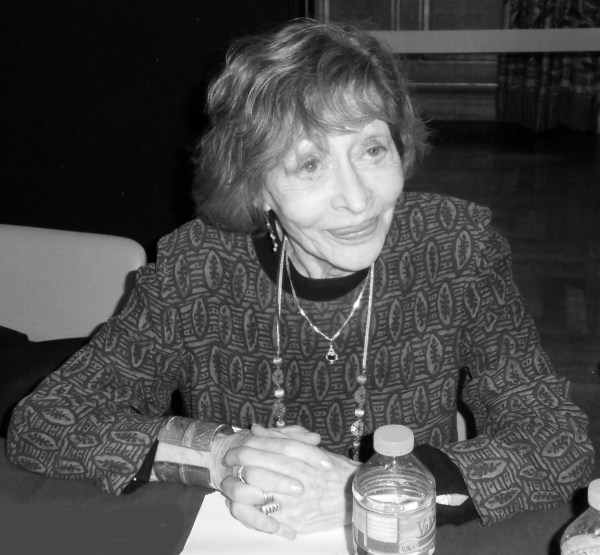
A recent black and white photograph of Alice Cherki, sitting at a table, smiling.

Alice Cherki

ALICE CHERKI is a psychiatrist, psychoanalyst and author. Born in Algiers, 1936. She knew Frantz Fanon well, working by his side in Algeria and Tunisia as a psychiatrist, and sharing his political commitment during the war of independence in Algeria.

Alice Cherki has lived in France since 1965. She is co-author of the books, Retour à Lacan (Fayard, 1981) and Les Juifs d’Algérie (Editions du Scribe, 1987), and author of La frontière invisible (Editions des Crépuscules, 2009) Frantz Fanon, portrait (Seuil, 2000) translated into English by Nadia Benabid and published as Frantz Fanon: A Portrait (Cornell University Press, 2006) and Mémoire anachronique (Editions De L’aube, 2016).

Gaele Sobott: Can you talk a little about the history of your family, your place of birth and your childhood?

Alice Cherki: I was born in a family of Jewish Algerians who were in Algeria since the Romans or before the Romans. My parents were born in the small towns of Medea and Ksar Bukhari but they met in Algiers. I was born and I lived in Algiers. I am Algerian, voilà!

Some of my family are Jewish Berbers.

GS: Were there Jewish people in Algeria before the Arabs?

AC: Yes, the majority were there well before. Some came later in 1492 from Spain through Morocco, others from Italy, and then Alsatian Jews, but at that point it was already colonial Algeria.  Many of those left again and went elsewhere. But most of the Jews of Algeria had been there for a very, very, very long. Some of them were Berbers who converted to Judaism. I belong to that history.

GS: Did you speak Arabic?

AC: Very little. I’m not very good at languages. I come from the same environment as Derrida. at school, we learnt Latin and Greek.

GS: Did you know Derrida?

AC: I knew Derrida very well. He was eight or nine years older than me and that represents a big difference but yes I knew Derrida well.

Like Hélène Cixous and Derrida, my childhood was marked by the Vichy anti-Jewish legislation which excluded Jews born in Algeria, denied us French nationality, the right to go to school, the right for Jews to work in government administration. This was hugely traumatic for me as a child.

One Christmas, I was 4 or 5 years old, my teacher said, “Tell your mother that after the break you must not come to school anymore.”

When I asked her the reason, the only answer I got was, “It’s because you’re Jewish.”

I didn’t know what that meant.  So, I gathered my courage and asked, “What’s Jewish?”

She replied, “It’s you with your big eyes, big mouth and big ears.”

Each of us, as Derrida also relates, was excluded from school, our parents could no longer work.

GS: How has this experience affected your adult life?

AC: It opened my eyes to the injustices of the world in which we live; a world marked by colonial ideology.  In Algiers in the 1950s, there was no intersection between Europeans, the Jews and Arabs –  the so-called natives. I didn’t experience it at home but we were caught up in all that. I talk about it a little in my book, Mémoire anachronique.  Everyone lived in their own sphere. Some of us would meet each other outside these spheres.

During my early years at primary school there was no mixing at all. In Grade 6, there were some girls; Rachida, Malika.  For the whole of my secondary schooling I only knew of one Algerian woman student even though my school was not the most snobbish high school in Algiers.

GS: It was the same principle as Apartheid?

AC: The same principle except that it was more camouflaged. Algerians were contained in their own neighbourhoods. Even the bourgeois had their areas. The Algerians passed like shadows in the European neighbourhoods

GS: What area of Algiers did you live in?

AC: I first lived on the border of a working-class suburb, near the boys’ school, known then as Lycée Bugeaud, now it’s called Lycée Abdel Kader. Later, at the age of 17, we moved to Central Boulevard in Hydra. Our house was on a piece of land owned by my uncle –  my father’s brother, my father’s sister, and my father. After some years, they managed to build a three-storey house there for the three families.

GS: What did your father do for a living?

AC: My father traded in cereal. He carried out transactions with farmers for the export and import of chickpeas and lentils.

GS: How did your interest in psychiatry come about?

AC: Firstly, it was a struggle for me as a woman to study. After I passed my baccalaureate, even though I was from the middle-class, it was not usual for women to continue their education. Women were expected to marry and so on. I had an older brother and a younger brother and was the only girl. Neither of my parents continued their studies. My father, a brilliant student, was pulled out of school at age 16 by his father. He was the eldest of ten children There were two or three girls before him so he had to work. I believe my mother chose to leave school to get married. When she met my father, she dropped out.

My parents were both very intelligent and relatively progressive. My father spoke Arabic, but they did not have a higher education.

I already had a certain outlook on society and I was more inclined towards literature. I wasn’t a good student and had never received any awards for excellence. I was impertinent and people always told me I would make an excellent actress. With no one to advise me, in those days, if I had decided I wanted to be an actress, it would have been worse than deciding to be a prostitute. Having said that, I did later have the luck to meet many people who became involved in theatre.

So, I found myself first in hypokhâgne and then khâgne. You know what they are?

GS: No.

AC: Preparatory literary classes for the grandes écoles. The equivalent also exists in the scientific field. I was interested in studying philosophy but decided that would mean cutting myself off from the real world. I made up my mind that I wanted to be useful so I chose to study medicine. But very soon I realized medicine didn’t meet my needs. It was all about identifying symptoms and responding with treatments. I remember a teacher saying, “But Mademoiselle, you ask too many questions.”

We never say, “Why” in medicine. Instead we talk about, “How to fix it.”

So, I was part of two cultures; one of interest for human beings and their psyche, and the other a group culture which stemmed from my medical studies.

GS: Were there other women you knew of who were studying medicine then?

AC: There were a few, but they were a definite minority.

There was a saying that summarized the situation quite well. It relates to sitting the intern examination:

If you are white, European and male, you have an 80% chance of sitting the exam. If you are female and European, you have a 60% chance. If you are Jewish and male, you have a 50% chance. If you are female and Jewish, you have a 25% chance. If you are Muslim and male, you have a 10% chance. As for being Muslim and a woman, you are not even mentioned because you just don’t get the opportunity.

Some managed to study medicine or become trainees but none got to sit the intern examination, voilà!

GS: When did you meet Fanon for the first time?

AC: I was part of a youth movement called AJASS (Association of Algerian Youth for Social Action) and Fanon was invited to give a lecture by a friend of mine, Pierre Chaulet, who died recently. It was a lecture on fear and anxiety in 1955. I must have been 19 or 20 at the time and had to leave my parents’ home where I’d been living. Most of the interns at the hospital were French-Algerian and because of my opinions I faced all kinds of problems. My car tyres were punctured, my white doctor’s coat soiled, my files stolen. So, when Fanon found out I wanted to do psychiatry, he told Pierre Chaulet I should come and intern under him at Blida psychiatric hospital.

GS: So you lived at the hospital in Blida?

AC: Yes, as an intern. That’s where I met my husband, Charles Géronimi. He shared my ideas, but having Corsican parents, teachers but Corsicans, they had trouble accepting a little Jew in their family, especially my mother-in-law.

GS: What were your first impressions of Fanon?

AC: My first impressions, at 20, I found everything he had to say very interesting and didn’t think of him as black. He analysed the subjectivity of racism which was very different from the discourse of the time. On the one hand, we had Existentialism and on the other, Marxist materialism which didn’t include questions of subjectivity. It was the first time I’d met someone who was only 10 years older than me but had immense experience, and a developed understanding of these two worlds, of the two ‘ideologies’.  He was neither on one side nor the other which met my expectations, answered my questions.

GS: He had practical ideas?

AC: Yes, he was a hands-on kind of man.

GS: That’s to say, the development of his thought was founded not only on the theoretical but also on his lived-experience?

AC: On his experience, yes. And that also pleased me. It was from his lived-experience that he elaborated his ideas. But he also had very advanced psychiatric training.

GS: What were some of the work experiences during your time with Fanon in Blida that influenced your practice of psychiatry?

AC: Everything he brought to psychiatry, especially his critique of the School of Algiers’ theory of primitivism. He also introduced social therapy, institutional psychotherapy.

GS: How do you define institutional psychotherapy?

AC: Institutional psychotherapy, as developed by Tosquelles, took off in France with the support of Oury and Bonnafé. It encourages the residents of psychiatric institutions to share things with their caregivers. Through humanising the functions of these institutions, it allows understanding not only of patient symptoms but also the roots of these symptoms. There are still two or three people in France who are struggling to create places that foster institutional psychotherapy, but it is becoming more and more difficult.

GS: Why is it becoming more difficult?

AC: Because of the prevailing ideology. Now we have DCM 3, DCM 4, DCM 5. It is a performative ideology that absolutely bypasses all subjective aspects of alienation.

GS: Did you have any significant experiences in the hospital setting as a female doctor caring for patients in that historical and social context?

AC: What do you mean by significant experiences?

GS: For example, when you worked at Joinville-Blida Hospital, were there certain events that affected you?

AC: Yes, of course.

GS: What were they?

AC: So many things. For example, I saw women hospitalised after childbirth for postpartum, transitory delirium. Some doctors didn’t understand and sometimes even people in the women’s families said, “It’s the djnoun who came to inhabit her.”

It affected me deeply because  I wanted to ascertain their experience of the delivery because it influences their relationship to the newborn baby.  It’s a complicated relationship.

GS: Did you have your own children at that time?

AC: No, I had no children at the time. I now have a son who is 40 years old. He studied political science and then he got involved in theatre.

GS: So, he is fortunate?

AC: Well there you have it.

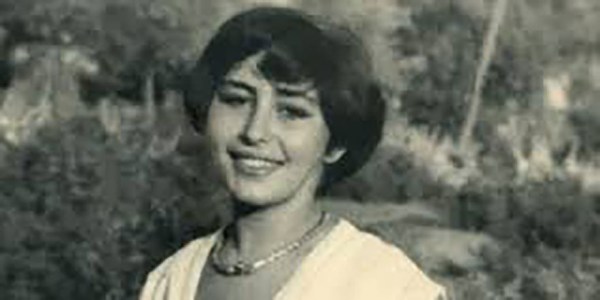
Black and white photograph of Alice Cherki as a young women. She has short, dark hair, is wearing a white, V-neck dress and a necklace, and she is smiling.

GS: As a female doctor, what were your professional relationships like with your colleagues at the hospital?

AC: Amongst us interns at the psychiatric hospital of Blida, I was considered an equal.

I married an intern from the hospital. No, I can’t say I had any problems. On the other hand, before that when I was at the Mustapha Hospital in Algiers, I was very young, I did my hair in a bun and put on big glasses to make myself look older so I’d be left in peace.

GS: Was your husband originally from Blida?

AC: No, he was also from Algiers but he was an intern with Fanon in Blida. They wrote a paper together on Algerian women and the cultural specificity of TATs (Thematic Apperception Tests).

GS: In your book, Fanon, Portrait, you mention a meeting between Fanon and Jeanson. (1)

AC: Yes.

GS: In that meeting Fanon expressed his wish to go beyond certain ideas so that readers can experience aspects of life that they could never know firsthand.  You talk about Fanon exploring the sensory dimension of language. Do you think that this approach to writing could enable us to communicate experiences around difference, to understand our differences from an egalitarian point of view – not superior or even inferior?

AC: Yes, I think this type of writing is essential. In my experience, sensory writing starts from perceptions, sensations to try to improve communication with the other, I think it is very, very necessary.

GS: Do you know any writers today who write like that?

AC: I’m not qualified to say. I don’t know today’s writers that well. But Kateb Yacine wrote like that.

GS: Do you see difference as a dialectical space that can trigger creativity and imagination?

AC: Yes, that’s what I call the relationship to the other, the recognition of the outside, the stranger. It is important. I wrote another book called La frontière invisible, in which I insist on the relationship to the other. This allows you to accept the outsider in yourself.

GS: In your book, La frontière invisible, you link psychoanalysis and politics. I understand colonial violence, violence of displacement, violence against the subject in the social context, the context of specific historical and political circumstances, for example, those of Algeria and France. But when I try to analyse this violence from a psychoanalytic point of view, I find it difficult to understand.

AC: It is complicated. But you have sought out strangers?

GS: Always, yes.

AC: Perhaps it’s not by chance.

GS: Perhaps not.

Did you know Fanon outside his work, in his family life? What kind of man was he as husband and father?

AC: Yes, of course I had the opportunity to know Fanon outside his work. I knew his wife well and I know his son very well. As a dedicated husband and father. At the same time, he was a very busy man. But he was very dedicated to his family. When his father left for Africa, Olivier didn’t see him that often only from time to time when Fanon came back from working there.  Olivier was only five when his father died.

Fanon loved life. He liked to go out to dinner, go dancing, things like that.

GS: What type of dancing did he like?

AC: All the dances of that time, le slow, the rhumba . . .

GS: Did you like to dance?

AC: It has been a long time since I really danced but yes at the time I loved it.

GS: At friends’ places?

AC: Yes.

GS: What type of music did Fanon like?

AC: He especially loved Caribbean music.

GS: And you?

AC: Back then my tastes were very eclectic. I liked the Arab-Andalusian, Jewish-Andalusian music right through to Bach, Beethoven, Mozart and then Jean Ferrat, Barbara, Montand. More and more now I love Musique Concrète.

GS: Tell me more. 

AC: When I was a psychoanalyst, I was working very hard. In the evening, when I had finished working and my head was full of words, words, words, I’d play the likes of Kurtág and Blériot. The music is largely based on the sonority of the human body. It defies the normality of melody. It’s best to listen to it alone. There are not many people who love and desire that genre of music. It scares them.

GS: What kind of a sense of humour did Fanon have? What made him laugh?

AC: He had a great sense of humour, Fanon. It was humour that made him laugh.

GS: People who are very involved in revolutionary struggle often dedicate huge amounts of time and energy to the cause, and I suppose that doesn’t allow them to be very good parents.

AC: That’s true, yes. Especially at the time because the people involved in the struggle were very young.

GS: Have you met children whose parents were not only very involved but who were tortured, wounded or killed as part of the struggle?

AC: Yes, children who became orphans.

GS: Regarding the children of revolutionaries, what observations have you made?

AC: It was very variable. For example, Fatma Oussedic, her father was a great militant and she has good memories of her relationship with him. In addition, many families did not only consist of the father and mother, there were, aunts, uncles, cousins etc. They weren’t nuclear families. If we’re talking about orphans this helps a little. But when you see your parents killed before your eyes, that’s not the same thing. As for the children of the surviving revolutionaries following independence, the notion that their fathers are heroes has weighed heavily on many of them.

GS: Would you mind giving me a brief definition of your concept of alienation and the ways it may be experienced in countries marked by colonisation.

AC: That’s a big question. Both the coloniser and countries who achieved their independence, like Algeria, deny in various ways the colonial wars that have taken place. Algeria swept a large part of the past away by claiming the national story begins at the time of Independence. Generations have been taught that they have one history, one language, one origin. This kind of discourse has done a lot of damage. There are many young people who now don’t know who they are.

GS: How does that manifest psychologically?

AC: It varies considerably and is different in Algeria and in France. Here in France these young people are excluded from participating in the inner circle, In Algeria they are divided. There is group of social conformists who represent the youth, and another group of which no one ever speaks but which gnaws away at the heart and soul of the country.  Young people are suffering a great deal, even those who are socially successful. Many young people ask, “What was Algeria like before 1962?” Many are Berbers. The heterogeneity of their roots has been hidden from them. It is as if these roots don’t exist but they are longing for what I call multiple identification … not to be cast in a single mould.

In France there are many young people who describe their lives very well and write novels. Some are very interesting, written in the language of the suburbs. For example, Sabri Louatah, Les Sauvages.

GS: What is your definition of dignity, especially the dignity of colonised people, people considered mentally ill or disabled?

AC: Dignity is essential. Dignity means we are viewed by the other as a human being.

GS: In revolutionary situations, when a group of people can no longer withstand massive pressure and extreme violence, they react violently to create a change in the power structure. This changeover is often quick, lasts for a moment, the objective is specific: to get rid of the immediate cause of the violence that oppresses them. Beyond this moment of revolutionary violence, what measures do you think people can use to get rid of the everyday violence that continues?

AC: Firstly, to speak.

GS: To whom?

AC: Speak, tell, write. . . I think there are many forms of expression, of creation. Because we must get by. We must get out of the stupor. The essential thing is to get out of it, including through collective struggle.

GS: What for you is the most urgent task required to change human relations in the future? What needs to be done to update and develop new definitions of power?

AC: We need to do work in many areas if we are going to change human relations and bring about new definitions of power. Each person should focus on their own domain, the place where they live. It’s true, like many people, I feel I am very active and committed. At the same time, I denounce all modes of liberalism and things like that.

GS: How do you define liberalism?

AC: It is being governed by financial capitalism which transforms the subject into an object.

GS: Is it enough to denounce? Sometimes I get the impression that it is useless.

AC: I know it well. Organisations are important. There are organisations, people who are militant. I am fortunate to have a son, and nephews who are politically engaged in their fields. Me, everyone knows my positions, my writings. My son works in theatre. They go to schools, to high schools. I am not against the revolution.

GS: Do you think that as individuals, we are afraid of revolutionary violence, afraid of revolutionary confrontation?

AC: It depends. There are many people who are afraid of violence. In my case, I’m not afraid. Many French people want to stay in their little cocoons. In Europe, the French are very much like that, withdrawn on their plots of land, and yet they made a revolution.

But I believe violence is . . . for example, what happened in 2005 in the housing estates, with Sarkozy insulting everyone. People called them riots but I called them revolts. Those young people were not afraid.

GS: It is temporary, a moment?

AC: Revolution is always like that. It’s a moment. But moments that produce difference. Every revolutionary moment must be seen as the introduction of change.

GS: Even if it takes a long time to get to that point.

AC: Yes, like psychoanalysis.

GS: Why did you choose to become a psychoanalyst?

AC: Because I found it was the best way to understand the psyche and help people. It’s exciting, I love it, yes, I like it very much.

GS: You must undergo psychoanalysis for several years to be a psychoanalyst?

AC: Yes, you do. It’s experience. You see, even you talk to an 80-year-old woman who is a psychoanalyst and it’s fine.

GS: Yes, it’s been good.

AC: I have lots of stories to tell. I am attentive to other human beings.

GS: Ah yes, but not all psychoanalysts are like you.

AC: That’s true.

GS: Did you have any conversations with Fanon about the ‘Jewish question’ or the events that led to the establishment of the State of Israel?

AC: Of course, Algerian Jews, like myself and Jacques Azoulay, worked with Fanon in Blida. Fanon had very close Jewish friends in Tunis. The subject of the establishment of the State of Israel was far from our concerns. Fanon was profoundly atheist. I, too, am an atheist. We were part of the struggle for Algerian independence, there was never any conversation about the existence of God for example. Those questions and discussions were not on our radar.

GS: But religious discourse was there nonetheless with Messali . . .

AC: Oh, yes. Those discussions took place within the independence movement. It was very heterogeneous. There were plenty of different poles of thought, different ideas. For example, Fanon, returning from sub-Saharan Africa, jokingly said to his colleagues, to the revolutionary friends of the mujahidin, that they should follow the example of Islamic Africans, their wives can walk topless. He said that jokingly. I mean the issue of Islam as a fundamental direction was probably underestimated, but religion was not ubiquitous in our workplace. I think, even Messali, he was for independence from France, he was married to a French woman, he wasn’t a religious Iman.

GS: When and why did you leave Algeria? Do you consider yourself a woman in exile?

AC: I did not really leave Algeria. I settled in Paris but with frequent trips to Algeria and back. I’m not in national exile and I think exile of the psyche is the hallmark of any successful human life.

Notes:

1. Alice Cherki refers to a meeting  between Fanon and Jeanson in her book, Fanon, portrait (Seuil, 2000), however the English translation, Fanon: A Portrait, (Cornell University Press, 2006) refers to a letter.

Alice Cherki was interviewed by Gaele Sobott in Paris, 26 September 2015 and by email between 18 and 20 November 2016.

Translated from French by Gaele Sobott

Creative Commons License
“Dignity is essential. Dignity means we are viewed by the other as a human being”: an interview with Alice Cherki by Gaele Sobott is licensed under a Creative Commons Attribution-NoDerivatives 4.0 International License.

La dignité est essentielle. C’est être regardé par l’autre comme un être humain : un entretien avec Alice Cherki

SAMSUNG DIGITAL CAMERAALICE CHERKI est psychiatre, psychanalyste et auteure.  Née à Alger, 1936.  Elle a bien connu Frantz Fanon, en travaillant à ses côtés, en Algérie et en Tunisie dans son service psychiatrique, et elle a partagé son engagement politique durant la guerre de l’Independence d’Algérie. Elle vit en France depuis 1965.  Elle est coauteur des livres, Retour à Lacan (Fayard, 1981) et Les juifs d’Algérie (Éditions du Scribe, 1987), et auteur de La frontière invisible, (Editions des crépuscules, 2009) Fanon, portrait (Seuil, 2011), et Mémoire anachronique (Editions De L’aube, 2016)

Gaele Sobott: Pouvez-vous m’en dire un peu sur l’histoire de votre famille, votre lieu de naissance et votre enfance ?

Alice Cherki : Je suis née dans une famille de juifs d’Algérie qui était installée là depuis les Romains ou avant les Romains. Mes parents sont nés dans les petites villes de Médéa et Ksar Boukhari. Mais ils se sont rencontres à Alger. Je suis née et j’ai vécu à Alger. Je suis Algéroise, voilà ! Une partie de cette famille est juive berbère.

GS : Y avait-il  des Juifs en Algérie  avant les Arabes ?

AC : Oui bien avant, majoritairement.  Quelques uns sont arrivés d’Espagne en 1492 par le Maroc, d’autres d’Italie, et ensuite des Juif alsaciens, mais c’était déjà l’Algérie coloniale, beaucoup d’entre eux sont repartis d’ailleurs. Mais la plupart des Juifs d’Algérie étaient là depuis très, très, très longtemps. Certains d’entre eux étaient des Berbères judaïsés. Moi j’appartiens à cette histoire-là.

GS : Est-ce que vous avez parlé l’arabe ?

AC : Très peu. Je ne suis pas très douée pour les langues. Et en plus, je suis un peu comme Derrida. On a vécu certainement dans le même milieu et puis à l’école, on apprenait le latin et le grec.

GS : Vous avez connu Derrida ?

AC : J’ai très bien connu Derrida. Il avait huit ou neuf ans de plus que moi et ce qui représente une grande différence mais oui j’ai bien connu Derrida.

Mon enfance a été marquée tout comme Hélène Cixous et  Derrida par les lois de Vichy qui excluaient les Juifs nés en Algérie, les destituaient de la nationalité française, du droit à fréquenter les écoles et à exercer dans les administrations. Vous voyez, cela a été un grand traumatisme d’enfance.

A 4 ou 5 ans, à Noël mon institutrice m’a dit,  « Tu diras à ta mère qu’à la rentrée, tu ne viens plus à l’école. » 

Lorsque je lui ai demandé la raison, j’obtiens pour seule réponse, «  C’est parce que tu es juive. » 

Moi, je ne savais même pas ce que ça voulait dire. J’ai pris mon courage à trois mains et je lui ai demandé, « Etre juive c’est quoi ? » 

Elle m’a répondu, « C’est être comme toi avec des grands yeux, une grande bouche et des grandes oreilles. »

Chacun d’entre nous, comme le raconte Derrida, a été exclu de l’école, nos parents ne pouvaient plus travailler.

GS : Comment est-ce que cela a marqué votre vie d’adulte ?

AC : Cela m’a ouvert les yeux sur l’injustice, sur le monde dans lequel on vivait, un monde marqué par l’idéologie coloniale, pas chez mes parents, mais on était pris dans ce mouvement-là. A Alger dans les années 50, il n’y avait pas d’intersection entre les différentes sphères. Il y avait les Européens, les Juifs et ceux qu’on appelait les Arabes, les indigènes. Il n’y avait pas d’interpénétration. J’en parle un peu dans mon livre, Mémoire anachronique. Chacun vivait dans sa sphère. Les rencontres se faisaient à l’extérieur.

Quand j’étais dans les petites classes où la mixité n’existait pas à l’époque, il y avait quelque filles qui s’appelaient Rachida ou Malika, mais dès que je suis rentrée en 6e, dans ma classe il n’y avait qu’une seule Algérienne pendant toute ma scolarité secondaire et pourtant j’étais dans un lycée qui n’était pas le lycée le plus snob d’Alger.

GS : C’était le même principe que l’Apartheid ?

AC : Le même principe sauf que c’était plus camouflé. Les Algériens étaient contenus dans certains quartiers. Même les bourgeois avaient leurs quartiers. Les Algériens passaient comme des ombres dans les quartiers Européens.

GS : Vous habitiez quel quartier d’Alger ?

AC : J’ai d’abord vécu près du lycée de garçons, le lycée Bugeaud, devenu maintenant le lycée Abdel Kader, à la frontière du quartier populaire. Plus tard, à l’âge de 17 ans, nous avons emménagé sur le boulevard central, à Hydra, dans une maison sur un terrain qui était une copropriété appartenant à mon oncle, le frère de mon père, la sœur de mon père, et mon père. Ce n’est qu’au bout d’un grand nombre d’années qu’ils sont parvenus à y construire une maison à trois étages pour y abriter les trois familles.

GS : Quel métier exerçait votre père ?

AC : Mon père était céréalier. Il faisait les transactions avec les agriculteurs pour l’exportation et l’importation de pois chiches et de lentilles.

GS : A quand remonte votre intérêt pour la psychiatrie ?

AC : J’ai d’abord beaucoup lutté pour faire des études. Quand J’ai passé mon bac, même si je venais de la moyenne bourgeoisie, ce n’était pas classique que les femmes continuent leurs études. Pour eux, c’était le mariage et cetera. J’étais la seule fille. J’avais un frère ainé et un frère cadet mais mes parents n’avaient pas fait d’études. Ils avaient été tous les deux retirés de l’école.

Mon père, un brillant élève, a été retiré du lycée à 16 ans par son propre père parce que c’était une famille de dix enfants et qu’il était l’aîné. Il y avait deux ou trois filles avant lui et il fallait qu’il travaille. Ma mère a choisi de quitter sa classe de première, je crois, au lycée pour se marier. Quand elle a rencontré mon père elle a abandonné ses études.

Mes parents étaient tous les deux étaient très intelligents et plutôt progressistes. Mon père parlait l’arabe, mais ils n’avaient pas fait des études supérieures comme on dit à l’époque.

J’avais déjà un regard sur la société. J’étais plutôt littéraire. Je n’ai jamais eu de prix d’excellence parce que je n’étais pas une bonne élève. J’étais plutôt impertinente. On me disait toujours que j’aurais pu être une excellente comédienne. Il n’y avait personne pour  vous conseiller. Si j’avais dit je voulais être comédienne, cela aurait été pire que prostituée à l’époque. Mais J’ai eu la chance de rencontrer beaucoup de gens qui sont devenus des gens du théâtre ensuite.

Je me suis retrouvée d’abord en hypokhâgne et khâgne. Vous savez ce que c’est ?

GS : Non.

AC : Ce sont des classes préparatoires littéraires pour intégrer les grandes écoles. Elles ont leur équivalent dans le domaine scientifique. Mais je me suis mise en tête que je voulais être utile et que si je me mettais à faire de la philosophie je me couperais de la vraie vie si vous voulez. J’ai donc obliqué vers la médecine. Mais très vite en médecine, je me suis rendue compte que ça ne répondait pas du tout à mon interrogation. C’était une médecine des symptômes auxquels on répondait par des traitements. Je me souviens d’un prof qui me disait,  « Mais Mademoiselle vous posez trop de questions. »   On ne dit jamais,  « Pourquoi  » en médecine. On dit toujours,  « Comment faire. » 

 Donc j’avais cette double culture de l’intérêt pour l’humain et son psychisme et puis une culture de groupe seulement parce que j’ai fait mes études de médecine.

GS : Est-ce qu’il y avait d’autres femmes qui faisaient des études de médecine ?

AC : Il y en avait quelques unes mais elles étaient très minoritaires.

Il y avait un dicton qui résumait assez bien la situation pour passer le concours d’internat qui était assez prestigieux :

Quand on est blanc et européen et garçon on a 80% de chance d’avoir le concours, quand on est fille et européenne on a 60% de chance, quand on est juif et garçon on a 50% de chance, quand on est fille et juive on a 25% de chance, quand on est musulman et garçon 10% de chance et quant aux filles musulmanes le dicton ne mentionnait rien parce que il n’y en avait pas.

Certaines parvenaient à devenir externes ou stagiaires mais aucune n’obtenait le concours d’internat, voilà.

GS : Quand avez-vous rencontré Frantz Fanon pour la première fois ?

AC : Je faisais partie d’un mouvement de jeunes qui s’appelait AJASS (Association de la Jeunesse Algérienne pour l’Action Sociale) et Fanon était venu faire une conférence par l’intermédiaire d’un ami à moi, Pierre Chaulet, décédé récemment. C’était une conférence sur la peur et l’angoisse en 1955. A cette période-là,  j’ai dû quitter mes parents chez qui je vivais encore à l’époque. Je devais avoir dix-neuf, vingt ans. A l’hôpital, compte tenu de mes opinions, comme la majorité des étudiants et des internes en médecine qui étaient plutôt Algérie-Française, j’y avais beaucoup d’ennuis.  On nous crevait des pneus de voiture, on me salissait mes blouses, on volait mes dossiers et quand Fanon avait su que je voulais faire de la psychiatrie, il a dit à Pierre Chaulet et bien qu’elle vienne comme interne chez moi à l’hôpital psychiatrique de Blida.

GS : Alors, vous avez habité à l’hôpital de Blida ?

AC : Oui comme interne. C’est là où j’ai rencontré d’ailleurs mon mari, Charles Géronimi. Il partageait mes idées, mais ayant des parents Corses, instituteurs mais Corses, ils ont eu du mal à accepter une petite juive dans leur famille, plus particulièrement ma belle-mère.

GS : Quelles ont été vos premières impressions de Fanon ?

AC : Mes premières impressions, à vingt ans, j’ai trouvé ses propos très intéressants et je ne me suis pas rendue compte qu’il était noir. Il analysait la subjectivité du racisme ce qui était très différent du discours de l’époque. Il y avait d’un côté l’existentialisme et de l’autre le matérialisme marxiste pour qui les questions de subjectivité n’étaient pas à l’ordre du jour.

C’était la première fois que je rencontrais quelqu’un qui avait 10 ans de plus que moi avec un immense vécu et une grande expérience de la rencontre de ces deux mondes, des deux idéologies entre guillemets. Il  n’était pas d’un côté ou de l’autre et cela a répondu à mes attentes et mon interrogation.

 GS : Il avait des idées pratiques ?

AC : Oui, c’était un homme de terrain.

GS : C’est-à-dire que le développement de sa pensée était fondé non seulement sur le théorique mais aussi sur le vécu ?

AC : Sur le vécu, oui.  Et cela aussi me plaisait. C’était à partir de l’expérience vécue qu’il a élaboré une pensée. Mais il avait une formation psychiatrique très poussée.

GS : Quels événements vécus lors de votre travail avec Fanon à Blida ont influencé votre pratique de la psychiatrie?

 AC : C’est tout ce qu’il a apporté par rapport à la psychiatrie et la théorie du primitivisme de l’école d’Alger, et il a introduit la thérapie sociale, la psychothérapie institutionnelle.

GS : Qu’est-ce que c’est la psychothérapie institutionnelle ?

AC : Voilà, dans la psychothérapie institutionnelle, que Tosquelles a développée, et qui a trouvé d’ailleurs un grand essor en France avec Oury et Bonnafé, il s’agit de permettre aux pensionnaires des institutions psychiatriques de partager des choses avec leurs soignants, d’humaniser le fonctionnement de ces établissements, et que de là puisse émerger si vous voulez non seulement une compréhension des symptômes mais aussi des racines. Il y a encore deux ou trois personnes en France qui se battent pour créer les lieux de psychothérapie institutionnelle mais c’est de plus en plus difficile.

GS : Pourquoi plus difficile ?

 AC : A cause de l’idéologie ambiante. Maintenant on en est au DCM 3, DCM 4, DCM 5. C’est l’idéologie performative qui court-circuite absolument tous les aspects subjectifs de l’aliénation.

GS : Avez-vous eu des expériences significatives dans le milieu hospitalier en tant que femme médecin soignant des patientes dans ce contexte historique et social ?

AC : Qu’est que vous entendez des expériences significatives ?

GS : Par exemple, quand vous avez travaillé à l’hôpital Joinville-Blida, est-ce que certains événements vous ont affectée ?

AC : Bien sûr que oui

GS : Lesquels ?

AC : Tellement des choses. J’ai vu par exemple, des femmes hospitalisées pour des post-partum, après l’accouchement, avec un délire transitoire. Certains médecins ne comprenaient pas et parfois même des gens de sa famille disaient,  «C’est les djnouns qui sont venus l’habiter.»

Cela m’affectait beaucoup parce que ce qui m’intéressait vraiment était tout ce qui concernait la manière dont elles avaient vécu cet accouchement, ce qui avait infiltré leur rapport à ce nouveau-né qui est toujours un rapport compliqué.

GS : Est-ce que vous aviez des enfants vous-même à cette époque ?

AC : Non, je n’avais pas d’enfant à l’époque. J’ai actuellement un fils qui a 40 ans. Il a fait des études de sciences politiques et est ensuite devenu un homme de théâtre.

GS : Alors il y a de la chance ?

AC : Bon ben . . . voilà.

alicecherki

GS : Quelles étaient vos relations professionnelles en tant que femme médecins avec vos collègues à l’hôpital ?

AC : Dans le milieu de l’internat de l’hôpital psychiatrique de Blida, j’étais considérée comme leur égale.

Je me suis mariée avec un interne de l’hôpital. Non, là je ne peux pas dire que j’avais des problèmes. En revanche dans un milieu Algérois de l’hôpital de Mustapha quand j’étais très jeune, je me faisais un chignon et mettais des grosses lunettes pour paraître plus vielle, pour qu’on me fiche la paix.

GS : Votre mari était originaire de Blida ?

AC : Non il était d’Alger aussi mais il était interne en psychiatrie à Blida avec Fanon. Ils ont écrit un article ensemble sur les femmes Algériennes et la spécificité culturelle de T.A.T.
(Thematic Apperception Tests)

GS : Dans votre livre, Fanon, Portrait, vous évoquez la rencontre de Fanon avec Jeanson.

AC: Oui

GS : Il y exprime le fait qu’il aimerait dépasser certaines idées afin que le lecteur puisse expérimenter des aspects de la vie qu’il ne pourrait pas capter dans un premier temps. Vous parlez aussi de la dimension sensorielle du langage. Pensez-vous qu’une telle conception de l’écriture peut nous permettre de communiquer des expériences autour de la différence,  de comprendre nos différences d’un point de vue égalitaire  –  non supérieur voire inférieur ?

AC : Oui je pense que ce type d’écriture est essentielle. Mon expérience avec l’écriture sensorielle qui part des perceptions, des sensations pour essayer d’améliorer la communication avec l’autre, moi je pense que c’est très, très nécessaire.

GS : Vous connaissez des écrivains d’aujourd’hui qui écrivent comme ça ?

AC : Je ne suis pas qualifiée pour en parler. Je ne connais pas aussi intimement les écrivains d’aujourd’hui mais je sais que Kateb Yacine écrivait comme ça.

GS : Envisagez-vous la différence comme un espace dialectique déclencheur de créativité et d’imagination?

AC : Oui c’est ce que j’appelle le rapport à l’autre, le fait de reconnaitre l’étranger. C’est important. J’ai écrit un autre livre qui s’appelait,  La Frontière Invisible, dans lequel j’insiste sur le rapport à l’autre et qui vous permet d’accepter l’étranger en soi.

GS : Dans ce livre La Frontière Invisible il y a un lien entre la psychanalyse et la politique.

Moi, je comprends la violence coloniale, la violence de déplacement, la violence faite au sujet dans le contexte social, le contexte des circonstances historiques et politiques précises, par exemple, ceux de l’Algérie et la France. Mais quand j’essaye d’analyser cette violence d’un point de vue psychanalytique, je trouve que c’est difficile à comprendre à mon niveau.

AC : C’est compliqué. Pourtant vous avez été cherché des étrangers ?

GS : Toujours, oui.

AC : Ce n’est peut-être pas par hasard.

GS : Peut-être pas.

Avez-vous eu l’occasion de connaître Fanon en dehors de son travail, dans sa vie familiale ?

Quel genre d’homme était-il en tant que mari et père?

AC : Oui, bien sûr j’ai eu l’occasion de connaître Fanon en dehors de son travail. J’ai bien connu sa femme et je connais très bien son fils. En tant que mari et père, il était très présent. En même temps il avait beaucoup à faire. Mais il était très présent. Bon, Olivier, quand son père est parti en Afrique, il ne l’a plus beaucoup vu à ce moment-là sauf si Fanon venait de temps en temps. Olivier n’avait que cinq ans quand son père est mort.

Il aimait bien vivre Fanon. Il aimait aller dîner, aller danser, les choses comme ça.

GS : Il aimait quelles danses ?

AC : Toutes les danses de l’époque, le slow, la rumba . . .

GS : Et vous aimiez la danse ?

AC : Ça fait longtemps que je ne danse plus vraiment mais oui à l’époque je l’aimais.

GS : C’était chez des amis ?

AC : Oui.

GS : Fanon aimait quel genre de musique?

AC : Il aimait surtout la musique antillaise.

GS : Et vous ?

AC : A l’époque j’étais très éclectique. J’aimais la musique arabo andalouse, judéo andalouse jusqu’à Bach, Beethoven, Mozart et puis Jean Ferrat, Barbara, Montand. J’aime de plus en plus la musique concrète.

GS : Dites-m’en plus.

 AC : Quand j’étais psychanalyste, je travaillais beaucoup. Le soir, lorsque j’avais fini de travailler et j’avais la tête remplie de mots, de mots, de mots, je mettais des choses comme Kurtág et Blériot, et c’est uniquement la sonorité qui vient du corps et qui s’échappe de la normalité de la mélodie. Il faut écouter seul parce qu’il y a peu de gens qui aiment et envient cela.  Cela leur fait peur.

GS : Quelle sorte d’humour avait Fanon ? Qu’est ce qui le faisait rire ?

AC : Il avait beaucoup d’humour, Fanon. C’était l’humour qui le faisait rire.

GS : Les personnes très impliquées dans la lutte y consacrent souvent beaucoup de temps et j’imagine que cela ne leur permet pas d’être de très bons parents.

AC : C’est vrai, oui. Surtout à l’époque car les personnes impliquées dans la lutte étaient très jeunes.

GS : Avez-vous rencontré des enfants ayant eu de tels parents, non seulement très impliqués mais qui ont pu aussi être torturés, blessés ou tués dans le cadre de leur combat?

AC : Mais oui les enfants qui devenaient orphelins.

GS : Concernant les enfants de révolutionnaires, quelles observations avez-vous pu faire ?

AC : C’était très variable. Pour Fatma Oussedic, son père était un grand militant et elle garde un bon souvenir de sa relation avec lui. En plus et dans beaucoup de familles il n’y avait pas que le père et la mère à l’époque, il y avait tout un environnement, les tantes, les oncles, les cousins, les cousines, etcetera, pas de famille nucléaire. Si on parle des orphelins ça aide un peu. Mais quand on voit leurs parents tués sous leurs yeux, ce n’est pas la même chose. Quant aux enfants des révolutionnaires survivants après l’indépendance, le caractère de héros de leur père a pesé lourdement chez beaucoup d’entre eux.

GS : J’aimerais que vous me donniez une brève définition de votre conception de l’aliénation sous toutes les formes où elle peut être vécue dans les pays marqués par la colonisation.

AC : C’est une grande question. Il y a eu  les dénis qui ont porté sur les guerres coloniales d’un côté et puis sur les pays nouvellement indépendants, notamment l’Algérie. On a fait table rase de ce qu’ils  avaient avant en disant que l’histoire commençait au moment de l’Independence. On a enseigné aux générations ce type d’histoire en leur disant vous avez une histoire unique, une langue unique, une origine unique. Ca a fait beaucoup de dégâts. Il y a beaucoup de jeunes qui savent plus  où ils en sont.

GS : Comment est-ce que ça se manifeste psychiquement ?

AC : C’est très variable. Ce n’est pas pareil en Algérie et en France. Ici, ils sont exclus de l’intérieur si vous voulez. En Algérie ils sont clivés.  Il y a une partie sociale conformée et puis une partie intérieure dont ils ne parlent jamais mais qui les rongent. Les jeunes vivent une grande souffrance, même ceux qui ont réussi socialement. Et puis beaucoup d’entre eux demandent, « Avant 62 c’était comment l’Algérie ? »   Beaucoup sont des berbères. Il y a tout une hétérogénéité de racines qu’on leur a cachée. On leur a dit que ça n’existait pas. Eux ils ont envie d’avoir ce que j’appelle des identification multiples… ne pas d’être assignés à un moule.

En France il y’a beaucoup de jeunes qui racontent très bien leur vie. Ils écrivent des romans, et quelques-uns sont écrits dans le langage des banlieues et sont très intéressants. Par exemple, Sabri Louatah, Les Sauvages.

GS : Quelle est votre définition de la dignité et plus particulièrement la dignité des personnes colonisées, des personnes considérées malades mentales ou handicapées ?

AC : La dignité est essentielle. C’est être regardé par l’autre comme un être humain.

GS : Dans les situations révolutionnaires, lorsqu’un groupe de personnes ne peut plus supporter la pression massive et l’extrême violence, sa réaction est violente afin de créer un changement dans la structure du pouvoir. Cela est rapide, dure un moment, l’objectif est spécifique : se débarrasser de la cause immédiate de la violence qui les opprime. Au-delà de ce moment de violence révolutionnaire, quelles mesures pensez-vous que les gens peuvent utiliser pour se débarrasser de la violence quotidienne qui continue ?

AC : D’abord parler.

 GS : A qui ?

 AC : Parler, dire, écrire . . . voilà je pense qu’il y a beaucoup de formes d’expression, de création. Parce qu’il faut s’en sortir. Il faut sortir de la sidération. L’essentiel est d’en sortir y compris par la lutte collective.

GS : Qu’est ce qui reste le plus urgent pour vous aujourd’hui à comprendre afin de changer les relations humaines dans le futur ? Que devons faire pour mettre à jour et développer de nouvelles définitions du pouvoir ?

AC : C’est dans beaucoup de domaines, changer les relations humaines dans le futur pour mettre à jour les nouvelles définitions du pouvoir, chacun dans son domaine, chacun dans le lieu où il vit. Moi, c’est vrai comme beaucoup de gens, je me sens très engagée. En même temps je dénonce tous les modes du libéralisme et les trucs comme ça.

GS : C’est quoi pour vous le libéralisme ?

AC : C’est être régi par le capitalisme financier qui transforme le sujet en objet.

GS : Est-ce qu’on se contente de dénoncer ? Quelque fois j’ai l’impression que cela ne sert à rien.

AC : Je sais bien. Les organisations sont importantes, il y a des organisations, des gens qui militent. J’ai la chance d’avoir un fils, et des neveux qui sont engagés politiquement dans leurs domaines. Moi, tout le monde connait mes positions, mes écrits, mon fils dans le domaine du théâtre, il fait  justement du théâtre vivant. Ils vont dans les écoles, dans les lycées. Moi je ne suis pas contre la révolution.

GS : Pensez-vous que nous, en tant qu’individus, avons peur de la violence révolutionnaire, peur de la confrontation révolutionnaire ?

AC : Ça dépend. Il y a beaucoup de gens qui ont peur de la violence. Ce n’est pas mon cas. Beaucoup de Français veulent rester dans leurs petits cocons. En Europe, les Français sont très comme ça, très repliés sur leurs lopins de terre et pourtant c’est eux qui ont fait une révolution.

Mais, moi, je crois que la violence elle est . . ., par exemple, ce qui s’est passe en 2005 dans les cités, avec quelqu’un comme Sarkozy qui avait été insultant et tout, les gens appellent ça les émeutes, moi, j’appelle ça des révoltes et ces jeunes-là n’avaient pas peur.

GS : C’est temporaire, un moment ?

AC : La révolution est toujours comme ça. C’est un moment. Mais les moments qui produisent les différences. Chaque moment révolutionnaire doit être vu comme l’introduction d’une différence.

GS : Même si ça prend beaucoup de temps.

AC : Oui, comme en psychanalyse.

GS : Pourquoi avez-vous choisi de devenir une psychanalyste ?

AC : Parce que j’ai trouvé que c’était la meilleure façon de comprendre le psychisme et d’aider les gens et c’est passionnant, j’adore, oui, j’aime beaucoup.

GS : On doit faire une psychanalyse de plusieurs années pour être une psychanalyste ?

AC : Oui. Il faut en faire une. C’est une expérience. Même vous, voyez, vous parlez à une femme de 80 ans qui est psychanalyste et ça va.

GS : Ça va.

AC : Je raconte beaucoup de choses. Je suis attentive aux autres d’êtres humains.

GS : Ah oui, mais tous les psychanalystes ne sont pas comme vous.

AC : Ça c’est vrai.

GS : Avez-vous eu des conversations avec Fanon au sujet de « la question juive » et des événements qui ont conduit à l’établissement de l’Etat d’Israël?

AC : Bien sur des juifs Algériens, comme moi et Jacques Azoulay, ont travaillé avec Fanon à Blida. Fanon avait des amis juifs très proches à Tunis. Le sujet de l’établissement de l’Etat d’Israël, c’était loin de nos préoccupations.  Fanon était profondément athée. Moi aussi je suis athée. Nous étions dans le combat de l’Indépendance de l’Algérie, on n’avait jamais de conversation sur l’existence de Dieu par exemple. Ce n’était pas du tout dans les champs de nos interrogations, de nos conversations.

GS : Mais le discours religieux était là quand même avec Messali . . .

AC : Ah oui. Il y avait ce discours dans le mouvement indépendantiste. C’était très hétérogène.  Il y avait plein de gens qui étaient dans des pôles différents, des idées différentes. Par exemple, Fanon, qui en revenant de l’Afrique noire, disait en plaisantant aux collègues, aux amis révolutionnaires de moudjahid, qu’ils devraient prendre l’exemple de l’Islam des Africains, leurs femmes elles peuvent se balader les seins nus. Il leur disait ça en plaisantant. Je veux dire que la question de l’Islam comme direction fondamentale était probablement sous-estimée mais la religion n’était pas omniprésente dans le milieu de travail dans lequel on se trouvait. Je crois que même Messali, était un indépendantiste, il était marié avec une française, Il n’était pas un iman religieux.

GS : Quand et pourquoi avez-vous quitté l’Algérie ? Considérez-vous comme une femme en exil ?

AC : Je n’ai pas vraiment quitté l’Algérie. Je me suis installée à Paris mais avec de fréquents allers-retours. Vous savez, je ne suis pas dans l’exil territorial et je pense que l’exil psychique est le propre de toute vie d’humain réussie.

Alice Cherki a été interviewée en direct par Gaele Sobott à Paris le 26 septembre 2015 et par courriel entre le 18 et le 20 novembre 2016.

Remerciements à Martine Cassagne et Karima Mezoughem pour leur assistance dans la transcription de cet entretien.

Creative Commons License
La dignité est essentielle. C’est être regardé par l’autre comme un être humain : un entretien avec Alice  by Gaele Sobott is licensed under a Creative Commons Attribution-NoDerivatives 4.0 International License.

People love stories: An interview with Amit Sharma

A young woman wearing a blue singlet lying on a bed with an anxious expression on her face. Next to her is a young man also lying on his back. He is only wearing black shorts.

GENEVIEVE BARR AND ARTHUR HUGHES AS ALICE AND PHIL IN THE SOLID LIFE OF SUGAR WATER BY JACK THORNE CREDIT: PATRICK BALDWIN


Amit Sharma 2Credit-Matt Cetti-RobertsAmit Sharma has been the Associate Director of Graeae Theatre Company, London, since 2011. He recently directed The Solid Life of Sugar Water, a Graeae Theatre Company and Theatre Royal Plymouth production, gaining unanimous acclaim at the 2015 Edinburgh Festival Fringe, leading to a 2016 UK tour including a run at the National Theatre.

Amit is a graduate from Graeae’s Missing Piece actor training course. In 2012, he co-directed the outdoor spectacle Prometheus Awakes (with La Fura dels Baus/co-commissioned by GDIF and SIRF), marking the first large-scale outdoor production to be artistically led by Deaf and disabled people in the UK. Also for Graeae, he directed Ted Hughes’ The Iron Man, which toured both nationally and internationally and co-directed Graeae’s Rhinestone Rollers in Sequins and Snowballs with Jenny Sealey at the Southbank Centre. As Assistant Director, he has worked on Graeae’s productions of The Threepenny Opera, The Changeling and on The Four Fridas for Greenwich and Docklands International Festival 2015. Amit currently leads on Write to Play, Graeae’s flagship new-writing programme in partnership with venues across the UK.


GaeleSobott: Can we start by talking about the set design in The Solid Life of Sugar Water. The bed is central, upstage, vertical with the actors standing against it. From the audience perspective it is as if they are looking down on the characters lying on the bed.

Amit Sharma: The thing about Sugar Water and the aspect that I was really interested in was the relationship between the two characters, Alice and Phil, how much they were or weren’t communicating. The style, as it was written by Jack Thorne, consists of two monologues essentially inter-dispersed with both the characters’ dialogue. Well it is much more intricate and clever than how I’ve just described it to you, but the nature of them not talking to each other and addressing the audience set up something which is immediately striking, irrespective of the subject matter. There is some form of subtext that is going on between the two characters, which is very exciting. When we did our original set design it was very abstract, very sparse actually. Then we did a reading of it and the designer said to me, ‘I think we’ve got this wrong. I think the audience needs to be placed in the bedroom. The bed is missing.’

She was absolutely right. The bed was like the third element of the relationship within the text. So then we needed to decide how to be artistic about it. We didn’t want the bed to be literal. The piece isn’t naturalistic. We jump from the past to the present and then back again. So we developed the idea of looking down into the couple’s bedroom.

GS: What is that perspective? What does it give to the play?

AS: I really wanted the audience to feel that they couldn’t get away from being privy to and a part of the couple’s life. I don’t know about you, but when I visit a friend’s house the bedroom is always the last place I look. It would be a bit weird to go and look in their bedroom. That’s because it’s private and you’d feel as if you were prying into someone’s very personal space, even if they’re not in the room. I wanted the audience to feel like they were able to be in that space.

GS: How does this position the audience? Are they voyeurs or perhaps fly on the wall?

AS: I think more fly on the wall. I think voyeurism has an element of choice about it. Maybe fly on the wall does too. I just wanted the audience to really feel the pressure cooker of the couple’s relationship and be a part of that. Not able to separate themselves from it. That’s what the play does. You fall into it and by the end you’re feeling all kinds of emotions because of the performances but also because of Jack’s writing. The writing and the set. That’s why I wanted the audience to be together in the bedroom with the couple. I wanted them to be with them in their private moments without feeling they were intruding. At the end I wanted the audience to feel they have been through so much with this couple. It’s actually about healing both for the couple and also for the audience.

GS: The audience are looking down on the bed but they are also being spoken to directly by the characters. It is not possible for the audience to position themselves as just observers. They have to participate. What are your thoughts on this?

AS: That’s the good thing about theatre. You can set up a convention and then just totally break it. So whenever the characters were on the floor, that was like the wall of their bedroom but it became less about the bedroom, it was the post office, the bridge, even though the bed was always present. As a creative team we wanted it to be subtle, so yes the bed was always in the background because there was always that big question of them trying to have sex.

GS: There are many disabled artists and directors who feel there is a need to explore sex and disability, for various reasons including societal attitudes, the infantilisation of disabled people. What is the importance of sex in disabled art? What is the relation of this play to the exploration of sex and disability?

AS: The most interesting thing coming out of Sugar Water is that question has not been asked. It has not been unpacked. What the play does is almost normalise that very question of sex and disability. It is such a huge topic for so many different reasons. Perhaps it is because of the performers, one performer is Deaf and one performer has a physical impairment, but not to the extent where it impacts on their sex lives. What I mean by that is that if, say, one of the characters was a wheelchair user who had 24 hour personal care then that dynamic shifts. I was reading an article today about the Independent Living Fund and this guy saying how it can be difficult to live independently for example to go out and chat up girls because you’ve got someone else there all the time. So you have to negotiate that relationship. This play doesn’t go there. People have picked up on the element of communication between the couple, but the sex element not so. I also think it is because of how Jack as a writer was playing with the idea of sex. There’s a lot of comedy with some really graphic descriptions.

GS: Well yes there is comedy and there are very serious moments, a fine line.

AS: Yes, Jack Thorne gets that fine line absolutely right. In rehearsals we spoke about how graphic we should get or if we should get graphic at all. If we were brave enough to show our naked bodies and those kinds of discussions. It quickly became apparent that it wasn’t about that. It would have become alienating, as opposed to the audiences going: ‘Come on, we’re theatre audiences. We’re pretty smart. We can go whichever way you want us to go. We don’t have to see nudity to get what you’re talking about.’

It felt like we could just tell the story. The most interesting thing is the intricacy of communication between the audience and the performers. The couple think they are talking to each other and they’re not really, and they do the direct address where there is a conceit between each character and the audience. There are many different levels of communication.

A close up of a man's head, profile looking down with streams of water flowing over his head and face.

GS: Can you talk a little about the quality of the reviews the play has received?

AS: Well I think the journey of journalism and the way this show, and other shows at the Edinburgh Fringe by Deaf and disabled artists, have been reviewed has really shifted. It’s really come a long way. The art is now being reviewed as opposed to the performers and their physical shapes and sizes and what have you. It is really refreshing to see the work being reviewed in this way.

Talking about Sugar Water the reviews spoke about the subject matter as happening to two human beings not to two disabled people. In relation to Genevieve, being a Deaf performer, the discourse was quite intelligent as opposed to talking about a Deaf person blah blah blah, it was more sophisticated in both the reviewing and the conversation around it. That hasn’t always been the case.

GS: What comments did reviewers make in relation to Genevieve being a Deaf performer and character?

AS: The discussions were linked to the idea of communication. Naturally if your partner doesn’t sign then you have to rely on lip reading and you may not catch all the communication. Phil can’t sign so he is not able to get what he feels across all the time. The scene when he’s on the bridge and he tries to sign and gets it completely wrong really resonated and got the biggest laugh every time. By that point the audience realises Alice and Phil are not communicating on a number of levels. It was about them as individuals and what they felt for each other, what they wanted and needed from each other. Phil had never had a huge number of relationships before hand. Alice had just come out of a very difficult relationship. So that makes two very vulnerable people in a position where they are wondering if the relationship can work, can they get along. Can they get married and try to have a baby. Is their relationship driven by their love and passion for each other or by their insecurities? Sometimes the best art doesn’t answer the questions it poses. It poses the questions for the audience to consider.

GS: Do you think Alice and Phil’s relationship is resolved in the end?

AS: I don’t want to say. Some people are unsure whether they continue or they don’t and I intended for that to happen. In my head they do, yeah. But I didn’t want to answer that. I spoke to Jack about it. He really wanted a happy ending and I really didn’t want a happy ending. I said, “Ok if we’re going to have a happy ending we have to hint and suggest the possibility.”

GS: I do think the play ends with them understanding and respecting each other.

AS: It’s only at the end that they actually say, ‘I love you’ to each other. Having been through the trauma of losing a baby. Jack’s a smart dude!

GS: There seems to be some relationship and similarities between The Solid Life of Sugar Water and Lungs, which also played at 2015 Edinburgh Fringe. Can you explain this?

AS: We had read the script about three or four years ago. When we got the script we were really interested. Duncan Macmillan is a great writer. We were thinking of doing a double bill but then Paines Plough went ahead with the commission so we didn’t.

GS: I found the story quite similar.

AS: Yes that’s why we had the idea that the two plays could work together.

GS: Where are you taking the play next?

AS: We’re putting a tour together. We’re going to be at the National Theatre for three weeks, which is superb. It’s the first time Graeae has been there and we’re incredibly proud. We hope the momentum builds from there.

It’s one of those plays. I remember reading it for the first time, here as a company, and the kind of silence at the end of the reading, everyone taking deep breaths. We knew it was a huge impact type of play. Audience reactions to the play have been emotional and deep. One woman stopped watching half way through. She sat there with her head down and just wouldn’t watch. There was obviously something that really connected with her. She started watching again a bit later. She was with a group of her friends and I saw her at the end. She was just in complete floods of tears. I don’t really feel bad about too many things but I did then.

GS: Why did you feel bad?

AS: I felt for her because I didn’t know her story and didn’t know what it was that she was relating to. I went over and asked her and her friends if they were alright and did as much as I could, offered her a gin and tonic. Theatre is such a powerful thing. I think people sometimes forget the impact theatre can have.

GS: Why do you think theatre powerful as opposed to other mediums of storytelling?

AS: It’s so immediate. You’re there. You can connect, relate to the work. You are immersed in the play for the length of the piece. People love stories.

GS: You can watch a series on TV and experience stories. What is it specifically about theatre?

AS: The craft of theatre is important, the putting together of the story although you can also do that with film and TV. There is something unique about theatre in showing that passage of time. I think the immediacy of you as a member of the audience and your relationship with the performers is so unique to you in an environment where there are other people as well. That is very special. You can watch television or a film in a cinema however the screen allows you to be one step removed from it. You can’t really do that with theatre. It is more interactive. It’s more immediate.

The question in theatre is – Why now? What’s important about telling the story now? With TV and film you can go back to it again and those performances won’t change but with theatre they will. You can go one night and the next night there will be subtle differences, something may have shifted – become more superficial, something may have become deeper. There’s an unknown quality. There’s that thing also where if something ‘goes wrong’ the performers just have to pick up the baton and carry on and audiences love those moments when it doesn’t all go to plan. Film and TV are created where it all goes to plan so with theatre there’s a different type of freedom and an improvisational quality.

It’s about creating the story. The performers grab the audience very quickly, in a vital and stark way, asking them to empathise with them.

GS: Did the actors contribute to Jack Thorne’s script during rehearsal. Were changes made for any reason?

AS: Well the actors didn’t really suggest changes but we did shift the script around them. We didn’t have any idea who we wanted to work with so in the beginning in Jack’s script the character, Alice, wasn’t Deaf. When we cast Genevieve as the actor for that part, Jenny Sealey, the Artistic Director of Graeae, and I had a conversation and we gave notes to Jack saying there are elements relating to Genevieve that should have some representation in the script. But in contrast, the Post Office scene about Phil not being very strong wasn’t adapted for him because of Arthur’s arm or anything. That was the original script.

GS: I didn’t take that scene as being about his arm.

AS: Well some people do you see. They think that was where his impairment was being referenced because he had this big box that he couldn’t quite carry. That was always there. But Phil signing on the bridge wasn’t there before we cast the actors. Jack did a couple of rewrites based on Jenny’s and my notes.

The stuff that happens behind the scenes may change according to the actor you cast. At the beginning we had created a soundscape and every now and then there’d be a heartbeat noise as a cue for the actors to shift position. There was also a sound cue for the actors to know the audience was seated and we’d got clearance from front of house. It was a dog bark. Genevieve has hearing aids so she could feel the vibrations of the heartbeats, the shift and the change, because there was a speaker close to her. What became slightly tricky was her trying to listen to the dog barking because of the frequency and because there were so many people in the room all making noise. So we discussed a better way of cueing and her feeling comfortable within the cueing system.

Also because there is so much direct address, I said, ‘You have permission to look at Arthur whenever you want. We’re not asking you to play hearing.’ But Genevieve got around that by learning Arthur’s script as well and picked up on his rhythms, picked up on how he delivered the text. That was her process. She wanted the same access and freedom as him and decided on her own cues. That didn’t mean Arthur had to do it exactly the same way each time. So there was that kind of negotiation going on during rehearsal.

GS: How do you cast at Graeae? How did you cast the actors for this play?

AS: For this play I got a casting director in. We work with some amazing performers and some amazing actors. I just felt this time round it would be really healthy for the Company to audition new people and add to our expanding pool of performers.

GS: Do you specifically cast disabled actors?

AS: For this play I decided the casting breakdown. Irrespective of impairment this is what I’m looking for. Just by the nature of the play we needed people who would be good at delivering text. I don’t mean in the classical sense, I mean it’s such a wordy play. There is a demand that Jack’s writing presents itself. That doesn’t mean being quick or slow or whatever. That’s what Graeae does – we say this is the play and this is what we are looking for. Let’s see who we can get through the door.

GS: I believe Graeae practises some form of affirmative action in casting performers and actors who identify as Deaf and disabled. How does this work?

AS: Yeah in our plays we’ve got at least fifty percent actors who identify as Deaf or disabled. For the two-hander I thought we had to have two performers who identify. We couldn’t have one. It just didn’t feel right. It was such a small company. But when we did the Threepenny Opera there were something like twenty performers so ten were disabled and ten were non-disabled. As it transpired, we got to the end of rehearsals and three of the people who previously didn’t identify said, Oh yeah, I’m deaf in this ear or I’ve got this impairment. So the Deaf and disabled were staring to outnumber the non-disabled. It was interesting. One of the reasons is that if people declare their impairment jobs shut down.

GS: But not here at Graeae?

AS: Yeah exactly, absolutely not at Graeae. For Sugar Water we were conscious we wanted new blood and we found it. The other thing is that we will use some of the people who auditioned but didn’t get involved in Sugar Water for other projects. So we did pull in a new pool of actors. We are good at that.

GS: What’s the next project?

AS: At the moment we’ve got the Write to Play initiative, nurturing new writing talent. We’re also developing a new adaptation of The Hunchback of Notre Dame for production in 2017. There is also a verbatim play around the Incapacity Benefit, the Employment and Support Allowance, that’s under commission.

GS: Whose voices are represented? Those who apply for or receive the benefit, or those in the bureaucracy who assess people, hand out the benefit.

AS: A bit of both but mostly people on the receiving end of decisions. We’ve got a doctor. We’ve got a legal aid person, a variety. We’re doing a taster session at the moment in aerial training building up to a project with war veterans in 2018 – an outdoor piece I think. It’s linked into the recent 1914-1918 reflections on the First World War. There’s a big artistic element to it all. We are very fortunate to be working in this profession on great projects with wonderful people. It’s a really odd time because for a lot of Deaf and disabled people at the moment they don’t know whether they’re coming or going.

GS: Are you referring to government austerity measures?

AS: Yeah but the profile of Graeae is really accelerating. The Company is being recognised for the work that we’re doing. We’ve got Ensemble starting next week. It’s an eight-month, work-based, professional-development programme for six young artists. They’re nineteen to twenty-five year olds and we’re training them as theatre makers. Jodi Alissa Bickerton is our Creative Learning Director. She’s running that programme. It’s in response to barriers faced by many Deaf and disabled artists, as well as a lack of diversity within the current theatre climate.

GS: How do you choose the participants?

AS: We get the information out there. There’s an application process. We audition, then we interview them and go from there.It’s difficult at the moment because the austerity drive is seriously impacting disabled people on a number of levels, work, living, health.

GS: Do you think disabled artists have a responsibility to reflect this in their art?

AS: I think disabled artists have a responsibility to their art. It’s a tricky one. I think it’s about choice. Some artists are deciding to reflect in their work what’s happening socially, economically in our society. Other artists feel that the art itself, no matter what it’s about, will create the shift, create the change. It’s a difficult choice but I don’t begrudge anyone for whatever the choice is that they make. I really resist the idea of hierarchical disability. Disability includes such a wide range of circumstances. It can mean so many different things to people. The wider the experience and the subject matter of our art, the better it is for changing perspectives. Graeae does a lot of advocacy work but it can be really relentless. The cuts are creating a lot of insecurity.

GS: How important do you feel disability-led writing and directing is to changing public perceptions around disability?

AS: I think everything needs to be driven by the story that the writer or the director is trying to convey. Sometimes that feeling of importance can be restricting and uncreative. Audiences are smart, open and intelligent. If you take them on a journey then they’ll go with it. If everything about a play or a show becomes agenda driven then it can fail in changing those perceptions. The story is the thing.

Further Information:

Interview with Genevieve Barr & Arthur Hughes

Information on Graeae and the tour of The Solid Life of Sugar Water  or

The interview was conducted by Gaele Sobott on 28th September 2015 at Graeae Theatre Company in London

Creative Commons License
People Love Stories – an Interview with Amit Sharma by Gaele Sobott is licensed under a Creative Commons Attribution-NoDerivatives 4.0 International License.