The Struggle Continues: An interview with Juby Mayet and Cecilie Palmer

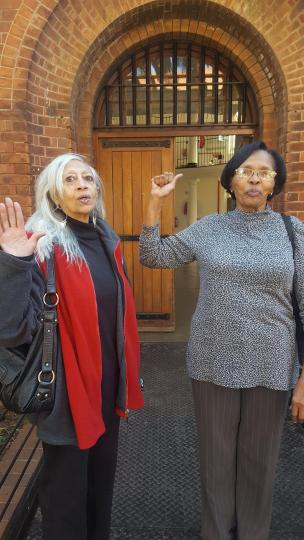
Juby Mayet and Cecilie Palmer standing in front of Constitution Hill Women's Prison

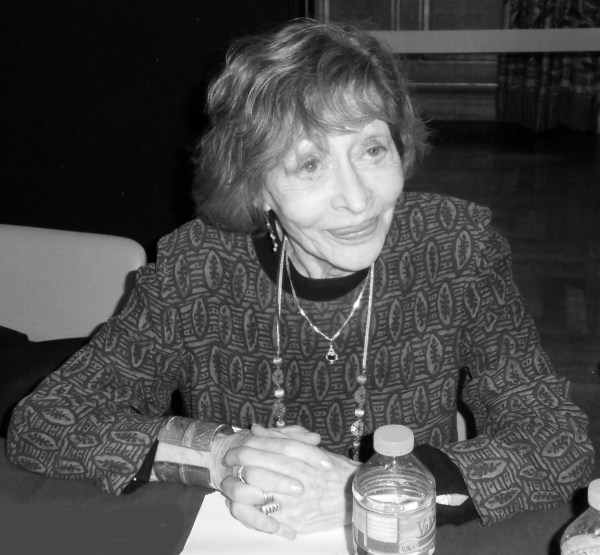
Zubeida ‘Juby’ Mayet (1937 – 2019) was a journalist who dedicated her life to fighting for a free press in South Africa, gender justice and an end to the Apartheid regime. She began writing for the Golden City Post in 1957 and worked for Drum magazine. In 1977 she joined The Voice, in Lenasia, Johannesburg, where she was appointed Deputy Chief Sub-Editor, a first for black women journalists. She was a founding member of the Union of Black Journalists (UBJ), serving as its assistant secretary-treasurer, a member of the Writer’s Association of South Africa, and contributed a great deal to the Media Workers’ Association of South Africa (MWASA). Juby also wrote for UBJ Bulletin Asizothula and The Worker. She was detained in 1979 and upon her release, served with a five-year banning order under the Internal Security Act. She and her family suffered continued police harassment and surveillance

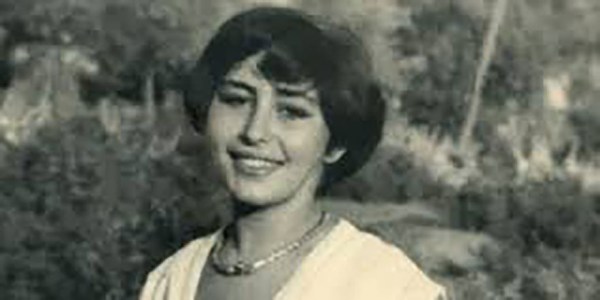
Cecilie Palmer (1944 – 2019) was a stateswoman, active in the struggle against the South African Apartheid regime and in fighting for the emancipation of women. She served in many organisations including, the United Democratic Front, the Federation of Transvaal Women, the Legal Resource Centre and Sizoya Sibuye, a platform for raise public awareness of women’s experiences of torture and jail during the struggle and counselling ex-prisoners. Before her arrest in 1976, she was active in the National Union of South African Students on the University of the Witwatersrand campus. Cecilie was also one of the founders of  the Women’s Institute for Leadership, Development and Democracy (WILDD). She and her family experienced continued police harassment and surveillance after her release from prison.

Gaele Sobott: We have just visited the Constitution Hill Women’s Prison, where you were both detained in the 70s. You’ve described the torture of women in the prison and the mental scars that have plagued you and the other women who were detained from the time of their release onward. Cecilie, you had two children and you were pregnant when you were detained and your mother, Vesta Smith, was also detained in the same prison. Juby you relied on friends to look after your children while you were detained. You were both involved in your different ways in the struggle against Apartheid and to bring about a more just society in South Africa.

In the years leading up to 1994, I am wondering how you balanced or negotiated the need for a hierarchical leadership to overthrow the old Apartheid regime and establish a new regime with the need to broaden and deepen the education of the general population?

Cecilie Palmer: I remember the time, years ago, I think it was 1982 or 1983, when the President’s Council presented its proposals for the reform of government structures, and we were having debates about whether to go into that Council under the new constitution or not to go in. I was sitting with Professor Mohammed and Firoz Cachalia and some others in the UDF office. We were debating and we were dead against going into the Council. Firoz and them were trying to push us to change. That was the kind of consultation that went on. We debated in the branches and the decisions were taken from there up. It’s true, education, that kind of education stopped, that kind of mix of people, it stopped when the exiles arrived back here and they said, ‘This is how it’s going to be done!’

GS: When was that?

Juby Mayet: They started coming back late eighties, early nineties. Sorry I have almost lost my voice. It’s a bit difficult for me to speak. I’ll whisper.

CP: Ja, they built a different structure and they said, ‘This is how you will fight.’ So then you had this structure where the country was really being ruled by six people sitting in Luthuli House.

GS: How did they gain the power to do that?

CP: I don’t know. What ever they did, it was very cleverly done. Remember, people used to trust each other. We were all comrades in the struggle. Some of us were mixed, right.

GS: What do you mean by mixed?

CP: In the sense that I didn’t really belong to the African National Congress (ANC). I didn’t belong to the Black Consciousness Movement (BCM).

JM: Yes.

CP: I didn’t belong to anybody. I went where it was necessary to fight a battle. That was how I operated. Then they came with the UDF and at that time, I remember we were asked very specifically,  because we had a very good women’s movement at that time, the Federation of Transvaal Women. Each province had their own women and we saw ourselves as women working towards common goals. Then we were told no, we had to choose whether we Charterists or whether we were BC. I remember one ANC woman asked me that question and I stood back and said, ‘None. I like to work where I’m needed most.’ But when the ANC was unbanned, people positioned themselves where they knew or thought the power was going to be …

JM: Where they thought their bread was going to be buttered.

CP: For instance, in Eldorado Park, which is a township just on the other side of Lens.

JM: Ja, we passed it. I pointed it out to you.

GS: Yes.

CP: We worked very hard there. We had established a really strong activist community where we had an advice centre, a women’s group, we had women against the abuse of women, we had a pre-school programme. The pre-school programme was designed by one of the women in Eldorado Park who was a pre-school specialist and that programme was designed on a non-sexist, non-racist basis. It was assessed by a professor from Rhodes University who said the programme should expand right through Africa. We replicated that programme from Eldorado Park throughout the Transvaal.

GS: By we, you mean the Eldorado Park women’s group?

CP: Yes. We had a strong movement going. We also had a civic association. Our belief and my belief was that civic associations belong to the people of the community that starts those associations, irrespective of what their political affiliations are.

JM: Yes, absolutely.

CP: Then we were asked by the ANC, because they had regrouped, to spearhead the formation of the South African National Civic Association (SANCO) and that was affiliated directly to the ANC. We said, ‘No, we’re not going to do that.’ Our pre-school programme had established pre-schools in the Transvaal and those pre-schools each had parent bodies. We taught the women in those parent bodies politics, not party politics but  community activism, so they knew about political, social and economic injustice and they were figuring out ways to build alternatives in their communities. This all grew from the strong community activism in Eldorado Park, so we brought those Eldorado women and the women from the pre-school parent groups into the Federation of Transvaal Women. We didn’t realise the ANC and those leaders who decided to identify with them, were positioning themselves for future power. The ANC started choosing people for their executive committees in Eldorado Park. They were lobbying.

JM: Manipulating.

CP: Ja, so, none of the activists, the youth groups, the women’s group, none of those activists were chosen for the executive committees. Anyone who wasn’t ANC was kicked out of those groups. We were very innocent then. Not skilled in that kind of politicking.

GS: Do you think the ANC saw those people, those activists on the ground who did not want to join them, as a threat and if so why?

CP: I really don’t know why they saw them as a threat but they did.  I think they were scared of people who had experience in the struggle but were refusing to join the ANC, probably because they were a stumbling block to those who were opportunists, those people who joined the ANC to climb. Those activists were wise and they expected the organisations to be run on same lines as they had been run on before. I think that’s probably what it was. I don’t know. One needs to think very deeply about this time and what happened.

JM: It was the ANC state capture. They rode roughshod over all these people and groups, like they were the only ones who fought to liberate us. The Pan African Congress (PAC), Azanian People’s Organisation (AZAPO), all the rest, were just thrown to the wayside. I’ve never been a card carrying member of any political party. I was labelled a sickly humanist. I worked for the human rights committee which had ANC members and Liberal Party members, then after I covered the  South African Student Organisation (SASO) trial in Pretoria, Sathasivan Cooper, Sivalingam Moodley, Audrey Mokoape, I became kind of involved with, not involved but enamoured of the Black Consciousness Movement and of course when I met people like Sobukwe, he was such a lovely man, and  Joe Tlholoe who was so young when he was sent to jail for so-called PAC activities, so I never really had a particular inclination towards any political party, I just felt I had to do a typical sickly humanist’s job.

GS: As an individual do you resent being dominated in a job or within a community?

JM: Not really. If I am dominated by anybody who thinks they are better than me, yes. I think I am as good as the next person.

CP: In other words, you refuse to be bullied.

GS: There is bullying and there is sometimes the need for hierarchical leadership. Do you think it is possible for South Africa to change existing social and economic conditions without hierarchical leadership?

JM: It has got to come from the younger generation.

CP: Exactly.

JM: I don’t know if they are better educated. They go to varsity and vandalise the school structures, the very place of learning. I don’t understand that mentality.

CP: I think our education system doesn’t teach people to think. It teaches them to regurgitate stuff without thinking.

JM: I went on protest marches but I never threw a stone through anybody’s window or set fire to any buildings. We marched with our banners and we sang our freedom songs without vandalising or damaging people’s cars or property. I cannot understand that mentality, especially when they go and burn down schools.

CP: Twenty eight schools burnt just a few months ago.

GS: Why? What caused that anger?

CP: Municipal demarcation. Dividing the wards up. The local government structures are divided in to wards. It affects voting. That’s why they keep changing it. They changed the boundaries and the community didn’t want it. Like Vuwani, where the community withdrew their children from school as a form of protest. Then they burnt the schools. The schools become the targets.

JM: That is why I say it is because of a lack of education. Those parents obviously did understand that this is not the right way to protest and make change. We need those schools. We are depriving our children of education.

CP: If you look at the age group of those people, it’s the age group that went to school after 1994. They are keeping their children out of school. They are the ones who are throwing stones. The ones who were born in the mid-eighties. That’s my view. Yes, we had Bantu education, Coloured education, Indian education but I swear that was one-hundred-and-ten-times better than the education we have today.

GS: During that period of change, how do you think it could have been done differently in terms of education?

JM: It would help if we had a president who was actually literate. Our education system is terrible. They keep saying how young people must be educated to become future leaders but it has become empty rhetoric, just words, no substance.

CP: It was during his time, that education started deteriorating. With every step, the education system seems to deteriorate further with every change they make. The very last change was the curriculum assessment policy called CAPS, a system that came in 2013. Plus the mentality of the new teachers is not good. We need better teacher training.
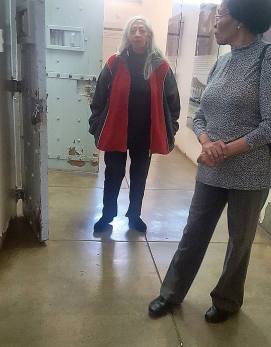
Juby Mayet and Cecilie Palmer standing in front of cells in Constitution Hill women's prison

GS: What happened to AZAPO, PAC leaders?

CP: They were just pushed out and ignored.

JM: I meet up with those guys and we talk. There was a group of students from SOWETO and they were quite surprised by the way I spoke. I make it quite clear that the ANC sucks! They irritate the hell out of me. I don’t have anything to do with them. I tell them that. I don’t vote for the ANC. Sometimes I say why don’t you guys form a coalition. Can you imagine if AZAPO and the BC people came together then the ANC would be seriously challenged, voted out in elections.

CP: They pushed out a lot of leaders, extremely well educated people, some died, like Percy Qoboza,   but none of them are anywhere in government structures. Brilliant people were pushed aside.

GS: What do you think can be done to stop the party that is about to take power in a situation like that from isolating or silencing intellectuals?

CP: They didn’t just sideline intellectuals they also preached that the older people who stayed in the country, that we were stupid and didn’t know what we were doing. Some children are extremely angry because their parents have been treated so badly.  We’ve got this inter-generational dialogue and it’s all about talking with the younger people and not at them. Some of them are extremely angry at Nelson Mandela.

GS: Why?

CP: Because he sold out. I sit there and I think, yes, it is true what you say but I cannot say that. So, I go the other way and say, ‘Look, he had to do what he did otherwise violence would have consumed the country.’  That’s true. There was Eugene Terre Blanche and Inkatha and all that but if you go further back they had been negotiating with Mandela a very long time before his release without the other prisoners being involved. They actually moved him from Robben Island and took him to Pollsmoor and Pollsmoor wasn’t private enough so they took him to Victor Verster where he was living in a house. So that is the truth of the matter and that is where a lot of the anger comes from. That is why they are saying, “We are struggling today because our parents are not living any differently than before apartheid, look at my mother living in a little pondotjie somewhere and so on. All those things are boiling. We can’t pay bills. Even when people study where are they going to get jobs.

JM: We should suggest to them that the next time they want to go on a burning spree, they should start with Luthuli House.

GS: How were the big corporations positioned during the transition from Apartheid?

JM: Big business just kept going like a steam roller.

CP: The same white bosses and even though black Joe might be the CEO, he still doesn’t really control the business. They are definitely not going to change our society for the better. I told you the story of Eldorado Park, now also in Eldorado Park we were working with UNISA against violence and that kind of thing and then they came and told us that they had been funded by the police. Imagine, funded by the police during the time of Apartheid! We said, ‘Oh oh, no thank you. Within a week, I was summoned to Luthuli House, Ralph phoned me and said, come in to see us because we want to talk to you about the UNISA program. I said, ‘No, I will not come to Luthuli House. You come to the township!’ I mean that was where the group started. He could talk to the board there were we all operated. Then they also asked us to spearhead the formation of the ANC women’s league in Eldorado Park. We said no to that too. Like I said, our belief about the women’s group was that we were all working together, no matter what party women supported. We were combining our strengths to make change happen. But from then on we were totally isolated by the ANC. We founded the Women’s Institute for Leadership, Development and Democracy (WILDD) in 1994 and we were being funded by the Swedes so what  the ANC did about the second or third year after they came into power, they ruled on bilateral funding so it then had to be government to government funding. So any foreign funding had to go through the government. That is how they destroyed a lot of the NGOs. So they were quite clever. They managed to destroy independent community organisations and thinkers. Through the WILDD, we used to help women’s groups in townships. Let’s say a group was working against gender violence, we would write a proposal that might include establishing shelters for women, things like that and that was one of the ways we increased the consciousness, the awareness and the education of women and men. We had a women’s cooperative that was a successful community enterprise. So, we would write the proposals and the women would get money. Then we would teach them to draw up progress reports and insist that they prepared and submitted regular reports to us. We needed those reports to get more funding and train more women. Very, very soon, the women began to say that the government was giving them funding because of this new government to government funding I spoke about. So the ANC was the one giving them the funding not foreign sources and the women did not need to report to us anymore. They could not be expected to bite the hand that feeds them. We as community leaders were isolated that way too. The original structures we had all built were destroyed. The government gave the groups money once, they gave twice, then they deserted the women and other civic groups.

So now we work very quietly.

GS: How do you think that kind of scenario can be prevented before it gets to that point?

CP: I don’t know. It is a very hard question to answer. But I think also what happens in people’s minds is that they saw the ANC as their liberators and they were told that they were their liberators.

JM: If the propaganda, the lie, is told often enough, people believe it.

CP: It’s like starting again right from the beginning which means starting in the house, starting in the street, in the factory, in the mines. It’s important to work within the community.

JM: I think we need a true revolution. It won’t be difficult to build up to a proper revolution because people have not settled into this so-called solution. They do not accept this life of entitlement that ANC officials and black CEOs and the like are living. The top guys are treating the country’s assets as if everything is there for the taking. That becomes the attitude. If they are doing, what is wrong with me doing it too.

CP: And the jargon is there all the time, you know, I can tell you now, let’s say I was going to a Women’s Day celebration, and the speaker gets on the stage. Before she opens her mouth, I know exactly what she is going to say. It will be the same thing that is repeated all the time, the same jargon, the propaganda repeated over and over again. Empty rhetoric. No real analysis. No encouragement of independent thinking. It’s also more difficult because before with Apartheid, the enemy was clearer. If you criticise the ANC, they say that you want to bring the white oppressor back.

JM: That’s another thing. We had Apartheid but there wasn’t the same yackety yack that there is now about racism. It’s used now for small things, almost like a diversion from the bigger picture, the economic problems, the economic system.

CP: The economic oppression is still very much there. We have a lot of black people in charge now of administration and the running of government but they treat other black people badly.

JM: You see it in the shops and the cafes and the post office. People are not there to serve. They are there to fill their pockets and stuff you Jack. I remember going to Ackermans with my late mother. She was struggling because my daddy left us and we were ten children. She somehow made friends with an Afrikaner lady working there. That woman used to assist my mother by putting extra items into the bag when she was buying school shirts or trousers for the boys. Sometimes my mother used to send me to Ackermans to buy items. I can’t remember that woman’s name now but I can see her face, a stylish woman and she would treat me in such a friendly way. She’d ask me how my mother was. Whatever I was buying, underwear or socks for the boys, she would always manage to sneak extra into the bag.

CP: Strangely, Juby, some of the Afrikaner people were very human, very genuine. An Afrikaner either liked you or hated you. It was clear cut. Where with the English you never knew. And Afrikaner children even up to today will respect an older person. They will say Tannie to me. That is how they are brought up. But if they don’t like you, they don’t like you and they make no bones about it. You knew exactly what your place was with them.

But going back to your question about what could be done differently, I don’t know but many people change. I cannot understand how they can change like that because it must be very uncomfortable.

JM: The day I landed in Number Four (Constitution Hill Prison), Debs wasn’t there at that time. Thenjiwe and Joyce and other women were. A white warden was taking me through to my cell, my new living quarters, and she was stunned when those other women prisoners broke into cheers and yelling Amandla and hey Juby what took you so long? The warden took me to my cell and she asked, ‘How do you know those women?’ I knew some of them personally, most of them knew me because I was a journalist but she couldn’t figure it out, ‘Die Coolie met dai Kaffir.’ When we were in there we had political discussions, we celebrated June 16. So then Thenji and all of them were released and I was left there with Gladys Manzi from Kwazulu and then they brought Debs from Maritzburg. She was in a bad way.

CP: Oh God.

JM: She’d been tortured. Her hair was falling out. Eventually I was released. We were all released. Some of us kept in touch. Some of us wrote to each other. Some moved on with their lives. The next time I saw one of the woman I had got close to in prison was  at some journalism awards event at one of the conference rooms at the South African Broadcasting Commission but you know, she didn’t acknowledge me. We were so close in Number Four but by then she had become ambassador or something like that. I looked directly at her and she looked directly at me. No smile. Nothing. I thought, God, what have I done? She just refused to acknowledge me. I was going  to go up to her and ask her how she was but then I thought okay I won’t. You give me a cold shoulder like that, I will ignore you. But I couldn’t believe it and I was hurt. From the person I knew in Number Four to this. She’s now up there and I am just the same old Juby.

CP: So why should she associate with you?

JM: Exactly. So, I thought, well stuff you, buddy boy!

CP: Yes, you can walk away and feel good about it. I must say, I feel free. I don’t owe anyone anything. I live on my one thousand five hundred Rand pension and I’m comfortable with it. I don’t owe anybody. I feel free but those people we are talking about have no vision. That is the sad part. They go into these positions. In 1994, nobody knew how to govern and we accept that. They employed consultants and what have you. They chased the Boer out who were in those positions. They didn’t want to learn from them. I think they should have first learnt from those people. Taken advantage of their knowledge and experience and then made them move over. They could have said, ‘Okay, we will make you consultant in this department for five years.’ They decided to chase those people out and employ consultants but up to today, they haven’t learned. About four years ago I spoke to one of the ANC women and told her what I saw happening in our communities. They don’t go to their constituents. They don’t know what’s really going on. I told her that communities are fragmenting more and more along lines of race, religion, political party and all that. We need to get these people back together. She agreed and suggested we involve other people in government and she did that. She got them in and I presented a proposal which we discussed. I emphasised that this drive to get people back together has to start by the ANC admitting their mistakes. The next thing, they were talking about fragmentation of communities and that the SACC was going to do this and that. They didn’t involve me nonetheless, I was happy it seemed to be going ahead. But it fell apart because they didn’t have the same vision. If you don’t have the vision for going forward, it is just not going to work. They stole people’s projects. A group would write a proposal to them with what they wanted. Then they would call those people in and ask for more detail. The group would give them all their ideas. Four weeks later they’d see someone from government announcing those very ideas on TV as a government initiative.

Juby, you know the saga about registering children on-line for school?

JM: Yes.

CP:  The education department has announced the idea of registering children on-line from grade one to grade eight. It’s an idea that they have stolen. Somebody presented this proposal to them around 2008. They dismissed her saying it was nonsense. Thank heaven she is taking it up with them. She’s not letting them get away with it. NGOs don’t stand a chance with the government stealing ideas like that. That lack of vision is terrible. They took over our women’s groups and now the gender violence is getting worse not better. Another peculiar thing that is happening most of our experts are whites and people who do not live in the townships. They are on TV telling us what we need.  So we are asking, why is it always about us but we are not leading. We know what is happening in the township. We know what is happening in our communities because we still live here. We don’t live in a big house in the white suburbs with high fences and security guards. But no, those experts have all the answers.

JM: The statisticians.

CP: We must sound like bitter people.

GS: You sound like people with many years of experience.

CP: When I do a tour or give talks, people sometimes ask me, ‘But don’t you hate the people who have done these things?’ No I don’t.

JM: Hatred is a waste of energy.

CP: Hatred to me is a wasted emotion, a waste of energy. I don’t hate but I also haven’t forgotten and I’m not going to forget because it did happen. Actually, I’m  not sure at this moment that I don’t hate the people who are sitting in Luthuli House. I’m not sure I don’t hate them for what they are doing to this country.

JM: My remedy is laugh it off and say stuff you lot!

CP: Like there is Kenny Motsamai who they have only just released from jail. Nearly twenty eight years in jail. Yet, they let Eugene de Kock out who tortured and murdered so many people who fought against Apartheid. There are still other PAC cadre sitting in jail.

JM: Now we have black on black Apartheid. That’s what it has come down to. Economic.

CP: They spent over a billion rand on the ANC campaign for the local government elections. Where did they get that money from?

JM: Exactly and why not use it on something more constructive? Building houses, schools, medical facilities. Prioritising the education of teachers. They did away with teacher training.

CP: They closed nursing colleges. They are trained at university with no practical experience. They come into the wards and will not take advice from the older nurses who did the proper training including the practical internships and the like. They are starting to privatise the services.

JM: Like the prisons are semi-privatised now.

CP: And the bureaucracy is getting bigger and bigger. It’s messed up. There’s no getting away from it.

JM: We need to teach that the ANC were not the only liberators of the country. Campaign to change voting patterns.

CP: I think we really need to get back to thorough and committed community activism, community responsibility and confidence. I work with the women from the inner city. They are eager to jump when the ANC Women’s League says jump, the rent a crowd kind of thing. Their responses and their problems are different to our problems in the townships. You know another thing we don’t have is an alternative media. We were lucky because we used to have the Vrye Weekblad, an Afrikaans newspaper which was really helpful, one of the best newspapers.

JM: Ja, Max du Preez.

CP:  It was run by Max du Preez. We need that kind of newspaper back. The Weekly Mail was also there. Those newspapers tried but they were never free to do what they wanted. The Post used to have ugly stories that didn’t educate anybody.

JM: Like the Sun today.

CP: Like the Daily Sun. Now that’s the only newspaper that people can afford. The Daily Sun will tell you that the rat ate the cat. Like the TV. Keep the masses uneducated and you can do whatever you want.

JM: That is why I read books. Our young people need to read more.

CP: Reading is very important. Education for our young people has to improve. Over half of our children cannot read fluently. We should be working on basic literacy and numeracy. We are condemning a huge majority of young people to unemployment and  poverty. You know, we are a depressed country at the moment. You don’t see people smiling and laughing. We used to laugh and talk and scream and sing even during the time of Apartheid. We’ve stopped. I definitely don’t think we would be  better off under Apartheid. We still need to rid ourselves of the legacy of Apartheid. We really need to sit and talk and analyse what has not worked in the struggle. The ANC has to admit its mistakes. Maybe then we will begin to smile again.
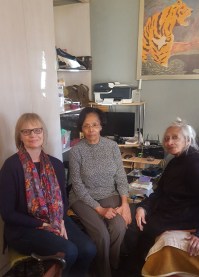
Gaele Cecilie JubyInterview conducted with Juby Mayet and Cecilie Palmer in Lenasia, 2016 – May you rest in peace and power my friends.

Links:

Black Wednesday, the day the Apartheid government banned 18 Black Consciousness Movement organisations and three newspapers (featuring Juby Mayet)

Interview with Cecilie Palmer  in the Constitution Hill Women’s Jail
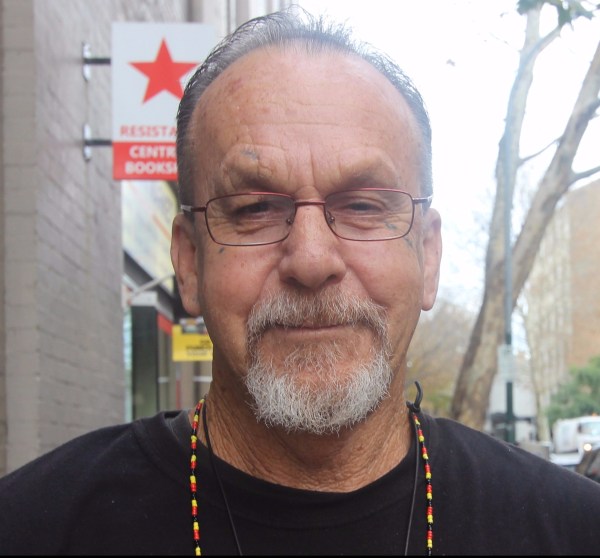
My freedom is writing. My freedom is my peace of mind. My freedom is building a good relationship – An Interview with Ken Canning

Head shot of Ken Canning. He is wearing glasses, and a long necklace of small, red, gold and black beads (Aboriginal colours). He has a greying mustache and beard, and he is smiling.

Credit: Socialist Alliance

Ken Canning is a Murri activist, writer and poet. His people are from the Kunja Clan of the Bidjara Nation in south west Queensland, Australia. His Bidjara name is Burraga Gutya. Ken has lived in Sydney for over 30 years. He worked as an academic and cultural adviser at the University of Technology Sydney and is currently a support worker at the Judge Rainbow Memorial Fund, where he assists people who have experienced the criminal justice system.

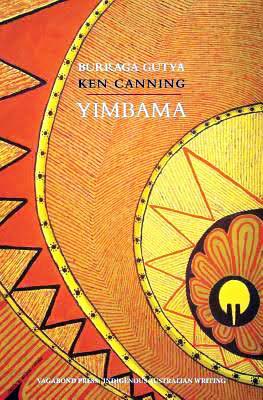
Ken’s poetry has been translated into several languages. His publications include Ngali Ngalga, Breakout Press,1990 and Yimbama, Vagabond Press, 2015. His first major play, 49 Days a Week, was showcased at the Yellamundie National First Peoples Playwriting Festival 2017. He has also written a half-hour film script called Cocky on a Biscuit Tin.

Gaele Sobott: Let’s start with your birth. There’s information on the Internet stating you were born on Bribie Island, Queensland.

Ken Canning: I spent some time on Bribie Island as a kid but I wasn’t born there. I was born in Frankston, Victoria. My mother’s family come from Charleville in Queensland.  Dad was stationed in Victoria when Mum was pregnant with me.

GS: Where was your father from?

KC: He was from Toowoomba. My Dad was a whitefella. The family was Irish from County Cork. They were very rich and very powerful. My grandfather’s name was Bob Canning.

GS: Where did you parents meet?

KC: Granddad worked out at Charleville. My father was in the navy and when he got leave, he went out to see his father. That’s where he met my mother. When they decided to marry, the Canning family didn’t want anything to do with us because they were against inter-racial marriage.

My grandfather said, ‘My son can marry who he wants.’

So, the family disowned both my father and Granddad. Any wealth, any land my father and grandfather were entitled to was stripped from them. They were outcasts. Granddad was disappointed with his family. He said they were traitor Irish. They took part in some of the massacres of Aboriginal people. I researched it years later with Dr Carroll Graham at University of Technology Sydney (UTS). They didn’t come here like your average Irishman who didn’t like authority. One of granddad’s uncles even became a policeman.

The reason I was born in Frankston was a bit random because while Mum was pregnant with me, she accidentally trod on a Red-Belly Black snake and got bitten on the foot. An old fella reacted quickly, got a sharp knife, cut her foot open and sucked the poison out. She was lucky, she was only a bit crook but after that she wanted to be with my father so she went and stayed in Frankston. About six months after I was born, we headed to Narrabeen in Sydney and then we took off to Queensland.

GS: So, you may have a bit of Red-belly Black venom in you?

KC: Well I might. I was fascinated by snakes growing up. There were snakes everywhere on Bribie Island. One time I was hiding from my cousins behind a tree, waiting to scare them and a snake crawled across my foot. I froze. I knew if I kept still it would leave me alone and it did. It took off when my cousins came running up the road. I admire snakes but I don’t really want them crawling on me!

I used to stalk kangaroos as a kid. I knew I couldn’t catch them. They were too clever for me. I’d chase goannas too then one evening a goanna turned on me. Jeez, I tell you what, I reckon if it had been an Olympic trial, I would’ve won. I ran home and slammed the door. My brother and I were looking through the front window and it was sitting there waiting for me to come out. It was much bigger than what I’d initially thought. They can give you a nice bite. The funny thing about a goanna bite is that every year to the day the bite mark will come back.

GS: Can you talk a little about your mother’s family?

KC: I don’t know the traditional names but my great, great granny was called Jane Boyd by the whites who invaded the area. I read a police document on her – ‘Jane Boyd, Aboriginal woman, associate of Chinese gardeners. Likes opium, is armed and will shoot at police.’ The Chinese came to the area because they were being persecuted. They lived with our people.

My great, great grandfather walked down from Tenant Creek right into the middle of the wars, the Forty-Year war. He married Jane Boyd. He was given the name Edward Prince. There are still Princes out West but he originally came from the Northern Territory, Carpet Snake Dreaming. My mother’s side are Magpie Dreamers. My great granny looked after me. She used to tell me stories about how her mother would stand up to the police. They were very strong people. Granny got kicked in the hip by a horse out West and the doctors wouldn’t come to see her. The family mended the hip bone as best they could but she had trouble with it all her life. So, a lot of the time she was bedridden. She was addicted to morphine. She passed when I was about fifty-six.

It was confusing growing up because Mum had me when she was young and when I was little, I thought she was my sister and called her Joan. I thought my grandmother was my mother. I used to call her Mum, and I thought my great grandmother was my grandmother. That still sticks in my mind today. Often when I talk about my gran, I’m actually talking about my great grandmother.

GS: Tell me more about the Forty-Year war.

KC: The Forty-Year War was one of the longest wars in Australian history. Not the whole Bidjara people but our clan group, the Kunja clan, fought for forty years. That war went from the 1860s right up to the 1900s when they allegedly defeated our people. Men, women and children were fighting against the British. After that a lot of my great uncles went off with the bushrangers to continue fighting for another twenty years.

My great, great grandmother was carrying a gun around everywhere she went, shooting at police. We were a people who travelled on foot then. We didn’t take to horses until the cattle stations started using us as labour. Some of people rode horses but basically our guerrilla warfare was on foot. We only have oral history records of that war. My cousin, Sam Watson, found some information in the archives in Brisbane. There was a box just sitting there collecting dust and he started reading through some fascinating documents, but the archive staff told him the material wasn’t for public viewing and he should come back. When he went back the whole box was gone.

There is no official acknowledgement that the Kunja clan of the Bidjara people fought for forty years. That’s two generations and no recognition. When you look at our society today, we’re coming up to Anzac Day where people beat their chests and say, ‘My grandfather fought to save this country.’ I don’t have that right. It’s a denial of history. Like the very first boys’ home I was put into, does not exist. It’s been wiped from history.

GS: Where was the boys’ home?

KC:  It was in Scarborough, run by the Catholics behind a boarding school for white kids. The building was full of Aboriginal kids who had allegedly committed crimes. They were totally brutalised. There is no record of that place ever existing. The Catholic Church denies it ever existed. It does not exist but I was there. I know other people who were there too. I knew people who committed suicide in there. It’s as though I fabricated eighteen months of my life. Our history is denied.

GS: How old were you when you went to Scarborough?

KC: I was ten, almost eleven. It was just after my great gran died. There were a lot of kids my age there and kids up to sixteen, seventeen-years. The place was run by brothers who were mad brutal rapists. They did some terrible things. They didn’t care what damage they caused. When they tried to take me, I’d jump up on the bed and scream, bite, kick. I was too much trouble for them. But they did bed checks every day so they set me up by putting two cigarettes under my pillow. I was flogged, every single day for the two cigarettes they’d find.

I was christened a Catholic. My parents were Catholic. Then I remembered Granddad talking about a cousin of his, called Archbishop Duhig, the archbishop of Brisbane at that time. I told one of the brothers. They must have checked it out and then there was a big change in attitude towards me.

GS: Why were you put in the boys’ home?

KC: I was living on Bribie Island and there was a shop I wasn’t allowed into because I was Aboriginal. The place was all bush back then. It was beautiful. Not like now. It’s disgusting. All built up. Multi-million dollar homes.  I was waiting on the road up from the shop for my cousin. Some white boys came out of the shop. I knew them. They were older than me.

They said, ‘Do you want a bag of lollies Johnny?’

That’s my middle name. Anyway, I said, ‘Yeah, thanks.’

So, I was standing there with the bag of lollies when the shopkeeper came out and accused me of stealing them. He knew I wasn’t allowed in the shop.

I said, “I’m not allowed in the shop. How could I have stolen them?’

He took me to the policeman who put me in the cells. Twice a week a priest came to Bribie from the mainland. He was there too. The shopkeeper, the policeman and the priest made the decision without any consultation with my family, to send me to Scarborough. My family didn’t know where I was. They assumed I’d been taken to Brisbane. Everyone was looking for me in Brisbane. Some of my relatives went to the boys’ home in Scarborough but there were only records for orphans. The people in the office didn’t know who was in the home. Most of us kids were taken there illegally.

When stories started circulating about the place, and blokes in jail started talking about the treatment they’d received at the home, the Catholics closed it down. No record of anything ever happening there.

GS: You came from Frankston in Victoria, stayed for a while in Sydney and then came back to Queensland. Where did you live? Was it Bribie Island?

KC: We came from Sydney back to Charleville.

GS: What are your memories of that time?

KC: I was a funny little kid. I was fair. The old people in the family who lived inland, didn’t have any contact with white people, they’d come and visit, and every time they left, I’d follow them back out to the desert. Those men and women laughed at me and gave me the nick name, Myal. In our region that means an Aboriginal person who doesn’t want anything to do with white ways. The whites changed the meaning to a wild Blackfella. I later heard that all the family were killed by white people.

West Queensland in those days was lawless. It was brutal towards Aboriginal people but we had some good fighters in our family. We had some victories. My uncle Bill Bailey was a big, powerful man, huge. Any time we’d work for the white man, he wouldn’t pay us. It didn’t stop Blackfellas from working to try and make a living. My Uncle didn’t accept it.

He said, ‘I don’t care if I go to jail. You pay me or you’ll be in your grave.’

They paid him. We weren’t allowed to have bank accounts so he saved his money in an old Sunshine Milk tin that he buried in different places. No one ever knew where. Aboriginal people weren’t allowed in Charleville. He’d walk up the main street. Blackfellas weren’t allowed in the pub. He’d go in and demand to be served and they served him. The local police couldn’t get him into the jail. He was too powerful.

He saved enough money to buy a block of land just out of Charleville. We weren’t allowed to own land but they sold him the land. It’s still in the family. He made history. I loved Uncle Bill.

GS: When did you move to Bribie Island?

KC: We were hounded out of West Queensland. My old gran, my mother’s mum, wanted us to go. The government didn’t let blackfellas go to school and because of my complexion, I would have been taken by Welfare. We moved around South-West Queensland for a while then we stayed in Brisbane. We lived at a hotel under the Story Bridge. Unfortunately, by then, Mum had become an alcoholic. I was about five years old and I wandered off and nearly fell into the Brisbane River. The authorities put me in an orphanage. Two years later Dad came out of the navy. Because he was white, he was allowed to take me from the orphanage. He was a violent man.

One time, I was sitting on the beach with my granddad when he was dying of leukemia in the 80s and I asked him, ‘Have you got any regrets?’

The old fella said, ‘Yes, one regret, your father!

I got on well with Granddad. We lived in Redcliff for a while. I was seven or eight when Grandad got me into a Catholic school but they kicked me out because I was disruptive. I stood on the desk and hit people on the head with a ruler so they gave me a warning. Not long after that I got up on the roof of the boys’ toilets, jumped down onto a group of people and got stuck into them. I had a lot of rage by then. After that we moved to Bribie Island.

GS:  Where did that rage come from?

KC:  The rage came from a whole lot of things. There was a lot of violence in the home and alcoholism had taken my Mum. I found my grandfather on my mother’s side dead at the kitchen table. That shocked me. I was starting to understand the attitudes of white people towards my mother, towards Aboriginal people, racism. The police, and white people in general would call my mother names like whore, slut. Those things affect you as a little kid.

 GS: You’ve said you chased kangaroos and goannas, how else did you like to spend your time as a kid?

KC: Yeah, I played in the bush but I’d also take time and go and sit with my Gran. She’d tell me stories about what was happening in her day and her mother’s day. She talk about which family groups were related to other family groups and where they went to when they were hunted out. She told me a whole lot of things. She told me stories about the black servicemen from the States stationed in Charleville during the Second World War. She didn’t like them. Stories of rape and violence towards our women. She experienced it personally.

In our land before white people came we were very much matriarchal. Gran and my old Granny Boyd, they had several husbands. They were open about their views that if a man started playing up, getting silly after he’d done his job, given them kids, they’d show them the door. Our lands were matriarchal. That didn’t mean that men were demeaned or exploited.

Another thing I liked doing was listening to the wireless. I used to listen to radio plays, the news, BBC programs.

GS: So, you were taken to the boys’ home in Scarborough from Bribie Island. How long were you in that home?

KC: I was in there for about one year or so. When I got out, the authorities took me back to Bribie Island and dumped me in the middle of the road outside an abandoned house. I was twelve going on thirteen-years-old. I went around to my old boxing trainer. He told me the family had gone to Brisbane looking for me. He drove me to Brisbane and I asked him to drop me at Musgrave Park. I sat with all the Blackfellas there and people took me in. They looked around and found Mum living at Wilston.

I was only in Brisbane for a little while and the local police grabbed me and took me to Windsor police station. They were screaming at me about a heap of break and enter crimes. Mum came in and tried to set the record straight. They called her every filthy name under the sun and threatened to lock her up. She got Granddad and he demanded to see the charge sheets.

He said, “My grandson was in the boy’s home in Scarborough for most of these.’ The coppers weren’t about to argue with Granddad and they let me go.

After the boys’ home in Scarborough, I made a habit of being alone. I didn’t want any ties for a long time. I got into a lot of trouble in Brisbane and ended up in Westbrook, another boy’s home. I ran away from there and stole a car. Police cars surrounded me down near Roma street and ran me off the road. They were shooting at me, bullets flying everywhere. One went through the door straight into my leg near the knee. I jumped out of the car and collapsed.

They put straight into the men’s prison, Boggo Road, Two Division. That was illegal because I was only sixteen. When Two Division was eventually closed in 1989, the Australasian Post, described it as the most notorious division in Australia. It was a hell hole. They had a young offenders’ yard but they put me in the men’s yard. I came in on crutches. My Uncle Vic was in there. He said, ‘You’ll be right. Settle down.’

Everyone knew Vic. Because I was his nephew, they left me alone. I only did a couple of months and I was let out. I told Mum I was going bush for a while. I had a bit of money because I was working hot so I caught the train to Sydney. Then went to Melbourne, across to Adelaide and on to Perth. I got knocked over there with a mini minor full of stolen property. How stupid was I then? You’d think I would’ve got a bigger truck.

The authorities contacted the Queensland authorities about me. They told them that they’d put me in Boggo Road because the boys’ homes couldn’t handle me. So, Western Australia put me straight into Freemantle adult prison. I was alright there because all the Blackfellas knew me. Again, I wasn’t there long. When I got out, the police put me on the train handcuffed. Just before it pulled out they took the cuffs off and said, ‘If you come back to WA we’ll put a bullet in you.’

None of the passengers would talk to me on the trip across the Nullarbor. It was a very spooky little trip.

I got to Sydney and found out that a member of our family had been shot to death by the police in Melbourne. Cuz and I went mental. We were already working hot but after that we made sure we were armed with sawn-off shot guns coxnd pistols wherever we went.

GS: I’d like to talk about your play 49 Days a Week.  I saw the reading at Yellamundie 2017. The story is very powerful, moving, thought-provoking.  Could you tell me a bit about the creative development process?

KC: I started writing that play years ago when I was at uni. I wrote a piece for a prisoner radio program. It was stream of consciousness, the thoughts of a bloke walking up and down his cell and I added some sound effects. That was the genesis but I changed it for Yellamundie reading. I set it in the cages at Bogo Road jail not the cells. That was the focus of the story, what the cage does to your mind. I had a lot of bad experiences in Long Bay jail too but I couldn’t set the Yellamundie play in two environments so I just kept it to the Boggo Road cages.

I wore myself down to the ground doing the writing. I was working, arranging the Invasion Day march at the same time and sitting up every night doing re-writes. I really wore myself out and I got ill. That sort of shut everything down. I’ve had a break now and I’m ready to write again.

Yesterday I was at the bus stop and along comes Fred Copperwaite, the director. He told me they are interested in developing the play further. He liked it because his father and his uncle had been in jail.  I was scared that audiences wouldn’t like it, that they wouldn’t get it, they wouldn’t get why it had to be so intense.  But the reception it got at Yellamundie was really good. The play means a lot to me because my friend was actually executed by the police in 1984. He was thirty-five.

GS: He was of Irish origin?

KC:  Yes.

GS: Can you tell me more about him?

KC: Well, he was a professional armed robber. We met when we were kids. He had a great sense of humour. Me and Cuz were up and coming and the older robbers took to us. Our friend was one of the people from that era who got in with the old guard of armed robbers.

GS: 1970s?

KC: Yeah, the late 60s going into the 70s. I started doing stick-ups in Brisbane when I was very young and got mixed up with older fellas. When I escaped, I did jobs in Sydney, then I’d head off to Adelaide to live quietly. That was a little recipe I had. Come back and do some more. I got to know some good people. They were good at their trade. They liked me and Cuz because we were naturals. We started when we were sixteen. We got knocked when we were eighteen but in those couple of years we did some big jobs. When we escaped, people saw exactly how willing and how good we were at the work.

GS: What makes a good armed robber?

KC: I used to talk to my best mates who were armed robbers about this subject. One of them is a whitefella with a long surname. I don’t know if it’s German or what. He was the most infamous escapee we had in this country and the most proficient armed robber we’ve ever seen. The authorities described him as a modern-day Ned Kelly, only better. I liked him. So, we’d spend hours discussing these sorts of things. Once you escape, the authorities always say, ‘He’s armed and dangerous and will shoot at police. Do not approach.’

So, the public gets the idea that you’re a raving lunatic and a killer. The consensus is that we’re low in intellect but my mates were all deep thinkers.

We talked about our early lives and how those experiences influenced what we did for a living. Whatever happened to one man must have been traumatic. He had no memory of anything before he was eight. He couldn’t remember what his parents or aunties or uncles looked like. Not one memory from his childhood. Completely blank. Another came from a poor Irish family. His father refused to assimilate, refused to obey authority. From the start, my friend was targeted because he was the son of a mad Irishman who hated the authorities and liked blackfellas. When he was about seventeen, he moved in with an Aboriginal woman. They had a baby together. He told me he had thought his life was hard but once he started living with a Murri woman, the police were breaking down the door, putting a gun to his head, calling her all sorts of filthy names, even putting guns at the baby’s head. It was like a horror story.

When you have those kinds of experiences, you can go two ways. You can take the anti-social path where you are reckless or the anti-social path where you want to beat them. We were driven by the desire to beat them. We were all thorough planners. We all had a mad survival instinct and a sixth-sense for trouble. Every one of us were experts at counter surveillance. If we were under surveillance, we knew it.

When one mate escaped from Katingal, he was out for eleven years. That’s a phenomenal amount of time to be on the run. He was the smartest of us all. In all aspects of criminality, he was an absolute genius. The other commonality we had was, we didn’t think we were doing anything wrong.

To be a good armed robber you need to be able to plan. A well-thought-out escape route is the most important aspect of the planning. you’ve got to be able to think on your feet. Something might go wrong. Someone in the crowd might try to rush you. It’s best to work by yourself or as a pair. Three people gets too complicated. We were a close circle of friends. We trusted and knew each other. Fitness was another requirement. We all worked-out very hard. Even in jail. Exercise was illegal in Boggo Road but I worked out in my cell all night. Fitness for when I escaped. We didn’t like drugs and alcohol.

GS: Can you briefly describe a typical job?

KC: We re-enacted one in the play. You run through the front door. You’re wearing overalls, gloves and balaclavas. One puts everyone on the ground, the other jumps the bank counter and takes the money. That’s easy to do.

We were the first groups to hit armoured trucks in the seventies. We’d wait for then to come out with the money. Then we’d come from behind, put them on the ground, take their weapons, take the money and get out. You’ve got to do your homework. I’d watch a place for five or six weeks. During the seventies and eighties and into the nineties vans were being done over left, right and centre. The insurance premiums were going through the roof. You can’t do it now. They’ve tightened up now, invested in better security in the banks, back-up people and back-up cars for the vans. Those cassettes they put in the ATMs hold A$200,000. I know that because even after I’ve done my time and retired, I still observe these things. If I see a van pull up I look at the time and note the location. I automatically go ding, ding, ding and start figuring out how to do the job. It’s a habit. I’m not remotely interested in robbing a place but I can’t help observing.

One of the smartest robberies was done by the late Jack Wilson and Don Flanders in the mid-seventies. They ran a postal van off the road, coming from the Sunshine Coast to the Reserve Bank. It was full of old bank notes but still legal tender. They got over a quarter of a million. In those days, it was a lot of money. Jackie Wilson was as smooth as a cucumber. We used to call him Hungry Jack because he’d be sitting on a fortune but he was as tight as they come. He’d open his wallet and moths would fly out. A cunning old bugger. He wouldn’t give away a thing but Donny got knocked and the coppers verballed Jackie.

GS: What does verballed mean?

KC:  It’s when an unsigned record of interview was used to convict suspects. I got convicted on unsigned records of interview. I never got convicted on evidence, neither did Cuz, or our mates. Brett Collins was one of my old colleagues. He started up the Prisoners Action Group and they worked hard to get verbals outlawed. You’d say nothing but the coppers would just type up a confession. They’d present it in court saying this man confessed then refused to sign the confession. It was accepted as evidence.

Before I first got verballed, we were in Sydney working, I was only young, and the armed robbery squad got hold of us and told us that if we gave them twenty-five percent of our earnings, we could do what we liked. Our answer was, ‘What earnings?’

They’d say, ‘We know you’re running hot.’

We’d say, ‘The only thing we’ve got going is a hot shower.’

No way we’d work with them. There were people that did work with them and they got free range but we hated them. They also gave up other criminals. Part of the deal was dropping other crooks in. They were dogs, informers. Barking to the coppers. I had so much contempt for people like that. All of us who refused to work with the police, when we got shopped, we were in for a very long time, but at least we had our honour. We chose a certain life and we stuck by what we thought were the rules.

We used to talk about all kinds of things in the cages. When I first tried to read Foucault, I wasn’t used to the language and it didn’t make much sense but once I did get the language, I sat down in the class at UTS and said, ‘You know, this is very ordinary.’

They said, ‘What?’

I told them I was sitting in a cage for years and we used to talk about this stuff. We were uneducated men talking about prison structures. Two Division was a circular design. You could see everybody at once. At any given time, you could be observed.

We didn’t call it the Panopticon but we did talk about how the prison meant you were under constant surveillance and that you ended up surveilling yourself and everyone else. You became your own jailer. We worked that out and we were one step ahead of the system because we deliberately allowed ourselves to fuck up. It was as simple as that. I was considered a very violent inmate. But all my life I have acted intentionally. I was violent intentionally. I don’t deny that sometimes I’d blow up. I’d lose my temper but most of the time it was planned and there was purpose to it. I saw what I was doing as part of the war against the invaders. My mate saw it as the continuing war against the British. We were aware that the surveillance was happening but we were not going to let them control us.

I’ve always felt that defiance, that wilfulness. I think that goes back to my old gran. Granny was strong willed too. Well before the Black Panthers came on the scene, she gave me my first taste of Black Power. It was on Queens Street in Brisbane. She wanted to go to a shop across the road. My cousins told her she had to walk down to the lights to cross.

She said, ‘Why would I want to go all the way down there and back when the place I want to go is just opposite?’

My cousins said, ‘That’s what it’s like in the city Gran,’ and they all ran off to the lights.

I was stuck with my grandmother. So, she just crossed the road there and then with me following behind. A car beeped its horn and she smashed the walking stick straight into the bonnet of the car.

She yelled, ‘I’m walking on my land. You don’t do that!’

It was in the middle of Brisbane where black people were locked up and shot at the drop of a hat. To use a biblical analogy, it was like Moses parting the Red Sea. The traffic stopped. She walked across her walking stick in the air, yelling, ‘I’ll go where I want to go.’

She didn’t speak very good English. I was in a sort of daze. I felt like I was floating a foot off the ground. It was an amazing thing for me after seeing so much oppression, then here was this black woman standing up to a city. She was my hero. The feeling that surged through me at that point was pure strength.

When I was in Sydney’s Long Bay we had some very bad things happen to us. We had an attempted breakout. It backfired and we took over the amenities block. The screws grabbed us, stripped us naked and flogged us. It got that bad some of the screws dropped their batons and went to get the senior to stop the others belting us. We were taken to the cells and dumped naked. The ones who stopped the beating insisted the prison doctor should come. He said we were alright. We weren’t alright. The sweepers could hear our groans. Other prisons knew we were not alright. They threatened to burn the jail down unless an independent doctor came in. There was an inquiry and that independent doctor gave evidence saying the four men he examined nine days after the beatings resembled four lumps of raw meat in a butcher shop. Heaven knows how we survived.

I was in and out of consciousness.  I couldn’t move and the only way I could breathe was taking lots of short breaths through my mouth. Later the pain of taking a drink of water was unbearable. One guy was found dead in his cell months later. We got sent back to Queensland and put in the cages. Cuz was put in the intractable section in Parramatta. They had him in a cage for five years. It was a horrific period of time but it taught me a lot.

GS: What did it teach you?

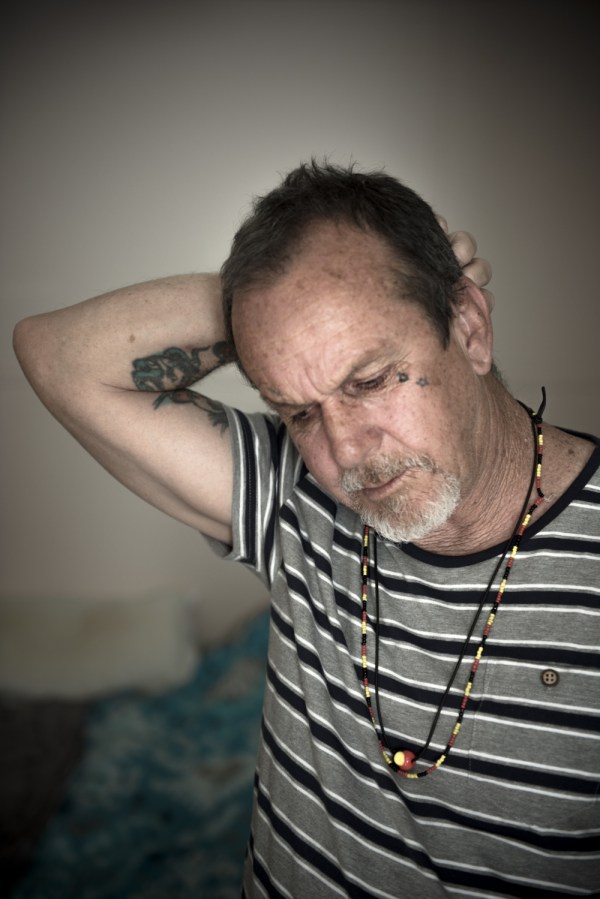
Colour photograph, interior, mid shot of Ken Canning standing in his apartment. Right hand clasped around the back of his head. He wears a striped grey, white and black T-shirt and two necklaces in the colours of the Aboriginal flag.

Credit: John Janson-Moore

KC: I know more about the world by being in there than I probably would if I was out. I know how peoples’ minds work. When you’re in there you’re seeing the most brutal aspects of mankind and you must work out how to survive. How to come out with your sanity intact? I developed some mental health issues but I learnt how to survive. When you get out, it’s worse. We didn’t do medium security or minimum security, it was all maximum. When you get out, you’re a lunatic. How do you survive that? The first few years I was completely off my head. Mad!

GS: When did you get out?

KC: In 1979. My parole was transferred to NSW. I was hallucinating, seeing things, screaming. By 1982 I was starting to calm down.

GS: Did the hallucinating start after you got out?

KC: No, I started hallucinating in jail. When I came out of the cages, I was in the mess hall getting my food, walking with my plate looking at one of the other prisoners and he turned into a creature. That was alarming.

GS: Can you describe the cages?

KC: They built six cages onto the walls in one corner of the yard where it narrowed into a point. Metal bars in front, to the sides and across the top. Small barred, rectangles joining each other.  A rough concrete floor and a seat built out of the same iron bars.  We’d get escorted down from the cells. We were in the cells at night. In the morning at about seven-thirty, the screws would drop the flap on the cell door, we’d put our hands out to get handcuffed. The screws would not enter the cell unless we were handcuffed and facing the back wall. Four small paces square. Because we were classified as intractables, they had to have a minimum of four prison officers to take one of us out.

GS: What are intractables?

KC: We didn’t accept the prison discipline and kept on escaping.  I was classified as an intractable not long after I first went to prison. That classification doesn’t exist anymore. Once your papers were stamped, intractable, they could isolate and brutalise you, put you in the cages for as long as they wanted.

GS: You were saying a minimum of four prison officers were required to take you out of the cell.

KC: Yes, the first thing they did when they entered was smash our head so our face would hit the wall. That was how every day started. Then they’d turn the cell upside down, go away and leave you to clean up the mess. They’d come back in ten minutes and escort the prisoner out of the wing, down a passage way and through the yard. The blokes in the yard were not allowed to talk to us.

Some refused to obey and would say, ‘How you goin’ Bra?’

We’d be carrying our toilet tub. When we got to the cages yard, there were three security doors to go through. The detail would grab the toilet tub and it’d be back outside the cell when we returned. Once in the cages, we’d put our hands out a little square in the door and they take the cuffs off. That was our outside time. They’d take us back about three o’clock. There was a cold shower at the front of the cages but for a while they wouldn’t let me shower. That’s why I’m fanatical about showering now.

GS: What was the worst thing about being in the cells?

KC: No space. As much as we got on together, sometimes we really got on each other nerves, wanting to kill each other. Most blokes were put in the cages for a couple of months, we were in there for years. For extra punishment, we’d be taken to the underground cells.

GS: You kept escaping?

KC: Yes, I liked to escape.

GS: Why did you like it?

KC:  It was like doing stick-ups, there was an adrenaline rush and it was defiance. There were cruel, despicable, white people in control in the jail. A hardened, inhuman bunch of people. I was not going to accept their authority over me.  I was always in maximum security. Escaping from maximum meant I only got three months on top of my sentence. Medium was twelve months and minimum was eighteen months. Every minute of every day, I’d be planning my escape. I was obsessed.

I talked to a criminologist, Dr Tony Vincent, about this. He believed that my obsession with getting out, stopped me becoming institutionalised mentally. If you go along with the daily routine and the surveillance, your mind becomes part of the system. Bodily I was pretending to go along with it most of the time but not in my mind. It was continual defiance on my part.

My initial sentence was thirty-two years. I’d just turned nineteen and I was given thirty-two years for four armed robberies. That’s unheard of. Every morning I’d come out of my cell and look at my cell card, my name, crime and sentence – thirty-two years. I was going to get out when I was fifty-one. When you’re nineteen, that’s like a death sentence. I appealed and got one of the sentences reduced to eight years so I ended up doing seventeen years, but when I was on appeal, I escaped from the courthouse. I’ve got a photo of me when I was on the run. It’s in a nightclub. I look like an office worker.

The next time I escaped, I faked a broken ankle, dropped my crutches and ran from the hospital. The time after that I turned a big garden sprinkler into a grappling hook, plaited sheets for a rope, jumped out of the yard and over the wall at Boggo Road. I escaped from maximum security three times.

Before that I escaped from police cells, and police cars, and I escaped from boys’ homes. There were a couple of attempted escapes too. One from Long Bay and one in Brisbane. I was working in the bake house in Boggo Road and watching their security when they send the bread out to the hospitals. They were slack. I got the blokes to pack me in the back of the truck with the loafs of bread. But the screws  did a random check in between gates and found me. I was laughing. If you’re busted, you’re busted.

Another time, it cost me a couple of grand but I got a little, diamond-tipped, flexible hacksaw smuggled in. I’d almost sawed through the top hinge of my door and was half way through the bottom hinge. I had no idea what I would do once I got out of my cell. Maybe I’d get out of the wing but then what? Hide somewhere until I figured out how to get out of the prison. But the guards came to do their usual check and one of them dragged his baton across the door. I was lying in bed and the door started wobbling. All hell broke loose. This was about two or three in the morning. They left me in the cell and cleared the rest of the wing out, tear-gassed it. Everyone was in the yards and it was cold. Then they came in armed, wearing their gas masks, the whole rigmarole.

I was put in the underground cells for that. They can only keep you underground for four days at a time because it’s brutally inhumane. They unscrew a big metal flap and lift it up then walk you down the stairs. There’s no light and hardly any air. Every day they give you a piece of bread and a jug of water but mix up the time so you are disoriented. Men go mad in those cells after two days and just start talking gibberish. They never came back from that. I knew some of those men. It broke them, I was afraid I might be next.

There was no bed in there just a toilet tub. I didn’t want to lay down because they don’t clean those places. People don’t always get the tub when they go to the toilet. I’d sleep sitting on top of the tub with my head against the wall. It stank and it was pitch black. If they wanted to keep me in longer than the four days, they’d wait until the middle of the day, run down, drag me up into the bright sunlight and order me to stand to attention and salute the Australian flag. I couldn’t. It was impossible. I was so disoriented and couldn’t handle the glare. So, then they picked me up, ran me over to the superintendent’s office, charge me with disobedience and took me for another four days down the hole. One time I was down there for almost twenty days.

GS: You’ve spoken about mental illness. How did you cope?

KC: I say to people, I went mad one hundred times but I came back ninety-nine times.

GS: One bit of madness is still hanging in there. When did you learn to read and write?

KC: Before I was in the cages, a whitefella, called Keith, who was in for fraud, taught me. He was a white-collar criminal but he gave the superintendent lip. One of the blokes who worked in the office told us. So, the super chucked him in our yard, Two Division, where all the ratbags were. The first day he walked in he had his hands behind his back. His hair was slicked down and he had an upper-class accent and he appeared arrogant. Normally, a bloke like that would get slaughtered. It didn’t happen. There was something about the guy and people just left him alone.

One day he sat down and asked, ‘Anybody have trouble reading or writing?

A couple of blackfellas said, ’Yeah.’

He asked, ‘You want to learn?’

It ended up he was a good teacher. He taught Aboriginal prisoners because only white prisoners could go to the education courses. We were in the middle of a campaign to change that.  So, this old bloke put the word out that we need equipment. The whitefellas who were going to the courses started knocking stuff off. Bringing back stencils and rulers and pencils. But in max the prisoners are not the only ones with instincts. The screws have instincts too. When something is going on, they know it. They were running around checking the cells then they did a big bust on Keith Edwards’ cell. It was the biggest bust they’d done for a long time. They were upending everything looking for contraband. We laughed because all they found was educational material. He went to solitary for seven days because of that.

It took a lot of years before Aboriginal prisoners were allowed education in prison. I was writing poetry by then and short stories.

The screws came to my cell and said, “Poetry’s considered a hobby and to do a hobby you’ve got to have permission. You don’t have a permission slip. This is an illegal hobby.’

They gathered up all my writing, handcuffed me, took me down to the incinerator and burnt all my work. That hurt far more than the floggings they gave me. I retaliated that night. Some of the poems were in my memory. I had a spoon in the cell and the concrete walls were old and a bit damp and soft, so I engraved a poem on the wall.

GS: Sometime after you were released, you went to UTS. What did you study?

KC: Yes, I went to UTS and studied Communications and then Oral History. Oral history became a battle in the politics of history. I was fighting to do my master’s thesis orally. I wanted to carry on the traditions of oral history in my work. They didn’t recognise oral history as history unless whatever was said, was proven to be true by someone else. After that Social Sciences developed a new master’s degree that allowed students to incorporate their cultural and socio-economic experiences.

GS: You were one of the founding members of Jumbunna Indigenous House of Learning at UTS. Tell me about that.

KC: Franny Peters-Little, Uncle Norm Newlin and I were the founders. It was called the Aboriginal Education Centre then. We did a lot of other things at UTS. The appointment of Debbie Stoddard as the first overseas students’ officer was because of a campaign we initiated. She became human rights coordinator for the ALTSEAN, the regional human rights group. We campaigned hard for more people from Non-English Speaking Backgrounds to study at UTS as well as Aboriginal students. We were responsible for the first anti-racism policy at UTS. The first policy aimed at hiring Aboriginal staff was drawn up by me and a non-Aboriginal man called Michael Refshauge.

GS: Were you one of the first Aboriginal students to enroll at UTS?

KC: There were other Aboriginal students before us but they didn’t sit it out. I finished in 1987 and I was the first Aboriginal student to graduate. Francis Peters-Little was the second. She was the first Aboriginal woman to graduate.  I graduated in 1988 and I pulled out the Aboriginal flag, wrapped myself in it, ran up and gave the black power salute. There was shock horror. Everyone was disgusted in what I did. At the reception. It was like I had spiders all over me. People just kept away. Twenty years later the University has used footage they have of that graduation to celebrate diversity at UTS. I didn’t realise they had filmed it.

GS: You published your first collection of poems in 1990, Ngali Ngalga: Let’s Talk.

KC: Yes, it was published by Breakout Press. The first poem I ever wrote is in that book. I eventually got permission to write and I wrote down the poems I remembered, the ones the screws destroyed, and I wrote other poems. A lot of those poems were rubbish some were so romantic, they were sick but writing was important to me. It was my survival. One bloke told me I had to have rhythm and rhyming schemes and all that and I was doing it but driving myself a bit mad. Then I thought oh bugger this. I was looking for words at the expense of feeling and emotion so I decided to just write what I think. I started writing my own patterns. Long lines then bang, one word. I liked that style. Sometimes it’s a bit disjointed. I like that too. Visually my poems are not square or rectangular.

GS: What is your favourite poem in Ngali Ngalga?

KC: ‘Black Baby’ is my favourite in that collection.  ‘Small soft baby, thrust from the womb . . . ‘

GS: Your second collection, Yimbanna, was published by Vagabond Press in 2015.

KC: Yes, Yimbanna means to understand. So, we’ve already talked in the first collection and now it’s time to understand. One of my favourite poems in the collection is ‘We Said.’ It’s about listening and understanding, about relationships. It’s a simple poem but deeper than what I originally thought when I wrote it. If everyone lived by this poem, we’d have world peace. You’ve got to listen to each other.

. . . LISTEN – To what
You said, I said, you said.
We both said instead,
I did, you did, I did – you.
Neither of us did,
Understand –
A word.
A sentence.
A thought.
A feeling.
A rejection.
A misperception
Of
each other.

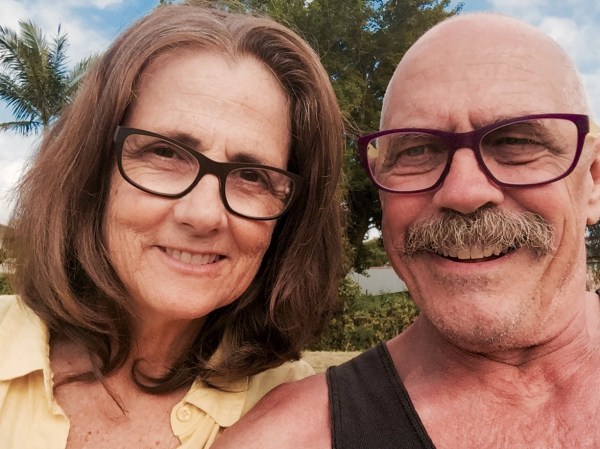
YimbamaIt’s not about blaming anyone. There’s a degree of fault all around. It’s about solving disagreements. You’ve got to sit back and look at each other, listen to each other. All parties need to engage. I’ve learnt to develop that skill of listening and talking with Cheryl, my wife. We have definite commonalities but we don’t always think alike. At times we are opposites. Our politics can be different but we have learnt how to co-exist. We have respect for each other.
I learnt about valuing other people’s opinions from my gran. She was really against putting people down because of their beliefs. She made that very clear to me. Once my cousin, Peter, called someone, I still can’t say the word, a W.O.G, she flogged him.

She said, ‘You don’t like people calling us bad names, you don’t call anybody bad names!’

GS: How would you describe the focus of your writing?

KC: I write about a diverse range of topics. I’m an Aboriginal man in my 60s who has seen a lot of oppression, my personal experiences and the experiences of my people. I write about the horror of these experiences, our strength and our survival, about the love of our culture and I write about our respect for mother earth.

GS: There are poems in Yimbama about mental distress. One is called ‘Psychotic Serenade.’ Why did you write that poem? What was going on in your life?

KC: I was living in Merrylands when I realised I had a serious mental health issue going on. It wasn’t just episodes where I was a bit off. The doctors had diagnosed PTSD, I wasn’t sleeping and I was a bit of a nervous wreck but I hadn’t been diagnosed with anything else. I was sitting on the veranda and I went straight inside and wrote that poem to describe what I was feeling.

Sing – high sing loud
the songs of the silent
musical mayhem,
suicidal symphonies.
Sprinkle sprinkle cyanide star
now I know how disturbed you are.

That’s the last stanza.

Realising I was experiencing some kind of mental distress was one thing but getting something done about it was another thing. I was picked up a lot in the Parramatta area. The police would take me in, give me the knuckle then let me go. It escalated and I got really disorientated.

One time the police took me in and where giving me a hiding in the cells. One copper came in and told them to stop. He realised I need help not a flogging. He had joined the police force in his thirties and worked as a plumber before that so he had a different perspective to the kid who came straight out of Goulburn Police Academy.

I was in hospital for a long time and I went in and out a few times after that. One of those times I was picked up by the police again and sitting in the back of the paddy van, handcuffed and one copper said, ‘You’ll have to wait a while, these other nut-jobs are getting booked in.”

I didn’t like that. That same copper who used to be a plumber heard him and saw my reaction. He intervened and told off the other copper.

The fact that someone who I saw as the enemy was understanding was a big part of my healing. Sometimes it just takes that one person.

I was diagnosed with Schizo-affective Disorder.  But if I allow the mental health diagnosis to define who I am, I’m allowing my life experiences of oppression and brutality to define me. I have always had very strong self-awareness. The psychiatrist who treated me was a wonderful woman. She said one of the saving graces was my awareness of my illness and where it came from. She believed I wouldn’t need to be on medication for the rest of my life.

At first the doctors at Rozelle told me I’d never be able to work again. When they let me out, I agreed to come back as an outpatient but made it clear that I fully intended going back into the workforce. I got my job back at UTS. I’m not saying it was easy but I got through it.

GS: You just said, ‘Sometimes it just takes that one person.’ Can you talk a bit more about that?

KC: Every other policeman was giving it to me, but that one policeman understood. In my journey since day one, there have been a lot of strange, undesirable people but I’ve also been fortunate enough to meet some of the most amazing people you’d ever want to know. Like the late Uncle Jimmy Little.  In his life time, he was called a Living National Treasure. He was Mr Smooth in his nice suits up on the stage but at home he’d be dressed in old ragged shorts and an old singlet, eating damper and because he couldn’t find a cup big enough to drink his tea. He was a big influence on me. Jimmy wasn’t as calm as everyone thought. He was radical in his way of thinking.

He said to me, ‘If you’re going to take a hard line, don’t take a backward step. Keep to that line. It’s your path.

GS: Do you see yourself as unflinching once you take a stand?

KC: Yes, and at the same time, I’m good at identifying the enemy. The enemy is not the woman next door, not the bloke who lives up the road, the enemy is bad government. The enemy is oppressive government and people who buy into racism like the United Patriots Front and groups like that. I don’t want to focus on the bloke who’s doing his job to earn a wage. I focus on the leadership, the heads of power. Even individual coppers, I’m not going to hate them. I don’t like coppers but I focus on the system that creates and uses them. There are some coppers out there saving people, running into house fires, things like that. I forged my political beliefs and direction in prison. I learnt a hard edge but a rational edge. I also developed a softness for people victimised by the system. In prison, we witnessed people being beaten to death. In my play, Mick hears Ray being beaten to death. I heard a very close friend of mine being beaten to death in the cell next to me. That experience has never left me. In those days when a prisoner was beaten to death, it didn’t require a coronial inquiry. All that was required was a doctor’s signature on the death certificate. Like I said before, the prison doctors were alcoholics who did whatever the jail wanted. The screws told the doctor the prisoner had a heart attack and that’s what the doctor signed. So, I was hardened by those experiences but sometimes I’d sit and cry. The authorities never succeeded in crushing my humanity. But jail does snuff out the humanity of some inmates. That’s sad too.

My saving grace was writing. I was so confused when I got out. Writing saved me.

GS: How do you define freedom?

KC: When they turn that key to let you out of prison, that’s not freedom. Cuz and I found the key to freedom. After we were brutalised and kept in institutions, from a young age, where within those mechanisms you had to be violent to survive, we didn’t continue to be violent. We didn’t go out of our way to hurt anyone. The very fact that I am not a violent person means I am free.

The authorities, the state, the society failed to turn me into a monster. I am a human being. That is freedom. If they turn me into a monster, I belong to them.

When Cuz and I got out, we talked about it a lot.

He said, ‘Now we’re out, we can’t afford to inflict our anger on those around us. I know there are times you feel like just giving it to everyone in the street.’

I said, ‘Yeah, I do.’

He said, ‘Well, we can’t cross that line. If we do, the authorities, the screws, own our minds, our hearts and our souls.’

There are good white people. There are also a lot of white people who have a history of despicable behaviour against our people. For me, freedom is not allowing that to cloud my thinking, not to be pre-judgmental towards all white people. If I say to myself, every problem we have as Aboriginal people in this country has come at the hands of white invasion, so therefore every white person is the enemy, then I’m still in prison. Racism wants us to think that way. But once we think that way, we cannot have conversations. Once we cannot converse, we can’t learn what happened, how it happened, how it continues.

Freedom for me is my old gran telling me, ‘Think what you want.’

My freedom is writing. My freedom is my peace of mind. My freedom is building a good relationship.

Ken Canning was interviewed by Gaele Sobott in Glebe, Sydney, 22 April, 2017

Creative Commons License
My freedom is writing. My freedom is my peace of mind. My freedom is building a good relationship – An Interview with Ken Canning by Gaele Sobott is licensed under a Creative Commons Attribution-NoDerivatives 4.0 International License.

Time to Draw the Line: An Interview with Amanda King and Fabio Cavadini


mandyfabio2Amanda King and Fabio Cavadini have been collaborating since 1987 as a co-producer/co-director team, making documentaries in a non-observational style combining interviews, archival and contemporary footage. They have worked together for almost 30 years tackling stories based in Australia and the region, about the environment, Indigenous rights and the arts. 
Their latest films include, Time to Draw the Line (Frontyard Films 2017), A Thousand Different Angles (Frontyard Films 2010), Starting From Zero (Frontyard Films, 2002) and An Evergreen Island (Frontyard Films, 2000).

Gaele Sobott: We are going to talk about your new film, Time to Draw the Line, which focuses on the story of the maritime boundary dispute between Australia and Timor-Leste over an area rich in oil and gas reserves in the Timor Sea.

But first, I would like ask you to speak about what led you to become film makers, and describe how your interest in East Timor developed.

Fabio Cavadini: You want the long version or the short one?

GS: The long version.

FC: I wasn’t a film maker when I came to Australia from Northern Italy, near Milan, in 1969. I grew up mainly in Switzerland. My father died when I was three. My mother was a waitress. In those days, waitresses had to live on tips. They didn’t get a wage. My mother needed to travel to wherever the tourists were. So, during summer she was at the lakes or the seaside. In winter, she would work in the mountains. We were jostled around all over the place. Staying with my grandparents in Italy was the best time I ever had. The worst time was when we were locked up in homes because she didn’t have any money. I was originally intending to go to New Zealand but my brother was already in Australia and he wrote to me encouraging me to go there.  I was a dental technician, specialising in making chrome cobalt plates. They were very thin and at that time there were not many people in Australia who could make them. I came as an assisted immigrant. I didn’t speak any English but it wasn’t a problem. I worked straight away.

I didn’t know anything about Aboriginal people or that they even existed in Australia until 1972. My brother, Alessandro Cavadini, was making a documentary film about the Left in Australia but the Left in this country was scattered all over the place, the in-fights, the ego-maniacs. Aboriginal people were very strong and unified in fighting for their rights. So he ended up making the film Ningla a-Na, about the first tent embassy in Canberra. I got involved. I liked still photography and I was happy doing odd jobs here and there. Subsequently I met some Aboriginal people who were involved in Basically Black, Bob Maza, Aileen Corpus, Zac Martin, Bindy Williams and Gary Foley. They were playing at the Nimrod Theatre at the top of Williams Street and were about to go on tour. They wanted somebody to take photographs and help with the lights so I stopped my work as a dental technician and went with them on the bus for six months. It was very exciting.

GS: Where did you tour?

FC: We went to Townsville and Innisfail. There was a festival on at the time. We also went to Yarrabah Mission up near Cairns. On the way, we met other people. In Townsville, people knew about Ningla a-Na. They said, “We want to tell our story too. Why don’t you come up?”

When I got back to Sydney I spoke to my brother and his then partner, Caroline Strachan, who managed to raise some money to make a film on Palm Island. I was earning a good income as a dental technician but it didn’t mean anything to me anymore so I didn’t go back to the job. Instead, I went to Palm Island. We made the film, Protected, in 1976. I was taking the photographs and generally helping. I’d never made a film in my life, and hadn’t touched a film camera. In those days, video was far lower quality than it is now so we were using 16mm film.

It became obvious that the project was going to take longer than we had originally thought. We were doing workshops so that the Aboriginal people there understood what film was. Plus, they were the ones telling the story. The story belonged to them. They had the connections, a cousin, a nephew, sons, daughters. They were acting in the film, controlling a lot of the process. They were intrinsic to the story telling so it was going to take  time. It’s always a collaboration.

GS: Can you talk a bit more about the importance of taking time when you are collaborating on creating a documentary?

FC: Whenever possible it’s important to allow people to fully participate in the project, in the creative process. Ultimately when you’re making a film, you are not making it by yourself. You make it with many other people who are bringing their private life, their lived experiences to the story so they should have a say. They should have a principal part in shaping the story. That takes time. Especially when you are working with people who may have no knowledge of what film making is. Sometimes in the film industry, film makers say, “Oh yeah, I’m making a film because such and such a film festival is coming up.” They want it ready by a certain deadline and rush everything. To me that doesn’t make any sense. You need to take time to make a film, especially documentaries. Sometimes they are quicker, sometimes they are slower depending on the location, the people you are dealing with. Things change because you’re dealing with real life. So, you must adapt.

GS: So, the project was going to take longer than originally planned.

FC: Yes, the cinematographer decided he couldn’t stay for the length of time necessary to do the project. It was difficult at that point to find somebody to replace him. I knew about lighting with my stills photography so he showed me how to use the camera. Then he left the camera with me and I shot my first film. I didn’t know how well I was shooting because we had to send the stock back to Sydney to be processed. The only reports we got from the lab were that there were no scratches, there was an image and it was in focus. We didn’t know anything else until we got back.

We made another film after that called, We Stop Here, because the people of Palm Island said, “Oh, you must go to Tully on the upper Murray river. The people there have a story to tell.” The Dyirbal Elders were directly connected to Palm Island. Their families were taken away from the land and put there. Palm Island was a penal colony, a jail. The government was putting people on there from Queensland and the Northern Territory.

That’s how I started making films.

GS: What do you think drew you to making documentaries on Aboriginal experiences?

FC: Possibly it was because of my upbringing. Living in homes like I did growing up, I learnt about injustice. In those circumstances you gain a perception of what society is really about, especially the way capitalism works. I’m not speaking from the point of view of a socialist or communist, in the sense that I have never belonged to any party. I’m more an anarchist. But I don’t like the way our society functions. I never liked it as a child, and I still don’t like it now. That is perhaps why I have a very strong interest in working with Aboriginal people to assist in telling their stories. When I came to this country I was given all sorts of information like don’t go into the sea because there are sharks, and be careful of spiders and snakes. Suddenly I saw another reality – the struggles of the Aboriginal people who own this land.

GS: When did you first become involved in making films about East Timor?

FC: I was part of the team that made, Buried Alive, the Story of East Timor, the first Australian film to examine the terrible death toll and the resistance of the Timorese people following the Indonesian invasion in 1975. I  co-directed with Gil Scrine and Rob Hibberd. I filmed José Ramos Horta, following him around in Australia, Mozambique, New York. There were only the two of us travelling. I had my own equipment. You could do a lot with very little money. That’s the way I’ve always operated.

Mandy and I make documentaries on low budgets. It used to be more difficult when the only option was to shoot on film. Now with modern technology you can do the production at home on your laptop.

GS: What about you Mandy? How did you start your film-making career?

AMANDA KING: A slightly different story. I went to art school in Newcastle to do training to become an art teacher. That was from 1973 to 1977 and film was the new big thing in art school. Film courses weren’t even established then so we were taught by the local ABC camera person how to operate a Bolex but basically, we were working with video.

It was while I was a student that I had my first contact with the politics of East Timor. In 1975 when Indonesia invaded East Timor and when the Australian journalists were killed there were a lot of protests. Newcastle was a strong unionist centre. It has a strong Workers’ Club, and the Communist Party. There were a lot of meetings, demonstrations on the street and that sort of thing. The killing of the five journalists affected people. It came a lot more real to Australians when Australian citizens became victims of that invasion. I took part in the demonstrations against the Australian government’s inaction to take up the case or do anything about the invasion.

So, I didn’t go into teaching because of my interest in film. I ended up in Sydney and around 1985 Martha Ansara, who is a well-established film maker herself, was approached by José Ramos Horta to make a documentary about East Timor. He obviously realised the value of films to inform people and the story was not being told. She was a bit busy at the time so James Kesteven and myself took on the project as directors. The film was The Shadow Over East Timor. We worked with Denis Freney, the journalist, who did a hell of a lot of research. He was a Communist Party member, an activist, who had very good relations with the Timorese community in Australia. He was an excellent journalist and researcher and had a lot of knowledge about the geopolitical aspects of the East Timor situation, the subtexts of what was going on politically.

GS: What were the subtexts?

AK: Well, the American and British involvement, the armaments industry, who were supplying the Indonesians with planes and armaments. Also, the background of what happened in the 1970s which included Gough Whitlam giving the nod from the Australian Government’s point of view. The Americans were well informed of the Indonesian army movements at the time and the invasion was okay by our government. This was one of the black marks against Whitlam. I’m a great admirer of a lot of things that he did but with Timor he had some sort of a rationalist attitude believing that small nations were not viable and East Timor was not going to be able to become a successful independent country.

We began work on The Shadow Over East Timor in 1985 and sent the finished version to SBS in the late ‘80s. We didn’t hear anything for a long time but then a producer at SBS, Barbara Mariotti, realised that actually this film was saying something that Australians probably would be interested in. There was a lot of Australian content in the story, Australia being such a near neighbour to East Timor. Then SBS came on board, in contrast to their response to our current film, and offered to purchase The Shadow Over East Timor. So, we said, “Why don’t we make it a proper television hour?” It was only about 38 minutes at that point. That would be adding another 20 minutes to the film and meant that we could contemporise it a bit. It allowed us to bring it up to date on the oil issue and interview some more Timorese people who could give eye-witness evidence of the level of oppression that was going on in a country. Timor was virtually blockaded from the world. Technically people could go there. Outsiders could visit but they tended not to because of the heavy vibe of intimidation. It was a neglected country with a strong military presence.

Fabio and I met because we were both concurrently working on documentaries about East Timor, and he came to watch our film. Then, because we got SBS interested in The Shadow Over East Timor and decided to expand the film, we decided to go to East Timor together to try to get new footage. That was the end of 1989. But unfortunately for us because everything had to be organised semi-clandestine in order to get in there and talk to people on the ground, it was quite an involved process. Unbeknown to us, José Ramos Horta had organised for Robert Domm to go in. So the week before we arrived in Timor, Robert had walked up into the mountains and got an interview with Xanana Gusmao. We had no idea.

FC: The ABC broadcast the interview with Xanana on the actual day we arrived in Timor so Indonesian intelligence were on high alert. We arrived by plane. There were four white people on the plane, Mandy and myself and another couple. The atmosphere was really tense. The country was occupied by Indonesia and a lot of killing was going on. Everyone was mistrusting everyone else. They didn’t know who was spying. A lot of people were forced to spy because their family was threatened and so on. We had the Indonesian secret service attached to us wherever we went. They were following us constantly.

AK: It was overt.

FC: They questioned us. What is your job? What are you really doing here? I had put my occupation down as house painter and Mandy had said she was a teacher. We said we were tourists, there on holiday. But they were obviously suspicious of us because we had a video camera and tourists were not going to Timor at that time. We had contacts and we had to wait there for them to come. We had to be patient. It was pretty full-on. Some students came to see us at night, talking to us, the next thing we heard a noise and the students disappeared.

AK: There was a curfew in Dili so truckloads of soldiers were patrolling the streets.

FC: With no lights on. Trucks full of Indonesian soldiers. It was quite freaky. It was a disastrous trip.

AK: We did get interviews with students in Jakarta, and we did finish the film.

FC: We had that footage with us in Timor because we had been to Jakarta first. We were in Timor for about three or four weeks so we thought in case the Indonesians search us we should do something about the footage. We opened the cassettes and cut the tape, rolled it on pencils and hid the pencils in various places. They didn’t search us in the end. When we got back to Australia we spliced it back together.

AK: The footage survived. That film was released on SBS months before the Dili massacre. It touched a nerve and got quite a lot of publicity. Buried Alive had been screened by the ABC the year before.

filmtimetodrawtheline

Time to Draw the Line cinema-on-Demand poster & DVD cover. Original artwork Tony Amaral

GS: What led you to make your latest film on Timor-Leste, Time to Draw the Line?

AK: We made another film, Starting from Zero. It came out in 2001. The story follows three people who had come to Australia as refugees in 1975 and went back to Timor during its transition into an independent country. We maintained connections with them. Most people in Australia think, well, East Timor is independent now. Everything’s ok. They are getting some money from the oil. They should just move forward and do the best they can. But it became clear to us through our continuing friendships with Timorese people that things were not quite right and Australia figured significantly in that story. It became much clearer to us through the process of making Starting from Zero that Australia is playing a big role in denying the Timorese their full sovereignty. It’s about the resources in the Timor Sea. This is the last hurdle that needs to be jumped. The Timorese are fighting for full sovereignty, full rights to their territory. They are fighting to define the borders, the maritime boundaries, as it’s vital to them achieving full sovereignty. We have been making these films over decades now in support of exactly this.

FC: We made films in Bougainville and Papua New Guinea that centre on the modus operandi of Australia in the region. It doesn’t matter which party is in power, Liberal or Labor. It’s the same. Australia is exploiting these countries. No respect. You see that in Timor, in Bougainville, in Papua New Guinea with the mining companies. BHP went to Papua New Guinea, opened a mine. Australia was happy. The company destroyed 700 kilometres of river. One of the biggest rivers in Papua New Guinea totally destroyed. Then they took off. That is what our film, Colour Change, is about.

AK: We made An Evergreen Island about the people of Bougainville under military blockade. In 1989 the land owners asked the company running the copper mine for proper compensation for damage to their land. These mines are massive and the impact on the local environment, in this case, 17 years of toxic waste and pollution, was horrific. People from many of the communities were living from the produce of the land. They were and still are catastrophically affected by the destruction. They had been negotiating with the company to get decent compensation and the company just said, No. We pay our royalties to the national government. End of story.

As the customary owners of the land, women were instrumental in setting up the Landowners’ Association, from which a core group of members formed the Bougainville Revolutionary Army and trained up in guerrilla tactics to defend their land. A number of local people were employed by the mine and they knew how it operated. They identified one weak point. It relied totally on one power source. Generators that were down at sea level. Power cables brought the power up the mountain to the mine. So, the landowners led by Francis Ona exploded a couple of power pylons and the mine was no longer functional. We heard that news report at the time. The brilliance of the tactic struck us but obviously, the consequences were severe bringing mayhem to the people because the army and police were brought in and almost a ten-year total sea and land blockade occurred on that island. We went there in 1997, towards the end of that blockade. We were attempting to do a character profile on Sam Kauona, general of the Bougainville Revolutionary Army. He’d been trained by the Australian army. He was working at the ammunitions depot when there was a big increase in the ammunitions order. He was thinking, why? Why are we suddenly needing all these ammunitions? He put two and two together. There was trouble in Bougainville and that was where the extra ammunitions were destined. The ammunitions that he was going to be handing out were to be used against his own people. So, he effectively deserted. It was a powerful story. We spent quite a lot of time with him and his wife, Josie, in Bougainville. On the way in, we hung out waiting to be picked up by the BRA, then travelled across the ocean in a banana boat looking out for the patrol boats and helicopters. We crossed the blockade. Once again this was an Australian story because the Australian government had given the PNG government patrol boats and access to helicopters.

FC: And pilots.

AK: Yes, and they were enforcing this blockade.

FC: The PNG army was shooting people. When they captured some of the BRA they tortured them but also some were taken out to sea in the helicopters and dumped. These events were recorded. The Australian government was supplying armaments, equipment and pilots.

AK: There were no Australian soldiers on the ground but there were Australian and New Zealand pilots involved in flying the helicopters.

GS: In relation to your new film, Time to Draw the Line, you were saying it was through your continued contact with Timorese people you met in the 80s, that you became aware that the exploitation of oil resources in the Timor Sea. And this was central to the ongoing Timorese struggle for full sovereignty. Would you like to talk more about that?

AK: Yes, one of the most astounding things is that Australia has completed negotiations with every other neighbouring country for just over 98% of its whole maritime boundary. Large amounts of that boundary have been negotiated according to the principle of the median line under international law where both countries conform to a median line equidistant from their shores. The boundary between Timor-Leste and Australia is the 1.8% of Australia’s maritime boundary that remains unnegotiated. There is no maritime boundary here. Two months before East Timor’s independence, Australia withdrew from maritime boundary dispute resolution mechanisms of the International Court of Justice (ICJ) and the International Tribunal for the Law of the Sea (UNCLOS). Many commentators conclude it was a move to avoid involving the international umpire in any future discussions about boundaries.

timor-leste

Diagram showing the 1.8% of Australia’s maritime boundary that remains undefined – the boundary between Timor-Leste and Australia.

We know how powerful the argument of borders is, and how politicians like to refer to borders in relation to refugees who come by boat to this country. The poignant aspect of this story is Australia’s politicians are infatuated with borders but they do not have that same infatuation in relation to the 1.8% of our maritime border that relates to Timor-Leste. Why is that? Every Australian should be asking themselves, why is that? There is a huge anomaly there. What is the story?

FC: As Steve Bracks says in the film, we can’t criticise China’s stance on the South China Sea when we are acting this way in the Timor Sea. It’s hypocritical.

AK: We are a wealthy country and our neighbours are not. Particularly Timor-Leste. Maternal mortality is 83 times higher in East Timor than in Australia. Malaria and tuberculosis are widespread. Education is desperately needed for future development. The oil and gas fields are on Timor-Leste’s side of the median line. The country desperately needs this revenue.

FC: Well, I just want to add that we are a wealthy country for some people, not for everybody.

AK: That’s true.

GS: Tell me more about the process involved in making Time to Draw the Line. How did you begin?

FC: We formulated the idea with Janelle Saffin and Ines Almeida who came on board as associate producers. We’ve known them for many years. Janelle served in both the Federal and State parliaments as a member of the Labor Party. She’s a lawyer and was an official observer for the International Commission of Jurists at the 1999 independence referendum in East Timor.  Ines was one of the characters in our film, Starting from Zero, about the Timorese people going back to their country. She has been at the forefront of the struggle for Timor-Leste independence and now to secure their sovereignty with the marking of maritime boundaries. We decided to concentrate on the Australian angle of the story. It is a message for Australian people from Australian people. We only have a few Timorese people coming into the story.

AK: It was an organic process. Obviously, we had an outline. We contacted a lot of people who have been more deeply involved in the issue of full sovereignty and defining the borders, and what’s going on with the oil. We started filming in the street in Melbourne to get a sense of how well informed Australians were. So then it moved organically from there, talking to a very deliberate cross-section of people in terms of their political backgrounds. Most of them feel very passionately about the issue. That is what has given the film a lot of energy and life. As well as those perspectives on the current situation, we did some historical storytelling. From our previous films, we know that the 1943 involvement of Timor in the Second World War is such an important element in Timor-Leste – Australia relations.  Australian soldiers in the 2/2nd Australian independent company went to Portuguese Timor, as it was known then, a neutral country, and many of those men felt very passionately about the support they had been given by the Timorese people at the time. The Australian mission was unsuccessful and they withdrew but our soldiers saw with their own eyes the beginning of the Japanese retaliation against the young Timorese people who had been supporting and protecting them. As the Australian soldiers were rescued by boat, Japanese soldiers were coming down the hill and killing those young people. The veterans have maintained a campaign for over 50 years to get redress because the Timorese were promised, leaflets were dropped, saying, we will never forget you.  Australia showed no signs of acknowledgement or generosity towards the country after the war. Now that Timor-Leste is an independent country, it has been able to reach out to the Returned Services League in Australia. The Timorese are building very solid connections with the veterans. That’s been going on for a ten-year period. There are not many veterans alive now. It’s a very significant part of the historical aspect of the story about the connection between the two countries. Some of those veterans have spoken out so strongly, and have been involved for a long time, particularly since the 1975 invasion.

Black and white photograph of World War II veterans, Paddy Keneally and Rufinl Alves seated and holding hands.

Australian, Paddy Kenneally, WWII veteran, Sparrow Force, Timor campaign with Timorese veteran, Rufino Alves Coreia

FC: Paddy Kenneally was one of those veterans. He was a character in Mandy’s earlier film in the 1980s. The continuity is there. People involved in this kind of struggle are very committed. They don’t change. They firmly and staunchly keep fighting for what they believe and eventually they bring about change. There are many people like this in the film from varied political and religious backgrounds.

GS: You speak of the World War Two veterans and their support for full sovereignty where else does or will support come from within Australian society?

FC: It has to come from the people in the streets. It’s not going to come from the politicians. They play too many games. They always have and they always will.  When the time finally came for the Timorese people to vote for their independence, we were filming Timorese in Australia and Mandy was there filming just before, the killing had already started, we knew, everybody knew that there was going to be a massacre if the Timorese people voted yes. But our government didn’t move to protect the people. Following the vote for independence in 1999 there were huge demonstrations in Australian cities. Thousands and thousands of people marched through the street. The government was forced to send troops but it was too bloody late.

The problem with our media is that the reporting centers on sensationalism. Something sensational happens and it goes on the news. It comes and it goes. There is no analysis, no depth to the reporting, it doesn’t continue over time. It’s as if these things happen with no historical or political context. That is another reason we made this film because it is a way of letting Australia people know what is going on. The Timor story is continuing and there is a dark side. The Australian people have the right to know. When we finished the film, we approached SBS, they weren’t interested. We went to the ABC. Compass was interested but they wanted us to cut it to half an hour and take out the references to the oil. This is the ABC mind you, forget about the commercial channels.

AK: To give the ABC due credit, they have done some excellent Four Corners stories on this issue.

So, not only do you have the Second World War veterans who are very passionate about Timor-Leste but you also have the 1999 INTERFET peacekeeping veterans who are passionate about the country. They made connections and friendship during their time there. They have on-the-ground knowledge of life there.

GS: Why are they speaking out? Do they see a disconnect with their peace keeping activities?

AK: Well, yes. The exposés of Australian government behaviour regarding East Timor made them question Australia’s role in Timor. They were peacekeepers. Most of them believed they were on a positive mission and the time they spent in Timor had a lifetime effect on them. They feel that there is unfairness and injustice that has occurred on Australia’s part. They feel betrayed on the oil issue and speak up very strongly in the film about the need for a median line boundary with Timor-Leste.  In the early 2000s when the Timorese were negotiating to try to sort out what had been happening in the Timor Sea with the deals between Indonesia and Australia, they negotiated with John Howard and Alexander Downer, they managed to get what could be perceived as a reasonable percentage of the royalties and signed a treaty in 2002. But then after the discovery of the huge oil and gas field, ‘Greater Sunrise’, valued at 40 billion dollars, negotiations started again in 2004. Even though there is a strong case that these resources fall within Timor-Leste’s sovereign territory, the Timorese got tied up in knots and signed the 2006 treaty (CMATS).  Part of that treaty locked them into not having any maritime boundary discussions with Australia for 50 years. Even such a huge oil and gas field as Greater Sunrise would be depleted within 50 years. One aspect of the negotiation is that it must be done in good faith. So, when in 2013, it was alleged by a whistle blower that the Australian government had employed people to pose as renovators of the government palace and install listening devices so they could hear what the Timorese were going to pitch for the Treaty, there was clear evidence that good faith was well and truly out the window. There’s no good faith if spying allegations are proven when you are in the middle of a negotiation.

GS: Australia is negotiating boundaries in relation to the oil and gas fields but who is extracting the resources from these fields?

AK: Woodside Petroleum has teamed up in a joint venture with Conoco Phillips and Shell. The Australian government granted Woodside leases over the Sunrise and Troubadour gas fields in the Timor Sea in the early 1970s. Australia has always claimed that its boundary was 150 kilometres off the Timorese coast because of the continental shelf. This is based on the reasoning used by President Truman in 1945 when he extended United States control to all the natural resources of its continental shelf.  These laws were superseded in the 1980s by the UN and UNCLOS ruling which created the new international law of median line or equidistant boundaries. Australia is out of step with international law and as I said earlier, in 2002 just before Timor-Leste finally achieved its independence, the then Foreign Minister of Australia, Alexander Downer pulled Australia out of the compulsory jurisdiction of international courts and tribunals in relation to maritime boundary matters.  Timor-Leste had been unable to call on an independent umpire to decide the border. But as Timor-Leste, has claimed the treaty was invalid, given Australian intelligence operations in 2004, and taken Australia to the Permanent Court of Arbitration in The Hague, they are now in Compulsory Conciliation hearings for the next 9 months. It is a result of these hearings that the recent 2006 CMATS treaty will be torn up.

FC: I just want to add that Downer was Foreign Minister when the INTERFET peace keepers went to Timor. When he left government, he became a consultant for Woodside Petroleum. That would make anyone question Australia’s role.

GS: Do you think people demonstrating in the street in Australian cities would be enough to create change in relation to Timor-Leste achieving its full sovereignty?

AK: There should be layers of activity. Public awareness does play a very significant role and influences the way politicians behave. The Labor Party is now saying it will certainly enter negotiations to discuss the boundary, which the current government said it wouldn’t do. We have yet to see what this recent news of the abandonment of the 2006 treaty, is going to mean. Is Australia going to step away from its claim to the continental shelf?

FC: Time to Draw the Line shows Australian people from all walks of life. Timor strikes a chord in the Australian population. I grew up with the Catholic religion and it goes very deep no matter how hard I try to wipe it from my brain. One character in the film, Sister Susan Connelly, tells the story of Jesus saying to Peter, “Before the rooster crows, you will disown me three times.” She feels Australia disowned Timor three times. The first time was during the Second World War, the second time was the invasion and 24-year occupation of Timor by Indonesia, and the third time is in relation to the oil. Australia has denied Timor access to these resources. We have been doing this for a long time and we are still doing it. That includes the business and industry that is created around the oil. You can see how Darwin has benefited since the exploitation of the oil fields in the Timor Sea. Billions and billions of dollars has just been ripped off. If they sought compensation for all that money, they wouldn’t even need to extract the oil and gas.

Timorese school children dressed in uniform - white shirts and grey shorts and skirts walkingand running along a road surrounded by greenery. They are having fun. Three Australian college students in their midst.

Radford College students from Canberra with Timorese school children

AK: The Timorese set up a sovereign wealth fund. Something that this country has not done. Our population has allowed the exploitation of our mineral resources with no thought what so ever to the rights of future generations. It’s mind boggling how irresponsible our politicians have been in this regard. The Timorese have done a brilliant job in this regard. Every country with large natural resources should be doing as they have done. Australia doesn’t. It highlights the weird hypocrisy going on regarding the Timor Sea. A few hundred kilometres south-west of the Timor Sea in the Indian Ocean we have Chevron and other multi-national companies extracting oil and gas in our territorial waters and the Australian people will not see any tax from these companies for up to 30 years. We are trying to grab resources that are entitled to another people, and in our own territory we are letting multinationals cream it off through tax cuts.

GS: Do you think the Australian government serves the demands of multi-national companies before anything else?

AK: Yes, it appears that way. Those companies should not be assisted by national governments. They are making huge profits as it is.

FC: Then the politicians get high-paying jobs with those big companies when they leave government.

GS: You have not had much interest in the film from the main television stations. Do you see this as a form of censorship? How will you get the film to the public?

AK: Back in 1989, 1990, SBS could see that the Timor story was something Australians would be interested in. How many years later, 26 years later there is a totally different attitude. SBS does deal with risky subjects sometimes but when it involves our own national government, there seems to be a whole lot more sensitivity around it.

FC: Distribution is very limited. Television is a problem. Look at what’s happened to SBS. When we were first associated with SBS you’d go into their offices and all the departments were run by Wogs. I can say ‘Wog’ because I am one. It was enlightening to be there. Hearing people in positions of power speaking with accents, people with different perspectives on life. That’s what SBS was created for. Over the years these people disappeared from their jobs and were replaced by Anglo-Saxon people.

AK: SBS told us, “Oh, it will do well in film festivals.” They were positive about their negative view of the film.

FC: SBS did get behind some good films but when it comes to deeper, more analytical films, they say they are  not interesting. They started doing all those cooking programs and now they’ve created a special channel dedicated to cooking programs. Don’t give the Australian public analysis, politics, history, give them cooking programs!  There was some hope with ABC international but that was cut when the Liberals got into power.

AK: NITV does some excellent current affairs.

FC: NITV is changing too. You watch. That’s what goes on in this country.

AK: Other alternatives do sprout up. Social media provides another platform. One of the new ways of getting around the kind of censorship we are talking about, is on-demand type screenings. It’s potentially democratising approach to getting a film out to the public. You can show a film in any cinema in Australia.

We have put Time to Draw the Line on the Demand Film Australia site. People in the community can organise their own film screenings. It’s user friendly with an easy step-by-step format. This company helped distribute Chasing Asylum, Eva Orner’s film. It was shown all over Australia in single-event cinema screenings. We are hoping, not perhaps for that scale of success, but we know that Timor does touch a chord with many Australians and this is a story they will relate to. Al Jazeera English contacted us this morning. They will feature excerpts from the film in a current affairs program. This is a national, regional and international issue.

GS: How would you like Australian people to react to your film?

FC: Go to politicians and tell them what changes you would like to see happen. Protest the injustices, go out on the street if need be, and talk to other people. If you know something, talk to your friends, your neighbours, your work colleagues. Don’t just talk about the nice cooking program you saw last night. Tell others about Timor, about our role in Timor. People talking to each other about real issues is very powerful. Stop hiding behind life-style programs.

AK: Yes, we need to cut through the politicians. Australians are aware of what’s happening, they are concerned and they are watching to see how the politicians they voted for are going to respond. Politicians should not just be listening to the fossil fuel industry and prioritising the agendas of big companies over how ordinary Australians feel. Respect for our neighbours and their sovereignty is right up there.

GS: You have a history of collaboration and giving. You help people tell their stories, you help people who do not have the means to make films, you assist with advice, equipment, sharing skills. What advice would you like to give to young film makers?

FC: Don’t do what we did. No, I’m joking. The film industry is a strange animal. It encompasses a whole lot. There are people like us who work on political films but the majority of people may have different attitudes to film, to stardom, to money etc. We represent a very small slice of the film-industry cake but we are there. We were teaching film for over ten years, especially when there was not much money coming in. I always remember telling the students on the first day, “Don’t think that a documentary-film maker, especially one making social and political films, is going to make much money. You will be working bloody hard but you won’t be making much money.”

AK: There are all sorts of ways of telling stories. In Time to Draw the Line, Robert Connolly appears and speaks passionately about Timor. He’s a very successful feature film director, a tele-series director. There are all sorts of ways you can tell stories in this industry. But it is going to require persistence. If you feel passionate about using film to get stories out there that you don’t feel are getting the attention they deserve, stick with it. You will eventually succeed. The media is diversifying and changing. Often it is young people who are at the forefront working out creative ways to tell stories. They are always at the vanguard even though they probably don’t realise it. So, go for it!

Further Information:

Time to Draw the Line on-demand screenings

Time to Draw the Line Trailer

Time to Draw the Line Facebook

Frontyard Films website

Time to Draw the Line is distributed by Ronin Films

Amanda King and Fabio Cavadini were interviewed by Gaele Sobott in Sydney, 15 January 2017

Creative Commons License
Time to Draw the Line: an interview with Amanda King and Fabio Cavadini by Gaele Sobott is licensed under a Creative Commons Attribution-NoDerivatives 4.0 International License.

Dignity is essential. It means we are viewed by the other as a human being : an interview with Alice Cherki

A recent black and white photograph of Alice Cherki, sitting at a table, smiling.

Alice Cherki

ALICE CHERKI is a psychiatrist, psychoanalyst and author. Born in Algiers, 1936. She knew Frantz Fanon well, working by his side in Algeria and Tunisia as a psychiatrist, and sharing his political commitment during the war of independence in Algeria.

Alice Cherki has lived in France since 1965. She is co-author of the books, Retour à Lacan (Fayard, 1981) and Les Juifs d’Algérie (Editions du Scribe, 1987), and author of La frontière invisible (Editions des Crépuscules, 2009) Frantz Fanon, portrait (Seuil, 2000) translated into English by Nadia Benabid and published as Frantz Fanon: A Portrait (Cornell University Press, 2006) and Mémoire anachronique (Editions De L’aube, 2016).

Gaele Sobott: Can you talk a little about the history of your family, your place of birth and your childhood?

Alice Cherki: I was born in a family of Jewish Algerians who were in Algeria since the Romans or before the Romans. My parents were born in the small towns of Medea and Ksar Bukhari but they met in Algiers. I was born and I lived in Algiers. I am Algerian, voilà!

Some of my family are Jewish Berbers.

GS: Were there Jewish people in Algeria before the Arabs?

AC: Yes, the majority were there well before. Some came later in 1492 from Spain through Morocco, others from Italy, and then Alsatian Jews, but at that point it was already colonial Algeria.  Many of those left again and went elsewhere. But most of the Jews of Algeria had been there for a very, very, very long. Some of them were Berbers who converted to Judaism. I belong to that history.

GS: Did you speak Arabic?

AC: Very little. I’m not very good at languages. I come from the same environment as Derrida. at school, we learnt Latin and Greek.

GS: Did you know Derrida?

AC: I knew Derrida very well. He was eight or nine years older than me and that represents a big difference but yes I knew Derrida well.

Like Hélène Cixous and Derrida, my childhood was marked by the Vichy anti-Jewish legislation which excluded Jews born in Algeria, denied us French nationality, the right to go to school, the right for Jews to work in government administration. This was hugely traumatic for me as a child.

One Christmas, I was 4 or 5 years old, my teacher said, “Tell your mother that after the break you must not come to school anymore.”

When I asked her the reason, the only answer I got was, “It’s because you’re Jewish.”

I didn’t know what that meant.  So, I gathered my courage and asked, “What’s Jewish?”

She replied, “It’s you with your big eyes, big mouth and big ears.”

Each of us, as Derrida also relates, was excluded from school, our parents could no longer work.

GS: How has this experience affected your adult life?

AC: It opened my eyes to the injustices of the world in which we live; a world marked by colonial ideology.  In Algiers in the 1950s, there was no intersection between Europeans, the Jews and Arabs –  the so-called natives. I didn’t experience it at home but we were caught up in all that. I talk about it a little in my book, Mémoire anachronique.  Everyone lived in their own sphere. Some of us would meet each other outside these spheres.

During my early years at primary school there was no mixing at all. In Grade 6, there were some girls; Rachida, Malika.  For the whole of my secondary schooling I only knew of one Algerian woman student even though my school was not the most snobbish high school in Algiers.

GS: It was the same principle as Apartheid?

AC: The same principle except that it was more camouflaged. Algerians were contained in their own neighbourhoods. Even the bourgeois had their areas. The Algerians passed like shadows in the European neighbourhoods

GS: What area of Algiers did you live in?

AC: I first lived on the border of a working-class suburb, near the boys’ school, known then as Lycée Bugeaud, now it’s called Lycée Abdel Kader. Later, at the age of 17, we moved to Central Boulevard in Hydra. Our house was on a piece of land owned by my uncle –  my father’s brother, my father’s sister, and my father. After some years, they managed to build a three-storey house there for the three families.

GS: What did your father do for a living?

AC: My father traded in cereal. He carried out transactions with farmers for the export and import of chickpeas and lentils.

GS: How did your interest in psychiatry come about?

AC: Firstly, it was a struggle for me as a woman to study. After I passed my baccalaureate, even though I was from the middle-class, it was not usual for women to continue their education. Women were expected to marry and so on. I had an older brother and a younger brother and was the only girl. Neither of my parents continued their studies. My father, a brilliant student, was pulled out of school at age 16 by his father. He was the eldest of ten children There were two or three girls before him so he had to work. I believe my mother chose to leave school to get married. When she met my father, she dropped out.

My parents were both very intelligent and relatively progressive. My father spoke Arabic, but they did not have a higher education.

I already had a certain outlook on society and I was more inclined towards literature. I wasn’t a good student and had never received any awards for excellence. I was impertinent and people always told me I would make an excellent actress. With no one to advise me, in those days, if I had decided I wanted to be an actress, it would have been worse than deciding to be a prostitute. Having said that, I did later have the luck to meet many people who became involved in theatre.

So, I found myself first in hypokhâgne and then khâgne. You know what they are?

GS: No.

AC: Preparatory literary classes for the grandes écoles. The equivalent also exists in the scientific field. I was interested in studying philosophy but decided that would mean cutting myself off from the real world. I made up my mind that I wanted to be useful so I chose to study medicine. But very soon I realized medicine didn’t meet my needs. It was all about identifying symptoms and responding with treatments. I remember a teacher saying, “But Mademoiselle, you ask too many questions.”

We never say, “Why” in medicine. Instead we talk about, “How to fix it.”

So, I was part of two cultures; one of interest for human beings and their psyche, and the other a group culture which stemmed from my medical studies.

GS: Were there other women you knew of who were studying medicine then?

AC: There were a few, but they were a definite minority.

There was a saying that summarized the situation quite well. It relates to sitting the intern examination:

If you are white, European and male, you have an 80% chance of sitting the exam. If you are female and European, you have a 60% chance. If you are Jewish and male, you have a 50% chance. If you are female and Jewish, you have a 25% chance. If you are Muslim and male, you have a 10% chance. As for being Muslim and a woman, you are not even mentioned because you just don’t get the opportunity.

Some managed to study medicine or become trainees but none got to sit the intern examination, voilà!

GS: When did you meet Fanon for the first time?

AC: I was part of a youth movement called AJASS (Association of Algerian Youth for Social Action) and Fanon was invited to give a lecture by a friend of mine, Pierre Chaulet, who died recently. It was a lecture on fear and anxiety in 1955. I must have been 19 or 20 at the time and had to leave my parents’ home where I’d been living. Most of the interns at the hospital were French-Algerian and because of my opinions I faced all kinds of problems. My car tyres were punctured, my white doctor’s coat soiled, my files stolen. So, when Fanon found out I wanted to do psychiatry, he told Pierre Chaulet I should come and intern under him at Blida psychiatric hospital.

GS: So you lived at the hospital in Blida?

AC: Yes, as an intern. That’s where I met my husband, Charles Géronimi. He shared my ideas, but having Corsican parents, teachers but Corsicans, they had trouble accepting a little Jew in their family, especially my mother-in-law.

GS: What were your first impressions of Fanon?

AC: My first impressions, at 20, I found everything he had to say very interesting and didn’t think of him as black. He analysed the subjectivity of racism which was very different from the discourse of the time. On the one hand, we had Existentialism and on the other, Marxist materialism which didn’t include questions of subjectivity. It was the first time I’d met someone who was only 10 years older than me but had immense experience, and a developed understanding of these two worlds, of the two ‘ideologies’.  He was neither on one side nor the other which met my expectations, answered my questions.

GS: He had practical ideas?

AC: Yes, he was a hands-on kind of man.

GS: That’s to say, the development of his thought was founded not only on the theoretical but also on his lived-experience?

AC: On his experience, yes. And that also pleased me. It was from his lived-experience that he elaborated his ideas. But he also had very advanced psychiatric training.

GS: What were some of the work experiences during your time with Fanon in Blida that influenced your practice of psychiatry?

AC: Everything he brought to psychiatry, especially his critique of the School of Algiers’ theory of primitivism. He also introduced social therapy, institutional psychotherapy.

GS: How do you define institutional psychotherapy?

AC: Institutional psychotherapy, as developed by Tosquelles, took off in France with the support of Oury and Bonnafé. It encourages the residents of psychiatric institutions to share things with their caregivers. Through humanising the functions of these institutions, it allows understanding not only of patient symptoms but also the roots of these symptoms. There are still two or three people in France who are struggling to create places that foster institutional psychotherapy, but it is becoming more and more difficult.

GS: Why is it becoming more difficult?

AC: Because of the prevailing ideology. Now we have DCM 3, DCM 4, DCM 5. It is a performative ideology that absolutely bypasses all subjective aspects of alienation.

GS: Did you have any significant experiences in the hospital setting as a female doctor caring for patients in that historical and social context?

AC: What do you mean by significant experiences?

GS: For example, when you worked at Joinville-Blida Hospital, were there certain events that affected you?

AC: Yes, of course.

GS: What were they?

AC: So many things. For example, I saw women hospitalised after childbirth for postpartum, transitory delirium. Some doctors didn’t understand and sometimes even people in the women’s families said, “It’s the djnoun who came to inhabit her.”

It affected me deeply because  I wanted to ascertain their experience of the delivery because it influences their relationship to the newborn baby.  It’s a complicated relationship.

GS: Did you have your own children at that time?

AC: No, I had no children at the time. I now have a son who is 40 years old. He studied political science and then he got involved in theatre.

GS: So, he is fortunate?

AC: Well there you have it.

Black and white photograph of Alice Cherki as a young women. She has short, dark hair, is wearing a white, V-neck dress and a necklace, and she is smiling.

GS: As a female doctor, what were your professional relationships like with your colleagues at the hospital?

AC: Amongst us interns at the psychiatric hospital of Blida, I was considered an equal.

I married an intern from the hospital. No, I can’t say I had any problems. On the other hand, before that when I was at the Mustapha Hospital in Algiers, I was very young, I did my hair in a bun and put on big glasses to make myself look older so I’d be left in peace.

GS: Was your husband originally from Blida?

AC: No, he was also from Algiers but he was an intern with Fanon in Blida. They wrote a paper together on Algerian women and the cultural specificity of TATs (Thematic Apperception Tests).

GS: In your book, Fanon, Portrait, you mention a meeting between Fanon and Jeanson. (1)

AC: Yes.

GS: In that meeting Fanon expressed his wish to go beyond certain ideas so that readers can experience aspects of life that they could never know firsthand.  You talk about Fanon exploring the sensory dimension of language. Do you think that this approach to writing could enable us to communicate experiences around difference, to understand our differences from an egalitarian point of view – not superior or even inferior?

AC: Yes, I think this type of writing is essential. In my experience, sensory writing starts from perceptions, sensations to try to improve communication with the other, I think it is very, very necessary.

GS: Do you know any writers today who write like that?

AC: I’m not qualified to say. I don’t know today’s writers that well. But Kateb Yacine wrote like that.

GS: Do you see difference as a dialectical space that can trigger creativity and imagination?

AC: Yes, that’s what I call the relationship to the other, the recognition of the outside, the stranger. It is important. I wrote another book called La frontière invisible, in which I insist on the relationship to the other. This allows you to accept the outsider in yourself.

GS: In your book, La frontière invisible, you link psychoanalysis and politics. I understand colonial violence, violence of displacement, violence against the subject in the social context, the context of specific historical and political circumstances, for example, those of Algeria and France. But when I try to analyse this violence from a psychoanalytic point of view, I find it difficult to understand.

AC: It is complicated. But you have sought out strangers?

GS: Always, yes.

AC: Perhaps it’s not by chance.

GS: Perhaps not.

Did you know Fanon outside his work, in his family life? What kind of man was he as husband and father?

AC: Yes, of course I had the opportunity to know Fanon outside his work. I knew his wife well and I know his son very well. As a dedicated husband and father. At the same time, he was a very busy man. But he was very dedicated to his family. When his father left for Africa, Olivier didn’t see him that often only from time to time when Fanon came back from working there.  Olivier was only five when his father died.

Fanon loved life. He liked to go out to dinner, go dancing, things like that.

GS: What type of dancing did he like?

AC: All the dances of that time, le slow, the rhumba . . .

GS: Did you like to dance?

AC: It has been a long time since I really danced but yes at the time I loved it.

GS: At friends’ places?

AC: Yes.

GS: What type of music did Fanon like?

AC: He especially loved Caribbean music.

GS: And you?

AC: Back then my tastes were very eclectic. I liked the Arab-Andalusian, Jewish-Andalusian music right through to Bach, Beethoven, Mozart and then Jean Ferrat, Barbara, Montand. More and more now I love Musique Concrète.

GS: Tell me more. 

AC: When I was a psychoanalyst, I was working very hard. In the evening, when I had finished working and my head was full of words, words, words, I’d play the likes of Kurtág and Blériot. The music is largely based on the sonority of the human body. It defies the normality of melody. It’s best to listen to it alone. There are not many people who love and desire that genre of music. It scares them.

GS: What kind of a sense of humour did Fanon have? What made him laugh?

AC: He had a great sense of humour, Fanon. It was humour that made him laugh.

GS: People who are very involved in revolutionary struggle often dedicate huge amounts of time and energy to the cause, and I suppose that doesn’t allow them to be very good parents.

AC: That’s true, yes. Especially at the time because the people involved in the struggle were very young.

GS: Have you met children whose parents were not only very involved but who were tortured, wounded or killed as part of the struggle?

AC: Yes, children who became orphans.

GS: Regarding the children of revolutionaries, what observations have you made?

AC: It was very variable. For example, Fatma Oussedic, her father was a great militant and she has good memories of her relationship with him. In addition, many families did not only consist of the father and mother, there were, aunts, uncles, cousins etc. They weren’t nuclear families. If we’re talking about orphans this helps a little. But when you see your parents killed before your eyes, that’s not the same thing. As for the children of the surviving revolutionaries following independence, the notion that their fathers are heroes has weighed heavily on many of them.

GS: Would you mind giving me a brief definition of your concept of alienation and the ways it may be experienced in countries marked by colonisation.

AC: That’s a big question. Both the coloniser and countries who achieved their independence, like Algeria, deny in various ways the colonial wars that have taken place. Algeria swept a large part of the past away by claiming the national story begins at the time of Independence. Generations have been taught that they have one history, one language, one origin. This kind of discourse has done a lot of damage. There are many young people who now don’t know who they are.

GS: How does that manifest psychologically?

AC: It varies considerably and is different in Algeria and in France. Here in France these young people are excluded from participating in the inner circle, In Algeria they are divided. There is group of social conformists who represent the youth, and another group of which no one ever speaks but which gnaws away at the heart and soul of the country.  Young people are suffering a great deal, even those who are socially successful. Many young people ask, “What was Algeria like before 1962?” Many are Berbers. The heterogeneity of their roots has been hidden from them. It is as if these roots don’t exist but they are longing for what I call multiple identification … not to be cast in a single mould.

In France there are many young people who describe their lives very well and write novels. Some are very interesting, written in the language of the suburbs. For example, Sabri Louatah, Les Sauvages.

GS: What is your definition of dignity, especially the dignity of colonised people, people considered mentally ill or disabled?

AC: Dignity is essential. Dignity means we are viewed by the other as a human being.

GS: In revolutionary situations, when a group of people can no longer withstand massive pressure and extreme violence, they react violently to create a change in the power structure. This changeover is often quick, lasts for a moment, the objective is specific: to get rid of the immediate cause of the violence that oppresses them. Beyond this moment of revolutionary violence, what measures do you think people can use to get rid of the everyday violence that continues?

AC: Firstly, to speak.

GS: To whom?

AC: Speak, tell, write. . . I think there are many forms of expression, of creation. Because we must get by. We must get out of the stupor. The essential thing is to get out of it, including through collective struggle.

GS: What for you is the most urgent task required to change human relations in the future? What needs to be done to update and develop new definitions of power?

AC: We need to do work in many areas if we are going to change human relations and bring about new definitions of power. Each person should focus on their own domain, the place where they live. It’s true, like many people, I feel I am very active and committed. At the same time, I denounce all modes of liberalism and things like that.

GS: How do you define liberalism?

AC: It is being governed by financial capitalism which transforms the subject into an object.

GS: Is it enough to denounce? Sometimes I get the impression that it is useless.

AC: I know it well. Organisations are important. There are organisations, people who are militant. I am fortunate to have a son, and nephews who are politically engaged in their fields. Me, everyone knows my positions, my writings. My son works in theatre. They go to schools, to high schools. I am not against the revolution.

GS: Do you think that as individuals, we are afraid of revolutionary violence, afraid of revolutionary confrontation?

AC: It depends. There are many people who are afraid of violence. In my case, I’m not afraid. Many French people want to stay in their little cocoons. In Europe, the French are very much like that, withdrawn on their plots of land, and yet they made a revolution.

But I believe violence is . . . for example, what happened in 2005 in the housing estates, with Sarkozy insulting everyone. People called them riots but I called them revolts. Those young people were not afraid.

GS: It is temporary, a moment?

AC: Revolution is always like that. It’s a moment. But moments that produce difference. Every revolutionary moment must be seen as the introduction of change.

GS: Even if it takes a long time to get to that point.

AC: Yes, like psychoanalysis.

GS: Why did you choose to become a psychoanalyst?

AC: Because I found it was the best way to understand the psyche and help people. It’s exciting, I love it, yes, I like it very much.

GS: You must undergo psychoanalysis for several years to be a psychoanalyst?

AC: Yes, you do. It’s experience. You see, even you talk to an 80-year-old woman who is a psychoanalyst and it’s fine.

GS: Yes, it’s been good.

AC: I have lots of stories to tell. I am attentive to other human beings.

GS: Ah yes, but not all psychoanalysts are like you.

AC: That’s true.

GS: Did you have any conversations with Fanon about the ‘Jewish question’ or the events that led to the establishment of the State of Israel?

AC: Of course, Algerian Jews, like myself and Jacques Azoulay, worked with Fanon in Blida. Fanon had very close Jewish friends in Tunis. The subject of the establishment of the State of Israel was far from our concerns. Fanon was profoundly atheist. I, too, am an atheist. We were part of the struggle for Algerian independence, there was never any conversation about the existence of God for example. Those questions and discussions were not on our radar.

GS: But religious discourse was there nonetheless with Messali . . .

AC: Oh, yes. Those discussions took place within the independence movement. It was very heterogeneous. There were plenty of different poles of thought, different ideas. For example, Fanon, returning from sub-Saharan Africa, jokingly said to his colleagues, to the revolutionary friends of the mujahidin, that they should follow the example of Islamic Africans, their wives can walk topless. He said that jokingly. I mean the issue of Islam as a fundamental direction was probably underestimated, but religion was not ubiquitous in our workplace. I think, even Messali, he was for independence from France, he was married to a French woman, he wasn’t a religious Iman.

GS: When and why did you leave Algeria? Do you consider yourself a woman in exile?

AC: I did not really leave Algeria. I settled in Paris but with frequent trips to Algeria and back. I’m not in national exile and I think exile of the psyche is the hallmark of any successful human life.

Notes:

1. Alice Cherki refers to a meeting  between Fanon and Jeanson in her book, Fanon, portrait (Seuil, 2000), however the English translation, Fanon: A Portrait, (Cornell University Press, 2006) refers to a letter.

Alice Cherki was interviewed by Gaele Sobott in Paris, 26 September 2015 and by email between 18 and 20 November 2016.

Translated from French by Gaele Sobott

Creative Commons License
“Dignity is essential. Dignity means we are viewed by the other as a human being”: an interview with Alice Cherki by Gaele Sobott is licensed under a Creative Commons Attribution-NoDerivatives 4.0 International License.